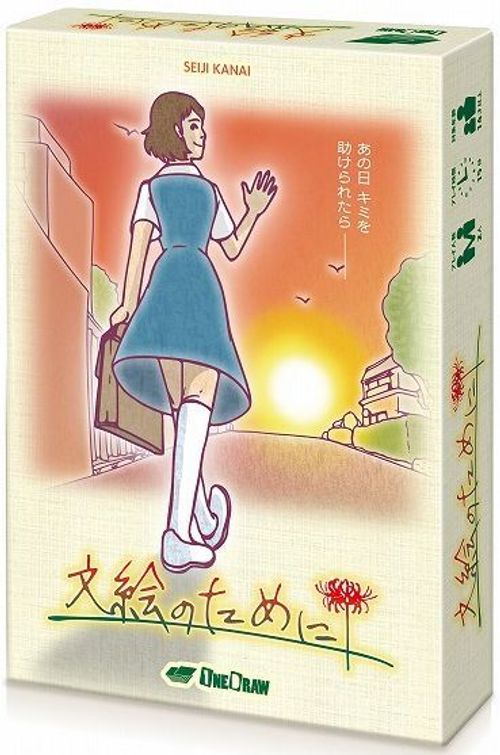
文絵のために (For Fumie)
文絵のために (For Fumie) Rulebook
Table of Contents
Table of Contents
Before You Play
Before reading the rulebook, put all the cards into sleeves with the side showing the "◆" beside the card name face up. Do this without looking at the other side of the cards.
Components
- Protagonist sheets: 2
- Cards: 44
- Game cards: 43
- Turn player card: 1
- Ending books: 3
- Card sleeves: 50
- Rulebook (this book): 1
Protagonist Sheets (Takeo / Fumie)
These sheets show the two protagonists of the story. Each sheet has a front and a back with different effects. Which side is used depends on the episode being played.
- In-use card area
- Effect
- END condition
- Belonging episode
Cards
The cards show the two protagonists, the people close to them, the events that happen to them, and important objects. There is a set of blue cards involving "Takeo" and a set of red cards involving "Fumie". The cards used in the game depend on the episode being played.
- Card name: the name of the character or object depicted. Some names change between the front and back.
- Type: shows whether the card is a "Person" or "Other".
- Effect: the effect that occurs when the card is used. Some cards change their effect under certain conditions. Effects marked with a ★ icon take effect at times other than when the card is used; follow the text.
- END condition: the condition for an ending. When it is met, the game ends and players read the matching episode in the ending book.
- Belonging episode: shows which episode the card is used in. Some cards are used in more than one episode.
- Belonging set: cards are divided into blue and red sets. Special purple cards belong to neither set. Refer to this when building the draw deck.
- Card description text: the flavour text on the card.
- Cards have an effect-side (the face with an effect printed on it) and a side without an effect (marked with the "◆" icon at the top of the card name). Before the first play, do not look at the side with the effect printed on it.
Card sets:
- Basic: "For Fumie" — the set needed to play the basic episode. It contains 12 blue cards involving "Takeo" and 12 red cards involving "Fumie".
- Expansion 1: "The Hidden Murderous Intent" — the set needed to play a different episode from the basic one. It contains 12 blue cards involving "Takeo" and 12 red cards involving "Fumie".
- Expansion 2: "Mr. Tadokoro's Love" — the set needed to play a different episode from the basic one. It contains 12 blue cards involving "Takeo" and 12 red cards involving "Fumie".
Note: the actual cards show their effects clearly. This rulebook hides some of them to illustrate the explanations.
Card Sleeves
Card sleeves protect the cards. At first, insert the cards so that the side without an effect (the side with "◆" at the top of the card name) faces out.
Ending Books
Ending books contain the endings for each episode. Do not open a book and read it until the matching ending condition has been met.
Characters
These are the characters of the game. The relationships between the characters strongly affect the game, so it is recommended that you read this section before starting.
Fumie — Cheerful and sociable, she is the centre of activity in her class. She is not especially beautiful, but her cute features make many admire her. Since childhood she has liked Takeo, and followed him to become manager of the soccer club. Wanting to keep their comfortable distance, she has kept her feelings hidden in her heart, but on his birthday she decides to tell him how she feels.
Takeo — An ordinary second-year high school student. His grades, athletic ability and looks are all upper-middle, and he is in and out of the soccer team's starting lineup. He does not talk much and is usually not especially noticeable in class, but his unsociable yet considerate behaviour quietly earns him a fair amount of popularity with the girls. He is a childhood friend of Fumie and often discreetly covers for her when she makes a blunder.
Mr. Tadokoro (Tadokoro-sensei) — The homeroom teacher of Takeo's and Fumie's class, and a 35-year-old single world history teacher. He seems dreamy but observes his students closely, and sometimes gives crucial advice, so the students respect him to a degree. He is nominally the soccer club's advisor, but has no particular soccer experience and does not fulfil the duties of a coach very well.
Ryosuke — Takeo's best friend, who belongs to the same soccer club. He is better at soccer than Takeo and is a regular in the lineup. He has noticed Fumie's feelings toward Takeo and is worried about their delicate distance.
Kanako — Fumie's best friend and a member of the library committee. She is a bookish girl with glasses and braided pigtails, well-behaved, upright, and academically gifted. She knows Fumie's feelings but has her own heart set on Takeo, and keeps questioning herself and falling into self-loathing.
Masahiro — Takeo's friend, a huge judo club member. Despite his size, he is timid. He has feelings for Fumie, and while he gazes with envy at Takeo, who is close to her, he secretly burns with a sense of rivalry.
Risa — Fumie's best friend, who always hangs out with Fumie and Kanako. She is a trendy modern girl whose grades are somewhat low. She talks as her appearance suggests and is somewhat avoided by the boys. She is not good at studying but is well informed, and knows the current state of relationships and the actions of various people in detail.
Senior Kondo — The third-year captain of the soccer club. He has all four qualities of athletic ability, academic ability, character and looks, and is a nice guy. He is aware of the bad habits of the manager, Senior Shidara, but she is a handful and he has a way of looking after her, sometimes getting closer to her and sometimes pulling away.
Senior Shidara — The third-year manager of the soccer club. She is beautiful, and she knows her looks are worth more than enough. She constantly flirts with members of the soccer club and often causes trouble. She is currently approaching Takeo, but she is irritated by Takeo's lack of response. Because she and Risa get along, perhaps because they share a similar sense of humour, she secretly intends to help Fumie's romance.
Setup: "For Fumie" (Basic Episode)
Note: this section explains the basic "For Fumie" episode. To play with the other expansions, see the sections below.
- Each of the two players chooses one protagonist to play. Each player receives the protagonist sheet for the chosen protagonist and the 12-card set of the opposing protagonist. Takeo's player uses the red card set as the draw deck, and Fumie's player uses the blue card set as the draw deck. Place the protagonist sheet in front of you with the "For Fumie" side face up.
- Takeo's player also receives the turn player card.
- Each player receives the card set of the opposite colour. This is easy to get wrong, so take care.
- Check the belonging episode of each card and pull out the cards marked "For Fumie". Put the rest of the cards back in the box. (There are 12 blue cards and 12 red cards marked "For Fumie".)
- Shuffle the card set you received and place it face down. This is called your "draw deck" (or "own deck").
- Each player draws 3 cards from their draw deck and holds them in the order drawn, so that you can tell which was drawn first. (Think of these cards as showing the opponent's "future".) Do not change the order of the cards. Do not tell the opponent what the cards are.
Setup is complete. Takeo's player starts the game.
Players sit facing each other. During play you may talk, but you may not discuss matters that affect the progress of the game, and you may not say anything that reveals information the opponent does not know.
Note: if the cards are not in card sleeves, follow the instructions on the cover of this book and put them in sleeves.
Objective
The goal for the "For Fumie" episode is for Takeo, with the help of his acquaintances and objects, to avert Fumie's death and save her. The game ends when an end condition is met. Read the ending that matches the condition in the ending book. If it is not the ending you wanted, you will once again have to borrow the power of the watch to try again.
Procedure
Takeo's player begins the game. Each turn, the active player uses one card from the opponent's hand, namely the card the opponent drew first.
1. Deciding How to Use the Card
Takeo's player uses the first card that the opponent (Fumie's player) drew from their hand. There are two ways to use it. Declare which method you are using:
- Reveal the card face up and use its effect.
- Use the card face down without revealing its face. In this case, use the common effect written on your protagonist sheet.
Once you have decided how to use the card, take it from Fumie's player and place it face up or face down, as declared, in the "in-use card area" of your protagonist sheet.
If a card without an effect side is used:
- When using a card face up, first check whether the card has an effect printed on it. If the side has no effect printed on it (the side with "◆" at the top of the card name), take the card out of its sleeve and reinsert it so that the side with the effect printed on it is visible.
- Exceptional re-sleeving: depending on how an effect is resolved, a face-down card in the discard pile may be turned face up, or a particular card may be removed from the game. If such a card is a card with no effect side, reinsert it so that the side with the effect printed on it is visible, in the same way.
2. Using the Effect
Takeo's player uses the effect of the card. If the card was used face down, choose one of the common effects written on the protagonist sheet.
3. Refilling the Hand
When the card has been used, Takeo's turn ends. Each player whose hand has fewer than 3 cards draws from their own draw deck until they have 3 cards in hand, and adds these cards to the back of their hand (the position that will be used last).
After using a card:
- A card used face up: its effect is resolved.
- A card used face down: the protagonist sheet's effect is resolved.
- After the effect is resolved, the used card is placed in its discard pile in the state specified (face up or face down). Place the used card in your own discard pile (discard piles are placed to the right of your protagonist sheet).
Then pass the turn player card to the other player. It is now Fumie's player's turn. Fumie's player likewise uses one card from the opponent's hand, namely the card the opponent drew first. The players alternate turns until the game ends due to one of the conditions.
Advice:
- At first you will not know what the cards' effects are. They become clear as you use them, so try to use them face up whenever possible.
- You must resolve a card's effect as long as it can be used.
- If you choose to use a card face down, the user may not check its face.
- The order in which cards are used may be changed by effects.
- Cards currently in use are not yet in the discard pile. Be careful not to confuse them.
- An effect cannot be interrupted by another effect while it is being used.
Card Effects and Notes
Effects of "Protagonist"
If a card's effect says "when you use the 'Protagonist' effect", the "Protagonist" effect has three patterns. The timing that any one of the following is met is when "you use the 'Protagonist' effect":
- Using the card "Takeo" face up.
- Using the card "Fumie" face up.
- Using any card face down (using the protagonist sheet's effect).
Your draw deck / the opponent's draw deck: "Your draw deck" means the draw deck you are using (if you are Takeo, the red card set). Conversely, "the opponent's draw deck" means the draw deck the opponent is using (if the opponent is Fumie, the blue card set).
Card in use: the card whose effect is currently being used is not in the discard pile at that point. It is added to the discard pile after its effect has been fully used.
Face-down cards: the information on the front of a face-down card (the side not visible in its sleeve) is not referred to at all. For example, even if a face-down card "Senior Shidara" is in your discard pile, that card is not treated as "Senior Shidara". Also, neither player may check the front of a face-down card.
Showing your hand (to the opponent): depending on the card's effect, you may show your hand to the opponent. A card you have shown may be shown any number of times while it remains in your hand. This is the same even if the order of use is changed by other effects. The opponent may use a card they have seen face down. Even if a shown card was a card with no effect side, do not reinsert it so that the side with the effect is visible.
Removal: depending on the card's effect, a card may be removed. A removed card is not placed in either the draw deck or the discard pile; place it face up in another area. If a removed card had no effect side, reinsert it so that the side with the effect printed is visible. When the game is next played, return removed cards to their places and set up as usual.
"Instead": effects and end conditions may contain wording such as "instead". When such a text's condition is met, it means that you carry out the processing after "instead" in place of the processing immediately before it.
Continue to the expansion sets once you are able to play the "For Fumie" episode to your satisfaction. There are two expansions, Expansion 1 and Expansion 2; enjoy them in order.
Ending the Game
The game ends in these situations:
- When a condition written on a protagonist sheet is met:
- One player has four or more face-down cards in their discard pile.
- One player's hand is empty and, when refilling from the draw deck, the draw deck is empty.
- When the end condition written on a card is met.
If the game loops and the end condition cannot be met, or if you want to stop partway, you may end the game at that point.
In all cases, open the ending book to the "For Fumie" episode and check the page that corresponds to the result. Endings are prepared to match the outcome. If you are not satisfied with the result, start again from "Setup". However, keep the cards in their sleeves in the same state as before.
Enjoy experiencing this world many times!
Expansion 1: "The Hidden Murderous Intent"
This expansion is played with the "The Hidden Murderous Intent" card set (12 blue and 12 red cards). Cards from this set are marked "The Hidden Murderous Intent" under belonging episode.
Characters
Detective Mihara — A detective at the police station that has jurisdiction over the area where Takeo's and Fumie's high school is. Since the area does not have a high crime rate, he is basically a lazy detective, but his investigations are well regarded. He regards the expected crime as a child's prank, so for him to take it seriously, solid material is needed.
The Caretaker — An elderly caretaker who does odd jobs at the high school. He speaks little and hardly converses even with students, let alone teachers, quietly carrying out the work he is given. He is a difficult person, but through his daily observation he seems to have noticed some clue about the present incident. Will it be possible to borrow his power?
Overview
In this episode, there is a "culprit" whom only Fumie knows the identity of. Takeo's player must first identify who this "culprit" is, drawn from their own card set.
Setup
Players sit facing each other. During play you may talk, but you may not discuss matters that affect the progress of the game, and you may not say anything that reveals information the opponent does not know.
Note: if the cards are not in card sleeves, follow the instructions on the cover of this book and put them in sleeves.
Note: cards whose effect text became known through playing a different set may remain as they are.
- Check the belonging episode of each card and pull out the cards marked "The Hidden Murderous Intent". Put the rest of the cards back in the box. (There are 12 blue cards and 12 red cards marked "The Hidden Murderous Intent".)
- Each of the two players chooses one protagonist to play. Each player receives the protagonist sheet for the chosen protagonist and the 12-card set of the opposing protagonist. Takeo's player uses the red card set as the draw deck, and Fumie's player uses the blue card set as the draw deck. Place the protagonist sheet in front of you with the "The Hidden Murderous Intent" side face up.
- Takeo's player also receives the turn player card.
- Fumie's player shuffles the card set they received, chooses 1 card, and checks it privately. If that card is a "Person", place it face down on the protagonist sheet. That card becomes the "culprit" in this game. If it is "Other", choose again.
- Shuffle the card set you received and place it face down. This is called your "draw deck".
- Each player draws 3 cards from their draw deck and holds them in the order drawn, so that you can tell which was drawn first. (Think of these cards as showing the opponent's "future".) Do not change the order of the cards. Do not tell the opponent what the cards are.
Setup is complete.
Objective
The objective for this episode is for Takeo to learn the identity of the culprit, prevent the crime before it happens, and save Fumie. The game ends when an end condition is met. Read the ending that matches the condition in the ending book. If it is not the ending you wanted, you will once again have to borrow the power of the watch to try again.
Only Fumie's player knows who the "culprit" is at the start of the game. Do not tell Takeo's player who the culprit is. Depending on a card's effect, the culprit may be revealed, and in that case Takeo's player also learns who the culprit is.
The procedure of the game is the same as in "For Fumie". Refer to the Procedure section above.
The Culprit
- Revealing the culprit: depending on a card's effect, Fumie's protagonist sheet's culprit may be revealed. When revealed, place it face up so that Takeo's player can also check it.
- Checking the culprit: depending on a card's effect, you may need to check whether the discard pile contains a card that is the same as the culprit. This check is made by Fumie's player. However, you must not declare which card is the culprit. Judge only whether the culprit is or is not in the discard pile.
- If you play again after finishing a game, the same culprit may be used for up to 3 games in total. If you play more than 3 games, set a new culprit. Even if the culprit was revealed, when you play again, return it to face down, so that it is not shown.
- If the culprit has not been revealed, Fumie's player is the one who sets up the next game.
For other notes on card effects, the same rules as in "For Fumie" apply. Refer to that section.
Ending the Game
The game ends in these situations:
- When a condition written on a protagonist sheet is met:
- One player has four or more face-down cards in their discard pile.
- One player's hand is empty and, when refilling from the draw deck, the draw deck is empty.
- When the end condition written on a card is met.
If the game loops and the end condition cannot be met, or if you want to stop partway, you may end the game at that point.
In all cases, open the ending book to the "The Hidden Murderous Intent" episode and check the page that corresponds to the result. Endings are prepared to match the outcome. If you are not satisfied with the result, start again from "Setup". However, keep the cards in their sleeves in the same state as before.
Expansion 2: "Mr. Tadokoro's Love"
This expansion is played with the "Mr. Tadokoro's Love" card set (12 blue and 12 red cards). Cards from this set are marked "Mr. Tadokoro's Love" under belonging episode.
Characters
Vice-Principal Nogami — A capable career woman known as a shrewd vice-principal, around thirty years old. Her work at her previous post was highly rated, and she was transferred young to this high school. She is a thoroughgoing efficiency-driven person who cannot stand sloppy people. This makes her quick to make enemies, and men tend to avoid her. The reason she became like this is said to be a major unhappiness caused by a romance during her university days and its breakup.
Overview
In this episode, Takeo and Fumie run around to save Mr. Tadokoro, the advisor who is about to be driven out of the school. Of course, Mr. Tadokoro's own outlook needs to change, but Vice-Principal Nogami, who has made him her target, also seems to have room for improvement.
Setup
Players sit facing each other. During play you may talk, but you may not discuss matters that affect the progress of the game, and you may not say anything that reveals information the opponent does not know.
Note: if the cards are not in card sleeves, follow the instructions on the cover of this book and put them in sleeves.
Note: cards whose effect text became known through playing a different set may remain as they are.
- Step 1: Check the belonging episode of each card and pull out the cards marked "Mr. Tadokoro's Love". Put the rest of the cards back in the box. (There are 12 blue cards and 12 red cards marked "Mr. Tadokoro's Love".)
- Step 2: Each of the two players chooses one protagonist to play. Each player receives the protagonist sheet for the chosen protagonist and the 12-card set of the opposing protagonist. Takeo's player uses the red card set as the draw deck, and Fumie's player uses the blue card set as the draw deck. Place the protagonist sheet in front of you with the "Mr. Tadokoro's Love" side face up.
- Takeo's player also receives the turn player card.
- Step 4: Shuffle the card set you received and place it face down. This is called your "draw deck".
- Step 5: Each player draws 3 cards from their draw deck and holds them in the order drawn, so that you can tell which was drawn first. (Think of these cards as showing the opponent's "future".) Do not change the order of the cards. Do not tell the opponent what the cards are.
Setup is complete.
The printed rulebook numbers these setup steps 1, 2, 4 and 5; there is no step 3 in this episode. The steps are transcribed as printed.
Objective
The objective for this episode is for Takeo and Fumie to work together to stop Mr. Tadokoro's transfer. The game ends when an end condition is met. Read the ending that matches the condition in the ending book. If it is not the ending you wanted, you will once again have to borrow the power of the watch to try again.
The procedure of the game is the same as in "For Fumie". Refer to the Procedure section above.
For card effect notes, the same rules as in "For Fumie" and "The Hidden Murderous Intent" apply. Refer to those sections.
Ending the Game
The game ends in these situations:
- When a condition written on a protagonist sheet is met:
- One player has four or more face-down cards in their discard pile.
- One player's hand is empty and, when refilling from the draw deck, the draw deck is empty.
- When the end condition written on a card is met.
If the game loops and the end condition cannot be met, or if you want to stop partway, you may end the game at that point.
In all cases, open the ending book to the "Mr. Tadokoro's Love" episode and check the page that corresponds to the result. Endings are prepared to match the outcome. If you are not satisfied with the result, start again from "Setup". However, keep the cards in their sleeves in the same state as before.