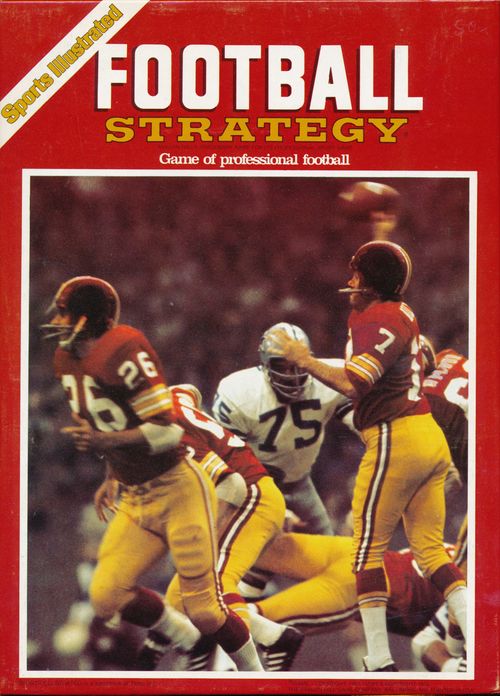
Football Strategy
Football Strategy Rulebook
Table of Contents
Table of Contents
Equipment
- Playing board - with Pro-Style Offense Plays Charts (Original Game I)
- Football
- Ten-yard marker
- 2 sets of ten defense cards
- 1 scoreboard
- 1 die
- 2 Ball Control/Aerial Game Offense Plays Charts (Game II)
- 1 instructions folder
- 1 Football Widow's Handbook
Prepare for Play
- Players choose which Offense Plays Chart they intend to use during the game. Once chosen, the chart must be used for the remainder of the game. Any combination is possible; i.e. both players may use the same chart or different ones as they see fit. It is recommended that both players use the "Pro Style Offense Play Chart" printed on the mapboard until they are familiar with the game's mechanics; thus assuring perfect play balance.
- Roll the die to determine which player wins the "toss of the coin." The player who rolls the highest number gets his choice of whether to kick-off or receive. Note: If a player chooses to kick-off rather than receive, his opponent has the option of deciding whether he wants to kick-off or receive to start the second half.
- The kicker refers to the Chance Table. Before rolling the die, he calls out whether the kick is to be Normal or On-Sides.
- Kicker rolls the die. He places the ball and the 10-yard marker on the corresponding yard line as called for by the Chance Table, and marks off 15 seconds of time on the "scoreboard clock." The game has begun.
Routine of Play from Scrimmage
After the kick-off, the kicker becomes the team on defense, hereafter called D/Q (Defense Quarterback). The receiving team is now the team on offense, hereafter called O/Q.
- The D/Q refers to his set of 10 defense cards. He selects one card representing the defense formation that will best stop the offensive play he thinks will be called by the O/Q, and places it face down on the board.
- The O/Q then calls out his first play from among those provided on the Offense Plays Chart.
- The D/Q then turns up his defense card.
- Refer to the Offense Plays Chart. Players cross-index the offense play called with the defense card selected.
- Players adjust the football, the time, the down - and the 10 yard marker if necessary.
- Repeat the above procedure for every succeeding play called from the line of scrimmage.
- The O/Q has 4 downs in which to gain a minimum of 10 yards. If he fails to do so, the ball reverts to the D/Q at scrimmage after the fourth down. If he does gain 10 yards in 4 downs or less, he gets another series-of-downs to gain a minimum of 10 yards, etc.
If at the start of the 4th down the O/Q doesn't feel he can make a first-down, he should then punt.
Offense Plays Chart
The O/Q may select Plays 1 through 20 on any yard-line with the following exceptions:
- a) Plays 17, 18, 19 and 20 may not be called when the ball rests between the defender's 1-20 yard lines inclusive.
- b) Plays 13, 14, 15 and 16 may not be called when the ball rests between the defender's 1-10 yard-lines inclusive.
- LONG GAIN: the O/Q refers to the Long Gain Chance Table - then rolls the die and marks off the gain from the line of scrimmage as called for by the Chance Table.
- FUMBLE: The O/Q automatically loses possession at scrimmage.
- INTERCEPTION: The D takes possession with the yardage gained or lost measure from scrimmage. For instance, if the scrimmage line is the O/Q's own 10 yard line and the D/Q intercepts on Play 19 with Defense Card "J" (Pro Style Offense), the D/Q takes possession on his opponent's 40 yard line. If the result of the interception would place the ball in the defender's end zone, the D/Q is given possession on his own 20 yard line instead. If the result of the interception places the ball past the physical confines of the defender's end zone it is considered an incomplete pass. If the interception is made "in" or "past" the O/Q's end zone, it is an automatic touchdown for the defender.
- PENALTY: All penalties are measured from scrimmage. In the case of those penalties where a choice is given, the team the penalty favors has the option to accept either the play or the penalty. If a penalty is accepted, there is no loss of down. Note that a half may not end on a penalty, nor may any score be registered via a penalty. A team may not be penalized more than half the distance between the line of scrimmage and the goal-line.
- OUT-OF-BOUNDS: Yardage gains and losses that are followed by the letters "O/B" indicate the play ended up out-of-bounds thereby stopping the clock and reducing the time of the play by 15 seconds.
- PUNTS: If the distance of the punt would place the ball "through" the end zone before the ball is runback, then the runback is ignored and the D/Q takes possession on his own 20 yard line. If the distance of the punt would place the ball "in" the end zone, the D/Q has his choice of either taking the "runback" or "downing" the ball and taking possession on his own 20 yard line.
- The end zone is 10 yards deep.
- If a pass is completed "beyond" the end zone, consider the excess as running yardage gained after the reception. Thus, the pass is still considered complete. Note the difference in procedure in this regard between a complete pass and an interception.
Time
- Before kick-off, set the Time wheel at 0.
- After each succeeding play, move the wheel clockwise according to the length of the play.
- Each team is allowed three time outs per half.
- In 2nd and 4th Quarters, there is an automatic time out at the two minutes remaining mark.
- The Time wheel represents a quarter - 4 quarters make up a complete game.
- A play which starts at the end of a quarter cannot use any time in the following quarter. For example, a 20 yard run (which normally would consume 45 seconds) started with only 15 seconds remaining on the clock would use up only 15 seconds. The clock is then reset while the players exchange goal-lines.
- Further instructions in regards to time are printed on the playing board under the heading "TIME."
Scoring
- TOUCHDOWN: The point of the ball has only to reach the goal line - not cross it. A touchdown counts as 6 points.
- POINT AFTER TOUCHDOWN: Consult the Field Goal Chance Table - refer to the 0-10 column. In case of penalty, roll the die again. No change in field position is made.
- SAFETY: Should the O/Q be pushed back to his own goal line, the D/Q is awarded two points. The team scored against must then kick from his own 20 yard line in one of two ways: a) he may use the regular kick-off table and simply add 25 yards to the result, or b) he may punt. To punt, the D/Q spreads his ten defense cards face down on the board. The O/Q chooses one, and the result is marked off from his 20 yard line. Note: Only the Punt (4th Down Only) column is used.
- FIELD GOAL: Players may attempt a Field Goal at any time provided the ball is no further than 45 yards from the opponent's goal line. The O/Q rolls the die, referring to the correct column. Field Goals are worth 3 points. In case of penalty, the O/Q moves the ball forward 5 yards (or half the distance to the goal line), and has the option to attempt another field goal or call a play from the Offense Plays chart. Note also that it is possible for a first down to be gained via the penalty on the Field Goal chart. If a field goal attempt is no good, the D/Q takes possession on his own 20 yard line. If the attempt is blocked, the D/Q takes possession at the line of scrimmage.
Multi-Player Games
In 4-player games, players are assigned as offense and defense captains. As the offense captain is calling plays, his partner (the defense captain) can assist by acting as spotter. He should keep notes on opponent's defensive patterns and thereby attempt to break his strategy. And while on defense, the offense captain should assist in a similar fashion.
Solitaire Version
One person may play by taking the part of the O/Q for both sides. Take one set of 10 defense cards and, from the second set, add cards D, E, F, and H. Merely shuffle the 14 defense cards before each play is called, placing them face down. After calling each play from scrimmage, simply turn up one card. Always re-shuffle the cards after each play.
Ladies Only
The beauty of Football Strategy is that the fun can be shared in a friendly husband & wife contest. It's even more fun when the wife knows something about the game. That's why we have included in each game-set the Football Widow's Handbook, a how-to manual (for ladies only) that shows wives how they can better share the joys of this national pastime with their husbands.