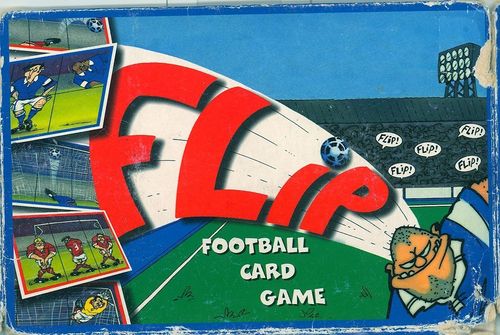
Football Flip Cards
Football Flip Cards Rulebook
Table of Contents
Table of Contents
Contents
- 53 Cards (Red Team)
- 53 Cards (Blue Team)
- 4 Instruction cards
Aim of the Game
To score the most goals by laying down cards which represent a complete game of football.
Preparing to Play
Players select a team – Red or Blue.
Each player needs to remove any eight cards from their decks and set them aside. These will be played in injury time at the end of the match.
Each player should shuffle their deck before each game.
Flip Action
During the game one player holds their team pack 'attack side up' and the other player holds their team pack 'defence side up'.
Players flip over their entire unused packs which they are holding in order to change from defending to attacking and attacking and defending.
Flip Action happens after:
- A goal has been scored
- A shot on goal has been blocked or missed
- A penalty
- A free Kick
- A ball is blocked (tackled)
- Or when a player is given offside
Play
Players compete by each laying a card onto the table at the same time. Each player has 45 double sided cards with attacking play on one side and defending play on the other side (plus 8 cards some or all of which will be used in injury time). Both sides feature four colour-coded areas, which are divided into sections.
The card areas are labelled:
- Attack Goal Area
- Attack Penalty Area
- Attack Area
- Attack Free Kick Area
- Defend Goal Area
- Defend Penalty Area
- Defend Area
- Defend Free Kick Area
To Start an Attack
Youngest player starts an attack first. The player attacking lays down a card attack side up and at the same time the defending player lays down a card defending side up.
The position of the attacker's ball in the attack section of his card is compared to the same section of the defender's defend section. An attack is successful if the attacker's ball is not blocked by a defender appearing in that same section.
Pictured: A Successful Attack — Attack Ball in Top-Right Area (the attacker's ball is in the top-right section) and No Defender in Top-Right Area (no defender is in that section).
If a defender is present in the same section as the ball of the attacker then the attacker has been tackled and that attack is over. Any part of a defender counts as a block if it appears in the defending section. If a tackle has occurred play is then flipped.
During an attack the ball may land in the same section as the symbols below.
- Offside – The team attacking has been caught offside and the player now flips from attacker to defender.
- Foul – The attacking team has been fouled or a hand ball has occurred. The attacking team gets a free kick.
LONG BALL When an attacker's ball is in a square where there is a goal in the Defend area it means a long ball has been played. The next card by the attacker is a shot on goal.
Scoring a Goal
If an attacker lays down three successful attack cards in a row they have the opportunity to shoot for goal. The next card is then laid down by both payers [sic] and play switches to the Goal section of the card.
A goal is scored if the ball of the attacking player is in a section where the defender has the goal and no defender or goal keeper.
Pictured under A Goal!: Ball in Top-Middle Section of Goal Area (a goal is scored) and No Player in Top-Middle Section of Goal Area (a goal is not scored).
Once a goal has been scored or a shot is blocked, players flip from attacker to defender.
Players keep count of goals scored.
Shooting for Goal
When shooting for goal the ball may land in the same section as one of the symbols below.
- Foul or Hand Ball – A foul or hand ball has occurred: the attacking team gets a penalty.
- Rebound – A rebound off a defender or goalkeeper: both players lay another card so the attacking player gets another shot on goal.
- Corner – The attack has gone for a corner: both players lay another card so the attacking player gets another shot on goal.
Taking a Penalty or a Free Kick
The attacker gets a penalty when a foul or hand ball has occurred in the Save section of the defending player.
The attacker gets a free kick when a foul or handball occurs in the Defend section of the defending player.
- Penalty or free kick is scored – A penalty or free kick is scored if the ball is in a section where the defender has the goal net and no defender or goal keeper. If a goal is scored play is then flipped.
- Penalty or free kick is blocked – A penalty or free kick is blocked if a defender has one of these symbols in a matching section of the attackers ball. If a shot is blocked play is then flipped. A penalty or free kick can hit the post or cross bar. If a shot hits the post or cross bar play is then flipped.
Half Time
Half time is reached when players have used all 45 cards. The cards are now sorted so all the attack cards are facing the same way and then shuffled.
The second half starts with the player who kicked off the first half now defending.
End of the Match
The match ends when all 45 cards have been played for both halves of the match.
Injury Time
The injury time cards are then used and are set by the number held up by the Assistant Referee on the last defending card played. Play is continued by both players from the last cards laid in normal time.
Once the injury time cards are played the game is over.
Winner
The player who has scored the most goals is the winner of the match.