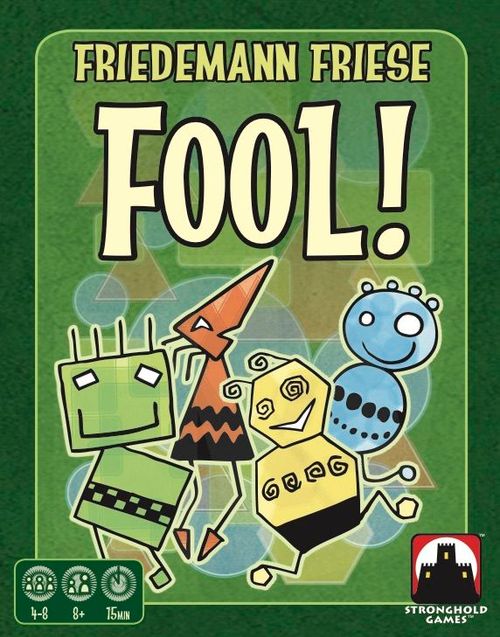
Fool!
Fool! Rulebook
Table of Contents
Table of Contents
Aim of the Game
In Fool!, you try to get rid of all your cards quickly. You do not need to win every trick, but your goal should be to play a card in every trick. If you play the worst card in a trick, you are befooled! You must pass during the next trick and cannot get rid of a card.
Contents
- 88 Playing cards (82 cards in four colors, and six of value "1")
- 2 Overview cards
- 2 Fool! discs
| Color | Cards |
|---|---|
| Green (square character) | 26 |
| Yellow (hexagon character) | 20 |
| Orange (triangle character) | 22 |
| Blue (circle character) | 14 |
| Wild "1" cards | 6 |
| Fool! discs | 2 |
Game Preparation
According to the number of players, place the matching Overview card in the center of the table. The Overview card shows the required number of Playing cards (the cards for the four colors and the "1s") and Fool! discs to play the game. Remove the Playing cards not used for the game and place them back into the game box.
Depending on the number of players, place one or both Fool! discs in the center of the table.
Shuffle the Playing cards and deal them evenly to all players, so each player receives 12 cards in their hands. With 8 players each player will only receive 11 cards.
You will need paper and a pen for scoring.
The player to the left of the dealer is the start player of the first round!
Playing the Game
In each round you play several tricks, until one or more players have emptied their hand by playing their last card.
The start player begins the trick by playing any card from their hand. The color led is referred to as the lead color. Following the start player, in clockwise order, each opponent also plays a card. If a player has a card in hand of the same color as the lead color, they must play that card. This is referred to as following the lead color. If a player's hand is void of cards which match the lead color, they will be forced to play a different color card. This is referred to as shedding a color.
The player playing the highest value in the lead color, wins the trick. In each color, the cards all have different values, so there is always a definitive winner of a trick.
The player playing the worst card is befooled! They take the Fool! disc and must sit out and pass during the next trick. With 7-8 players, the two players playing the worst cards each take one of the Fool! discs and both must pass!
Determining the worst card:
- If all players follow the lead color, playing cards of the same color, the worst card has the lowest value.
- If one or more cards are shedded, the shedded card with the lowest value is the worst card. If several cards are shedded, with the same lowest value, the last of these played cards is the worst card. This can happen, when players shed cards of different colors.
The winner of the trick places the trick face down to the side and begins the next trick by playing any card from their hand. Don't be the Fool! The player(s) in possession of the Fool! disc are not allowed to play a card during the current trick, but will be free to play in the following trick.
During the entire round, all players must hold their cards in such a way that all players can check the total number of cards in their hand!
Beware of the "1s"!
The "1s" are wild and always adopt the lead color. Thus, a player always follows the lead color when playing a "1"!
The player may play a "1" even if they have cards of the lead color in their hand. They do not have to play a "1" if they no longer have a lead color card in hand.
Playing a "1" is considered the lowest card in the lead color. With this in mind, the gameplay challenge to all players is to try to play their "1s" in the same trick when other players are shedding.
If the first player plays a "1", the next played card determines the lead color to be followed. If that second card is also a "1", the third card played determines the lead color to be followed. In rare cases, if all players play a "1", the first player wins the trick and the last player is befooled!
Examples
Anne, Paul, Rachel, and Camille play a game of Fool!. Camille is befooled and took the Fool! disc in the last trick, so she must pass this trick.
(A) Anne plays the first card (blue 7). Paul follows blue (5) and Rachel follows blue (8); Camille passes. Paul played the worst card (the lowest blue) and is befooled. Rachel wins the trick with the highest card.
(B) Rachel plays the first card (yellow 10). Camille is the only player who must shed a color — she plays a green 5 — and is befooled. Anne follows yellow with a 2. Rachel wins this trick again with the highest yellow card. Paul, holding the Fool! disc, passes.
(C) Again, Rachel plays the first card (blue 6). Anne sheds a green 14, and Paul sheds an orange 11. Camille passes. Paul is befooled, as compared to Anne he is shedding the lower valued card (11 versus 14). Rachel, the only player who followed the lead color, wins the third trick in a row.
(D) Rachel plays the first card (yellow 8). Camille's "1" follows yellow. Anne follows yellow with an 11 — the highest value lead color card — and wins the trick. Still, Camille is befooled, since her "1" counts as the lowest value in the lead color. Paul, holding the Fool! disc, passes.
(E) Anne plays the first card (green 10). Paul follows green with the "1". Rachel sheds a yellow 3. Rachel is befooled, takes the Fool! disc and must pass during the next trick. Camille, holding the other Fool! disc, passes.
End of the Round
The round ends after one or more players have emptied their hand by playing their last card. In this last trick, the players still need to take the Fool! discs.
Scoring
Players score negative points if they have cards remaining in their hand. For non wild cards, they score the sum of the face values as negative points. For each "1" they score 5 negative points.
If a player has emptied their hand having played their last card on the last trick, they score 10 positive points; unless they are befooled and took the Fool! disc in that last trick. Only then, the player scores 0 points.
Example: At the end of the round, Anne has a green 3, a green 9, and a wild "1" left in hand and scores 17 negative points (3 + 9 + 5); Rachel has a yellow 9 and a blue 4 left in hand and scores 13 negative points. Camille and Paul both played all their cards, but thanks to his worst card Paul is befooled and took the Fool! disc. Camille scores 10 positive points and Paul scores 0 points.
The Next Round
The previous start player is now the dealer and shuffles all cards. The new start player is the player with most negative points. In the case of a tie, the tied player closest in clockwise order to the previous start player becomes the new start player.
Game End
The game ends when either:
- Any player has scored 80 negative points or more,
- "10 positive points" has been scored 6 or more times by any/all players. Just make a tally on your score sheet.
The player with the most points wins Fool! This may be the player with negative points closest to zero.
Player-count reference: for 4 players, use 3x wild "1" cards and 1x Fool! disc, with colored cards numbered 2-17 (green), 2-11 (yellow), 2-13 (orange), and 2-8 (blue). The matching Overview card for your player count shows the exact range of numbered cards and discs to use; return every other card to the box.