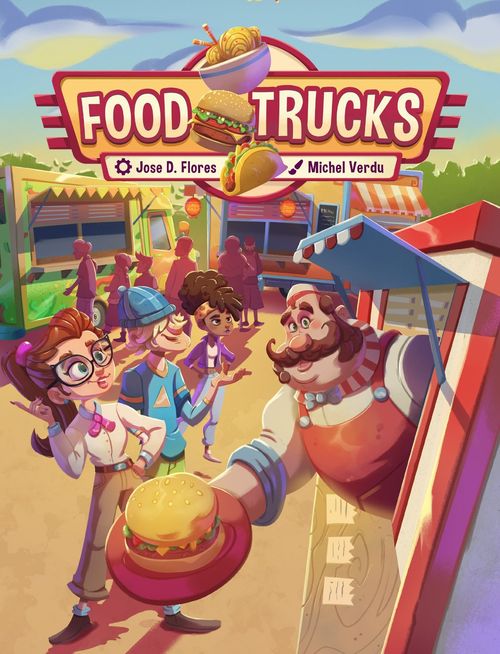
Food Trucks
Food Trucks Rulebook
Table of Contents
Table of Contents
Overview and Objective
You are the proud owner of a food truck and compete against the other players to be the customers' favourite fast-food business. And, of course, the most profitable. Your goal is to serve as many orders as possible before the food runs out and make more money than the competition.
Warning! This box contains only 1 of the 3 different types of food available in the current edition of Food Trucks!
Components
- 68 food cards. Each card shows the total number of cards of the matching dish included in the food deck.
- 4 food truck cards (the rulebook's illustration shows Hot Shot Dogs, Bocata Zapata and Kung Food).
- 24 order cards. The rulebook labels an order card's parts as: extra dish available, order requirements, and coins you gain at the end of the game.
- 2 delivery person cards.
- 1 unhappy customer card.
- 1 first player card.
Game Setup
- Take 6 order cards per player randomly, shuffle them to form the order deck, and place the deck face down in the centre of the table, within reach of all the players. Return the remaining order cards to the game box. Then, create 1 row of face-up order cards to the right of the deck, with as many order cards as the number of players.
- At the end of the row (next to the rightmost card), place the 2 delivery person cards. The orders in the delivery person space are considered takeaway orders.
- Shuffle the food cards and draw 16 cards face down. Nobody can look at them. Then, take those 16 cards, one at a time, and place them face up under the order deck (from left to right and top to bottom) to create a grid of dishes with 4 columns and 4 rows. Place the food deck near the grid of dishes.
- Deal 3 food cards and 1 food truck card to each player.
- All players place their food trucks in front of them. The player who most recently ordered food at a food truck will be the first player and takes the first player card.
- The last player in turn order (to the right of the first player) will take the unhappy customer card.
How to Play
During their turn, each player, starting with the first player and continuing in clockwise order, may perform 1 of the following 2 actions:
- Prepare orders.
- Serve orders.
Prepare Orders
This action consists in taking food cards (and wild cards) from the table and adding them to your hand.
During your turn, choose a dish from the table and take all the matching dishes and wild cards which are horizontally and vertically adjacent to the chosen dish. Repeat this process for each card you take from the table, as long as it matches the dish you chose or it's a wild card. Then, add those cards to your hand.
Example: Alice chooses a hamburger that is vertically adjacent to 1 wild card (on top), horizontally adjacent to 1 hamburger (to the left), and also horizontally adjacent to 1 wild card (to the right). This wild card is also adjacent to another hamburger (to the right). Therefore, Alice takes those 5 cards and adds them to her hand.
Remember you can never have more than 12 cards in your hand during the game.
If you ever exceed the 12-card limit while preparing an order, return any excess cards to the grid, placing them in the available spaces, in the order and position of your choice.
Then, complete the remaining empty spaces of the grid by drawing cards from the deck (one at a time) and placing them in order (from left to right and top to bottom).
Serve Orders
During your turn, you may spend as many food cards as required to serve an order; at the end of the game, you will score the points indicated by the coins. Place the cards used in a discard pile next to the food deck.
In every case, you need 6 dishes to serve 1 order. Additionally, you may use the extra dishes shown on your food truck or on the last order you served and placed in your food truck.
When you serve an order, remove it from the order row and place it below your food truck, on top of any previously served order.
You may serve more than 1 order each turn, as long as you have the required food cards and extra dishes (in your hand or in your food truck).
When you serve an order from the order row, immediately place the rightmost takeaway order in the empty space left by the order you just served. If there aren't any takeaway orders, draw 1 order from the order deck and place the card face up in the corresponding space. The order row must always have at least as many orders as the number of players.
If the order you served was a takeaway order, do not replace the card with another order.
Important: The extra dishes shown on the top of an order card are always AVAILABLE for the owner of that food truck.
Example: Arthur takes 2 burritos and 2 nachos from his hand and uses 1 burrito and 1 taco from his food truck to serve the order with 3 burritos, 2 nachos, and 1 taco (A). He takes the order and places it in his food truck, so now he has 3 extra dishes he can use to complete another order: 2 burritos and 1 taco (b). Then, he uses those 3 extra dishes from the food truck and 1 nachos, 1 taco, and 1 wild card from his hand to serve another order during the same turn (c).
New Orders
A new round starts when the turn returns to the first player.
Before playing their turn, the first player must draw 1 order from the order deck and add it to the order row: it's a takeaway order. Each delivery person space cannot have more than 1 takeaway order.
If there are already 2 takeaway orders in the row, it means the SERVICE IS TOO SLOW and customers get upset. All players suffer a penalty: each player removes the top order of their food truck (if possible) and the starting player also removes the order they just drew. Return the cards removed this way to the game box.
Example: The order the starting player just drew is placed at the end of the row, since there is 1 delivery person with no takeaway orders.
Example: Here, the order can't be placed at the end of the row, so it is returned to the box and every player (included the starting player) removes the last order they served from their food truck.
Unhappy Customer
The player who has this card can play it once during their turn.
This card allows you to steal the last order served by another player. To do so, you must serve the order as usual, using food cards from your hand or the extra dishes available in your food truck.
You must give the food cards used to serve the order (not the extra dishes from the orders in your food truck) to the player you stole the order from. If that player exceeds the 12-card limit, they will have to discard down to 12 cards.
Then, give the unhappy customer card to the player you stole the order from. From now on, that player can use it during their turn.
Example: Gloria, the owner of the Thai Tanic, plays the unhappy customer card to steal 1 order from Arthur, the owner of Maki and Teriyaki, using the dishes in her food truck: 3 gyozas, and 1 prawns. Then, she gives Arthur the 4 food cards and the unhappy customer card.
Note: Remember that you can serve more than 1 order during your turn (including the order stolen with the unhappy customer card) as long as you have the required dishes to do so.
End of the Game and Final Scoring
The game ends when a player must draw a card from the order deck and the deck has run out of cards.
The winner is the player with the most coins at the end of the game.
In case of a tie, the winner is the tied player with the most served orders in their food truck. If the tie remains, the winner is the tied player with the most food cards in their hand.
"The Happy Hour" Variant
In this game variant, customers get upset quicker because there is only 1 delivery person, but food is at half price; therefore, demand skyrockets and work piles up.
The rules are the same as in the standard game, with the following exceptions:
- In step 2 of the setup, place only 1 delivery person card at the end of the order row.
- During the game, the service is considered "too slow" and customers get upset if there is 1 takeaway order in the order row (instead of 2).
The players suffer the same penalty explained in the "New Orders" section. The rest of the game proceeds as usual.