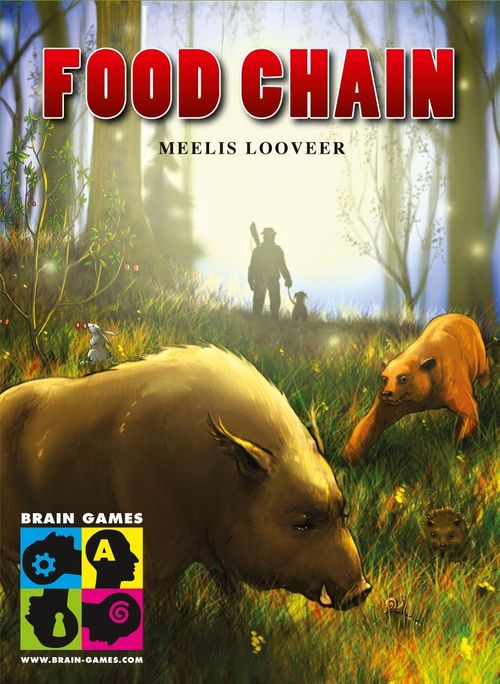
Food Chain
Food Chain Rulebook
Table of Contents
Table of Contents
1. Game overview
Create natural food chains by playing cards, hunting and eating animals and plants in the forest by competing with each other for the best dishes of the day. Be the player who collects the most points from the food you have eaten to win the game!
2. Game components
52 cards
16 tokens – 4 tokens in 4 colours
Game rules
3. Cards
Playing cards each represent one animal or plant member of the food chain, which, depending on the situation, can be either predator or prey.
Card diagram notes:
- The number printed on the Sun symbol is the point value that is scored at the end of the game if it has fallen prey to one of your predator cards.
- The animals represented in the red circles on the upper part of the card are the predators of the animal or plant this card represents.
- Creatures in the green circles below are the ones that the animal can prey on.
- The Roman numeral on the moon symbol indicates on what level of the food chain the plant or creature is on – the smaller the number, the lower the level.
There are also two bonus cards – the Huntsman, who can prey on any creature or plant he likes, and the Swarm that can chase away any predator standing on top of any food chain played out in the game.
4. Game setup
Each player chooses 4 tokens of the same colour. Shuffle the cards and deal 4 cards to each player – these are the predators you secretly hold in your hand. Place 4 cards (or 3 cards in a 2–player game) face-up on the table – this is the food or prey in the forest, and each represent the start of a food chain. Place the rest of the deck face down next to the food cards on the table as a draw deck and leave room for a discard pile.
5. Playing the game
The player who has most recently spent time in a forest starts the game.
During their turn, players must choose one of the following actions:
- Prey;
- Eat;
- Back off;
- Switch card;
- Pass.
A player's turn ends after the action has been completed, and is followed by the next player's action in clockwise order.
Note: the list above reads "Back off" while the action heading in section 6 reads "Back out". Both are printed as such in the source.
6. The actions
1) Prey
Play one card form your hand by placing it face up and, partly covering any suitable food card on the table, thus creating or continuing a food chain (note that the preying card placed on top must have the food's symbol in one of the green circles and the food being preyed on must have the symbol of the predatory card in a red circle). Mark the played card with one of your colour tokens and draw a new card from the draw deck. Players can even hunt cards that have their own tokens of them.
Remember that any number of predators can compete for the same food card – you can place a predator card on a food card even if there is already another predator (or more) on it. But beware: every predator in the woods can be preyed upon by the animals depicted in the card's red circles – this means that a player may place a predator on top of cards that are themselves preying on other cards – thus expanding the food chain. If at any point it happens so that a card has a token on it but it is not preying nor being preyed upon, the card is discarded and the token is returned to its owner.
2) Eat
Your predator cards can eat the food they are preying on if they are on top of a food chain and at a higher level than any other rival predators preying on the same food card. To eat, your predator must be both free – not preyed upon by other predators; and strongest – you can only eat the food if your predator card's level (Roman numerals) is higher than any other predator preying on the same food. If the players are tied for the highest level predator none can eat the food. However, if any of these players have another predator on the food they compare them – if only one player has a predator, he gets to eat the food, however, if they both have – they yet again compare their levels as before and so on.
Food that has been eaten is placed face-down on the table in front of you in a food pile. If there were any colour tokens on the food being eaten, you can take them into your own possession. Any rival predator cards preying on the same food and not being part of another food chain are discarded and the colour tokens on them go back back to their owners.
All food chains containing at least two cards remain on the table. If there are less than four food chains on the table (or three in a two-player game), one card from the deck is placed facing up to start a new food chain in the forest.
3) Back out
You can decide to no longer prey on a food card by removing your predator card and putting it in the discard pile. Don't forget to collect your own colour token.
You can perform this action only if the predator card is free!
4) Switch
You can switch one card from your hand with any free predator card lying on top of a food chain if the card you are picking up from the table is on a higher level (Roman numerals) than the one coming from your hand. There may not be any predators or other players' tokens on the card being switched from the table.
5) Pass
Place one card from your hand on top of the discard pile and pick one up from the draw deck (if possible). If near the end of the game you have no cards left in your hand, you pass without discarding.
7. Bonus Cards
There are two bonus cards in the game that can be played during your turn as predatory cards for the Hunting action:
The Huntsman: Can be used to prey on any food in the forest.
Swarm: Can be used to chase away any creature or predator (even the Huntsman) on the top of any food chain.
Both cards go to the discard pile after use and any tokens from the cards are returned to their owners.
8. Game end and scoring
The game ends when the draw pile is empty and there are no more actions possible except passing. Players add up the points on cards that they have eaten as food and add 1 point for each token they possess (this means if you capture opponents tokens you will receive more points). The winner is the player with the most points.
9. Optional rule
When counting points, instead of adding 1 point for each token in your possession, take one random card per captured token from the eaten food pile of opponents you have captured tokens from (players keep their cards hidden from each other). Add the value of any such cards to your score and determine the winner.