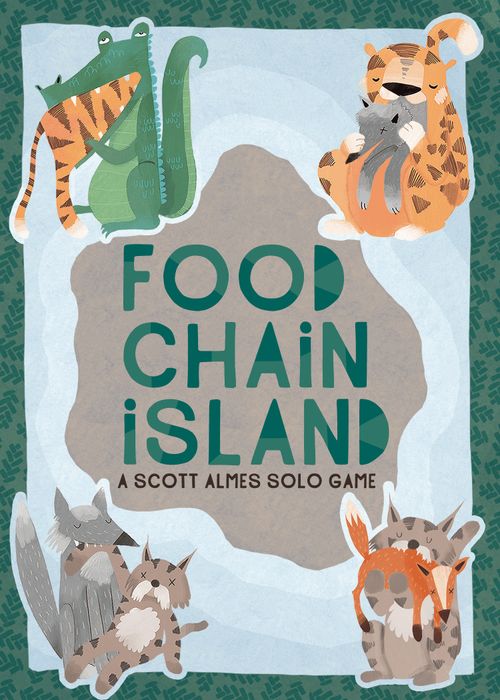
Food Chain Island
Food Chain Island Rulebook
Table of Contents
Table of Contents
Components
- 16 Animal Cards
- 2 Sea Animal Cards (Shark and Whale)
Setup
Set the Sea Animals to the side, face up.
Shuffle the remaining animals and deal them face up in a 4x4 grid representing a map of the island.
Gameplay
Take a series of turns as follows, until you cannot take another turn. Each turn, one animal will eat another and then activate its special ability.
Eating
Choose one animal on the map to be the predator, and move it on top of an adjacent animal (the prey) to eat it.
The predator may only eat adjacent prey (not diagonal), and may only eat prey with a value of 1, 2, or 3 less than its own.
Valid plays — an 8 moving right onto an adjacent 7; a 6 moving left onto an adjacent 4; a 1 moving up onto an adjacent 0. Each of these are valid as they are adjacent and 1, 2, or 3 less in value.
Invalid plays:
- Not 1, 2 or 3 less in value — a 10 moving onto an adjacent 3.
- Eating without any prey — a 9 moving onto an adjacent empty space.
- Eating a higher value — a 5 moving onto an adjacent 8.
Eating Notes
Normally, the predator moves onto the prey's space; the prey does not move.
When a predator eats prey, they form a stack. Stacks may grow by eating additional prey.
A stack is treated as a single animal with the value and ability of the topmost animal.
The animals in a stack move together, both when eating and when resolving special abilities.
If a stack eats prey, the stack is placed on top of the newest prey.
A stack does not need to be ordered by value.
Stack Example
- The 7 eats the 4 by moving on top of it.
- The 7 is now the top card of the stack, with the 4 beneath it.
- The 7 eats the 6. The entire stack (the 7 and the 4) is moved on top of the 6.
Special Abilities
After the predator eats its prey, the predator activates its special ability. The ability must be resolved even if it does not benefit you.
Movement Notes
Some abilities require you to move animals.
Only animals on the map may move. Sea Animals never move and are not part of the map.
Animals must move to open spaces.
Animals can move to open spaces outside of the original map (imagine the map as a grid extending in all directions).
If an animal moves multiple spaces, it can move over other animals but it must land on an open space.
If an animal moves multiple spaces, it can move in multiple directions. For example, it can move down and then right to move 2 spaces (if the final space is open).
If an animal moves multiple spaces, it cannot end where it began. For example, it cannot move left and then right.
Sea Animals
At any time during a turn, you may discard a Sea Animal to use its ability. You may use multiple Sea Animals in one turn.
If a Sea Animal's ability conflicts with a predator's special ability, ignore the predator's ability.
Winning the Game
When you're unable to take additional turns, count the number of remaining Land Animals on the map. If you have three or fewer animals left, you win the game! Otherwise, you lose the game.
- One Animal Left: Ecosystem Expert
- Two Animals Left: Accidental Matchmaker
- Three Animals Left: Island Intern
Card-Specific Notes
For any questions on specific cards, visit the Food Chain Island online FAQ at either of the below sites:
- buttonshy.com/faq/food_chain_island.html
- bit.ly/2DDwdLz
Additional Challenges
To increase the difficulty, try playing without one or both Sea Animals, or try an alternative starting layout:
The rulebook illustrates six alternative 16-space starting layouts to deal the animals into in place of the standard 4x4 grid — irregular shapes such as an offset staircase, a plus/cross, a comb of alternating columns, a hollow rectangle with a gap, a wide block on a narrow top row, and a hollow ring. Deal the 16 Land Animals face up into the spaces of whichever layout you choose.