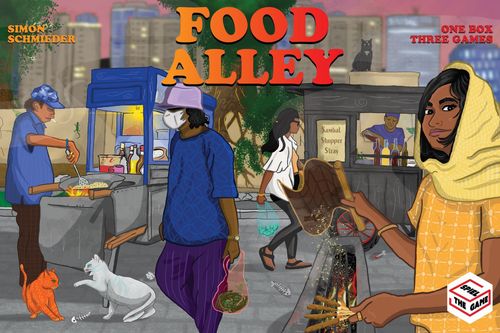
Food Alley
Food Alley Rulebook
Table of Contents
Material
The material is double-sided and used for different game modes. For each game mode, the required components are listed. The heart of the game are the ingredient tokens, which will be used in every game. Simply store the ingredient tokens in the bag.
The ingredient tokens are also double-sided. On one side you can find the ingredients, a price tag showing the number 1–6, and a coloured basket in one of 7 colours. Note that there are special ingredients:
- Tofu is considered to be any colour.
- Rice is considered to be any number.
- Sambal is considered to be any ingredient and only appears in the colour red.
On the other side, you find a coin with the value 1–6, showing the symbol of the ingredients as well as a symbol indicating the colour of the token. The sum of the price tag and the value of the coin is always 7. Therefore, players always know what's on the other side of the coin.
You find an overview of all ingredients on your player screen. Let's learn the games in the order of their complexity from low to complex.
Components list:
- 54 ingredient tokens / coins
- 24 grocery lists / recipes
- 1 bag
- 10 paw tokens / 1 VP marker, in all 4 player colours
- 4 player screens
- 4 player boards / city quarters
- 1 shopper token and 6 cat tokens in all 4 player colours
- 1 board
Shopper
You've been sent to the market to do the grocery shopping. The market is so crowded that you don't have time to check your grocery lists. Only during quiet moments can you sneak a peek to see if you've gathered everything you need. Will you manage to find all the groceries and make your family happy, or will you return home and start a fight because you forgot too many items?
Required Components (Shopper)
- Game board
- Player screen, 6 cat tokens, 1 shopper token for every player
- All ingredient tokens in the bag
- 24 grocery lists (side showing the smiley symbol)
Shopper Setup
- Place the game board in the centre of the table and fill all 25 spaces with ingredient tokens from the bag, ingredient side face up.
- Flip the following ingredient tokens to their coin side.
- 2 players: Flip the centre token and 2 diagonally opposite corner tokens.
- 3 players: Flip all 4 corner tokens.
- 4 players: Flip all 4 corner tokens and the centre token.
- Each player takes 1 shopper token, 6 cat tokens and the player screen in the colour of their choice. Shuffle the cat tokens and place them face down next to your screen.
- Sort the grocery lists by type (6 per type). Shuffle each pile and place 5 of them around the board, one type per side. Place the remaining 4 grocery lists (1 of each type) within easy reach next to the board.
- Determine the starting player by drawing a token from the bag. The player who draws the coin with the highest value goes first (draw again in case of a tie). The starting player keeps the coin, as a reminder who started the game.
- The player to the right of the starting player (who will play last) chooses a coin on the board as their starting position and places their shopper token there. They also pick one of the four available grocery lists (kept behind their screen). Proceed counter clockwise until all players have placed their shopper token and collected a grocery list.
- Finally, draw three tokens from the bag and place them coin side up next to the board, within reach of all players.
Goal of the Game (Shopper)
Collect the most smileys by completing grocery lists, keep your stray cats close and don't buy too many ingredients! The game ends when any player reaches 20 points.
Turn Structure (Shopper)
- Move
- Shop / Claim
- Bidding
or
1b. Store groceries & check for end game trigger.
Note that sambal is any object, tofu is any colour and rice is any number! The active player can always decide for those items to either match or not.
1 Move
Your shopper always starts on a coin and moves in a straight line, exactly the number of spaces shown on the coin (here 3).
- At the edge of the board: If there's a grocery list, the shopper can turn left or right. At corners, the shopper turns along the border.
- You may only change direction if you pass a cat or another shopper.
- Openings (created when grocery lists are claimed) are all connected: exiting through one allows re-entry through any other.
2 Shop / Claim, depending on end position
Your shopper can either end on an ingredient token, a cat token or with another shopper token.
- Ingredient Token: Collect the token and declare either same price, same ingredient, or same colour. Then collect all orthogonally adjacent tokens matching that trait. Place cat tokens on emptied spots. Keep ingredients behind your screen.
- Example: Black collects the grey peanut (2) and declares "same price." They also collect the grey rice and the blue chicken, as all tokens share the same price value. Black places two cat tokens on the empty spots where the rice and chicken were previously located.
- Cat Token: Check the entire row and column for grocery lists. Then take one grocery list of your choice from the corresponding side. Return the cat to its owner.
- Same value bonus: Check if the value of the cat token equals the value of smiley points on the collected grocery list. If so, you pick up another grocery list from that row or column.
- You can only have 1 unfulfilled grocery list of each type (colour) at the same time.
- Another Shopper: Use their coin value to continue moving until you land on an ingredient or cat.
3 Bidding
After moving and either shopping or claiming a grocery list, you must choose one of the three coins next to the board or draw a coin blindly from the bag and place it under your shopper. This will determine your movement on your next turn. You must also flip the coin you have used to move in this turn.
Restock the coins if needed up to 3 coins by drawing a coin from the bag. Play continues in clockwise order.
1b Store Groceries
Instead of moving, you can complete purchases:
- Create a set of exactly 4 ingredient tokens.
- Check your grocery lists - complete as many as possible (max. 1 per type, so a maximum of 4 grocery lists).
- Place completed lists face up in front of your screen.
- Discard used ingredients back to the bag.
Try to optimize your 4-ingredient token set to complete as many grocery lists as possible in one turn.
Example: In this example the player can complete 3 grocery lists! The sambal token can count as a veggie token and fulfill the object grocery list (2 pairs). For the "Exact Match List" the sambal cannot be used, the yellow noodle token checks both the colour (yellow) and the 5 price tag. Since there is a veggie token in the set, the grocery list is completed as well. Note that you always have to form a set of exactly 4 ingredient tokens (even if you can fulfill the "Exact Match List" with less tokens).
Grocery List Types
There are 4 types of grocery lists:
- Ingredient Lists – Based on the ingredients itself. Example: 1 pair + 2 other objects.
- Colour Lists – Based on token colours. Example: 3 of one colour + 1 of a different colour.
- Price Lists – Based on the numbers shown on the price tag. Example: 4 tokens with different numbers.
- Exact Match Lists – Require specific objects, colours, and prices. You must match all exactly—no substitutions with sambal, tofu, or rice. One token may fulfill multiple conditions. Example: Yellow, price tag 5, veggie.
1b Check for End Game Trigger
At the end of your turn, add up the smileys on your completed grocery lists (keep those in front of your screen). If you have fewer than 20 smileys, play continues clockwise.
End of the Game (Shopper)
If you have 20 or more smileys, the final round is triggered. Finish the running round until the start player! Players may either pass or "Store Groceries".
Final Scoring (Shopper)
- Add together all smileys from completed grocery lists.
- Add 1 point for every one of your cat tokens that is not on the board.
- A set of all four types of grocery lists is worth 4 points.
- Subtract 1 point for each unused ingredient token behind your screen.
Winner's reward: You return home with everything your family asked for. Peace. Everyone else? They forgot something and will be reminded of it all week.
Tie breaker: more grocery lists > more cats off the board > less minus points.
Sambal
You and your food truck are out in the market, and so are your competitors. Bargain for the freshest ingredients, craft stunning dishes, and maybe feed some street cats, to gain their trust.
Required Components (Sambal)
- Board
- Player screen, 6 cat tokens, 1 player board (chili symbol side) for every player
- All ingredient tokens in the bag
- 24 recipe cards (chili symbol side)
Sambal Setup
- Place the game board in the centre and fill all 25 spaces with ingredient tokens, ingredient side face up.
- Each player takes:
- 1 player board (kitchen)
- 1 player screen
- 6 cat tokens in their chosen colour.
- Shuffle your 6 cat tokens and place them face down next to your kitchen so no one knows their values.
- Draw 5 ingredient tokens from the bag and place them coin side up behind your shield — this is your starting capital.
- Sort the recipe cards into 4 piles by colour (based on paper colour). Shuffle each pile and place them around the board, visible to all. Each pile should contain X + 2 recipes, where X = number of players. Return unused recipes to the box.
- F.e. in a 3 player game every pile contains 5 recipes.
- In a 4 player game simply use all recipe cards.
You're all set to cook!
Goal of the Game (Sambal)
Earn the most VP by claiming recipes and feeding stray cats from other players. Remaining coins will also gain you 1 bonus point each by the end of the game.
Sambal Turn Structure
- Bargaining (Simultaneous)
- Gather Ingredients (Turn Order)
- Cook & Feed Cats
1 Bargaining (Simultaneous)
All players secretly choose a coin from behind their screen. Once everyone is ready, reveal them together.
- 1a If two or more players reveal the same value, they fail to bargain: All players with the same value flip their coins to the ingredient side and place them in their kitchen (player board). If all players have the same coin value, move on to the next round and start bargaining again. Otherwise players who misbargained will continue their turn after all players with unique coin value are done.
- 1b Players with unique coin values proceed to the next phase.
2 Gather Ingredients (Turn Order)
Players with valid coins now take turns in descending coin value (highest goes first).
You may buy any ingredient from the board with a price tag equal to or less than your coin value. Place your coin on that space and take the ingredient, storing it on the left side of your player board.
Example: In this example the black player with the coin of the value 5 starts to buy ingredients. Black buys the veggie token with the value 5. After placing the coin on the board, the player triggers the bonus and takes the adjacent rice token as well. Now a black cat is placed on the space where the rice token was placed, with the value of the cat token revealed. Finally the player flips the coin to its ingredient side.
Bonus: If the price exactly matches your coin value: Gain one adjacent orthogonal ingredient! Place a cat on the empty spot, reveal its number. Finally flip the coin you used to its ingredient side.
3 Cook & Feed Cats
Immediately after gathering ingredients, you may cook and fulfill recipes and feed stray cats (see next section). Players who failed bargaining can neither cook nor feed stray cats.
3a Cooking (Once per Turn)
Now you may cook a dish using exactly 3 ingredients from your player board. Slide them into your pan, grill, or pot. You can now claim any recipe that matches your dish.
- Every dish may only contain 1 Sambal token!
- This symbol means "any ingredient".
Claiming Recipes
Take a recipe card that matches your dish and place it on your board. The dish must show the required ingredients shown on the recipe (1, 2 or 3) and the dish may only contain 1 Sambal token!
Follow the recipe's instructions: Flip the shown number of ingredients to their coin side and store them behind your shield (this becomes your future budget). Discard unused ingredients into the bag. If a coin is shown for "any ingredient" the player may decide which ingredient token to flip.
Brown Recipes (No Match): You can only claim a brown recipe, if your dish doesn't match any other recipe! Keep the ingredient with the highest price on the recipe (you choose in case of a tie). The price of this token becomes the VP you earn at game end. Discard the other two ingredients. If you use a rice token, it's always worth 6 VP.
3b Feed a Stray Cat (as many as you want)
Stray cats are picky eaters, to feed a stray cat do this:
- Discard 1 ingredient that matches the number on the cat and the colour of one of the orthogonally adjacent tokens.
- Sambal cannot be used.
- You can also feed your own cats.
- Place the cat you fed on your player board.
- Return the ingredient to the bag, shuffle.
- Each cat scores VP equal to their value at game end.
Example: The black cat has the value 4 so it needs to be fed with a number 4 token of a colour of one of the orthogonally adjacent tokens (here pink, green or black). Rice tokens in the right colour can always be used (because they are any number). Tofu token with the value 4 also works, since tofu is any colour. If a cat is orthogonal to a tofu token it can be fed with any colour. Place the cat on your player board and discard the token into the bag you use to feed it in the bag.
Ending Your Turn
Both cooking and feeding are optional. If you choose to pass, the next player (by coin value) continues with the step "Gather Ingredients" and then "Cooking & Feeding".
Players who failed the bargaining phase play in clockwise turn order, after all other players passed on their turn. These players can only cook or feed stray cats.
Once all players have used a coin, and cooked, fed cats or passed, empty spaces (from cats) are not refilled. Check for end game conditions, if not matched, start a new round by selecting and revealing coins simultaneously ("Bargaining").
Running Out of Coins (Sambal)
If you run out of coins during the bargaining phase, sell your kitchen ingredients: Flip 1 ingredient token on your player board to their coin side and store them behind your screen.
If you have no coins and no ingredients, you are eliminated from the game.
Game End (Sambal)
The game ends when:
- A player places their last cat, or any recipe stack runs out or less there are less than 6 ingredients on the market.
Complete the current round until everyone finishes gathering ingredients, cooking, and feeding cats.
Scoring (Sambal)
- Add up all VP (chili icons) from recipes.
- +4 points for a complete set of all four recipe types.
- Add the value of cats collected from other players.
- Add 1 VP for each remaining coin behind your screen (regardless of coin value).
Tiebreakers (Sambal)
Higher total value of your unused cats. If still tied, the winner is whoever has more value on their coins.
Winner's reward: People love your food and you become so successful that you earn enough money to open your own restaurant. A Michelin Star is now within reach ...
Stray
The bustling market doesn't just attract hungry shoppers — rival street cat clans stray in the alleys, scavenging for scraps and staking out turf. Send your cats to claim territory, but be careful: one wrong move, and they might end up in the trash!
Required Components (Stray)
- Game board
- Player screen, 6 cat tokens, 10 paw tokens, 1 score marker for every player
- All ingredient tokens in the bag
- 4 City Quarters (backside of the player boards)
Stray Setup
- Every player takes 6 cat tokens, 10 paw tokens, 1 score marker and the player screen in a colour of their choice. Place your cat tokens behind your screen, face up, so only you can see their numbers.
- Place the game board in the centre of the table and fill it with ingredient tokens from the bag based on the number of players:
- 2 players: Fill the upper 3 horizontal rows.
- 3 players: Fill the upper 4 horizontal rows.
- 4 players: Fill all spaces (5 rows).
- If playing with fewer than 4 players: Fill the unused rows with face-down cat tokens of a matching colour (not belonging to any player). Place the last of these neutral cat tokens in the 4th and 3rd spot of the conflict area.
- Arrange the city quarters around the board as shown in the graphic. Draw and place 5 ingredient tokens in the upper market area—one for each vertical row. If you draw a Sambal or Tofu, return it to the bag and draw again. These tokens should not appear in the upper market area at setup.
- To determine the starting player, each player draws one token from the bag and compares its value. Redraw in case of a tie. Player can now place their score marker next to the scoring board in turn order (clockwise from the start player).
Set up for a 3 player game: The black cat tokens are placed on the lowest vertical line to show that this line is not in play. Blue is start player for the first round. Play proceeds in clockwise order.
In a two player game we recommend to reveal one of the neutral cats in each row and resolve conflicts as usual (with the topmost cat choosing the conflict area), the neutral cat clan does not score points, but fights in conflicts.
Goal of the Game (Stray)
Gain the most victory points on the VP counter and claim the food market as your territory. Each round you gain an ingredient token. Make sure you claim territories to score points by the end of the game and avoid ending up in the trash or getting into fights.
Game Flow (Stray)
The game is played in two sets of 5 rounds, with a conflict after each set. One round per vertical row! In each round, players take turns placing a cat token face down on an ingredient token in the active vertical row. Place the cat token in a way that players still can see the price tag of the ingredient token it is placed onto.
In the first row, the starting player goes first, followed by others in clockwise order.
The turn order for each row after that is determined by the order of cat tokens from top to bottom in the previous row.
Placing Cats and Resolving the Row
Once all players have placed a cat token in the current row, follow these steps:
- Reveal Cat Tokens: Flip all cat tokens from the players playing face up to reveal their values. Leave the neutral cat tokens face down.
- Check for Exact Matches: If the number on your cat token matches the price tag of the ingredient token it's on, gain 1 VP. Advance your VP marker on the track.
- Collect Ingredients: Each player takes the ingredient token their cat is placed on.
- Resolve Conflicts: If multiple cats have the same value, a conflict begins. All players involved in the conflict (starting with the highest cat value) must place a paw token into the conflict area. There are 4 areas to choose from, it's up to the involved player with the topmost lying cat in the row to choose an empty conflict area. They all have different rewards and punishments (see "resolve conflicts"). It's possible for 3 or even all 4 players to enter the same conflict area, if they all have the same value on their cats. Conflicts will be resolved after the set (5 rows) have been claimed. If all conflict areas are occupied, players do not join any conflict.
Claim Territory
Players with unique cat values (not involved in a conflict) must claim a territory above or below the current row. The player with the highest cat value chooses first. Claiming is mandatory if space is available. Mark the claimed area with one of your paw tokens.
Example Resolution: All players place cats and reveal them.
- Orange and White gain 1 VP (cat values match ingredient prices).
- Orange and White trigger conflict (same cat values).
- White chooses conflict area (topmost position in row).
- Black claims territory first (highest unique value).
- Blue claims remaining, free territory (next highest unique value).
- White starts the next round followed by blue, orange and then black.
In this example white will go first, then blue, then orange and then black. But blue just claimed the roof and will actually go last in the next row. Before blue places the cat token, blue flips all cat tokens to reveal their value.
Playing the Next Row & Conflict Resolution
After resolving the current row, move on to the next row. Turn order is determined by the cat tokens placed in the previous row, with the topmost cat becoming the new start player.
Once all five rows have been resolved, the last remaining cat tokens are placed into the conflict area, in turn order from left to right determined by the fifth row.
Resolve Conflicts: Now check all conflict markers and resolve each conflict area from top to bottom:
- In each conflict area, players with paw tokens present compare the value of their cat token. The cat token in the conflict area with the highest number wins. The winning player moves their paw token to the victory zone—this can trigger immediate effects and gain VP by the end of the game.
- After, other players move their paw tokens to the trash area. These cats gain strength from their wounds but will gain minus points and/or trigger immediate negative effects in turn order. If two or more cat tokens are tied in value, the cat token placed earlier in the conflict area (in turn order) wins the tie.
- As you resolve each conflict, update the strength of any tied or wounded cats. Cats who lost conflicts grow stronger—this may affect outcomes in the next conflicts.
Example: The first conflict is between orange and black. Both cat tokens have the value 4, but black is first in the turn order and claims victory. Orange's cat token gains +2 strength. Now orange's cat token has a value of 6 and therefore wins the conflict against white. The white cat now gains +1 strength and can therefore defeat black and orange in the third conflict. Both black and orange move their paw tokens to the right, and white to the left. Blue is not involved in any conflicts and gains the value of the cat token on the VP counter (+3).
No paw tokens in the active conflict area? If you didn't trigger any conflicts, you immediately gain the value of your cat token as victory points. Advance your VP marker on the VP counter (don't forget to add value from lost conflicts).
Conflict Area Effects
- +x: Your cat token in the conflict area gains +x value.
- Replace one of your paw tokens (but not the one in this area).
- Swap 1 of your ingredient token with 1 from the board (for losers in turn order).
- Gain 1 ingredient token from the board/discard 1 ingredient token.
New Round
After all conflicts are resolved:
- Each player takes back their six cat tokens.
- Refill the board with new ingredient tokens from the bag.
Play proceeds again through all five rows, but this time from right to left. Start player is the player who is last on the VP counter. For the first round only, play proceeds again in clockwise order. All paw tokens placed on immediate effects the previous set are triggered again once the vertical row was resolved!
Final Scoring (Stray)
After the second set of five rows and any final conflicts are resolved, it's time to score:
- Score all areas marked with end game symbol.
- Compare ingredient tokens in your possession with area requirements (Sambal always scores for any ingredient requirement, tofu for any colour requirement and rice can be used to fulfil seller requirements in the lower quarter).
- Update VP counter for each resolved area (if you pass 25 VP, flip your marker).
- Remove paw tokens from scored areas to track progress.
- Add and subtract VP points from paw tokens in conflict areas.
The player with the most Victory Points wins the game.
Tiebreakers: Fewest lost conflicts > Most chicken tokens (Sambal doesn't count).
Victory! Congratulations! Your stray cat clan has successfully claimed the food market as its territory. Your cats will feast like kings and queens, and soon make their way to the city's fanciest district, living out the rest of their lives in feline luxury.
Area Types and Effects
There are two types of areas players can claim:
- Areas marked with the paw symbol are scored at the end of the game.
- Areas marked with the ! symbol trigger immediately, after resolving the row from top to bottom.
Upper Quarter Areas (End Game Scoring)
The three areas above the board all work similarly. To resolve them, use the ingredient token* in the same row as a reference:
- 1a Top Area – Same Ingredient: Gain 2 VP for each ingredient token in your collection that shows the same ingredient type as the reference token.
- 1b Middle Area – Same Colour: Gain 2 VP for each ingredient token in your possession that matches the same colour as the reference token.
- 1c Bottom Area – Trash (Avoid This!): Lose 1 VP for each ingredient token you own that matches the same ingredient and/or colour as the reference token. Tofu and Sambal always count as minus points, no matter the reference. This is the trash area your cats should avoid!
*reference tokens: 1a Ingredient +2VP; 1b Colour +2VP; 1c Ingredient & colour -1VP.
Lower Quarter Areas
- 2 Trash with rats (Immediate effect): Your cat ends up in the trash. Together with some rats. That's lucky! After everyone claimed the ingredient tokens, take the remaining ingredient token in that row and add it to your collection.
- 3 Roof (Immediate effect): Sitting on the roof allows you to foresee other players move for the next round. In both adjacent vertical rows you will play your cat token last, no matter where your cat is placed in the turn order. Before placing your cat flip all opponent cat tokens and reveal their value. Then place your cat token as usual.
- 4 Quiet backyards (Immediate effect):
- Upper backyard: Immediately swap one of your cat tokens from the board with a cat from your supply.
- Lower backyard: Immediately swap an ingredient token from your collection with one on the board.
- 5 Street food sellers (endgame score for price tags):
- a) Gain 7 points for 4 tokens with the same price value
- b) Gain 6 points for a set of 6 tokens with different price value
- c) Gain 1 point for every odd price value (rice always scores)
- d) Gain 1 point for every even price value (rice always scores)
Icons
- Opponent cat / cat
- Your cat
- Cat in conflict
- Price (price tag)
- Any colour
- Any ingredient
- Colour & ingredient
- Ingredient token
- Coin
- Paw token
- Discard 1 ingredient token
- Gain 1 ingredient token
- Replace 1 of your paw token
- Max 1 Sambal token
- No Sambal token
- Open cat token
- Swap 2 ingredient tokens