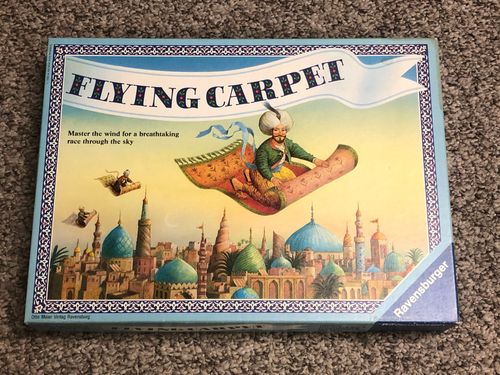
Flying Carpet
Flying Carpet Rulebook
Table of Contents
Table of Contents
Overview
A game for 3-6 players, ages 12 and up.
Contents: game board, 12 scenery pieces (houses, trees, clouds), 72 wind cards, 45 steering tokens (Steuerkärtchen), 6 flying carpet playing pieces, 1 special die.
Object of the Game
Each player uses wind cards to make his playing piece "take to the air" and fly over a fairy-tale city out of 1001 Nights. The winner of this race is the player who is first to have safe ground under his feet again at the finish.
Preparation
At the start the board shows a desert landscape. The brown platform in the lower left corner of the board is the starting space for the race. The corner space at lower right with the blue platform is the finish space.
The board is divided into three wind zones: in the beige area there is no wind, in the light blue strip of sky the crosswind blows with wind strength 1, in the dark blue strip of sky with wind strength 2. The arrows at the left and right edges of the board show the wind strength for each strip of sky. The wind always blows from left to right. More on the wind zones below.
Building the scenery
Before each game the players jointly design the board with the scenery pieces (houses, towers, trees, clouds). In this way they build anew each time the city over which they then start their race. The scenery pieces are obstacles that must be flown over and around during the race.
Any number of scenery pieces may be used: in one game only a few, leaving much desert showing, another time so many that almost the entire board is covered. Unused scenery pieces are set aside. However, at least one space behind the starting platform and one space in front of the finish platform must stay free.
The houses, towers and trees are placed in any arrangement along the lower edge of the board so that they cover the board spaces exactly, i.e. fit exactly into the grid. Gaps may be left between the individual pieces.
The clouds are placed as obstacles anywhere in the sky. They may lie on spaces of both wind zones at once. They may also be placed on stars.
The landscape must of course be designed so that the playing pieces can always get through somewhere between sky and ground.
Cards and tokens
The wind cards are shuffled. Each player receives four wind cards, which he takes into his hand face down. The remaining wind cards are placed as a face-down supply stack beside the board.
Each player additionally receives five steering tokens (Steuerkärtchen), which he places on the table in front of him.
Now everybody chooses his flying carpet, and the race can begin.
Rules of Play
The playing pieces are moved by playing wind cards.
The youngest player starts. He "climbs" the brown starting platform by placing his playing piece on the platform space. Now he plays one of his four wind cards and moves his flying carpet accordingly (see Wind Cards).
The wind card is laid face up beside the board and the player then draws a new wind card from the face-down stack, so that he always has four wind cards in hand. Then it is the next player's turn.
When the face-down stack is used up, the discard pile is shuffled and placed beside the board as the new face-down stack.
Turn summary: play a wind card - move the playing piece - take a new wind card from the supply stack.
The Wind Cards
The wind cards show how far the flying carpet is carried by the wind. The numbers in the arrows give the number of spaces the playing piece must be moved up or down and sideways.
There are two types of wind cards:
- Flight direction up or down.
- Flight direction up and sideways, or down and sideways.
The coloured arrows give the flight direction. Before a player plays a card, he must decide according to which arrow colour he wants to move. He must always move his playing piece according to the arrows of the same colour and by the exact number of points.
Important: The wind cards may only be read in portrait format (upright), not turned sideways.
Blue arrows mean flight direction up, into the sky; beige and orange arrows mean flight direction down, toward the ground.
An example: whoever plays this card (one with four arrow pairs) can choose between four possible moves:
- following the light blue arrows, he moves his playing piece first two spaces to the right and then three spaces up,
- or following the dark blue arrows, first three spaces up and then two spaces to the right,
- or following the beige arrows, first two spaces to the left and then three spaces down,
- or following the orange arrows, first three spaces down and then two spaces to the left.
The choice of arrow order for the flight direction is especially important with obstacles, since with his flying carpet one must fly around obstacles, i.e. avoid them. The right choice is also decisive for the wind zones, since there additional wind strengths affect the sideways movement.
Another example: here the player can only follow the dark blue arrows and move his carpet first three spaces up and then two to the right. The scenery piece with the elephant is an obstacle he may not fly into - so he may not move sideways first and then up. He also cannot choose the beige-orange flight directions, since his playing piece stands at the very bottom edge of the board at the start of the move - and further down does not go in this game.
Important: Per turn only one sideways movement is allowed. A playing piece may not be moved in steps (staircase fashion). This is especially important in the wind zones. (Illustration: correct / wrong.)
A player whose playing piece is blown beyond the edge of the board must begin the race again from the starting platform.
The Steering Tokens
Each player has a supply of five steering tokens (Steuerkärtchen). They can help the players steer the carpet, as they act like a wind amplifier. Each steering token means "wind strength 1" and may be used for any direction: either one space up, or one space down, or one space sideways.
If it is played in addition to a wind card, it strengthens the flight direction by one space in any direction, or, as a "headwind", slows the wind by one space in any direction.
A steering token may also be played alone - without a wind card. The playing piece is then moved one space in any direction.
In one example the steering token strengthens the upward movement by one space, because otherwise the flying carpet would have flown into the wall of the palace... and that would have hurt!
In another example the steering token is used as a "headwind" and slows the wind by one space, so that the flying carpet is not blown beyond the edge of the board but glides gently down onto the finish platform.
Important: Only one steering token may be played per turn. Played steering tokens are not replaced.
The Wind Zones
When a player's playing piece gets into one of the two wind zones, the corresponding wind strength takes effect every turn. To the value of the played wind card or steering token, one or two spaces to the right are always added at the moment of the sideways movement. When moving toward the finish the carpet is thus accelerated; on a move to the left the wind brakes the sideways movement.
In an example the carpet flies one space up and - as stated on the card - one space to the right, and in addition is pushed on by the wind in zone 2 by two more spaces to the right.
Drifting / sinking
A player who does not want to play a card lets himself drift on one or two spaces, depending on the wind zone. In the windless lower zone he sinks one space down instead. Sinking applies in any case only if no card is played.
Whichever way one moves one's flying carpet forward, the important thing is: per turn a playing piece may be moved only once in vertical direction and once in horizontal direction, never in steps (staircase fashion).
Using the wind zones is important for getting ahead quickly, but also for getting past the clouds. When changing from one wind zone to the other, one must consider beforehand which additional wind force is more favourable for continuing the flight.
In an example, the player can only use the additional wind strength 2 at the start of his move. He cannot first move down in order then to move 1 + 1 spaces sideways, because he would have had the cloud as an obstacle in this flight path.
Summary of move options
The playing of wind cards and the use of steering tokens give each player four move options for his flying carpet:
- Play a wind card - move the playing piece - take a new wind card from the stack.
- Play a wind card + steering token - move the playing piece - take a new wind card from the stack.
- Play a steering token - move the playing piece one space in any direction - take no wind card.
- Play no card, i.e. let the playing piece drift with the wind - if needed, exchange a wind card for a new one from the face-down stack.
The last-named move option brings advantages especially in the wind zones.
The Special Die
If a playing piece ends its move on a free star space, the player must roll the special die and carry out the instruction. The results are:
- The rolling player must skip his next turn.
- The player may move the clouds in the sky. Playing pieces may not be moved or covered in doing so. Care must also be taken that afterwards every player can still move forward, i.e. is not hemmed in and thereby unable to move.
- The rolling player may immediately take another turn, i.e. move his playing piece according to one of the four move options.
- The rolling player receives two additional steering tokens from the supply.
- The rolling player must swap positions with any fellow player of his choice. The playing pieces are exchanged on their respective spaces.
- The player may move his playing piece to any free board space at a distance of at most four spaces in any direction. He may also turn a corner once. If at the end of this move he lands on a star space again, this has no meaning, i.e. he may not roll again!
Blockade / Intermediate Landing of a Flying Carpet
If a flying carpet ends its move on a space on which another flying carpet is already hovering, he may choose either to block it or to force it to make an intermediate landing.
Blocking means: one places one's playing piece on top of the other playing piece, so that it is blocked. The player thus blocked must skip his next turn, since he cannot move on.
Forcing an intermediate landing means: one lets the other flying carpet sink, straight down to the edge of a scenery piece, or even to the edge of the board if there is a gap between scenery pieces there. If a playing piece already stands down there, the sunken playing piece is placed on top of it, thereby blocking it.
The player whose playing piece had to land plays on normally when it is his turn again, i.e. he plays a wind card that lets his flying carpet rise again, up into the action.
Important: During a move, other playing pieces may be jumped over. They are not obstacles.
This also applies when a playing piece is forced to make an intermediate landing. It sinks down to the edge of the scenery or of the board without pulling down playing pieces lying in between. (Example: the green playing piece stays where it is; only the blue one must sink down onto the roof of the house.)
The clouds are obstacles and must be flown around. However, if a playing piece is forced to sink over a cloud, the cloud offers it no support. It glides vertically through it down to the edge of the scenery or the edge of the board.
End of the Game
The winner of this race is the player who is first to land his playing piece exactly on the finish platform in the right corner of the board. The finish platform must be reached with the exact number of points. No points may be left over. A player who manages this neither with his wind cards nor with his steering tokens can let himself sink one space per turn in the windless zone.
A tip for tacticians: whoever prefers more tactical play can leave out the special die. In that case the star spaces have no special meaning.