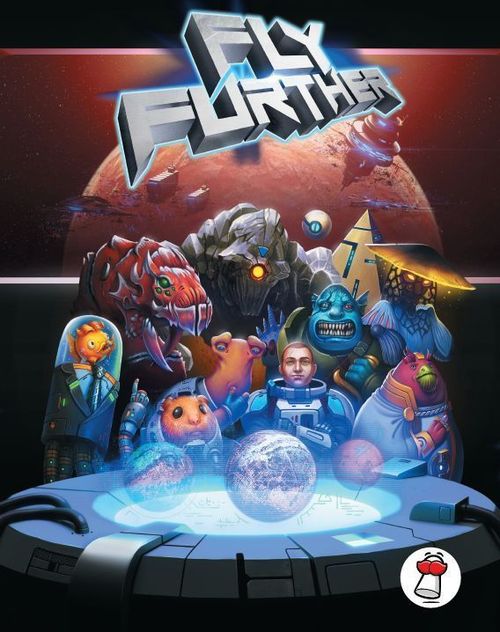
Fly Further
Fly Further Rulebook
Table of Contents
Table of Contents
Goal
Using the unique abilities of your race, try to anticipate the actions of your opponents so that you manage to colonize more planets along the Covcheg's route before it is destroyed by asteroids, in the name of the flourishing of your civilization and for victory points.
Components
- 1 score track board (Поле для подсчёта очков)
- 18 race cards (Карты рас)
- 9 race event cards (Карты событий рас)
- 19 order cards (Карты Приказов)
- 32 race special action cards (Карты специальных действий рас)
- 30 standard action cards (Карты стандартных действий)
- 6 reference cards (Карт-памяток)
- 30 near and far space cards (Карты Ближнего и Дальнего космоса)
- 9 race planet cards (Карты планет рас)
- 3 asteroid belt cards (Карты пояса астероидов)
- 6 player tokens (Фишки игроков)
- 7 observer tokens (Жетоны Наблюдателей)
- 40 energy tokens (Жетоны энергии)
- 4 diplomat tokens (Жетоны Дипломатов)
- 1 Neurofungus immunity token (Жетон иммунитета Нейрогрибницы)
Setup
- Place the score track board in the centre of the table.
- Place the energy tokens next to it.
- Prepare each player as follows.
A. Choose a race
There are 18 races. They are divided by colour into 6 groups of 3 races each. Some races have a limit on the number of players and are used only in games of 4 or 5 participants. The limit is shown in the upper right corner of the race card.
Within each group there is 1 simple, 1 medium and 1 complex race. The difficulty level is shown on the race card in the upper left corner.
For example: the Insectoid race is green and of medium difficulty.
Take the player tokens and let each player choose one. Then each player receives 3 race cards in the colour of their token and chooses 1 of them to play. Note that the card must suit your number of players.
Place your race card in front of you. Return the other cards to the box.
We recommend that your first game be played with simple races.
B. Assemble your race's deck (in some cases with tokens)
The composition of your race's deck is shown on your race card (in the upper right half). Find the necessary cards in the corresponding decks and take them into your hand:
- Red: cards to take from the standard action deck in your race's colour. Standard action cards are marked with a coloured frame on the front side. Their colour matches the frame: for example, Spekuloids have cards with a blue frame, the same colour as the race itself.
- Yellow: cards to take from the race special action deck. (For several races you will take tokens instead.)
- Green: cards to take from the race planet deck or from the race event deck (as in the example).
Belonging of race special action cards, planets and events to a race is always indicated by the race icon in the upper left corner of the card. Race decks can differ greatly from one another.
Divide the resulting deck into 2 parts: action cards and space cards (events go into space). The easiest way is by the backs of the cards: some show planets, others dark and light space. Keep the action cards (with the planet on the back) in front of you. The space cards will be needed for further preparation (see step 4).
C. Place your token on space "0" of the board
Place your player token on the space marked "0" on the score track.
D. Take 1 energy token
Take 1 energy token and place it in front of you.
4. Prepare the Journey deck
A. Take the Far Space deck and draw 2 random cards from it. Add to them 1 random asteroid belt card. Shuffle without looking and place these 3 cards face down.
B. Draw 3 more random Far Space cards. Add to them the 2 remaining asteroid belt cards, and the planet and event cards of the races in this game that are to be added to Far Space (with dark space) from step 3.B. Shuffle thoroughly and place them face down on top of the pile from step A. Return the remaining 10 Far Space cards to the box.
C. Take the Near Space deck and draw 5 random cards from it. Add to them the planet and event cards of the races in this game that are to be added to Near Space (with light space) from step 3.B. Shuffle and place them face down on top of the Far Space cards (from steps A and B). Return the remaining 10 Near Space cards to the box.
Your Journey deck for this game is ready. Do not shuffle this deck again! Place it in the centre of the table.
5. Shuffle the Order deck
Shuffle the Order deck and place it face down in the centre of the table.
You are ready to set off on the flight!
Game flow
The game consists of a series of rounds. Each round consists of 4 phases:
- Discovery of a new planet
- Colonization
- Scoring
- Restoration
1. Discovery of a new planet (from the prepared Journey deck)
Planets can give victory points (VP, победные очки) for colonies built and mines built on them. Each planet is of one of two types, water or dry, and has additional properties.
The planet type is shown by the icon in the upper left corner of the card. The VP for built mines are shown in the centre right, the VP for built colonies in the centre left, and the planet's special property at the bottom of the card.
On this card, the total VP for colonies is divided equally among all players who build colonies on this planet, and the total VP for mines is divided equally among all players who build mines on it.
Example, water planet: the card shows 8 VP for colonies and 9 VP for mines. Players who build a colony here also receive 1 extra energy token, as the planet's property states. For example, if 2 colonies and 4 mines are built on this planet, each player who built a colony receives 4 VP (plus 1 energy token), and each player who built a mine receives 2 VP (8 ÷ 2 = 4 for colonies; 9 ÷ 4 = 2.25 for mines, rounded down to 2).
VP are always rounded down.
Example, dry planet: the card shows 6 VP in total for colonies and 10 VP in total for mines. As the property states, if at least 1 mine is built on this planet, the total VP for colonies rises to 16.
The bonuses for a dry or water planet type are described below, on the description of the Fly Further card (phase 2, Colonization).
So: turn over the top card of the Journey deck, place it beside the deck, and read the planet's parameters and properties.
- If you turned over an Event card or an Asteroid belt card, carry out all the actions written on it.
- If this is the third asteroid belt card of this game, the game ends after its effect is carried out (proceed to phase 3). In all other cases, proceed to phase 2.
2. Colonization
In this phase, players simultaneously play 1 action card each, face down.
The action deck of a player can contain:
Standard action cards. These are the ordinary mine, the ordinary colony, and the Fly Further card. Play a mine or a colony face down if you want to colonize the planet and gain VP. If you want to gain energy, play the Fly Further card. It gives you energy tokens, which will be useful in phase 4 (Restoration). If the planet on which you played this card is a dry planet, you receive 3 energy tokens. If it is a water planet, you receive 2 energy tokens and 1 Order card (see below).
Race special action cards. These are of three kinds:
- A. Special mines and colonies. In essence these are the same as ordinary colonies and mines, but they have features specific to a particular race. They are played, and counted for VP, by the same basic rules as standard mines and colonies.
- B. Special action cards. These are cards with special race abilities, marked with a red star icon in the upper left corner. They are played face down instead of a mine, a colony or Fly Further.
- C. Additional action cards. These are marked with a green plus sign. They are played in addition to an action card. They can be played face up at once, but at a specific moment (when stated on the card).
Based on the planet's properties, the game situation and the race abilities, players decide whether to build colonies or mines, use their special abilities, or fly further to restore energy.
Each player must choose one of the action cards from their hand and place it in front of them face down. Each player may also, if they wish, play a special card of their race (if they have one) and apply its effect. As soon as all players have placed their cards, all action cards are revealed simultaneously.
If you are unsure about the order of resolution of cards and actions, use the player order indicated on the reference cards.
Order cards. Order cards may also be played during the round. These are common bonus cards with powerful effects. Any player may obtain one, regardless of race, by playing Fly Further on a water planet (or through the properties of some cards). Order cards are played face up. The time of resolution and the effect are shown on each card.
EACH PLAYER MAY PLAY ONLY 1 ORDER CARD PER ROUND.
Some orders and special action cards act on the cards played by other players, and some can even destroy them. Mines and colonies that "survive" all effects in the Colonization phase are considered built.
3. Scoring
First, each player who played the Fly Further card receives either 2 energy tokens and 1 Order card, or 3 energy tokens, depending on the type of the current planet (water: 2 tokens and 1 Order card; dry: 3 tokens). That player then returns the played Fly Further card to their hand.
Next, the properties of the played action cards are applied.
DO NOT FORGET TO TAKE INTO ACCOUNT THE PECULIARITIES OF THE CURRENT PLANET.
If you find yourself in a situation where you must pay something but do not have enough of the resource, it is considered that you have paid. This does not apply to the Restoration phase!
Example: on the Parasite planet (a dry planet), if you played Fly Further, you must pay 3 energy tokens, because the planet takes energy instead of giving it. If you have fewer than 3 tokens, give what you have. If you have none, you pay nothing.
Divide the total VP for colonies among all players who built colonies, rounding down. Move each player's token on the score track by the corresponding number of VP, taking into account the abilities of each player's race.
Divide the total VP for mines among all players who built mines, rounding down. Move each player's token on the score track by the corresponding number of VP, taking into account the abilities of each player's race.
If your construction on a planet does not yield VP, because of the planet's property, the actions of other players, or any other reason, you do not receive VP for it.
ALL PLAYED CARDS (EXCEPT FLY FURTHER) ARE SENT BY EACH PLAYER TO THEIR OWN DISCARD PILE, VIA THE SPECIAL SLOTS ON THEIR RACE CARD.
Each race card has marked slots for discarding specific cards. This lets other players see which cards their opponents hold and predict their actions.
Example: the Neurofungus race card has a slot for colonies on the left, a slot for mines on the right, and a slot at the top for 2 special action cards.
4. Restoration
Players may spend the energy tokens they have accumulated to return played action cards from their discard pile to their hand. The cost of returning a card differs for different types of card and is shown by the lightning icons in the upper right part of the action card.
Example: to return this colony from the discard pile, you must pay 3 energy tokens.
The required number of energy tokens is paid into the common bank in the centre of the table, and the player returns the chosen card from their discard pile to their hand. In the Restoration phase a player may return as many cards from their discard pile as they wish, as long as they have enough energy tokens.
Note that energy tokens are needed only to return cards from the discard pile to your hand. To play cards from your hand, no tokens are paid!
End of the game and determining the winner
The game continues until 3 Asteroid belt cards have come out of the Journey deck, or until an alternative game-end condition is triggered (some races have one). The effect of the last Asteroid belt card is resolved by the usual rules. After that your flight ends, and it is time to learn the winner.
The player who gained the most victory points, or who fulfilled a special victory condition of their race, becomes the winner.
If several players are tied, the winner is the one among them with the greater total return cost of the cards in hand (counted in lightning icons) plus any remaining energy tokens.
Some races have alternative or additional victory conditions.
Solo and two-player rules
Translated from the companion rules sheet "Летим дальше. Соло и 2 игрока" (solo and two-player rules), published with the same Russian edition.
Overview
The rules for 1 and 2 players are the same as the base rules, so read the base rules first.
The difference is that in a two-player game 1 bot appears, and in a solo game 2 bots appear.
At the start of the game, choose 1 of the 2 races (Люди / Humans, or Пираниты / Piranites) for a two-player game, or both races for a solo game. Bots can be only these 2 races.
Setup
Take the bot cards of the chosen race, or of both races at once for a solo game. Shuffle them, form the bot deck(s) and place them in the centre of the table. Further setup follows the base rules.
Bots do not receive energy tokens and do not spend them to return cards.
Place the bot's action cards that are to be in its hand face up, next to the bot's race card.
Game turn
The participants play by the base rules. The bot(s) take their turns after the players, face up.
- After the players have revealed their cards in the Colonization phase, look at the icon on the revealed planet card. It is placed above the icon for victory points from mines.
- Turn over the top card of the bot's deck and find on it the same icon. The bot plays the first action card shown under this icon. If that action card is in the bot's race discard pile, the next card under this icon is played instead.
Foreign cards: if the bot's deck contains cards from other players, for example a Colony or a Cylon Mine, the bot always plays the foreign action cards first. For example, if the bot must play a mine, it plays the Cylon Mine rather than the basic mine card.
- After VP are scored by the base rules, the bot's card goes to the discard pile on the bot's race card.
Return rule: the return rule of a bot card is shown at the bottom of the card. For example, if the bottom shows the colony icon, the bot returns a card from its discard to its hand if its discard contains a colony card. Otherwise the card stays in the discard pile.
Reshuffling: if only 1 card is left in the bot's deck, shuffle it together with the other cards in the bot's discard pile to form a new deck.
Trash icon: some bot cards show a trash icon (urn) in the centre of the card. Such a card leaves the game immediately after it is resolved.
Order cards: bots do not receive Order cards and do not play them. Players may play Order cards on bots.
End of the game
Scoring of victory points and determination of the winner follow the base rules.