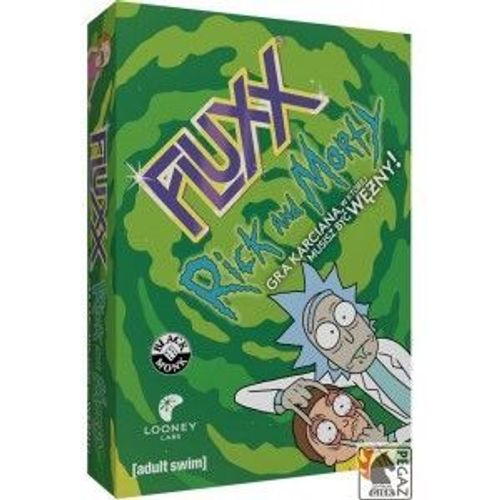
Fluxx: Rick and Morty
Fluxx: Rick and Morty Rulebook
Table of Contents
Table of Contents
Game Contents
- 100 cards
- Rulebook
Setup
Place the Basic Rules card in the middle of the table. Shuffle the deck thoroughly and deal each player 3 cards. Put the deck next to the Basic Rules card face down - players will draw cards from it.
(The Basic Rules card reads: "Before the game starts, shuffle the deck and deal 3 cards to each player. Choose who goes first. Do not remove this card from the table." It shows: Draw 1, Play 1.)
Setup steps: place the Basic Rules card in the middle of the table; shuffle the deck; deal each player 3 cards.
Who Goes First?
Whoever wants to go first, goes first. The easiest way to claim the first turn is to take the top card from the deck as soon as setup is finished.
How to Play
Be ready - the rules of the game will change in the course of the game. The starting rules are very simple, but with every turn the game gets more complicated because of cards that introduce new rules and cancel old ones.
Begin the game as written on the Basic Rules card ("Draw 1 card, play 1 card"). Pass the turn clockwise. Adjust to all the new rules that are added whenever somebody plays a card. The game lasts until someone fulfills the conditions of the current Goal card (it, too, first has to be played).
On their turn a player may play any card from their hand that they want. If they are not sure how it works, they should read the text on the card in full, aloud and with expression - that should help.
Order of Turn
- Draw cards from the deck (as many as the current rules require).
- Play cards from your hand (as many as the current rules require).
- Discard excess cards from your hand so as not to exceed the Hand Limit (if there is one).
- Discard excess played Keepers (themes) so as not to exceed the Keeper Limit (if there is one).
Additional actions required by New Rule cards, Keepers, etc. are performed at various moments of the turn.
Example of Play Layout
The Goal card is placed in the center of the table. After playing an Action card, put it into the discard pile (discard pile face up). New Rules are put in the center of the table next to the Basic Rules. A played Keeper is placed in front of you face up.
Types of Cards
Basic Rules. The game starts with them. Gradually they are displaced by New Rules, but the Basic Rules card always stays in the center of the table. The basic rules are simple: on your turn, draw 1 card and play 1 card (there are no Hand or Keeper Limits yet - breathe out).
New Rule. When you play a New Rule, lay its card face up next to the Basic Rules card. If the card contradicts a previously played New Rule, send the previous rule to the discard pile.
A New Rule takes effect immediately. Usually because of this the player whose turn it is has to immediately draw or play several more cards. It is also possible that other players will need to discard some cards from their hands.
Example: After drawing 1 card, Dima plays the New Rule "Draw 4" from his hand. Now every player must draw 4 cards on their turn. Since on this turn Dima has already drawn 1 card, he must draw 3 more from the deck into his hand. The next player, Oleg, draws 4 cards. Then he plays the New Rule "Draw 2". The card-drawing rule has changed again, but Oleg has already taken the required 2 cards (and even more), so he does not need to draw any more. Since the "Draw 2" rule contradicts the previous one, the "Draw 4" card is discarded.
Goal. At the beginning of the game there is no Goal yet. When you play a Goal card, lay it face up in the center of the table. Discard the previous Goal, if there is one. The Goal card states which Keeper cards must lie in front of a player for them to win. The Goal is the same for everyone: the player who fulfills its conditions wins the game (even on someone else's turn).
Keeper (Theme). When you play a Keeper card, lay it in front of you face up. Very often, to win you need to lay out a particular combination of Keepers, so playing a Keeper is usually a good idea.
Symbols on cards. Some Keeper cards carry a speech symbol and Rick's imaginary-friend symbol. They are there for a reason:
- the speech symbol: when you play such a card, you will have to say something (maybe once, maybe many times);
- the other symbol: this is a Keeper that is an imaginary friend of Rick. This symbol may matter for some Goal cards.
Action. When you play this card, do everything written in its text, and then discard it. Actions may cause a chain of far-reaching consequences, or may have no effect on the game at all. Some Actions may force a player to play additional cards.
Important: an Action card and all the cards played according to its instructions count as one played card.
Example: After playing the Action "Draw 2 and use them", Dima immediately draws 2 cards from the deck and plays both. One of them is also an Action: "Draw 3, play 2". Dima again takes cards from the deck, plays 2 of them and discards the third - and it is considered that he played just one card.
Problem (Creeper). Unlike Keepers, which are needed to win, Problems are undesirable cards that often get in a player's way. Problems are placed on the table in front of the player, next to the Keepers, face up.
While a Keeper can be held in your hand, Problems go on the table regardless of the player's wishes. Having drawn a Problem, the player must lay it on the table in front of them and take the next card from the deck. If the next card is also a Problem, the story repeats.
If a player cheats by not laying a Problem from their hand on the table, then they and their glowing boulders do not belong at this table.
In Fluxx: Rick and Morty there are 3 Problem cards.
Important: a Problem laid on the table does not count as a played card.
Example: Oleg played the Action card "Draw 3, play 2". He starts drawing cards into his hand. Among them there is a Problem: he lays it on the table in front of him and immediately draws a replacement card. Only when Oleg has drawn 3 cards from the deck, not counting Problem cards, can he choose 2 of them to play. Oleg discards the third card (according to the rules written on the Action card).
Discarding
Discarding a card and playing a card are not the same thing. When a card is played, the player must do everything written on it, if possible. You cannot just discard an unwanted card. This is only possible when the Hand Limit is exceeded or when a special Action is played. And yes, this may mean you will have to play a card that will help your opponent win!
Victory
The game continues until one of the players fulfills the conditions of the current Goal. As soon as the Goal is achieved, that player instantly becomes the winner, even if it is not their turn.
Notes
- The game lasts until a winner is unambiguously determined. If for some reason several players have achieved the Goal at the same time, the game continues until only one player remains who fulfills the conditions of the current Goal.
- If the deck runs out of cards, shuffle the discard pile, form a new deck and continue the game.
- When the text of a card says "in play", "laid-out cards" or "cards on the table", this does not apply to cards in the discard pile.
- Some cards allow you to perform bonus actions on your turn. Such cards say "Free Action".
- New players can join the game at any moment - just deal each newcomer 3 cards. Likewise you can leave the game in the middle of a match: just discard all the cards from your hand and everything laid out in front of you.
- If during setup you were dealt a Problem, you must immediately play it and draw a card into your hand, so that you have three cards in your hand and none of them is a Problem.
Questions and Answers
I want to play a New Rule, but there is already a New Rule on the table. Can two cards remain in play, or must one necessarily replace the other?
It depends on how these rules relate to each other. There can be any number of New Rules on the table at the same time, as long as no two cards govern the same moment. If a player lays down a New Rule that does not contradict the current rule cards in any way, they all remain on the table. But if two New Rules - the previous one and the one just played - concern the same thing (for example, how many cards to draw at the start of the turn), the fresh rule takes effect and the previous one is discarded.
(The rulebook illustrates this with example New Rule cards: "Repeat" - Each player who has at least one Keeper or Problem laid out must carry out one instruction of every... (partly illegible), "Spin" (Free Action: once per turn you may discard any number of Goal cards and draw as many cards from the deck as you discarded), "Play 4" (replaces the rule "Play"; if you have fewer than 4 cards in hand, play all your cards), and "Keeper Limit 4" (if it is currently someone else's turn, you must have no more than 4 Keepers in play - immediately discard the excess; choose yourself which Keepers to keep; on your own turn ignore this rule, and when you finish your turn immediately discard all played Keepers except four).)
What if a New Rule, for example "Play 3", contradicts the Basic Rules?
In this case the New Rule takes effect, but the Basic Rules card stays on the table anyway. To avoid confusion, the New Rule card is laid as shown in the illustration (placed next to/partly over the Basic Rules card).
What should I do if a rule requires me to play 4 cards, but I have only 2 in hand?
Play as many as you have - 2 cards. If your hand is empty, the turn is over, even if the rule requires you to play more.
Suppose the rule "Play 2" is in effect and with the second card of my turn I lay down the New Rule "Play 3". Do I have to play a third card, since I have already played two?
Of course you do. All rules take effect immediately.
Help! I got the card "Play All". Must I, as long as this rule is in force, play all my cards each turn until I am left with an empty hand?
Exactly so.
Suppose it is my turn and the current Goal requires 2 Keepers for victory. I have one Keeper, and I see the second in front of an opponent. If I take it from him by brute force (hypothetically), will I be credited with the win?
In Fluxx you cannot win by hooligan methods. But the game does have an Action card "Steal Something", which is perfect for exactly that hypothetical situation. Play it, take the Keeper from the opponent - and that's it, victory!
I have a Keeper laid out, and I want to play another one. Do I have to discard the previous one? How many Keepers can be in play at once?
No need to discard! You may lay out any number of Keepers in front of you, but as soon as the rule "Keeper Limit X" comes into force, the excess must be discarded at once. After that, on your turn you can lay out Keepers in any quantity, but at the end of the turn always check whether the Keeper Limit is exceeded. Discard the excess Keepers (of your choice).
When discarding cards because a limit is exceeded, can I choose what to discard?
Yes, of course.
Suppose that at the start of my turn the rule "Hand Limit X" or "Keeper Limit X" is in effect. By playing a New Rule or Action card, I ended up cancelling the limit and discarding the rule. Do I have to discard cards at the end of the turn according to a limit that is no longer in force?
No! A rule stops working after its card has been sent to the discard pile.
Does the Hand Limit mean I can keep any number of cards in hand not exceeding the current value of the limit?
Absolutely right. It is not a number of cards you must draw up to when short, but a "ceiling" - the greatest number of cards that may be in your hand.
May I play a replacement card if someone has cancelled, with a Surprise, a card I played?
No.
What can I do when it is not my turn? Can I play cards?
On someone else's turn you cannot play cards. However, you need to follow the game and adapt to the changing rules. For example, if somebody plays the rule "Hand Limit X", all players must discard excess cards, if there are any.
If the card "Hand to Hand" (pass cards) is played and my opponents have no cards in hand, must I give away my cards for nothing, or is the action optional in this case?
The card is played, the action must be carried out, so be so kind as to hand over all your cards in exchange for air, if your opponents got rid of their cards beforehand. Of course, the opposite is also possible: with a good alignment you will receive a valuable stack of cards without giving anything in return.
I played the Action "Draw 2 and use them", drew two Goals, and one of them would bring my opponent victory. May I play both Goal cards at once so that the "winning" one ends up at the bottom and the opponent cannot take advantage of it?
No. When laying out each Goal, the player must give opponents time to assess the situation. If at the moment a Goal appears some player holds the winning combination of cards, the game ends immediately.
Suppose I play the Action "Keep It Simple" ("Discard up to half of the New Rule cards in play"). May I discard no cards at all, since 0 is also "up to half"?
No. An Action card obliges you to perform the action. You must discard at least one played New Rule card, but no more than half of such cards.
Can cards from different versions of Fluxx be mixed?
Yes, it is possible. However, that does not mean the cards will combine well. The rules of different games may contradict each other without offering ways to resolve the collisions, and a Goal may become unattainable or simply absurd. And, after all, a big deck is inconvenient to shuffle, so we recommend limiting yourself to a couple of your favorite cards from another version.
If I discard a Keeper to get rid of a Problem, must I discard it from my hand or from those laid out in front of me? Is this a "Free Action", or does it count toward the cards I can play on my turn?
Discard a Keeper from those already lying in front of you. This does not count toward the cards you can play on your turn.
Is there a way to get rid of a Problem card?
Several: with the help of Action cards, New Rules and sometimes Keepers. And you can also come to terms with the Problem and wait. There are several Goals for which the player needs exactly a Problem. In an instant the rules may change, and the Problem will not get in the way of victory.