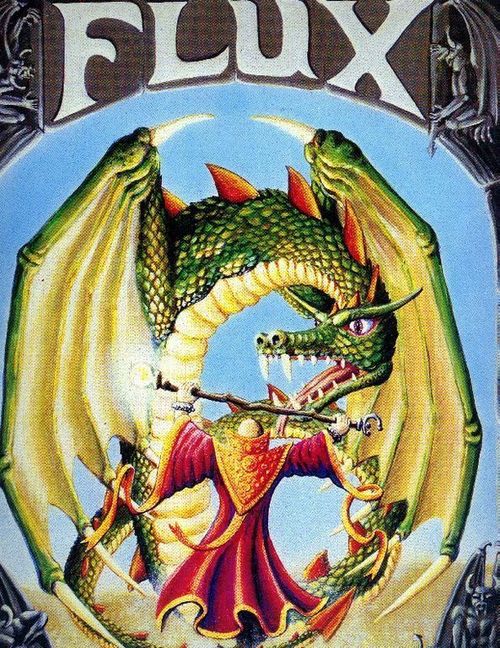
Flux
Flux Rulebook
Table of Contents
Table of Contents
Introduction
Players are wizards competing against one another for the title of Master of Wizards. This annual event, held on the Great Plains of Grob during the month of Forthauary, is used to select the Loremaster for the Associated & Amalgamated Guild of Wizards, Warlocks Witches and Magic Users (1978) for the coming year.
Thankfully, the days when the losers were lowered slowly into a cauldron of boiling sziglion oil laced with bat's wings and viper droppings are long gone. Nowadays they leave out the bat's wings.
Finally place yourself (the wizard counter that is) on one of the corners of the Great Plains.
For your information the throbbing light beneath you feet is not a plantiorpimus egg just about to hatch but a flux globe. Make sure you occupy the flux globe of the same hue as your counters.
Let the competition commence....
Outline of the Game
The Great Plains of Grob were created by the Archmage Randolfinius specifically for this event. At each corner of the hexagonal competition area and scattered carelessly around the area are flux globes. As you know you will need flux to cast your spells so the more globes you have under your control the more spells you will be able to cast.
Wizards cast spells, either Earth or Animate, in turn. Earth spells allow a wizard to claim territory while animates can be used to destroy another wizard's earths or animates. The winner is the wizard who, at the end of the game, can claim the most flux globes to be under his control.
Flux Globes
Each flux globe in a corner gives 10 flux per round. These cannot be captured by another wizard, neither can a wizard use one of the incorrect hue.
All other globes give the amount marked on them to the undisputed owner of the globe at the end of each round. Flux globes can neither be created or destroyed without Archmage Randolfinius' permission in writing, which is going to be very difficult as he was banished to Vbijklax by the guild accounts committee for fiddling his expenses back in '76.
Order of Play
At the start of each round all wizards claim flux from their globes and add it to any left over from the previous round. Then all roll the decapod, whosoever throws the largest number takes his turn first. The wizard on his left plays next and so on until all have had a turn. Within each wizard's turn he may do in this order:
i. Move Animates (including the wizard) up to the movement ability of the piece.
ii. Cast Spells to create animates or earths.
iii. Resolve Combat between his animates and another wizard's animates.
iv. Destroy Earths of other wizards.
Preparing for the Competition
Each aspiring Loremaster selects Earth and Animate counters of a particular hue. You will also need something to record your available flux. A Ghionkajabbabus with thruddle is ideal, but a pencil and paper will do for those of you of restricted abilities and means. Assure yourself that you are conversant with the counters, and for your reference I have been able to get permission to reproduce them here, thus:
[Diagram: the counters are shown labelled Troll, Phoenix, Knight, Wyvern, Gnome, Great Dragon, Wizard and Manticore; the terrain tiles are labelled Forest, Hills, Swamp and Mountains.]
Moving
Animates and the wizard may move up to their movement allowance each turn provided they do not move over earth types which are forbidden to them. A wizard may not have more than one animate on a hex at a time. (This allows combat between animates of different wizards).
Animates with unused movement may not move again after they have cast spells, engaged in combat or attempted to Destroy Earth.
Casting a Spell
To cast a spell, declare what and where you intend to cast. The flux needed is given in the table below. Deduct it from your reserve. Calculate what the casting chance is from the Casting Chance Table then throw the decapod.
If you throw on or below the casting chance you have cast it and may now place the appropriate counter on the board. Try to ensure you place the counter of the correct hue on the board as arguments are so frightfully tedious.
Earths may not be cast onto existing earths, animates or flux globes. Earths must be cast onto a full two hexes i.e. they may not be cast onto a part hex at the edge of the plains.
Animates may be cast onto earths and other animates, but not globes.
Casting Chance
The further away you want to cast your spell, the more difficult it becomes. Each time you cast a spell you must throw the decapod. In the table below all distances are measured from yourself, the wizard.
| Distance from Wizard | Successful throw |
|---|---|
| 1 - 4 Hexes * | 1 - 8 |
| 5 - 6 " | 1 - 6 |
| 7 - 8 " | 1 - 4 |
| 9 - 10 " | 1 - 2 |
* All of an Earth must be within a given range band.
Wizards may cast as many spells as they wish during their turn and may repeat failed spells provided they pay the flux cost again.
Combat
Any animate moving into the same hex as an enemy animate must fight it.
To resolve combat, each wizard rolls the decapod for his animate and adds the animate's Combat Rating. The highest result is the winner and kills the other animate which is removed from the board. (If the result is a draw, throw again).
Animates killed are then available for recasting during the wizard's next turn.
[The following chart is printed in a box below the Combat text. The printed page shows no separate heading for it.]
| Type | Name | Flux Cost | Combat Rating | Move | Restrictions & Abilities |
|---|---|---|---|---|---|
| Earth | Forest | 2 | - | - | May not cover a lake. |
| Earth | Hills | 4 | - | - | May not cover a river or lake. |
| Earth | Swamp | 5 | - | - | Must touch water, but may not cover a lake or straddle a river. |
| Earth | Mountain | 7 | - | - | May not cover a lake or river. |
Destroying Earth
Most animates can destroy particular types of earth.
To do this move, an animate onto an earth type during the movement phase then roll against the chance to destroy in the Destroy Earth phase. If the roll is equal to or below the chance to destroy as given in the table, the earth is removed from the board and the animate remains in position on the plain.
An animate only has one chance to destroy earth per turn. There is no flux cost for destroying earths. Destroyed earths are then available for recasting during the player's next turn.
If an enemy earth type is occupied by an enemy animate on either earth hex, then the enemy animate must be destroyed before a Destroy Earth roll can be made.
Destroy Earth can be used on your own earths when you want to remove them from the board and recast them to a different location.
Territory & Flux
A wizard's territory is the area enclosed by his earths. (See example). The starting point of his territory is always his starting Flux globe hex. Where territory from different wizards overlaps it is called disputed territory. During the game globes in disputed territory will not supply flux to either wizard (see example).
[Printed example diagram, a hex board with these callouts:]
- "This wizard can claim 10 + 2 = 12 Flux this turn."
- "Disputed territory; neither wizard can claim the Flux from this globe."
- "Territory runs from the corners of a hex. Where the territory line goes through a hex, the wizard can claim the flux if over 50% of the hex falls into his territory."
- "Starting flux globe of player 1. Provides 10F per round and cannot be claimed or disputed by another player."
At the end of the game, each wizard counts up the total amount of flux he can claim. Disputed globes are shared equally between those wizards in dispute. Add undisputed flux to disputed flux. The wizard with the highest total is acclaimed The Loremaster. The other wizards should make suitable arrangements to lower themselves into boiling cauldrons of sziglion oil laced with viper droppings. (Please use the viper dropping available from H.G.Gibloid & Co).
Duration of the Contest
Ten rounds. Less or more by agreement. (Please ensure all wizards can count up to ten before starting. We don't want a repeat of the 1963 final do we?)
Grangiomagus Flozbilius III.