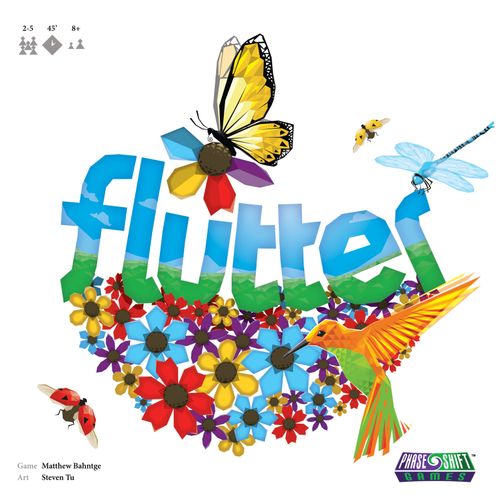
Flutter
Flutter Rulebook
Table of Contents
Table of Contents
Eco-friendly
All paper, punchboard, and wood components, in all versions of Flutter, are made using 100% FSC-compliant (Forest Stewardship Council) materials.
Components
- 60 meadow tiles (12 for each of 5 types of pollinators: hummingbirds, ladybugs, moths, dragonflies, and butterflies)
- 1 "rainbee" starting tile
- 16 water tiles
- 5 bee tokens (1 in each of 5 player colors)
- 20 petal tokens (5 in each of 4 petal colors)
- 5 petal tracker boards (1 in each of 5 player colors)
- 60 pollen tokens (36 x 1s, 12 x 5s, 12 x 10s)
- 1 sun token
Pollinators: The animal depicted in the middle of each meadow tile is referred to as a pollinator.
Color blindness key: Each white sparkle shape corresponds to one of the petal colors in the game.
Game Setup
- Place the rainbee starting tile in the center of the table.
- Create the meadow rondel:
a. Separate the meadow tiles by shape into 5 stacks.
b. Shuffle each stack, and arrange them in a circle off to the side of the play area, in any order.
c. Based on the number of players, remove from the game a number of tiles from the top of each stack, as follows:
- 2 players: Remove 6 tiles, leaving 6.
- 3 players: Remove 5 tiles, leaving 7.
- 4 players: Remove 5 tiles, leaving 7.
- 5 players: Remove 4 tiles, leaving 8. d. Place the sun token on the ladybug (diamond-shaped) tile stack, or select a stack at random for a more varied setup.
- Shuffle all the water tiles, and place them facedown in the center of the rondel.
- Place the pollen tokens with their numbered sides up near the rondel.
- Player setup: The player who most recently marveled at the wonders of nature is the first player. Starting with the first player and proceeding clockwise, each player selects a color and takes the corresponding bee token and petal tracker board. Each player places 1 petal token of each color (4 total tokens) on the "0" space of their petal tracker board.
You're now ready to play!
How to Win
During play, you score pollen points by pollinating the meadow and strategically placing your bee. Leftover petals are worth additional pollen points when the game ends. The player with the most pollen points at that time is the winner!
Game Summary
Starting with the first player and proceeding clockwise, each player takes a turn consisting of the following steps:
- Step 1: Rotate the Sun
- Step 2: Select a Tile
- Step 3: Place a Tile
- Step 4: Grow Flowers
- a. Grow Matching Flowers
- b. Grow Mismatched Flowers
- Step 5: Pollinate the Meadow
- a. Fill in Pollen Ponds
- b. Score Enclosed Meadow Tiles
- Step 6: Place Your Bee
You will move petal tokens up and down on your tracker board during Steps 4 and 5.
Game end: The game end triggers when the last tile of any stack in the rondel is placed in the meadow. Proceed as indicated in the Game End section, and the player with the most pollen points is the winner!
Step 1: Rotate the Sun
(Skip this step on the first turn.) Move the sun token to the next tile stack in clockwise order.
5-player summer solstice rule: When playing with 5 players, each time it is the first player's turn, move the sun 1 additional stack forward.
Step 2: Select a Tile
You may always select the tile that is located on top of the stack just after the sun token in clockwise order at no cost. Alternatively, you may pay petals to skip tile stacks, as follows:
- You may skip the tile stack directly after the sun token by paying 1 petal of the color of the pollinator showing on the top tile of that stack. Move the petal token of that color down 1 space on your petal tracker board.
- You may pay an additional 2 petals to skip the next stack, matching the color of the pollinator on top of that stack.
- You may pay an additional 3 petals to skip the next stack, matching the color of the pollinator on top of that stack.
- You may pay an additional 4 petals to skip the last stack, matching the color of the pollinator on top of that stack. NOTE: Paying this amount (10 total petals) means you will be selecting the tile that the sun is currently on.
Skipping tile stacks costs petals: Because players start the game with no petals, skipping tile stacks will not be possible until later in the game.
Testing tiles: You are always allowed to test how a tile might fit the meadow before officially selecting it. Return the tile to the top of its stack if you choose not to use it.
Can't legally place a tile on your turn? While this is a nearly impossible scenario, if you cannot legally place any tile you are eligible to select, then remove the tile just after the sun token from the game, and gain 1 petal of each color as your turn.
Example (selecting and placing a tile): 1. Lilly wants to place the red ladybug tile, so she will need to pay petals to skip three stacks. She pays 1 blue petal to skip the blue hummingbird stack, 2 purple petals to skip the purple dragonfly stack, and 3 more purple petals to skip the purple moth stack (6 petals total). She may now place the red ladybug tile.
Step 3: Place a Tile
Place the tile you selected anywhere in the meadow, following these rules:
- You may rotate or flip the tile as desired before placement.
- One or more sides of the tile you place must touch the side of one or more tiles already in the meadow.
- You must grow at least 1 flower. A flower is grown wherever one or more petals on the tile you are placing touch one or more petals on other tiles already in the meadow, whether or not the petal colors match (see Step 4).
Example (continued): 2. Lilly can place the selected tile on the top-left of the yellow dragonfly, as shown, because it both touches a side and grows a flower. She cannot place the tile below the yellow dragonfly as shown, because this placement does not grow a flower.
Step 4: Grow Flowers
A properly placed tile always grows at least 1 flower, which will be classified as either matching or mismatched.
- Matching flowers: A flower is considered matching if any of the flower's petals on the tile you placed match AT LEAST ONE of that flower's petals on tiles that were already in the meadow.
- Mismatched flowers: Conversely, a flower is considered mismatched if NONE of the flower's petals on the tile you placed match that flower's petals on tiles that were already in the meadow.
- Rainbow petals: The rainbee starting tile has rainbow petals in two of its corners. These rainbow petals match all colors.
A single tile placement may grow both matching and mismatched flowers.
Step 4a: Grow Matching Flowers
For each matching flower, increase the petal tokens on your petal tracker board corresponding to all of that flower's matching petals (petals on both the tile you placed and on any tiles it touches that were already in the meadow).
Example: Corey placed the red ladybug tile. He gains the following petals:
- 3 blue petals for the top flower (2 for the blue petals on the tile he placed and 1 for the blue petal on the existing tile; note that Corey does not gain a red petal in this case, because the tile he placed did not have a red petal)
- 4 purple petals for the left flower
- 3 yellow petals for the bottom flower
There are also enclosed spaces and tiles here (see Step 5).
Step 4b: Grow Mismatched Flowers
For each mismatched flower, decrease the petal tokens on your petal tracker board corresponding to all the flower's mismatched petals (petals on both the tile you placed and on any tiles it touches that were already in the meadow).
Example: Mahati placed the red ladybug tile. She must pay the following petals:
- 2 yellow petals, 1 red petal, and 1 blue petal for the top mismatched flower
- 1 purple and 3 yellow petals for the left mismatched flower
- 2 blue petals and 1 purple petal for the bottom mismatched flower
There is also an enclosed space here (see Step 5).
Limited to 21 petals of each color: You cannot gain more than 21 petals of any one color. Ignore any excess you would have gained, leaving the corresponding petal token on the 21 space on your tracker board.
Don't have enough petals to pay? If you do not have enough petals to pay for a mismatched flower, then you cannot place that tile in that way.
Step 5: Pollinate the Meadow
If any spaces and/or tiles are fully enclosed after you place a tile, you must fill in pollen ponds and score the enclosed tile(s), respectively. Enclosing meadow tiles is the primary way to gain pollen points and win the game! A space or tile is considered enclosed when all of its sides fully border other meadow or water tiles.
Step 5a: Fill in Pollen Ponds
If the tile you placed encloses any amount of empty space, fill that space completely with water tiles. Draw and place water tiles faceup in the empty space, gaining the printed rewards for each water tile placed. These rewards include:
- Gain 1 pollen point.
- Gain 2 petals of the indicated colors.
- Gain 1 petal of any color you choose (rainbow petal).
- Gain no reward (when the water tile is blank).
Example: Yi-Xin placed the purple dragonfly. He fills the large triangular dead space with 4 water tiles, immediately gaining the following rewards: 1 yellow petal, 1 blue petal, 1 petal of any color, and 1 pollen point. Two meadow tiles were also enclosed (see Step 5b).
Out of water? If you run out of water tiles, treat any further empty space as enclosed and "filled" with tiles (for the purposes of enclosing other tiles later in the game), and gain 1 pollen point for each space that would have been filled with a water tile.
Step 5b: Score Enclosed Meadow Tiles
If you place a tile that causes one or more meadow tiles to become enclosed, proceed as follows for each of the newly enclosed tiles:
- Pay a number of petals equal to the number of white sparkles on the tile, matching the color of the tile's pollinator.
- Gain pollen points equal to the number of white sparkles on the tile. Take the appropriate value of pollen tokens from the supply, and keep them facedown in front of you to hide your current score.
- If you enclosed a tile with a bee token on it, the player who owns that bee immediately gains 2 pollen points from the supply (whether or not you are that owning player). Then, that player may immediately place the bee token on another unenclosed tile that does not already have a bee on it (and is not the rainbee starting tile), or they may place it next to their petal tracker board, allowing them to place it back in the meadow on one of their future turns (see Step 6).
Can't pay for an enclosed meadow tile? If you do not have enough petals to pay the cost of a tile you enclosed, then you do not pay any petals, and each of your opponents immediately gains 2 bonus pollen points. You do not gain any pollen points for this enclosure.
Multiple bees: If you enclose multiple tiles that have bees on them in a single turn, resolve the bees in player order, starting with you and proceeding clockwise. This may affect which meadow tiles are available for players to place their bee on next.
Example: Yi-Xin placed the purple dragonfly. After filling in pollen ponds, he proceeds as follows:
- He pays 4 blue petals for the enclosed blue hummingbird tile, scoring 4 pollen points.
- He does not have enough purple petals to pay for the purple ladybug tile, so instead, all other players gain 2 bonus pollen points.
Enclosing the rainbee starting tile: While the rainbee starting tile can be enclosed, you do not need to pay any petals to do so, and you do not gain pollen points for enclosing it.
Enclosing only happens once: A space or tile cannot be enclosed (or scored) more than once during the game.
Step 6: Place Your Bee
If your bee is not already on a tile in the meadow, you may place it on any tile that follows these rules:
- The tile does not already have a bee on it.
- The tile is not already enclosed.
- The tile is not the rainbee starting tile.
Alternatively, you may keep your bee next to your petal tracker board so you can place it during this step on a future turn.
When the tile your bee is on becomes enclosed by any player (Step 5b), you immediately gain 2 pollen points. You may then immediately place the bee on another eligible tile, following the rules noted above, or you may keep it next to your petal tracker board so you can place it during this step on a future turn.
Bees cannot be moved voluntarily: You cannot voluntarily move a bee once it has been placed in the meadow, except when the tile it is placed on becomes enclosed.
End of Turn
Once you have placed your bee (or decided to keep it for later use), your turn ends. Play passes to the player to your left, who will begin their turn at Step 1. Play continues in this fashion until the game end is triggered.
Game End
The game end is triggered when the last tile of any stack in the meadow rondel is placed. At that point, proceed as follows:
- The active player finishes their turn as normal.
- Continuing in player order, all other players take one final turn, ignoring empty stacks in the meadow rondel for the purposes of sun movement, selecting a tile, and/or skipping stacks. In other words, pretend that stack was never there.
- Players receive bonus pollen for their unused petals. For each petal token, players gain the number of pollen points indicated in the upper right corner of that token's current space on their petal tracker board.
- The player with the most pollen points wins! Ties go to the player with the most remaining petals. If still tied, the tied players share the victory!
Example: At the end of the game, Chloe gains 7 bonus pollen points, as follows:
- 1 pollen for the 5 blue petals she has remaining
- 2 additional pollen for the 8 yellow petals she has remaining
- 4 additional pollen for the 13 red petals she has remaining
"Perfect information" Variant
For a game with less randomness, water tiles are always played facedown and are worth 1 pollen point each. This results in a game with nearly perfect information, where players must rely solely on their own strategy to win.