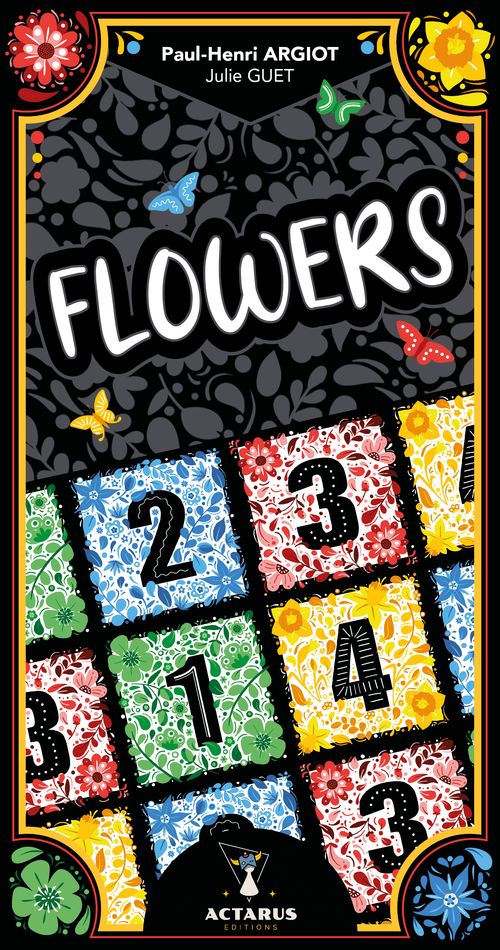
Flowers
Flowers Rulebook
Table of Contents
Table of Contents
Goal of the Game
Place your cards as best as possible in your playing area.
- To avoid losing cards, place them according to their placement restrictions.
- Regroup cards per color to score points.
Be advised! Ignoring placement restrictions will cost you points!
Components
- 1 Rule Leaflet
- 108 Cards, 27 in each color (yellow, red, blue, and green): 3x "1", 6x "2", 8x "3", 10x "4", including 3 cards with a butterfly
- 4 Purple Starting Cards for the Summer Variant
- 1 Scoring Pad
- 2 Template Cards to prepare stacks depending on the number of players:
- 1 player: around 40 cards per stack (2 stacks)
- 2 players: around 25 cards per stack (3 stacks)
- 3 players: around 30 cards per stack (3 stacks)
- 4 players: around 35 cards per stack, use all cards (3 stacks)
Setting Up the Game
Shuffle the cards. Each player receives a card at random and places it face up in front of them in their playing area.
Form three stacks of cards of equivalent size. Use the appropriate templates (see Components).
Flip the first card of two stacks face up. The third stack remains face down.
Determine the starting player in any fashion you like.
The Game Turn
In Flowers, players play clockwise, starting from the first player.
On your turn, draw a card and place it in your playing area.
1. Draw
Draw the top card from any of the three stacks (either one of the two face up cards, or the top card from the face down stack). If you draw from the face up stacks, the next player flips the next top card face up so that there are always two face up cards and one face down card. The face down stack remains face down for the whole game.
2. Place
Place the card that you've drawn in your playing area:
- either next to a card from your playing area (both cards have to share an edge)
- or onto a card of your playing area (covering it).
End of the Game
The game ends when a player draws the last card from a stack. The player can still place this card, but the game ends immediately after. Proceed to final scoring.
Final Scoring
To score points, you need to create fields in your playing area. A field is a group of at least 5 adjacent cards of the same color, regardless of their value. However, you also need to observe placement restrictions based on the values of each card. Each value ("1", "2", "3" or "4") must be part of a group of as many cards as its number, regardless of their color:
Every "4" must be part of a group of exactly four "4". Every "3" must be part of a group of exactly three "3". Every "2" must be part of a group of exactly two "2". Every "1" must be alone (i.e. it must not be adjacent to any other "1"), which means it's part of a group of exactly one "1".
Cards that are not in a valid group by the end of the game will be removed from the game.
You will lose points for every card removed that way.
Proceed as follows, in the order depicted on the scoring pad:
- Remove every card that is not in a valid group and lose 1 point for each card removed that way. Set these cards aside as a tie breaker (see below).
- Score your fields: gain 1 point for each card in a field (at least 5 adjacent cards of the same color).
- Score your butterflies: gain 1 point for each butterfly that is adjacent to its color.
The player with the most points wins. If there is a tie, the player with the fewest removed cards (see 1.) wins. If players are still tied, they share the victory.
1) Removed Cards
Every card that is not in a valid group must be removed. You lose 1 point for each removed card.
2) Victory Points
You score 1 point for each card in a field (group of at least 5 adjacent cards of the same color).
3) Butterflies
You score 1 point for each butterfly adjacent to a card of its color.
Example: +1 point if the yellow "4" with a green butterfly is adjacent to any green card (as in the example above).
IMPORTANT: values do not count as points! You always score 1 point for each card in a field, regardless of its value. Covered cards do not score. However, if you must remove a card because it is not in a valid group, you must also remove any card(s) that it covered, and lose 1 point for each card removed that way.
Final Scoring Example
This red field scores 5 points (1 per card).
This card must be removed because this "3" is alone instead of being in a group of 3 (regardless of their color). The player loses 1 point (1 per card).
These cards must be removed because there are three "2" in this group instead of two. The player loses 3 points (1 per card).
This green field scores 7 points (1 per card).
Summer Variant
Setting Up the Game
Each player receives a starting purple card instead of taking a card at random.
The rest of the rules remain unchanged: on your turn, you may either place a card next to an existing card, or cover an existing card. The only restriction is that you cannot cover your starting purple card.
Final Scoring
A field must have at least 5 cards and be adjacent to the starting purple cards to score points. Otherwise, it does not score.
Solo Mode
Setting Up the Game
There are only two stacks in this version. Take the template card to create two stacks. Flip the top card of one of the two stacks face up.
The Game Turn
1. Draw
Take a card from either stack. If you choose the face up card, replace the card that you've taken with a new card so that there is always one card face up.
2. Place
Place the card in your playing area. Placement rules remain unchanged.
3. Timer
Discard the face up card from the top of the stack and replace it with a new card for your next turn.
End of the Game
The game immediately ends once one of the two stacks is empty.
Results
- 10 points or less: Beginner
- 11 to 17 points: Apprentice
- 18 to 25 points: Expert
- 25 points and more: Master
You can also use the Summer Variant when playing solo!
Designer's Note
Thanks to all friends that took the time to place flowers, and to my two butterflies, Louise and Céline, for our daily games.
© 2023 - Actarus éditions 102 avenue de la Salanque 66000 Perpignan