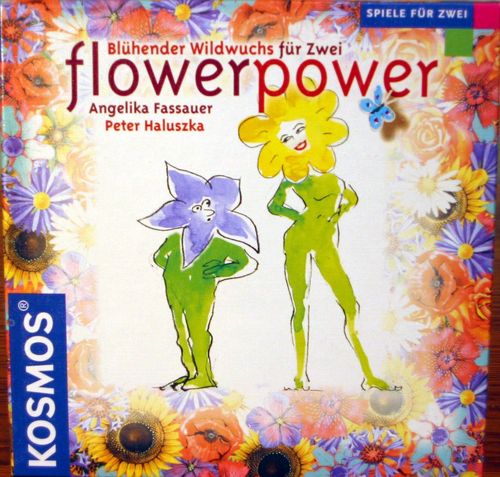
Flowerpower
Flowerpower Rulebook
Table of Contents
Table of Contents
Goal of the Game
The larger you make each connected area of the same variety of flowers, the more points you get. Whoever has the most points at the end of the game wins.
Material
- 100 tiles, each showing 2 flowers
- 1 gameboard
- 2 bloom disks as score markers
- 1 butterfly as a marker
- 1 bag
Set-up
- Before the first game, carefully punch out the tiles, bloom disks, and butterfly.
- The gameboard is placed so that the green strip in the middle divides the board between the two players.
- The 100 tiles are put in the bag.
- Each player chooses a bloom disk and places it in front of himself. The back of the disks show the scoring table.
- The butterfly is set beside the gameboard. It will be used at the end of the game during scoring.
- The player with the most colorful clothing begins. Play then alternates.
Play of the Game
Placing Tiles
The active player draws a tile from the bag and places it on the board. It may not be placed on top of tiles already on the board. It may only be placed in unoccupied spaces.
When placing tiles, the following rules apply (see the illustration below from the perspective of player A):
- Player B: scoring list
- Player A: score track
- The tile may be placed on empty spaces on your own side of the board.
- The tile may be placed on empty spaces in the green area.
- The tile may be placed so that half of it is on an empty space on your side of the board and the other half is on an empty space in the green area.
- The tile may not be placed such that it is partially or completely in your opponent's side of the board.
Flower Beds
Flowers of the same variety that are connected to each other horizontally or vertically are called flower beds. The larger a flower bed is at the end of the game, the more points it scores (see Scoring).
The Green Area
There is a green strip in the middle of the gameboard. This area is neutral, i.e. both players may place tiles there. The following rules apply for scoring tiles in this area:
- A tile in the green area is considered to be part of your flower bed only if it also connects to a flower of the same variety on your side of the board.
This flower bed consists of 8 daisies. Since it extends into Player A's side of the board, these 8 daisies score for him.
- A flower bed that connects to both sides of the board only scores for the player who has the most flowers of that variety connected to that bed on his side of the board.
If the players tie for the number of flowers of that variety connected to that bed on their respective sides of the board, neither score for that bed.
This flower bed consists of 11 sunflowers. Since Player A has four flowers connected to the bed on his side of the board and Player B has only one flower connected on his side, all 11 flowers score for Player A. Note: The two poppy flowers don't score for either player since they are only in the green strip and not connected to any flowers in the players' areas.
Weed Tiles
Three times during the game, each player may place a tile, after he has drawn and looked at it, face-down into his opponent's side of the board (not into any part of the green area, however). This weed tile interferes with the growth of the opponent's flower beds.
End of the Game
Once a player can no longer legally place a tile, the game is over for him. The other player may still continue to draw and place tiles, however, as long as he can legally do so. When both players can no longer legally place tiles, the game ends. The game also ends if all tiles have been drawn and placed.
Scoring
Players now determine how many points they have earned for each flower variety. Scoring starts with the roses. To indicate this, the butterfly is placed next to the rose on the scoring list on the gameboard and the rose is scored.
Both players count the roses in their rose beds and calculate the number of points earned. Players can score multiple times for a flower variety if they have formed more than one bed of that variety. Each player moves his bloom disk the appropriate number of spaces along the score track (starting from the end that shows a rose).
The different sizes of flower beds score points according to the following table:
- Beds with 0-2 flowers of the same variety score 0 points
- Beds with 3-5 flowers of the same variety score 1 point
- Beds with 6-9 flowers of the same variety score 2 points
- Beds with 10 and more flowers of the same variety score 4 points
Once the first variety of flower is scored, move the butterfly to the next variety, score it, and so on.
After all ten varieties of flowers have been scored, the winner is determined. In case of a tie, the player with the largest flower bed wins. If the players are still tied, then the second largest flower bed wins, etc.
The Solitaire Game
In the solitaire game, you play using the entire board, including the green area.
As in the 2-player game, you draw individual tiles from the bag and place them on the board. Once the board is completely covered or there are no more tiles in the bag, the game ends. You score differently than in the 2-player game, however:
To determine your score, you square the number of the flowers in each flower bed for each variety.
For example, if you have a bed with 9 sunflowers and one with 4 sunflowers, you score 81 (9x9) + 16 (4x4) = 97 points for sunflowers. You do this for each of the 10 flower varieties to get your total score. Do you think you can beat that score the next time?