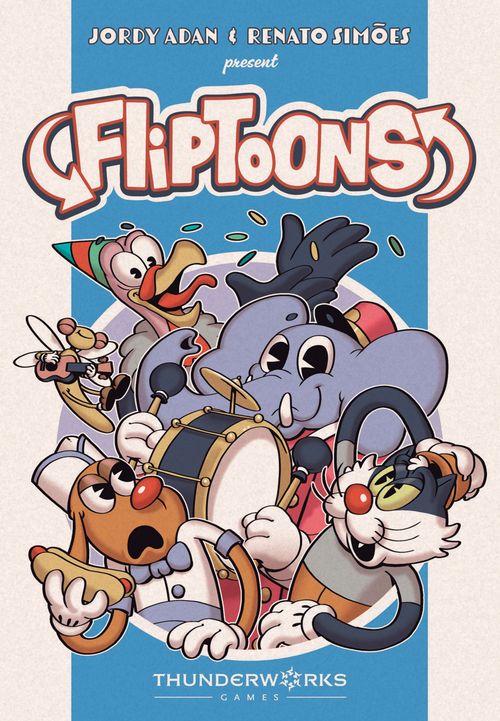
FlipToons
FlipToons Rulebook
Table of Contents
Table of Contents
Objective
In FlipToons, players compete to have the most fame in their grid of toon cards.
Each turn, players shuffle their toon cards, flip them into a grid, and use their fame to hire new toons or dismiss cards in their grid.
Once any player's flip generates 30 fame, all players do a Final Flip, and the player with the most fame wins the game!
Components
- 24 starting cards
- 53 toon cards
- 5 price cards
- 4 reference cards
- 4 fame cards
- 1 critic's choice card
- 1 first player card
Toon Card Anatomy
Each toon card shows: the card's Name, its Rank (top left), the number of copies of that card in the deck (Card Count, top right), the Fame it generates (bottom left), a Special Effect icon (bottom right, if any), and an Ability describing what the card does in words.
Icons
The reference card explains the icons printed on toon cards:
- A "cannot be flipped face-down" icon: this card cannot be flipped face-down.
- A "hired or gained" icon: this card has a special effect that is triggered when hired or gained.
- A "dismissed" icon: this card has a special effect that is triggered when dismissed.
- A combined "hired, gained, or dismissed" icon: this card has a special effect that is triggered when hired, gained, or dismissed.
- A "cannot be dismissed" icon: this card cannot be dismissed using the Dismiss a Toon action or by another card's ability.
Setup
-
Give each player a reference card and a fame card.
-
Give each player a deck of six starting cards: 2 caterpillars, 1 skunk, 1 dragonfly, 1 bee, and 1 snail. Leave space for your dismissed cards.
All starting cards are gray and have a rank of 0.
Return all unused starting cards, reference cards, and fame cards to the game box.
-
Place the five price cards face up in the center of the table, in ascending order from left to right.
-
Shuffle the toon cards and place them face down to create the toon deck.
-
Reveal and place the top five cards from the toon deck to create the market. Sort them by rank, placing one card below each price card, so that the toon card with the lowest rank is below the leftmost price card, and the toon card with the highest rank is below the rightmost price card.
-
Place the critic's choice card face up near the toon deck.
-
Give the player who most recently watched a cartoon the first player card.
The game is ready to begin!
2-player setup example: the diagram shows a player's deck and grid space, the critic's choice card, the five price cards in ascending order, five market toon cards (ranks 3, 4, 7, 10, and 15) sorted beneath them, the player's reference and fame cards, and the first player card — each element numbered to match the setup steps above.
How to Play
FlipToons is played over a series of rounds. Each round is divided into the following four phases: Flip, Check Fame, Market, Cleanup.
1. Flip
All players do this phase simultaneously.
First, each player shuffles their deck face-down. Next, they reveal cards from the top of their deck one at a time and place them in a 3-by-2 grid, from left to right, top row followed by bottom row.
Some toon cards have abilities that activate when placed, before the next card is revealed.
Each player reveals and places cards until all six slots of the player's grid are occupied. Any remaining cards stay in their deck, face down in their play area.
If a player does not have enough cards in their deck to complete their grid, they reveal and place as many as possible.
Some abilities may change the total number of cards played in a player's grid.
Unless otherwise stated, special effects and abilities in a player's grid only affect that player's grid.
If there are multiple card abilities that resolve at the same time, they are resolved left to right, starting with the top row.
2. Check Fame
All players simultaneously review each toon in their grid to determine how much fame they have generated. Each player marks their fame by overlaying their reference card on their fame card so the arrow points to their total.
Once calculated, this amount does not change until spent during the Market phase.
Example: Renato generates 12 fame in his grid.
- Caterpillars: 0 fame.
- Sheep: 5 fame (1 + 4 as it's in the center column).
- Dragonfly: 2 fame (1 per each unique adjacent toon).
- Bee: 1 fame.
- Camel: 4 fame (2+2 as no other player or the market has more camels).
If any player generated at least 30 fame, the player who generated the most fame takes the critic's choice card that will generate an additional 3 fame during the Final Flip. If multiple players generated at least 30 fame and are tied for the most fame, return the critic's choice card to the game box instead. This triggers the end of the game (see Final Flip).
3. Market
Starting with the first player and going clockwise, each player spends their fame to perform up to two actions. There are two types of actions: Hire a Toon or Dismiss a Toon.
A player may perform both actions once, or one action twice. They may also choose to skip one or both of their actions.
Hire a Toon: Take one toon card in the market, spending fame earned in the Check Fame phase equal to the cost on the price card above the card. Add the hired card to the player's deck of unrevealed toon cards.
Dismiss a Toon: Dismiss one toon card in that player's revealed grid for 5 fame. A dismissed card is permanently removed from the player's deck and is not shuffled into the player's deck during the Flip phase. Place the dismissed card face-up next to the player's deck.
Cards in the player's deck or face-down in the player's grid cannot be dismissed.
Players may only dismiss cards in their own grid.
Players may not dismiss a toon if they have fewer than four cards in their deck and grid.
Fame is not recalculated during this phase. Unspent fame is not carried over to the next round.
Refill the Market: Once a player has completed their actions, if there are fewer than five cards in the market, reveal cards from the toon deck until there are five available and rearrange the cards in the market so that they are ordered by rank (lowest to the left and highest to the right).
The next player in clockwise order completes the Market phase. Once all players have completed the Market phase, proceed to the Cleanup phase.
If the toon deck is ever depleted, do not add additional cards to the market. Any remaining cards in the market are arranged under the highest price cards, in order by rank.
If the market is also depleted, complete the round and proceed to the Final Flip.
Market phase example: Renato has 13 fame. For his first action, he hires the goat toon card in the market for seven fame. He places it on top of his deck.
For his second action, Renato dismisses a caterpillar toon card in his grid and moves it from his grid to a pile of dismissed cards in his area. While a card typically costs 5 fame to dismiss, the caterpillar's special effect indicates that it can be dismissed for 3 fame instead. This leaves him with 3 fame remaining, but he has no more actions available.
Renato refills the market by revealing a new card from the toon deck and adds it to the market, rearranging the toon cards by their rank.
4. Cleanup
All players collect the cards in their grid and add them to their deck.
If playing with two players, after refilling the market during the last player's market phase, discard the leftmost and rightmost cards in the market. Refill the market again and rearrange the cards by rank, as needed.
If no player generated at least 30 fame during the Check Fame phase, pass the first player card to the next player in clockwise order and begin a new round.
If any player generated at least 30 fame during the previous Check Fame phase, the end of the game is triggered. Proceed to the Final Flip.
Final Flip
All players complete one last Flip phase and check their fame. If a player has the critic's choice card, they add 3 fame to their total.
The player who generated the most fame on the Final Flip has assembled the best cast of characters and wins the game!
If players are tied for the most fame, the tied players collect all the cards in their grid and deck, shuffle their deck, Flip, and Check Fame again. The tied player who generated the most fame wins. Repeat this procedure until a winner is determined.
FAQ
Skunk (0): Only one player can benefit from the skunk's ability each round. In case of a tie, the skunk has no effect. The skunk's ability can be used to dismiss itself. This ability is mandatory and does not cost an action. If a player benefits from the skunk's ability, they still take up to two actions in the Market phase.
Ostrich (1): If an ostrich is placed as the final card of a player's grid, do not reveal or place another card. The next revealed card is stacked before its ability is resolved. If the next revealed card moves after being stacked on the ostrich, the next revealed card does not stack on the ostrich instead.
Eagle (2): If an eagle is placed as the final card of a player's grid, do not reveal or place another card. Ignore any special effect or ability of the card flipped face down.
Donkey (3): If a donkey is placed in the upper row of a grid, it is not dismissed.
Butterfly (4): The butterfly's ability may only dismiss a face-up caterpillar in the player's grid.
Dog (5): Fame generated by the dog is not affected by changes to the market in the Market phase.
Goat (6): If a monkey creates a new row above the upper row, the goat's ability still activates.
Camel (8): If there is a tie for most camels in the players' grids and/or the market, all tied players' camels generate four fame.
Horse (10): If a player hires a horse, immediately discard any number of cards in the market, reveal an equal number of new cards from the deck, and arrange them by rank. Place the discarded cards face-up next to the toon deck.
Snake (11): If the card on top of the player's deck cannot be dismissed, place it to the right of the snake instead, or return it to the player's deck if the snake is in the final space of the player's grid.
Snake (11) (cont'd.): If the player places a card with a "When Hired" ability due to the snake's ability, resolve it after the Flip phase is complete. If the stacked card is a peacock, add the fame to the player's total and take an additional action in the Market phase. If it is a rabbit or turkey, stack it on the snake. If a player's deck is depleted before revealing the snake, you still stack a card from the deck on the snake, even though no card is dismissed.
Elephant (12): If an elephant is the first card placed in a player's grid, ignore its ability. The elephant flips the last placed card, even if that card has moved to a new position.
Alligator (15): The target of the alligator's ability generates fame in the Check Fame phase which can be spent in the Market phase, even though the target is dismissed at the end of the Market phase. If the target of the alligator's ability is a stack, dismiss any one card in the stack. If dismissed during the market phase, the alligator no longer dismisses a card.
Monkey (17): When a monkey is placed in the upper row of a player's grid, move the card above the upper row, creating an additional row. Place the next revealed card in the space the monkey was originally placed. This additional row is considered part of the player's grid, but does not fill one of the six slots of the player's grid and is not considered the "upper row".
Pig (18): The pig can be placed in any player's deck or back in the toon deck. Shuffle the deck if placed in the toon deck.
Turkey (20): If a turkey is the first card placed in a player's grid, ignore its ability. A turkey is stacked on the last placed card, even if that card has moved to a new position in the grid.
Bear (24): The bear counts all face-up stacked cards as well as itself.
Cow (25): If there is a stack adjacent to a cow, you may copy any one card's fame in the stack.
Keywords
Some toon cards have special effects or abilities with keywords:
- Adjacent: Cards next to each other in a player's grid that share a side (left, right, top, or bottom) are considered adjacent. Cards that are diagonal from one another are not adjacent.
- Dismiss: Remove a card from a player's grid and place it face up in their area. A player may examine any player's dismissed cards at any time.
- Flip: Turn over a card in a player's grid. A face-down card has no name, rank, special effects, or abilities and does not generate fame. A face-down card may be flipped face up again by another card's ability. A face-down card flipped face up again does not activate any of its abilities.
- Stack: Place a card on top of another card in the player's grid so that the special effects and abilities of all cards in the stack are visible. If an ability stacks a card on another card, and there is already a card stacked on the first card, the new card is added to the top of the stack. Stacked cards share a slot in a player's grid, and the names, fame, ranks, special effects, and abilities of all face-up cards in a stack are active.
- Stack Adjacency: Cards within a stack are not adjacent to one another. All cards in a stack are considered adjacent to cards in neighboring spaces in a player's grid.
Solo Play Rules
To win in a solo play game, you must generate 30 fame in a single Check Fame phase before the toon deck runs out.
Solo Setup
-
Use a starting deck containing: 1 dragonfly, 1 bee, 1 snail, and 3 caterpillars (instead of 2 as in the multiplayer game).
The skunk is not used in solo play.
-
Return the pig toon card to the game box.
-
After completing setup, discard 20 cards from the toon deck to a face-up discard pile.
-
The first player card and the critic's choice card are not used in solo play.
Solo: How to Play
During each turn, complete the Flip, Check Fame, Market, and Cleanup phases as in the multiplayer game.
After refilling the market at the end of the Market phase, discard the leftmost and rightmost cards in the market. Refill the market again and rearrange the cards by rank, as needed.
When refilling the market, if there are not enough cards in the toon deck to refill the market, the game is over, and you have lost.
If, at the end of a Check Fame phase, you have generated at least 30 fame, you win the game!
Adjusting Solo Difficulty
To adjust the difficulty of solo play, change the number of cards discarded during setup:
- Slapstick Starter (Easy): 17 cards
- Wacky Workload (Normal): 20 cards
- Maniacal Mayhem (Hard): 23 cards
For additional information or support, please visit us at www.thunderworksgames.com
© 2025 Thunderworks Games LLC. All Rights Reserved. 7182 US Hwy 14 Suite #402, Middleton, WI 53562 USA