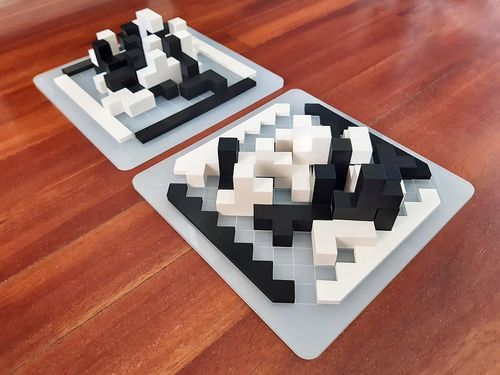
Flink
Flink Rulebook
Table of Contents
Table of Contents
Introduction
FLINK (F + link) is a connection game that uses the 'F' pentomino:
[Diagram: the 'F' pentomino, shown in isometric view.]
Players alternate turns placing one of their pieces according to some simple rules, each trying to connect the two sides of the board of her colour.
Equipment
20 white 'F' pentominoes, 20 black 'F' pentominoes, dual board, carrying case.
How to Play
Each player has an allocated colour (White or Black) and takes all the pieces of her colour.
Players agree on the board type to be used during the game:
[Diagram: the Square board, a blue rectangular play area with black borders. Caption: "Square".]
[Diagram: the Diamond board, an orange diamond-shaped play area with black and white borders. Caption: "Diamond".]
Starting with White, players alternate turns placing one of their pentominoes on the board in any position (even standing vertically) following these placement rules:
a) The piece must align with the square grid. b) It must be completely placed inside the board grid (coloured area). c) It must be fully supported by either the board or pieces below it; i.e. no overhangs are allowed.
[Diagram: example of legal opening by White.]
[Diagram: example of illegal placement by Black (piece not fully supported – see marked space).]
Game End
The game ends when, at the end of her turn, one of the players has connected the two sides of her colour. The path connecting the two sides of the board must be continuous along the surfaces of the same colour; however, the path can travel along the exposed top or any exposed side of a tile. This means that blocking your opponent is harder than you think! (See the example below.)
[Diagram: example of a game won by Black (path indicated in red). Notice how the path goes along the side of one tile.]
If the players run out of pieces and a connection has not been made, it is a draw.
Special Cases
If two pieces touch only at a vertex they are not connected:
[Diagram: neither the two white tiles nor the two black tiles are connected to each other.]
Note that false connections due to misalignments are not valid.
[Diagram: example of invalid connection due to misalignment.]
In the Deluxe Edition, the coloured borders are not flat, but consider them flat (board level) for connection purposes. This is particularly important in the Diamond board.
[Diagram: the Diamond board with the coloured borders. Caption: "The black tile is not connected to the black edge of the board as only the vertex is touching."]
Notes from the Designer
Flink is somehow reminiscent of Stefan Kögl's Caminos (2010), which in turn resembles Cameron Browne's Druid (2004), which was the inspiration for Flink. Flink distills the mechanism to use a single piece shape, and introduces the innovation of the connecting path being traced like an insect walking along the tops and sides of the pieces to get to the other side. Of course, all of these games (and numerous others) owe their existence to the original connection game: Hex (AKA CON-TAC-TIX, Piet Hein, 1942).
I've tested all tetrominoes and pentominoes and I've found out that the 'F' one is the most interesting.