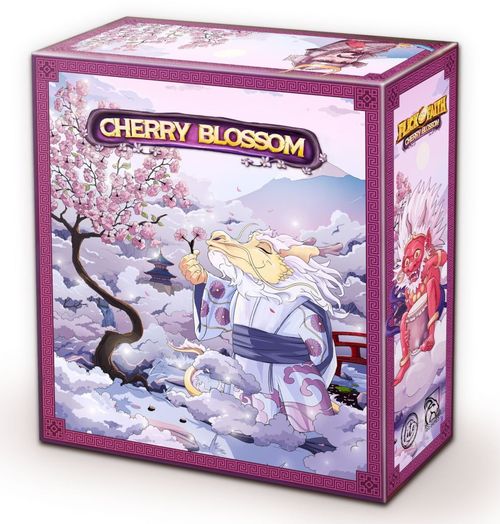
Flick of Faith: Cherry Blossom
Flick of Faith: Cherry Blossom Rulebook
Table of Contents
Table of Contents
Game Components
- 1 double-sided God Ability card
- 20 Law cards
- 7 Prophets (bright, small wooden discs)
- 2 Mystics (bright, small wooden discs)
- 2 Templars (bright, medium wooden discs)
- 4 Temples (bright, giant wooden discs)
- Set of stickers for all wooden discs
- 1 Help card
- 1 Torii (used by some new Laws)
- 2 Chopsticks (used by some new Laws)
- 2 Cherry Blossom tokens
- Other tokens
Cooperative Mode components (used when you play the Cooperative Mode):
- 1 Cooperative sheet
- 20 Challenge cards
- 6 Blessing cards
- 4 Oni tokens
Modules
Flick of Faith: Cherry Blossom expansion contains the 4 following modules, which can be picked separately or mixed with other modules (from the Cataclysm expansion as well):
- Additional Content
- Cooperative Mode
- 5th and 6th Player
- Team vs Team
Additional Content
More Laws are more fun! There are never too many options to choose from, right?
If you want to experience Cherry Blossom to the fullest, you should play only with Law Cards from this expansion. You can also mix these Law Cards with the ones from the base game (and even from the Cataclysm expansion).
Torii
Torii are used mostly by new Law Cards. All Law Cards which use Torii last until the end of the game, with one exception: only one such Law Card may be active at any one time, so when a second Law Card with a Torii enters the game, discard the old one.
Placing Torii
A Torii is placed on the Map in two instances:
- At the start of each Mission Phase, if a Law Card regarding Torii is in play (even if the Torii is already on the Map, it should be removed and placed again).
- After the active player knocks it over.
When the Torii should be placed at the start of each Mission Phase, the player holding the First Player Token places it in the area between the Islands. While placing, the Torii may be rotated in any way chosen by the first player but has to be placed in a way that it touches the Navel Border and does not touch any Island Border.
Other Torii Rules
A Torii can remain on the Sea and is not discarded.
A Torii has two characteristics, described on each Law Card regarding it:
- Blessing – Triggered immediately when the active player flicks their Prophet through the Torii (the whole disc goes fully through the Torii contour).
- Punishment – Triggered when the active player knocks the Torii over. After it is resolved, the player who caused it should place the Torii back, using the 'Placing Torii' rules above (regardless of having the First Player Token).
If you move a Torii while flicking, nothing happens and the Torii stays as it is.
If a Torii is moved off the Map as a result of flicking, follow all the standard steps of resolving a Punishment.
If, as a result of your flick, any other Prophet or Temple goes through the Torii, the Blessing is ignored.
Important! Once a Torii appears in the game, it stays there till the end of the game.
Exception: When playing the Cataclysm module, some effects of Cataclysms can remove the Torii from the Map. If that happens, do not place that Torii back on the Map and discard the corresponding Law Card. However, it can enter the game again with another Law Card.
Japanese Gods
The Japanese gods introduced by this expansion are Raijin & Fujin and Ryujin, printed on the new double-sided God Ability card. You can use the new God Ability Card along with the ones from the base game.
Source note: the rules text printed on the God Ability card illustrations in the source PDF is too low-resolution to transcribe reliably for Raijin & Fujin, so that text is not reproduced here. The Ryujin text below was read from the source image and should be checked against the physical card.
RAIJIN & FUJIN
[Card text not transcribed: illegible in the source PDF. See the printed card.]
RYUJIN
At the beginning of the Mission Phase place the Tide Jewel Token on the chosen slot below.
At the beginning of each Worship Phase resolve the effect of the active Tide Jewel slot.
- Move any 1 Prophet from the Sea to any Island.
- Move any 1 Prophet from any Island to the Sea.
Cooperative Mode
The world fell victim to the Oni invasion. Our brave heroes, blessed by the gods, must face various challenges to get rid of these malicious demons.
The Cooperative Mode is incompatible with any other module (Cataclysm expansion included) and can be played in a group of 2 to 4 players.
In this mode there are no Generations, as well as no Council nor Worship Phases.
Setup
- Give each player the following number of Prophets:
- 2-player game: 10 Prophets + 2 Templars – in 2 chosen colors.
- 3-player game: 7 Prophets + 1 Templar.
- 4-player game: 5 Prophets + 1 Templar.
- Take all 20 Challenge Cards and shuffle them. Then, choose the difficulty level and prepare (randomly) the Challenge Deck for your game:
- EASY – 7 Challenge Cards.
- NORMAL – 10 Challenge Cards.
- CHALLENGING – 15 Challenge Cards.
- HARD – 20 Challenge Cards.
- Each player picks a Blessing Card at random.
- Draw 3 cards from the Challenge Deck and place them face-up next to it.
- Place 3 Oni Tokens on 3 different Islands so that they touch the City Borders.
- Place the remaining 1 Oni Token and all other tokens close to the Map, as they might be needed during the game.
- Choose the first player and begin the game.
Oni Tokens
Oni Tokens represent hostile forces invading the world.
Whenever a player places their Prophet in the Reserve Pool (even when building a Temple), this player places an Oni Token on any Island containing no Oni Tokens, so that it touches the City Border.
If a player must place an Oni Token on the Map, but all 4 Oni Tokens are already there, all players lose the game.
To get rid of the Oni Tokens, they must be pushed out of the Island Borders. Place all the removed tokens next to the Map, as they can enter the game again.
Blessing Cards
Blessing Cards contain unique abilities which may be used by players. During their turn, a player may decide to Exhaust (turn the card face down) their Blessing and resolve its effect. Exhausted Blessings may be Refreshed (turn the card face up again) only after completing some of the Challenge Cards, so use them wisely!
Example Blessing card, "Greek Blessing": EXHAUST THIS CARD: Move any player's Temple to any other Island.
Challenge Cards
Example Challenge card, "Applause" (callouts 1 to 4 are explained below): Land your Prophet on the Navel when there are at least 2 Islands with at least 1 Temple on each.
- Card name.
- Challenge text – this is the condition which must be met in order to complete this Challenge Card.
- Retrieve icon – each of these icons on a Challenge Card allows a player to Retrieve 1 Prophet when that Challenge Card is completed.
- Refresh icon – when a Challenge Card with this icon is completed, 1 player may Refresh their Blessing.
Completing a Challenge Card
When the conditions stated in the Challenge text are met, this Challenge is considered completed; Retrieve Prophets and Refresh Blessing accordingly to the icons on that card. Then, discard this Challenge Card and draw another one in its place (if there are any cards in the Challenge Deck left).
Retrieving a Prophet
When a Challenge Card gets completed and allows you to Retrieve a Prophet, 1 chosen player (any player, no matter who has completed the Challenge) may take 1 of their Prophets from the Map or the Reserve Pool and place it back in their resources.
Turn Order
Player turns are very similar to the Mission Phase in the base game and are as follows:
- Flick your Prophet.
- Building Temples – this is resolved in the same way as in the base game (remember that you need to place an Oni Token when removing a Prophet to the Reserve Pool).
- Navel – all Prophets which touch the Navel are removed from the Map and go back to respective player resources (instead of the Reserve Pool).
- Challenge step – If you have not completed any Challenges, ignore this step. If you have completed any Challenge Cards, resolve all completion effects (Retrieve/Refresh) of claimed Challenges. Then discard the resolved card and draw a new one for each discarded Challenge Card.
- Remove all Prophets that were flicked/pushed off the Map and put them on the Reserve Pool (and place an Oni Token for each one of them).
- Players take back their Temples which are outside an Island Border.
- End your turn.
Win & Lose Conditions
YOU WIN if:
- You complete all the Challenge Cards.
YOU LOSE if:
- You need to add an Oni Token but 4 of them are on the Map.
- A player has no Prophets to flick during their turn.
5th and 6th Player
Adding the 5th and 6th player increases the gameplay time by up to 15 minutes per player and makes Flick of Faith tighter. Much tighter!
All rules not listed below remain the same as in the base game.
5-Player Game
After choosing the first player, the player to the right of the player with the First Player token becomes the Wild Contender.
At the beginning of each Generation (before the Council Phase), the Wild Contender has to choose one Player's Corner. For the rest of this Generation, the Wild Contender has to flick their Prophets from that Player's Corner. The Wild Contender may change their Player's Corner before each Generation.
The Wild Contender always flicks before the player who's holding the First Player Token.
Ignore the Wild Contender when passing the First Player Token during the Worship Phase.
The 5-player game lasts 3 Generations.
6-Player Game
(You need the Cataclysm expansion to play this mode.)
During Setup, each player chooses their Player's Corner. Players may choose any corner of the Map (like in a 4-player game) or any Side of the Map. Each player has to choose a different Player's Corner.
Note that players who chose a side of the Map as their Player's Corner have two Islands closest to their Player's Corner and two Islands closest to the opposite Player's Corner.
Diagram captions: "Side of the Map" and "Corner of the Map".
The 6-player game lasts 3 Generations.
Team vs Team
In the Team vs Team module, players join two divine alliances that compete against each other. This mode can be played with all modules from this and the Cataclysm expansion (except the Cooperative Mode) and can be played by 4 or 6 players (2vs2 or 3vs3).
Changes to the basic rules:
Choosing Player's Corner
- 2vs2 – Players from the same team choose opposite corners.
- 3vs3 – Two players from the same team choose corners on the same side, and the third player uses the Side of the Map (see page 13), which counts as Player's Corner.
Diagram captions: "2vs2" (corners marked 1 for one team and 2 for the other, diagonally opposite) and "3vs3" (Sides of the Map marked with team numbers 2, 1, 2 along the top and 1, 2, 1 along the bottom).
Winning the Game
- After the last Generation, all Victory Points gained by individual players go to the common VP pool of their team. The team with more Victory Points wins the game!
- If at any moment any player meets the condition to win the game due to a Law Card (like The Great Builder), this player's team wins the game!
Important Rules
- Prophets of players allied to you don't count for your Domination, Presence and when you score the Navel.
- When resolving Law Cards or God Abilities, all Prophets of players allied to you count as the opponents' Prophets.
- When you occupy a Side of the Map instead of a Player's Corner, and a Law Card refers to the Island closest to your Player's Corner or to the Island closest to the opposite Player's Corner, treat both Islands closer to your Side of the Map as closest to your Player's Corner, and the other 2 Islands as closest to the opposite Player's Corner.
Team vs Team Domination Score Example
Diagram: one Island with Prophets of several players, and the cards for Zeus, Freja, Anubis and Morrigan.
Domination score example: Zeus (Team 1) and Freja (Team 1) have both 2 Prophets on the same Island. Also, Morrigan (Team 2) has 1 Prophet there. No one has Domination over the Island, so Zeus gains 1 VP, Freya gains 1 VP, and Morrigan also gains 1 VP. In the end, Team 1 has earned 2 VP, and Team 2 has earned 1 VP.
The source prints the god's name as "Freja" on the card and "Freya" in this text; both are as printed.
Glossary Update
- YOUR ISLAND – the Island closest to your Player's Corner.
- OPPOSITE ISLAND – the Island that is diagonally opposite from your Player's Corner.
- RETRIEVE – take a Prophet either from the Map or the Reserve Pool, back to the player's resources.
- PLACE A TEMPLE – take a Temple from your resources and place it on the Map, without removing any of your Prophets.
Keep in mind that 'Place a Temple' is different from 'Build a Temple'!