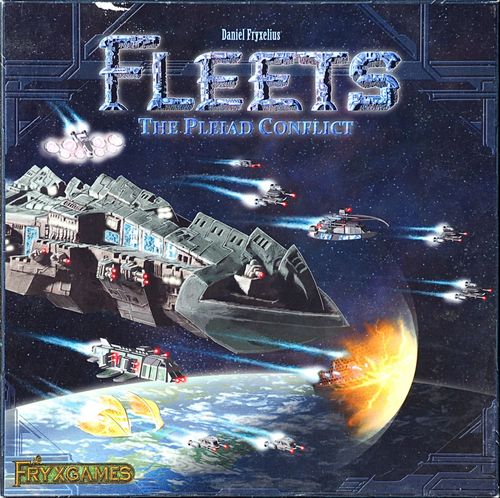
Fleets: The Pleiad Conflict
Fleets: The Pleiad Conflict Rulebook
Table of Contents
Table of Contents
Goal of the Game
In Fleets - The Pleiad Conflict each player controls a corporation. Each system that is controlled by only one corporation at the end of a round gives 1 Victory Point (VP) to that player. The game ends when any player has 7 (or more) VPs. Then the player with the most VPs wins the game (ties are won by diplomacy points, or total value of possessions if still equal).
Game variants: For beginners we recommend playing a shorter game to 5 VPs, where the players start without action cards. For 2 players we always recommend playing to 5 VPs, and switching player order each round instead of randomizing.
Game Components
- 74 Escort Ships of 8 different types to customize your fleets. Each type has its own cost, size and strength (cost, attack strength, special effect, health).
- 20 Fleet Boards, each with a Flagship with its own Attack strength and Health. The Fleet Boards also have spaces for Upgrade Cards and Escort Ships, as well as an Energy Track for use in battle actions. The Initiative Number shows attack order from 1 to 4. The Flagship (and its initiative number) has damage markers placed on it if the ship is damaged. The Reactor supplies energy; the Energy Track has a starting point.
- 28 Upgrade Cards that can be bought at a separate market and have various costs and functions. Each has a space for an Upgrade Card on the fleet board.
- 20 Dice for use in battles.
- 60 Markers to indicate diplomacy points, megacredits, VPs, energy and damage.
- 4 Player Boards to keep track of players' money (MCs), Diplomacy Points (DPs) and Victory Points (VPs).
- 58 Action Cards for use in diplomacy and in battle (energy cost, diplomacy cost, effects).
- 1 Rule Book.
- 10 System Tiles for randomly selecting planets or asteroids (diplomacy effect, rewards, space for fleet markers; each player has his "own" corner).
- 4 Player Order Cards to randomize a new player order each round.
- 2 Rule Sheets with game summary and ship overview.
Setup
-
Game board: Randomly select as many system tiles as the number of players plus one, for example 5 tiles for 4 players. Place them in the middle of the table. Put the unused system tiles back into the box.
-
Action cards: Shuffle the action cards and put them in a pile face down. Action cards are either diplomacy action cards (green), to be played in the diplomacy phase, or battle action cards (purple), to be played in the battle phase.
-
Markets: Shuffle the fleet boards and upgrade cards (yellow) and place them face down in 2 separate piles. Turn up the top 3 fleets and the top 3 upgrades and place them in 2 rows. These are now the Market and the items can be bought by the players in the build phase. The Market always consists of 3 fleets and 3 upgrades. When someone buys a fleet or an upgrade, it is immediately replaced with the top card from the corresponding pile. A fleet or an upgrade that is destroyed in combat is placed at the bottom of the corresponding pile, and may thus be available again in the market later on (see Phase 5 - Battle).
-
Nice piles of stuff: Sort out markers, escort ships, fleet markers, player order cards, and dice into separate piles and make them easily accessible for all players.
-
Player Boards: Each player gets a player board, representing a corporation, and 2 markers. Each player starts with 26 megacredits, 5 diplomacy points and 1 action card.
The Corporations
In the Pleiades, there are 4 major corporations that players can choose to control. These have been the main actors in the colonization of the Pleiades and are now both wealthy and strong, controlling their own battle fleets. The rivalry between these giants has now escalated into open warfare...
- PhoboLog: The first corporation to reach the Pleiades, PhoboLog got a head start and is now in a position to challenge even the strongest competitors. PhoboLog specializes in ship building and space technology.
- The ThorGate Alliance: Energy giant ThorGate arrived in the Pleiades, forging a strong alliance with lesser factions, making them one of the top contenders for power in the Pleiades. Many planets and corporations are dependent on ThorGate energy technology.
- Teractor-Olympiac: A conglomerate of several martian and earth-based corporations after the terraforming of Mars, Teractor-Olympiac are great colonizers and terraformers, as well as being one of the strongest corporations in history.
- Poseidon: Weapon technology and money is a powerful combination. Poseidon is poised to strike and claim whatever they can in the Pleiades. Several planets have already surrendered to their rule.
Round Overview
Each round consists of six phases where the players will be able to build fleets, deploy their fleets, use diplomacy, then battle, and finally collect VPs and other rewards. Finally all players withdraw their fleets and start a new round.
- Player order
- Building
- Deployment
- Diplomacy
- Battle
- Rewards
Phase 1: Player Order
Each round will have a new, randomized player order. Shuffle the player order cards and hand them out. This determines the player order during the different phases, always starting with player number 1, then number 2, and so on.
There are different advantages to being early or late in the player order. For example, during battle it's good to be early, because your ships may act first in each initiative stage. On the other hand, during deployment it's an advantage to see where your opponents place their fleets before you have to place your own.
Phase 2: Building
During the building phase the corporations construct, buy, and organize their fleets. The players first take turns buying fleets and upgrades, and then equip their fleets simultaneously:
1) Buy fleets and upgrades
The players take turns (following the player order) buying 1 item at a time from the market. For fleets, pay the cost (in the yellow box) for the fleet, then take it from the market along with the corresponding fleet marker. Place a marker on the starting point (at 4 energy) of the energy track. For upgrade cards, pay the cost (in the yellow box) for the upgrade and place it beside your player board. Fleets and upgrades are immediately replaced with new ones in the market. (Note: A player may not own more fleets than there are systems in the game.)
The players continue to either buy from the market, or pass, until all players have passed consecutively.
2) Equip fleets
All players may then equip their fleets simultaneously (secretly if they wish). Each fleet has a flagship but also spaces where you can place escort ships and upgrades. Different escort ships have different sizes and must also be placed facing to the right (same as the flagship). This means, for example, that a cruiser (that takes up 2 spaces horizontally) cannot fit in a single space, or in a double space that is vertical, but it may fit into a horizontal double space, or take up 2 spaces in a 4-space box (the 2 remaining spaces may be filled with other ships). Buy as many ships as you like by paying their cost (see the yellow boxes on the rule sheets) and put them on empty spaces on your fleet boards.
Upgrades and escort ships may be placed and rearranged within a fleet during the building phase, but they may never be moved to other fleets. Once they are built they belong to that fleet. You may also discard ships and upgrades from a fleet, if you like, but you get no money back.
When all players are finished building, move on to the deployment phase.
Tip: It's often a good idea to have defensive escort ships, such as interceptors and shield ships, or your enemies may fire directly on your flagship to destroy it!
Phase 3: Deployment
During the deployment phase, all players take turns placing their fleet markers on the systems they want to control this round. Each fleet that you own must be placed on a system tile, and you may only place 1 fleet in each system, so you have to spread out your fleets.
The first player chooses a system tile and places one of his fleet markers on it. Then player 2 places one of his fleet markers in a system, and so on. All players take turns deploying 1 fleet at a time until all fleets are deployed. Remember to place your fleets in your "own" corners on the system tiles, so that it's easy to see which fleet belongs to which player.
If 2 or more fleets are deployed on the same system tile, there will be a battle between them. But before that happens, the diplomacy phase may change the situation...
Phase 4: Diplomacy
The players take turns doing 1 diplomatic action at a time. You may choose from the following actions:
- If you have a fleet on a system, you may use that system's special diplomacy effect (only once per player and round).
- If any of your fleets have a diplomacy effect, you may use it. (Only once per fleet. Only a few fleets have diplomacy effects. Look for the green diplomacy icon.)
- Play a diplomacy action card (and pay the DPs indicated by the green icon).
- Pay 2 DPs to withdraw one of your own fleets (back to your hand).
- Pay 6 DPs to force an opponent's fleet to withdraw from a system (back to his hand). You must have a fleet of your own in that system to force your opponent to leave.
- Pay 2 DPs to tax a system where you have a fleet. Gain the rewards for that system. Each system may only be taxed once per diplomacy phase (use markers). A taxed system still gives rewards during the rewards phase.
- You may pass and let the next player continue. On your next turn you may jump in again with an action if you like.
When all players have passed consecutively, the diplomacy phase ends.
Phase 5: Battle
If there is more than one fleet in a system, the fleets will engage in battle. In a battle, each player decides which enemy ships he wants to attack. Each ship must fire, but may only attack once per battle. If there are more than two fleets in that system, you must decide if you want to focus on one opponent, or divide your forces between different opposing fleets. You may also choose between attacking the escort ships, going for the flagship, or both. If the flagship of a fleet is destroyed, the fleet is lost and immediately taken out of the game. (See 'Attack')
You may not attack your own ships, or choose not to attack with your ships; every ship must attack an enemy.
If there are battles in more than one system in the same round, the first player in the player order decides in which order to resolve the battles.
Fleets not in battle: Fleets that have been withdrawn, or that have no opposition in their systems, are not involved in battles, but you may use any ship effects or flagship effects that do not affect enemy fleets (such as collecting energy or money, or healing damage). Do this before resolving the battles (See Ship Effects). You may not play battle action cards.
Initiative
The battles are divided into initiative stages. Initiative value for each ship is marked with large green numbers from 1-4 on the fleet board. These numbers indicate when the ships will act during the battle. The players perform their initiative stages one at a time, according to the player order.
There are 4 initiative stages:
Stage 1: The first player attacks with all his ships marked with initiative 1. The first player may also play battle action cards and use ship effects before or after firing his ships. Destroyed ships are removed immediately. When the first player is finished, the next player starts his initiative 1. When all players have performed their initiative 1, the battle moves on to stage 2. (Note: It's unusual for ships to have initiative 1. Instead, this stage is mostly an opportunity for the players to use battle action cards before the real fighting begins.)
Stage 2: The first player attacks with his ships with initiative 2. He may also play more battle action cards, and use ship effects, if he likes. When he is done, the next player starts his initiative 2, and so on...
Stage 3: And so on...
Stage 4: And so on...
After stage 4, the battle is over. To summarize, when two players have ships with the same initiative, the player order decides who fires first. Destroyed ships are removed immediately and may not return fire or use effects.
Some battle action cards or upgrade cards may alter the initiative values temporarily, but initiative may never be lower than 1 or higher than 4.
Battle Action Cards: When a player performs his initiative he may also play battle action cards (the engaged fleet pays the energy cost in the purple icon). Even if a player has no ships in that initiative stage, he may still play cards. A player may use his cards and ships in any order he likes, but when the next player has begun his initiative (playing cards, attacking, or using ship effects) it's too late for the first player to play more cards. Only cards marked "reaction" may be played during an opponent's initiative.
Attack
When a player attacks with a ship he first chooses a target and then rolls as many dice as the ship's attack strength. It is important to clearly state which ship attacks and which ship it targets, and to give the opponent a chance to react with cards or interceptors before dice are rolled. Each die showing 4 or more represents 1 hit, and damage is marked on the ship with red markers. (Note that some effects in the game may alter the die values temporarily.)
Example: A player points at his cruiser and says: "This cruiser attacks that battleship", and points at an opponent's battleship. His cruiser has attack strength 4, so he rolls 4 dice. The dice show numbers 1, 2, 5, and 5, which counts as 2 misses and 2 hits. The opponent puts 2 damage markers on his battleship.
If a ship gets damages equal to or more than its health, it is destroyed and immediately removed from the game. If a fleet's flagship is destroyed, then the whole fleet is immediately defeated and removed from the battle. In that case the fleet board and upgrade cards are turned face down and placed at the bottom of the market piles. Escort ships that are not damaged return to the player and may later be placed in other fleets during a building phase. Damaged ships are discarded.
Ship Effects
These effects are summarized in the rule sheets. Special effects may only be used 1 time per ship and battle (including special effects on flagships).
Fighter: Attack 1 - Health 1 (Cost 1). Special effect: After rolling the die, you may choose to pay one energy from the fleet to add 1 damage to the attack. Example: A fighter attacks another fighter but misses. The attacker pays 1 energy to give his opponent's fighter 1 damage, to take it out anyway. Or: A fighter attacks an interceptor and the player rolls a hit. The interceptor has health 2, but by paying 1 energy the attacker will give it the extra damage that will destroy it.
Interceptor: Attack 0 - Health 2 (Cost 1). Special effect: Reaction - You may pay 2 energy and sacrifice your interceptor to stop an attack. If the attack involves dice, you must decide before the dice are rolled. Example: The opponent's battleship is attacking your flagship with 6 dice. You decide to stop the attack by paying 2 energy and discarding your interceptor instead. If the dice are already rolled, it's too late to use the interceptor.
Cruiser: Attack 4 - Health 4 (Cost 3). No special effect.
Shield Escort: Attack 2 - Health 3 (Cost 3). Special effect: Reaction - You may pay 1 energy to stop 2 damages to 1 ship in your fleet. This effect is used after the dice are rolled (if dice were used), when you know how many hits your opponent got. Shield Escorts may also shield themselves with this effect. Example: An opponent attacks your flagship and gets 7 hits on their dice. You pay 1 energy to take away 2 damages, so your flagship "only" gets 5 damages instead, and survives. Or: A fighter attacks your shield escort and gets 2 hits (using his special effect). Instead of taking the damages, you decide to pay 1 energy to prevent it.
Generator: Attack 2 - Health 3 (Cost 3). Special effect: When the generator attacks, your fleet gets 2 extra energy. Note: Generators generate energy each round, even if the fleet is not involved in battle.
Mechanics: Attack 2 - Health 3 (Cost 3). Special effect: At the start of a battle, remove 2 damages from any ships in this fleet. Note: The mechanics may remove damages each round, even if the fleet is not involved in battle.
Battleship: Attack 6 - Health 5 (Cost 5). Special effect: Besides its attack, you may pay 3 energy to shoot 2 missiles at 2 different targets. The missiles count as 2 separate attacks. Each target gets 2 damages. Missiles may be launched before or after the normal attack but in the same initiative stage. Example: You want to attack a flagship with your battleship. You start by firing 2 missiles to take out the 2 interceptors. One of the interceptors is blown apart but the other interceptor is saved by an enemy shield escort. Rats! you think. Then you try to attack the flagship with 6 dice, but your opponent throws away his interceptor to stop the attack before you roll the dice. I'll get him next time, you think.
Refinery: Attack 3 - Health 5 (Cost 5). Special effect: When it attacks, you may pay 4 energy to get 4 MCs. Note: You can use the refinery effect each round, even if the fleet is not involved in battle.
About energy: It's important to have energy in a fleet to be able to use the ship effects and play battle action cards. Without energy enough to use your interceptors, for example, your flagship is an open target. Moving energy between fleets (except by using certain battle action cards) is not allowed, and you may only use the energy of the fleet that is involved in the battle.
Phase 6: Rewards
The last phase of the round consists of collecting VPs, rewards, and new resources for the players before the next round begins:
-
Go through the systems one at a time. If a player is alone in a system he gets 1 VP (puts a marker on his player board). Then all fleets in the system receive the rewards for that system. It might be energy, action cards, megacredits or diplomacy points (See the icons on the system tile). Energy rewards are only given to the fleet you have there. Rewards are collected even if there are 2 or more fleets on the system tile. After the fleets have received their rewards, they are withdrawn to the players' hands. Then move on to the next system for VPs and rewards.
-
Besides the planets' rewards, all players get 6 MCs, 2 DPs and 1 action card. Each player may also discard 1 card to draw 1 additional card, if they like. Each fleet gets energy equivalent to their reactor value.
-
If any player now has at least 7 VPs, the game ends. If not, a new round begins. Ties are won by having the most DPs. If still equal, the highest total value of fleets, escort ships and upgrades determines the winner.
Turn Order Summary
- Player Order Phase. Randomize new player order (for a 2-player game, just switch the player order cards.)
- Building Phase. Take turns buying fleets and upgrades. Then equip your fleets simultaneously.
- Deployment Phase. Take turns deploying 1 fleet at a time.
- Diplomacy Phase. Players take turns performing diplomatic actions and play diplomacy action cards.
- Battle Phase. If two or more fleets are located in the same system, there is a battle.
- Rewards Phase. Follow these steps:
- Go through each system. If a player is alone in a system, award him/her 1 VP. All present fleets gain the rewards of the system.
- Each fleet gains energy according to its reactor value.
- Each player gains 6 MCs, 2 DPs, and 1 card.
- Each player may discard 1 card to draw 1 card.
Corporation Special Effects (CLRules sheet)
The official companion sheet "CLRules" (Corporation Special Effects, Pirates and Merchants, Operation Bases, Unique Escort Ships) is transcribed in full in the companion file fleets-the-pleiad-conflict-clrules.md.