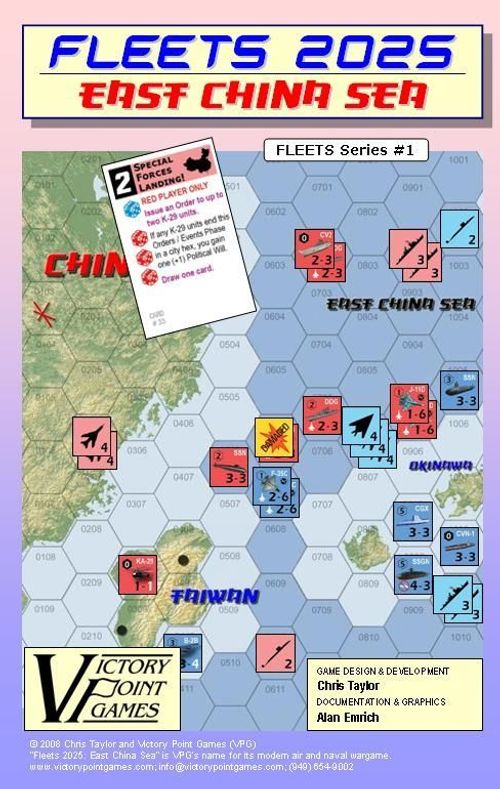
Fleets 2025: East China Sea
Fleets 2025: East China Sea Rulebook
Table of Contents
Table of Contents
[0.0] Using These Rules
New gaming terms, when they are initially defined, appear in dark red lettering for quick referencing. The instructions for this game are organized into major "Rules" sections as shown in large green CAPS font, and represented by the number to the left of the decimal point (e.g., rule 4.0 is the fourth rule). These rules generally explain the game's components, play procedures, the game's core systems and mechanics, how to set it up, and how to win.
With each Rule, there can be "Cases" that further explain a rule's general concept or basic procedure. Cases might also restrict the application of a rule by denoting exceptions to it. Cases (and Subcases) are an extension of a Rule shown in the way that they are numbered. For example, Rule 4.1 is the first Case of the fourth Rule; and Rule 4.1.2 is the second Subcase of the first Case of the fourth Rule.
Important information is in red text. Examples are in blue text and this font. Text in shaded boxes, like this, provides the voice of the game's designer, who is addressing you to explain an idea or concept that is not, itself, a Rule or a Case.
Battle Dice Not Included: Players are asked to provide their own 6-sided dice. A half dozen or so would be a good quantity.
Editorial note on die faces: the source prints die results as the symbols ! @ # $ % ^ (and die-face pictures in Rule 9.0). The Gameplay Example's own text fixes them as 1 through 6 in that order (! = 1, @ = 2, # = 3, $ = 4, % = 5, ^ = 6), and the rules use "$, %, or ^" for a Hit and "% or ^" for a Save, which matches that reading.
Captain Level Rules
[1.0] Introduction
FLEETS 2025: East China Sea is a low-complexity, high-strategy card driven wargame for two players simulating a hypothetical conflict in 2025 between powerful naval forces. The United States Navy (USN) player (i.e., the Blue side) has individually superior forces, while the People's Liberation Army Navy (PLAN) player (i.e., the Red side) has the advantage of numbers and easier access to reinforcements. Both military forces are limited by the 'Will' of their political masters. Too many casualties or too much unrest at home will cause a fleet to abandon its military goals and retreat.
[1.1] Game Scale: Each turn represents about 10-12 hours. Each hex is approximately 200km across. Ship units represent 1-2 ships plus support vessels. Submarine units represent individual subs. Aircraft units represent 1 to 3 squadrons of 8-12 planes each.
[1.2] General Object of Play: You defeat your opponent by increasing his casualties and reducing his Political Will (i.e., 'Will'; see 13.0) until they are at the same level. Casualties are inflicted by overcoming the defenses of your enemy's units in battle. You must employ your limited resources each turn, both units and actions, to overwhelm your opponent's defenses.
[2.0] Components
The Game Map: The 11" x 17" game map depicts the East China Sea area, including Taiwan and the southern islands of Japan. Land hexes are those that are clearly and predominantly filled by land terrain features; Shallow Water hexes are light blue and Deep Water hexes are dark blue.
The Player Aid Sheets: Each player receives one 8.5" x 5.5" Player Aid Sheet. It includes a Sequence of Play reminder, plus that player's Reinforcement Groups, Carrier Hangars, and his Political Will track.
The Playing Pieces: The Ships, Subs, and Aircraft that players maneuver around the map are collectively called "Units." Each unit counter has a designation, picture and the values of that unit. The reverse side of the unit is its Stealth marker side.
Information Markers: Markers are included for keeping track of damaged units, nuclear strikes, each player's current Political Will, and each player's respective card hand sizes.
Dummy Units: The reverse side of each Damaged marker is a Stealth marker. When placed on the map, Damaged markers on their Stealth marker side are called "Dummy units." Dummy units move and stack (see 11.2) as other unit of their indicated type do, but cannot attack and are removed from the map when revealed.
Unit Counter Values:
- Attack Range: Distance in hexes that unit can attack an enemy unit, with '1' being an adjacent hex. Units with a '0' range cannot attack.
- Battle Dice: The number of dice that unit throws in battle (more is better).
- Movement Allowance: The maximum number of hexes that unit can move when allowed. Air units with a cloud-white Movement Allowance never need to 'land.' Other Air units have an asphalt-black airbase icon on them, indicating that they do need to land at the end of each turn.
- Battle / Search Dice value (Blue = USN; Red = PLAN).
- Special Combat: Certain bonuses and restrictions are indicated with these icons as per Rule 9.0, Combat.
Unit Types: The unit abbreviations are listed below:
- B: Bomber
- G: Guided Missile
- C: Cruiser
- F: Fighter
- N: Nuclear powered
- UCAV: Unmanned Combat Aerial Vehicle
- X: Next-Generation (i.e., 'Advanced')
- CV: Aircraft Carrier
- DD: Destroyer
- SS: Submarine
For Example: An SSGN is a nuclear powered guided missile submarine.
Activity cards: The Activity cards represent various events and the command ability of each fleet. Each Activity card shows its Orders value, Event Title and Text, plus its Battle / Search Dice value. The Events (only) on some Activity cards are restricted to one player, as indicated. Both players can always use the Orders and Battle / Search Dice values of these restricted Activity cards.
Terminology: Activity cards played as Events are called "Event cards;" those played for Orders are called "Orders cards;" those used for Searches are called "Search cards" and those played in battle are called "Battle cards."
Hand Size: Players are limited to a Maximum Hand Size according to the scenario played.
Event Text: Event text always supersedes Rules text. Whenever there is a conflict, use a card's Event text.
Discarding (important): Players cannot voluntarily 'discard' cards from their hands.
[3.0] Setup
Place the map in the center of the table. Select a scenario and choose sides, giving each player his respective pieces and Player Aid Sheets. Place the dice and Nuclear Blast markers near both players. Each player takes his Will and Card Hand Size markers and places them on the numbered space on his Player Aid Sheet as indicated in the scenario setup instructions.
Next, in the order listed by the scenario, they each place their listed forces, including Dummy units, on the map face-down (i.e., in Stealth Mode) in the indicated hexes and conforming to the Stacking Limit (see 11.2), or on a Reinforcement Box on his Player Aid Sheet. Each player then returns his unused Dummy units, face-up, as Damaged markers to a spot near both players. The reverse side of these Damaged markers should remain hidden until and unless another Dummy unit is placed on the map.
Important: All Aircraft Carriers set up with their full complement of aircraft (each in Stealth mode), as indicated on that player's Player Aid Sheet.
Finally, shuffle the Activity cards and deal to each player the number listed in the scenario. Place the remainder face-down within easy reach to form the Draw Pile.
[4.0] Sequence of Play
Each turn is composed of a number of Phases that must be completed in an exact sequence (called the game's "Sequence of Play"). If the game does not end at the Victory Point (see 11.3), players refresh their hands and begin the next turn with the Reinforcement Phase.
- Reinforcements Phase (Red first)
- Movement Phase (Red first)
- Action Phase (Blue conducts all Steps first; then Red conducts all Steps)
- a. Searches
- b. Conduct Event
- c. Move first Ordered unit(s)
- d. Attack with first Ordered unit(s)
- e. Repeat Steps 'c' and 'd' with second, third, etc., Ordered unit(s) as needed
- Air Unit Movement Phase (Red first)
- Housekeeping Phase
- a. Air unit basing (Red first)
- b. Check 3-2-1 stacking (Red first)
- c. The Victory Point (Blue first)
- d. Refresh hand (Red first)
When conducting a Phase or Step, players alternate as the "Acting Player" in the order listed (e.g., "Red first").
[5.0] Reinforcements
If available (see Special Scenario Rules), players can add one Reinforcement Group per turn to the map. Reinforcement groups are designated by letter and placed on its owner's Player Aid Sheet as per the scenario setup instructions. They remain there unless voluntarily brought into play by their owner.
Procedure: To place a Reinforcement Group on the map, its owner must permanently reduce his Maximum Hand Size by one. Move his Card Hand Size marker down one row on the track. That player must then discard a card (of his choice) to conform to his new card hand size. Finally, that player places the units in that Reinforcement Group on the map, in Stealth mode (see 12.0, Stealth), according to the Special Scenario Rule.
[6.0] Aircraft Carriers
Aircraft Carriers are special units with some special capabilities.
[6.1] Aircraft Carrier Setup: The specific types of aircraft indicated on the Carrier Display are used only for Setup. They are setup on their Stealth side.
[6.2] Aircraft Carrier Capacity: The number of spaces on that Carriers' Player Aid Sheet display indicates the maximum number of aircraft units that it may Support. Important: Once play commences, only the quantity of Air units on a Carrier matters, not their specific type.
[6.3] Carrier Hangars: Aircraft on a Carrier's Player Aid Sheet are said to be "in its hangars."
- [6.3.1] & Stacking: Air units in a Carrier's hangars do not count toward the stacking limit for that hex.
- [6.3.2] & Combat: Air units in a Carrier's hangars cannot take part in combat in that hex. They are also destroyed if that Carrier is destroyed.
- [6.3.3] & Support: Aircraft units in a Carrier's hangars are supported by that Carrier during the Air Unit Basing Step of the Housekeeping Phase.
[6.4] Aircraft Launch and Recovery: Aircraft units may launch (i.e., be placed on the map in that Carrier's hex) or land (i.e., be removed from that Carrier's hex on the map) at any point during that player's movement.
For Example: Your Carrier can move three hexes, then launch aircraft from its hangar that move a further four hexes. In effect, those aircraft have traveled seven hexes this turn.
Since Aircraft Carrier units have a '0' Range and thus cannot themselves attack, their Carrier-based Aircraft units form their offensive capability. Defensive air cover is abstractly represented by the Battle Dice of the Carrier unit itself when it is attacked.
[7.0] Movement
Players have an opportunity to move none, some or all of their units before issuing Orders or conducting an Event. A player must complete each unit's movement before moving another unit.
Each unit has a Movement Allowance printed on it which represents the basic number of hexes it may move when given the opportunity. Each player moves only his own units during his portion of the Movement Phase. No enemy movement is allowed when you are moving units.
Procedure: Units move one at a time, hex by hex, in any direction or combination of directions that the player desires. A unit may continue moving until it has either spent its Movement Allowance, moved next to an enemy unit, or the player desires to stop moving it.
Cases
- [7.1] Integrity: A unit can only move once per phase and any unused Movement Points from its Movement Allowance are lost. Movement Points are not 'saved' between phases or turns, nor can they be transferred to other units.
- [7.2] No Mandate: Units are never forced to move when afforded a chance to do so.
- [7.3] Restrictions: The following movement restrictions apply:
- [7.3.1] Land: Submarines and Ships cannot enter land hexes, but Aircraft may freely do so.
- [7.3.2] Proximity: Units must immediately stop when they enter a hex adjacent to an enemy unit no matter how many Movement Points they have remaining. No unit can enter a hex containing an enemy unit. Exception: Submarine and Aircraft units do not need to stop and can enter and remain in a hex with enemy units of the other type (i.e., friendly Aircraft can ignore the proximity of enemy Subs and friendly Subs can ignore the proximity of enemy Aircraft).
- [7.3.3] Exit Strategy: Units cannot leave the map unless allowed to by a Special Scenario Rule.
- [7.4] Stacking: A unit may enter a hex containing other friendly units. It may continue to move through that hex, or stop in it. However, there is a Stacking Limit that must be adhered to during Step 5b (see 11.2: essentially 3 aircraft, 2 ships and 1 submarine).
- [7.5] Multiple Moves per Turn: Each unit can only move once per opportunity, but there can be more than one opportunity per turn to move.
- All units can move in the Movement Phase.
- Ordered units can move again in the Orders / Events Phase.
[8.0] The Action Phase
Each player has the opportunity to search, trigger an Event, and / or activate groups of their units to move (again) and conduct battles by playing an Activity card.
Procedure: The Acting Player first performs any and all desired Searches, playing one card for each Search Attempt.
After all of his desired Searches are conducted, he must select (play) one card of his choice from his hand (if he has one; if not skip the remainder of his Action phase) and place it face-up on the table. He must announce whether he is using it for its Event or to issue Orders with it. He may do one or the other with that card, but not both.
Once used, cards are placed face-up in a Discard Pile next to the Draw Pile.
[8.1] Searching:
Procedure: The Acting Player may designate a hex containing enemy Stealth units and must play one Activity card from his hand to conduct a Search there. He then rolls a number of Search Dice equal to the number of dice in his color on that card and uses the lowest number rolled among them as his Search Value.
If the Search Value is less than (<) the Movement Allowance of any enemy Stealth markers in the target hex, those Stealth markers that are less than (and only those Stealth markers) are immediately revealed. Otherwise, there is no effect.
For example, there are enemy Sub, Ship, and Aircraft Stealth markers in a hex. You designate a Search there, play a card with two Search Dice of your own color, and roll them for a % and a @. The 2 becomes your Search Value and is compared to the Stealth markers. It is lower than the enemy Aircraft units' Movement Allowance of '4' and the Ships' Movement Allowance of '3,' so those Stealth markers are revealed by that search. The enemy Sub Stealth marker, however, remains unrevealed by that Search.
A player may conduct multiple searches during this Step, and even Search the same target hex multiple times in a single turn. He may continue to conduct Searches as long as his cards (and patience) hold out.
[8.2] Events: Perform the card's text.
- Some Events allow for Orders to be issued as well (see below). The text is very exact about how that applies (often to a specific number or type of units; if a player does not have that specific type of unit available, the Order is wasted).
- Note: some Events are restricted to use by only one side.
[8.3] Orders:
General Rule: When an Activity card is played to issue Orders (i.e., as an "Orders card"), that player may issue a number of Orders up to the card's Order value (and, like Movement Points, they need not all be used nor can they be saved). Each Order's actions (i.e., the movement and then attack by the unit(s)) must be completed before the next Order is issued.
Procedure: An "Order" can be used to activate a single unit or all units of the same type in the same hex.
For Example: A fully-stacked hex has 3 Air, 2 Ship, and 1 Sub unit in it. With a single Order, either all 3 Air, both Ships – OR – the lone Sub could be activated.
Effects of Activation via Orders: Ordered units can move (first), if desired, and attack (after completion of their Orders Movement), if desired. After the Ordered unit(s) have done their desired movement and / or combat, then the next Order is issued and any movement and / or combat that it engenders is conducted, then the next Order's activity is completed, and so on until the player has conducted up to the number of Orders he has available for that turn.
- [8.3.1] Integrity: If a single Order is used to activate multiple units, they must all move to the same destination hex and / or attack the same target hex.
- [8.3.2] One Activation per Unit per Turn: A unit can only be issued one Order per turn. You cannot issue an order to one type of unit (Air, Ship, or Sub) in a hex and then issue an additional order to another unit of that same type in the same hex on the same turn. You can issue an order to a different type of unit in that same hex on the same turn.
For Example: That same fully-stacked hex would require three Orders to activate all three of the different unit types in it, if desired. If you issued an Order to just one Ship unit in that hex, you could not issue an Order to the other Ship unit in that hex on that same turn.
[9.0] Combat
Only units that have been activated by an Order may attack. If they do so, an attack (or "Battle") must include all of the ordered units wishing to attack the designated target hex. Note that a target hex may be attacked multiples times in a single turn, i.e., once per Order activation.
When attacked, all of the Revealed (only) enemy units in the target hex must be within each attacking unit's range.
Important: the attacker targets a hex with Revealed enemy units in it, not the individual units themselves inside the target hex.
Note that attacking is completely voluntary; Ordered units need not attack.
Procedure: Determine the range for the attack by counting the number of hexes from the attacking units' hex (exclusive) to the target units' hex (inclusive). After checking for Special Combat symbols and Cases, follow the Steps in a Battle to resolve its outcome.
Special Combat Symbols
- White Aircraft Silhouette: This unit receives one additional (+1) Battle Die per symbol when combating any enemy Air units.
- Negated White Aircraft Silhouette: This unit cannot initiate an attack exclusively against enemy Air units.
- Negated Submarine Symbol: This unit cannot initiate an attack exclusively against enemy Submarine units.
Special Combat Cases
- [9.1] Range 0 Units: Units with a Range of 0 cannot initiate an attack. They defend normally if attacked by the enemy.
- [9.2] Stealth Units: Defending Stealth markers in the target hex are ignored in a battle. They do not throw dice, nor can they receive Damage. The Acting Player cannot attack a target hex containing only enemy Stealth markers.
- [9.3] Submarine Targets: A hex containing exclusively Submarines can only be targeted if the attacker is in or adjacent to the submarine unit's hex, regardless of the attacker's range value.
Steps in a Battle
-
Reveal Stealth Units: All attacking Stealth markers must be revealed. The defender may reveal any Stealth markers in the target hex (so that they can participate in the ensuing battle; see 12.2).
-
May Play 1 Battle Card (Attacker First): Both players may select one Activity card from their respective hands to increase the number of their Battle Dice they will roll in this combat. They place their selected "Battle card," face-down, in front of themselves.
The attacker decides first if he wishes to play a Battle card, then (after noting the attacker's decision to play a Battle card or not), the defender decides. These Battle cards are revealed simultaneously.
The indicated number of Battle Dice (i.e., shown in that player's color along the left side of the card) will be added to his total in that combat. Once used, cards are placed, face-up, into the Discard Pile.
-
Roll Battle Dice: Both players roll a number of dice equal to the total Battle Dice from all of their Revealed units involved in the combat plus any additional Battle Dice afforded them by their Battle card selection (if any) in the previous step.
3a. Determine Hits: For each die showing a $, %, or ^ rolled by the attacker, he scores one "Hit." For each die showing a % or ^ rolled by the defender, he scores one "Save." Subtract the number of Saves rolled by the defender from the number of Hits rolled by the attacker. The defender applies the remaining Hits (if any) to any of his revealed units in the target hex.
Exception: Submarine units do not have to apply Hits if the attacker had no units in or adjacent to the submarine unit's hex. This Rule works in conjunction with Rule 9.3.
3b. Counterattacks: If the defender rolls more Saves than the attacker rolls Hits, a possible "Counterattack" ensues. If the attacker is within range of at least one of the defending units, the attacker must distribute one Hit for every complete pair of remaining Saves to attacking units (e.g., three remaining Saves would inflict only one counterattack Hit against the attacking units).
[10.0] Air Unit Movement
Aircraft units can move again as per Rule 7.0, Movement.
Important: Aircraft with an airbase icon on their counter need to land on a Carrier or airbase before the next Phase! Hopefully, you haven't moved your Air units 'out of range' of a safe landing site by giving them Orders and sending them off on a one-way 'suicide' mission. If you can't get them back to a Carrier or airbase at this time, they'll be crashing soon.
[11.0] Housekeeping Phase
Before ending the turn, players perform some housekeeping. They must check to see if the Victory Point has been reached and, if not, prepare for the next turn.
-
[11.1] Air Unit Basing: Revealed aircraft with an airbase icon on their counter must be in the same hex as a friendly Carrier (CV, CVN or CVX) or a friendly airbase at this time in order to be "Supported." This is just like musical chairs when the music stops; these planes need refueling. Aircraft that have a white Movement Allowance (including Stealth Aircraft markers) are always considered supported. Thanks to their longer range and air-to-air refueling.
Unsupported aircraft are destroyed and are placed on the owning player's Political Will track. See 13.0, Political Will.
-
[11.2] Check Stacking: The Stacking Limit is the maximum number of friendly units that can be in a single hex. It is:
-
Up to 3 Aircraft units, plus
-
Up to 2 Ship units, plus
-
1 Sub unit.
-
[11.2.1] Enemy Units: Enemy Submarine or Aircraft units in a hex do not count against the Stacking Limit of friendly units in that hex.
-
[11.2.2] Carrier Hangars: Aircraft units in a Carrier's hangars (see 6.3.1) do not count for stacking.
-
[11.2.3] Overstacking Penalty: Friendly units in a hex in excess of this '3, 2, 1 Vertical Stacking Limit' must be destroyed by their owning player at this time (his choice as to which specific units to destroy due to overstacking). Note that Dummy units do count against the stacking limit and can be selected for destruction in this manner.
-
How to Win
-
[11.3] The Victory Point: If your Political Will marker is stacked with a destroyed unit on your Political Will track, your opponent immediately wins the game. See 13.0, Political Will. Since the Blue player acts first during this Step, if both players lose their Will on the same turn, the Red player wins.
-
[11.4] Refresh Hand: Starting with the Red Player, players draw a number of cards from the deck until they have a number of cards in their hand equal to their Card Hand Size as indicated by that marker on their Political Will track. If the Draw Pile becomes depleted, shuffle the Discard Pile to form a new Draw Pile. At the end of this Step, players can never have a hand size greater than eight or less than one.
[12.0] Stealth
A Stealth marker shows a silhouette of the unit's generic type (i.e., Aircraft, Ship or Submarine) with its Stealth Movement Allowance. Stealth markers are commonly found on the back (reverse) side of units and on Damaged markers.
-
[12.1] Setup: Unless otherwise directed by the scenario, units set up on their Stealth marker side (i.e., in "Stealth mode").
-
[12.2] Revealing: A Stealth marker is flipped over to reveal its actual unit or Dummy status when:
- Its hex has been successfully Searched by the Enemy Player,
- It attacks, or
- Its owner voluntarily reveals it (this might occur, for example, when it is in a target hex and the defender wishes it to join the fray).
When revealed, Dummy Stealth markers (i.e., those on the back of Damaged markers) are removed from the map.
-
[12.3] Enter Stealthily: Reinforcements and eliminated units that are returned to the map during play are placed on the map in Stealth mode.
-
[12.4] Non-Stealthy Units: The KA-29 Aircraft type unit cannot use Stealth, as indicated by its reverse side (icon).
-
[12.5] And Stay Revealed!: With a few exceptions, once a unit is revealed, it remains so for the remainder of the game.
[13.0] Political Will
The Political Will track is used to determine which side backs down from the conflict first (and thus loses the game).
Procedure: The Blue side has two boxes per row on this track; the Red side has three boxes per row. Destroyed units are placed, one unit per empty box, at the bottom right of the track (i.e., in the first available empty box). Boxes on this track are filled with Destroyed units from right-to-left and from bottom-to-top. When casualties fill the row with your Political Will marker, your opponent has reached the Victory Point (11.3) and you've lost the game.
That side's Political Will marker starts toward the top of the track in the numbered column indicated by the Scenario Setup and is potentially moved by Events and / or Special Scenario Rules.
Aircraft Carriers: Aircraft Carriers are of extreme importance and expense to both sides. A destroyed Aircraft Carrier takes up an entire row by itself when placed on the Political Will track. Place it on the '0' box (unless there is already Carrier there; then use the '1' box, etc.) and reconfigure the other casualties on the track upward above the Carrier's row as necessary.
This is the end of the Captain Level Rules.
Admiral Level Rules
[14.0] Admiral Level Rules
The Admiral Level Rules add additional realism to the game to make it a better simulation of modern naval warfare. You should play the first scenario at the Captain Level before harpooning these rules.
Battle Damage and Losses
- [14.1] Ship Damage: Because they are structurally designed to take more damage, a Surface Ship unit will sink after receiving 3 Hits (i.e., you may place up to two Damaged markers on them to indicate their status).
- [14.2] USN Carrier Damage: USN Carriers are the largest ships afloat, thus they will sink after sustaining 4 Hits each (i.e., you may place up to three Damaged markers on them to indicate their status).
- [14.3] Aircraft Losses: Except for B-2B units, it takes two Aircraft units to completely 'fill' a box on the Political Will track. Thus, players must stack two non B-2B Aircraft units in a box on the Political Will track before placing a newly destroyed Aircraft unit in an empty box. Important: With this rule, reduce each side's starting Political Will value by one (-1).
Reverting to Stealth Mode
-
[14.4] Aircraft Units: US B2-B and UCAV units may revert back to Stealth mode if they begin their Movement Phase alone in a hex (i.e., unstacked) and outside the Attack Range of any revealed enemy units. The Blue player may also add a US Aircraft Dummy marker to that hex, if available, when 'restealthing' these units.
-
[14.4] CGX Cruiser Units: Similarly, undamaged CGX Cruiser units may revert to Stealth mode if they begin their Movement Phase alone in a hex (i.e., unstacked) and outside the Attack Range of any revealed enemy units. The Blue player may also add a US Ship Dummy marker to that hex, if available, when 'restealthing' these units.
-
[14.5] Submarine Units: Undamaged Nuclear Submarine units (those with an "N" in their ID) may revert to Stealth mode if they are in deep water. Undamaged Diesel ("SS") Submarine units can settle on the bottom of shallow water (i.e., light blue hexes) to avoid detection and may revert to Stealth Mode there.
A submarine unit can only revert back to Stealth mode if it is outside the Attack Range of any revealed enemy units and it expends one Movement Point to do so during the owning player's Movement Phase. The owning player may also add a submarine Dummy marker to that hex, if available, when 'restealthing' these units. Be sure to clear up this stacking irregularity by the Housekeeping Segment (11.2).
Note: the source prints two separate Cases numbered [14.4]; both are transcribed as printed.
[15.0] Gameplay Example
The following example plays the first turn of a scenario in sequence. Symbols shown as die faces are written as they appear in the source, with the example text's own description of the rolls.
Exposition: At the beginning of the turn, the Red player has a Political Will and Hand Size of 4; there are also 6 destroyed units on the Red Political Will Track (filling the bottom two rows, as shown). The Blue player has a Political Will of 3 and a Hand Size of 5; in addition, there are 3 destroyed units on the Blue Political Will Track (filling up 1 1/2 rows).
Card Hands
- The Blue player has the following cards: Operational Security Breach, Grave Tactical Error, UCAV Replacements, Damage Control and K-29 Replacements (which he cannot play for its Event, but it's still a useful card for generating Search and Battle Dice.)
- The Red player has the following cards: Flank Speed, Scramble!, Infiltration and Precision Targeting.
Starting Positions
In hex 1002, the Blue player has a DDG and CVN-1, fully equipped with aircraft units (i.e., two F-35C and one UCAV). In hex 1003, there is a CGX in Stealth mode.
The Red player has an SS in hex 0803, a CV1 and DDG in hex 0603. It looks bleak for the Red team, but that is about to change…
Reinforcements
The first phase is Reinforcements (5.0). The Red player goes first and decides to bring in a Reinforcement Group. He discards one card, Infiltration, and reduces his Card Hand Size from 4 to 3. He places the Reinforcement Group, one J-13C, one DDG and one SSN, in Stealth mode (i.e., face-down) in hex 0801.
The Blue player declines to enter a Reinforcement Group at this time.
Movement
The second phase is Movement (7.0). The Red player moves the three units in Stealth mode at 0801, one at a time, through 0802 to end their movement in 0902. Note, that the units must end their movement as soon as they enter 0902 because they are adjacent to enemy Blue units (7.3.2).
The Red player then launches the aircraft units based on CV1. These three aircraft are all still in Stealth mode from setup (6.1), and are moved together through hex 0702 and 0802 to hex 0901, where they, too, must stop moving due to the presence of Blue units.
Red is satisfied with its current positions; his movement is finished.
Blue Movement: Blue launches the CVN's aircraft, placing them in the Carrier's hex at 1002. They need not stop there due to the adjacent Red units, as they have not yet moved (they have only been placed), but this is where the Blue players wants them, so there they stay (in effect, flying 'Combat Air Patrol' or 'CAP' over their Carrier).
The CGX ship in Stealth mode moves to hexes 1004, 0904, and 0804.
Blue is happy with the situation and is done moving.
Blue Action
The next phase is Action (8.0). The Blue player acts first and decides that he needs to uncover at least one of the two adjacent Red stacks by Searching them (8.1). He plays the K-29 Replacements card as his first Search card and selects the stack in 0902 (containing one of each unit type in Stealth mode).
Blue rolls two dice with a result of ^ and #, so the 3 is his best throw among that Search Roll. This scenario is using the Technical Superiority Special Scenario Rule, so Blue finds the aircraft unit (with its 4 movement) and the ship unit (3 movement), but not the sub (2 movement).
Since that is all the searching the Blue Player has set out to accomplish, he announces that his Search Step is over.
Blue Orders
Blue then plays the UCAV Replacements card for its 3 Orders value.
Blue Order 1: His first Order is to the entire stack of aircraft in hex 1002 (even though there are multiple aircraft units in that hex, they can be combined into a single Order if they perform their actions together). Opting not to move them, the Blue player attacks the newly-revealed enemy units in hex 0902. At this juncture, the Red player could voluntarily reveal his submarine unit in Stealth mode, thus adding it to the defense of its hex, but declines to do so – wishing to keep his submarine safe for the time being.
Our first Combat (9.0) of the turn ensues! Blue has two F-35Cs and one UCAV attacking (i.e., only those units that are currently activated under this single Order; the Blue ships in hex 1002 can not participate) versus Red's one DDG and one J13C (i.e., only the Revealed units in the target hex are subject to attack and can defend it). Blue has a total of 7 Battle Dice (3 for his units' printed strengths + 4 white aircraft symbols versus a target hex including revealed enemy aircraft; thus, if the J-13C was not present and revealed, Blue would only have the 3 Battle Dice). Red has a total of 5 battle dice (4 strength + 1 white aircraft symbol).
The Blue player opts not play a Battle Card and, after seeing that, the Red player does; he uses his Scramble! card as a Battle Card, adding 2 more Battle Dice for a total of 7. So now it's 7 vs. 7 Battle Dice!
Blue rolls a !, @, @, @, #, %, and ^! (That's not very good.) Since the attacker needs $ or higher on each die to inflict a Hit, only the lone 5 and 6 deliver for a total of 2 Hits. Red rolls a #, $, %, %, ^, ^, and ^; a great roll! Defenders need a % or higher on each die for a Save, so Red has a total of 5 Saves. Blue's 2 Hits are negated, and there are still 3 Saves remaining; this means that there is a counterattack. The counterattack scores only one Hit since it takes two Saves to generate one Hit against the attacker.
Blue groans and removes his UCAV unit. The UCAV counter is placed on the Blue player's Political Will Track.
Blue Order 2: Blue's second order is to the CGX in 0804. Electing not to move it (again, his prerogative when it receives an Order), he simply reveals the unit and attacks the SS in 0803 (which is permitted because the attacking force is adjacent to the targeted submarine unit). Both players decline to play a Battle Card. Blue rolls 3 dice for $, $, and ^ (3 Hits!). Red rolls 2 dice for @ and ^ (1 Save). The two Hits are enough to sink the submarine unit and the Red player places it on his Political Will Track.
Blue Order 3: Blue's final order is to move his CVN and DDG via hexes 1102, 1103 and ending their movement in hex 1004.
Red Event
Red plays Precision Targeting for the event. This gives Red two Orders and any Ordered units that attack this turn inflict Hits on # or better instead of $ or better. Good times!
Red Order 1: Declining to do any searches, Red skips right to his first Order, which is to attack the CGX with his SSN in hex 0902. Note that one Order cannot activate multiple units in this same hex, as they are not of the same type performing the same activity, so the submarine is on its own here. Its attack causes the SSN to be revealed and, because the CGX is not adjacent to the submarine, the CGX is unable to counterattack with any excess Saves that it might roll, so this is a 'safe, no-risk' attack.
Red declines to play a Battle Card, but Blue plays Operational Security Breach for an additional Battle Die. Red rolls #, #, and % for 3 Hits; Blue rolls !, #, $ and % for 1 Save. The net 2 Hits means CGX goes down!
Red Order 2: Red's other order is to all of the aircraft units stacked together in 0901, where they must all act in unison in order to share the same Order. He moves them via hexes 0802 and 0803 to hex 0903 to set up an attack on the Blue CVN and DDG. Red then reveals his attacking units and shows his three J-13Cs.
Since this is for very high stakes, Red plays Flank Speed! as his Battle Card for one more Battle Die. Blue responds by playing Grave Tactical Error to increase his total Battle Dice by two. Red has 6 Battle Dice and rolls 2, 2, 3, 5, 5, and 6 for 4 Hits. Blue has 7 battle dice and rolls 1, 1, 3, 4, 4, 5, and 5 for 2 Saves. That means there are a net 2 Hits and Blue decides to apply 1 Hit to each ship and places a Damaged marker on both of them. That was a close one!
Aircraft Movement
The fourth Phase is Air Unit Movement (10.0). Red moves the aircraft stack in 0903 back to his CV, placing them on his Player Aid Sheet. He also needs to land the reinforcement J-13C in 0902 somewhere, but his only nearby Carrier's hangers are full and there is no friendly airbase within range. That J-13C will be unable to base this turn, so the Red player simply declines to move it (and hopes that search and rescue teams from the DDG can find the pilots). Blue moves the two F-35Cs from 1002 through 1102 and 1103 to 1004, and there recovers them back to his CVN hangers, placing them on his Player Aid Sheet.
Housekeeping
The fifth phase is Housekeeping (11.0). The first Step is to check for air unit basing, and the J-13C crashes into the ocean; it is destroyed (11.1) and placed on the Red player's Political Will Track. All of Blue's aircraft have landed.
The next Step is stacking (11.2), and there are no stacking issues to resolve. The Victory Point (11.3) follows. While Blue is very close to losing, it hasn't happened yet. Red is also safe for now.
Finally, both players draw their hands back to up to their Maximum Hand Size (11.4). Red draws a fresh hand of 3 cards, and Blue draws 4 cards to give him a total of 5.
[16.0] Designer's Notes
I started working on FLEETS 2025: East China Sea as a design exercise. I have known Alan Emrich for many years (we first met as coworkers at a computer game company in the 1990s), have played boardgames at his house, and I have followed Victory Point Games with considerable interest. The list of design components at the VPG website was a source of inspiration to me. What would a game look like that was based on the "small format" constraints dictated by the component list?
Many of my game design projects are designed purely for my own enjoyment or to play with my weekly gaming group. The designs often grow and consume whatever odd components I can find by scrounging around the house. (A giant box of gaming bits is a requirement for any budding game designer.) Since those games are unique prototypes made only for my group, they can use as many playing cards, full-page labels, illustrator board and little plastic cubes as I wanted without any sort of practical 'publishing constraints.'
A Snug Fit – Not a Straightjacket: But having constraints is fun, and makes game design 'real' in the sense that you're creating something that can be published. It instantly focuses the game's design and makes the designer seek elegance solution to design problems instead of applying the brute force of additional components and features. A friend of mine has rightly said that, "It is far more difficult to design a good simple game than a good complex game." How right he is!
With the VPG shopping list in hand (and after studying the games on their web site catalog), I brainstormed some ideas. The mechanics took shape before the setting. I had the general idea of a near-future naval conflict without specific opponents. The original design was simply Red vs. Blue.
Aaaaaaaand, Action!: My initial game concept did not include Activity cards. They were added to both give the player more control over the randomness caused by the fickle throws of dice, and to add an element of story and chaos with the Events. The Events provide the players a great opportunity to 'break the rules.' Having the event's rules text printed directly on the cards themselves reduced the size of the rulebook, which was very carefully crafted to fit into only four pages. Best of all, choosing between additional Orders or using a card's Event is an interesting gameplay decision and increases the 'fun factor' when playing it.
The Will to Win: The Political Will track was a design element that I found to be particularly elegant. It keeps track of unit losses and puts a timer on the game, thus adding some uncertainty to playing the endgame. Letting the player expend Political Will to power some of the stronger Event cards was a clean, effective way of keeping things balanced.
All the scenarios have Special Scenario Rules that drive the game clock by manipulating the Political Will track of one or both players.
Getting the Story Straight: From the very beginning, the forces were to be asymmetrical: a smaller, superior fleet versus a larger fleet with inferior individual units.
With this basic infrastructure in place, I returned to the setting. While there are many potential opponents for a near-future naval game, the very obvious 800lb gorilla in the room was a US vs. China conflict over Taiwan. China has both a massive naval development program and the political interest in the region to make for a serious potential opponent to the US.
The unit values were done with the help of a spreadsheet. The formulas are based on data extrapolated from real world performance figures. It's obviously impossible to correctly model aircraft, ships and subs that haven't been built yet, but using existing hardware, it is possible to make educated guesses. Ultimately, gameplay was of paramount importance when deciding on the final values.
As with all my projects, I appreciate any feedback. Please send your questions and comments to the designer's contact address printed in the source. [Designer's contact details omitted.]
Thanks!
[17.0] Scenarios
The scenarios on the separate sheet list which units start the game deployed on the map, which units are available for reinforcements (if any), each player's starting hand size and Political Will, plus any Special Scenario Rules that apply. A player may choose which types of dummy units to add to their forces, but they are restricted by the number and type of counters available.
Not transcribed: the individual scenarios are printed on a separate scenario sheet that is not included in the source file used for this transcription. Scenario setup, starting forces, hand sizes, Political Will values and Special Scenario Rules are therefore absent from this rulebook.
Expanded Sequence of Play
- 1: Red Reinforcements
- 1: Blue Reinforcements
- 2: Red Movement
- 2: Blue Movement
- 3a: Blue Search
- 3b: Blue Event
- 3c: Blue Move with first Ordered Unit(s)
- 3d: Blue Attack with first Ordered Unit(s)
- 3e: Blue repeats Move & Attack with Ordered Units until all Orders complete
- 3a: Red Search
- 3b: Red Event
- 3c: Red Move with first Ordered Unit(s)
- 3d: Red Attack with first Ordered Unit(s)
- 3e: Red repeats Move & Attack with Ordered Units until all Orders complete
- 4: Red Air Unit Movement