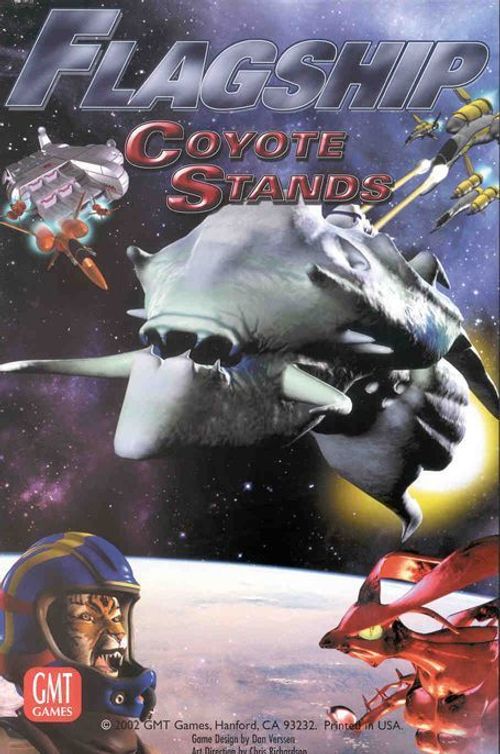
Flagship: Coyote Stands
Flagship: Coyote Stands Rulebook
Table of Contents
Table of Contents
Components
Each copy of the game contains:
- A deck of 55 Resistance cards (see the editor's note in Card Translation below on the printed card numbers)
- A deck of 55 Kirikin cards
- 6 dice, used to record hits and Command Points
- Rules
Game Terms
Before you begin, here are some terms and concepts referred to in the rules:
-
Active player: the player who is taking his or her turn.
-
Inactive player: any other player who is not the active player.
-
Placement points: points assigned to each player at the start of the game. They are used to buy the initial fleet.
-
Command points: points gained and used by each player during the game. There is no limit to the number of Command Points a player may have or keep.
-
Exhaust: rotate a card 90 degrees clockwise to show that it has been used. An exhausted card cannot be exhausted again until it is ready (returned to the upright position).
-
Pay the cost: when a card or rule specifies a cost, it must be paid immediately. Costs usually take the form of exhausting a ship, paying Command Points, or discarding cards.
-
Assigned cards: crew and some Action cards can be assigned to ships. An assigned card is placed under the card, with the bottom side showing its abilities visible. A player may assign as many cards to a ship as he or she wishes. Assigned cards cannot be transferred to other ships.
-
Hits: damage dealt to a ship. Once a ship has taken hits equal to or greater than its Hull value, it is destroyed.
-
Range: the range of a weapon determines how close a ship must be to its target in order to attack it. The ships of a fleet are arranged in one or two rows, and distance to a target is counted in rows. When determining which row a weapon can attack, count all rows from the attacking ship to its target, including the target's row.
The Cards
All of the cards have been translated and are included with this booklet. The following is nevertheless a key to the values printed on them:
- Placement cost: top left. The number of placement points that must be spent to buy the card for the fleet. Costs are in red and appear only on cards with a silver background.
- Background colour: shows when a card can be played from the player's hand.
- Silver: initial fleet cards (ships and commanders).
- Gold: crew cards played by the active player.
- Red: action cards played by the active player.
- Blue: action cards played by the inactive player.
- Command cost: the cost in Command Points to bring that card into play during the turn. This cost is in black (top left).
- Card title: the name of the card itself.
- Card number and artist's name: have no effect on play (central part, below the illustration).
- Flavour text: at the top of the box, a description of the background of the science-fiction universe of the game. It has no effect on play.
- Rules text: describes the special abilities of the card and when they may be used. Text in red indicates special rules that must always be followed.
- Trait box: shows the trait of the card, which determines whether other cards can be played with it or against it (bottom, just above the numerical values).
- Abilities: ship and crew cards have 4 abilities (the 4 numbers in the boxes at the bottom, from left to right):
Card Types
Initial Cards
Initial cards have a silver background and are used to build the player's starting fleet. They include flagships, commanders and other ships. Any initial card not chosen is set aside and is not used in the game.
Action Cards
Action cards have a red or blue background and are drawn from the deck.
- A red background means the card can be played from the player's hand when that player is the active player.
- A blue background means the card can be played when the player is inactive.
Each action card contains bold text that indicates when it can be played. To play it, place it face up on the table, pay the cost, and declare its effects. Most action cards are discarded once their effect has taken place. If a card remains in play, the card text says so.
Some cards have no effect when they are played but take effect at a later point in the game. Any cost to play a card must be paid when the card is played, even if the card does not immediately affect the game.
Crew Cards
Crew cards have a gold background and are drawn from the deck. To bring a crew card into play, pay its Command Point cost and assign the card to one of your ships. Crew members assigned in this way improve the ship's abilities. Once assigned, a crew card remains assigned for the rest of the game. If a ship is destroyed, any card assigned to it is discarded.
The colour of a crew card's ability text indicates the type of crew:
- Gold: commander or captain.
- Blue: first officer.
- Red: private soldier.
A ship may have only one gold crew member and one blue crew member. There is no limit on private soldiers.
Crew Placement
Crew members are considered to be at their posts at the start of the game. Using the fleet's control and command network, a crew member can influence the battle across several ships. The cards of that crew member may be assigned to different ships, or several copies of the card may be assigned to the same ship. The cards indicate that the crew member is performing an exceptional job.
A Word About Reaction
When the word Reaction appears in bold in a rule text, the card is played outside the normal sequence of play. The text also specifies when it may be played. When it is played, the card takes effect immediately.
How to Begin
Each player chooses an empire and secretly buys his or her initial fleet, spending 20 placement points. The initial fleet must contain exactly one Flagship with a Commander assigned to it. The remaining placement points are used to buy the other ships of the fleet. Initial cards that are not chosen do not enter play.
Each player rolls a die. The player who rolls higher has the choice of placing his or her ships first and taking the first turn, or of placing ships after seeing the opponent's placement and taking the second turn.
FLEET SETUP: the first player arranges his or her fleet in one or two rows and places a die beside the Commander card, to show the number of Command Points. Players begin with Command Points equal to the Commander's command ability (Cmd) of the initial fleet, usually 3 points. The second player then performs the same actions.
CREATING THE DECK: each player shuffles his or her Action and Crew cards together and places them face down to form the draw deck. The opponent has the option of cutting the deck.
DRAWING 7 CARDS: each player draws 7 cards (his or her hand) from his or her own deck. The cards are not revealed to the opponent.
START: the first player now takes the first turn, following the turn sequence.
Turn Sequence
The players take turns completing one turn each until one of them destroys the opponent's Flagship. The active player completes the following phases in the order given:
- Ready
- Gain Command
- Reposition Fleet
- Give Orders (repeated)
- Discard
- Draw
1. Ready
During the game, Orders and some special abilities require players to exhaust their cards. In this phase all cards are ready and return to the normal upright position.
2. Gain Command
Command Points are gained in this phase. The active player adds up the number of Command Points shown in the "Cmd" ability of the Flagship, Commander and other cards, obtains a total, and adds to it any Command Points saved from the previous turn. A die is placed beside the Commander to record the number of Command Points available.
3. Reposition Fleet
The fleet may be arranged in one or two rows. The active player may reposition it as he or she wishes, including adding or removing a second row. A fleet cannot have ships in its second row unless there is at least one ship in its first row.
4. Give Orders
TYPES OF ORDERS: there are two types of order: Attack and Base. The words in bold in the rule text of each card indicate which type of order it can be played with, and at what point.
Attack Orders are used to attack the enemy fleet. They are given in this sequence:
- a) Declaration
- b) Focus
- c) Support
- d) Defence (inactive player)
- e) Resolution
Base Orders are given in this sequence:
- a) Declaration
- b) Resolution
During a turn, the active player may give as many orders as he or she wishes or is able to give. Costs must be paid as orders are given. An order must be resolved before another is given. The effects of a card may be used only once per order. The cost may not be paid several times in order to obtain the effects more than once.
When an attack is launched by exhausting a card, only one card may be exhausted. Several cards may not be exhausted and their values added together.
There are four types of attack.
Direct Attacks
Direct attacks are made at range 1 and cause a number of hits equal to the attack capacity (Atk) of the ship used, plus that of its assigned crew cards, plus any other modifier in effect. All ships have the capacity to launch direct attacks. Some cards may increase the range of a direct attack by one.
Guided Attacks
Guided attacks are made at exactly range 2 and cause hits equal to the attack capacity of the ship used, plus that of its assigned crew cards, plus any other modifier in effect. All ships have the capacity to launch direct attacks. Some cards may increase the range of a direct attack by one.
Editor's note: the source text for Guided Attacks repeats the sentence about direct attacks verbatim. It is transcribed here as printed.
Boarding Attacks
Boarding attacks are made at range 1. They do not cause hits. The purpose of a boarding attack is to assign the boarding card to the attacked ship, so that the ship can be assaulted with later orders. Boarding attacks may only be launched by means of a boarding card. Some cards may increase the range of a boarding attack by one.
Assault Attacks
Assault attacks are made against ships to which a boarding card has been assigned. The assigned card is exhausted to cause hits equal to its assault value. Boarding cards must be readied in the Ready phase at the start of each turn.
The following sequence applies to attacks:
a) Declaration
The active player declares the type of attack and indicates the enemy row being attacked. If the attack is direct or guided and comes from a ship, that ship must be exhausted. Cards that have Declaration written in bold may also be used by placing them face up on the table and paying the associated cost.
b) Focus
The active player declares whether the attack is focused or not. In a focused attack the active player chooses the target but must pay 1 Command Point. In an unfocused attack, the inactive player chooses the ship attacked, within the row chosen by the attacker.
Boarding, direct and guided attacks are unfocused unless the active player pays the cost for focus. Assault attacks do not need focus, since they always take place against the ship to which the boarding card has been assigned.
Only one card may be attacked during an Order.
c) Support
The active player may play any card that has Support written in bold, placing it face up on the table and paying its associated cost. When a support card adds hits to an attack, the hits are of the same type as the attack itself.
d) Defence
The inactive player now has the chance to stop hits before they cause damage. He or she decides the defensive posture of the target, active or passive.
- ACTIVE: to take an active posture, the player must exhaust the ship. This posture stops a number of hits equal to twice the ship's defence capacity (Def).
- PASSIVE: if a player does not exhaust the ship (or if it is already exhausted), the ship takes a passive posture and the defence stops a number of hits equal to the ship's defence capacity.
DEFENCE CARDS: the inactive player may also stop hits by playing cards with Defence written in bold.
e) Resolution
Hits that have not been stopped are assigned to the target. Use a die on the ship's card to record the number of hits. If this number is equal to or greater than its Hull value, the ship is destroyed. Remove destroyed ship cards from the game and discard them. If the last ship in the first row is destroyed, that player's second row becomes the first row.
If the attack was a boarding attack, assign the boarding card to the target (place it beside the enemy ship).
Cards played in support or defence are discarded.
Giving a Base Order
a) Declaration
The active player places the card face up on the table and pays the cost associated with it.
b) Resolution
The order is resolved by following the instructions on the card or by assigning the crew card.
ENEMY BASE: the words Enemy Base in bold on a card give the inactive player the chance to give Base Orders when he or she becomes the active player.
5. Discard
The active player may discard any number of cards from his or her hand.
6. Draw
The active player draws cards from his or her deck until the hand is complete. The discard pile may be shuffled and reused when the draw deck is exhausted.
END OF RULES. HAVE FUN!
Alternative Placement Modes
Skirmish
Players receive only 10 points for their initial fleet. This is a good introductory game mode. The battle is shorter and less complicated because fewer ships are in play.
Team Play
Each team receives a predetermined number of placement points. The players then divide these among themselves as they wish.
The fleet of each player must include exactly one Flagship and a Commander assigned to it. The remaining placement points are used to buy other ships of the fleet.
Play alternates between teams. A player may not take a second turn until all players have taken a turn. This means that if the teams have an unequal number of players, the larger team will take turns without the opposing team taking any.
The order in which players take their turns must be kept for the whole game.
A player may play defence cards only when his or her fleet is under attack. Defence cards may not be played to help a fleet belonging to a friendly player.
When a player's Flagship is destroyed, discard all of his or her cards.
The first team to destroy all of the opposing Flagships wins.
When playing in teams with more than one copy of the game, all players of a team must use a single deck of 55 cards. This means that both players choose the initial fleet from the same deck and draw cards from the same deck. Each team has one discard pile. A deck may be used by at most two players. If you have more than one copy of the game, it is recommended to use any empire against any empire, including the same empire.
All Against All
More than two players may play. Players agree on the placement points and choose their initial fleets. A player may play defence cards only when his or her fleet is under attack, not to help a friendly fleet.
VICTORY: a player gains points for destroying enemy ships, equal to the placement or command cost of the ship destroyed. The player who destroys the ship gains all of its points. The game ends when the first Flagship is destroyed. The player with the most points wins.
Year of Use
Each card has a year shown in its text, enclosed in square brackets. Players may choose to set a battle in a given year by limiting the choice of cards to those dated that year or earlier.
Optional Rules
Constructed Decks
The game is not a collectible game, because every box contains a complete set of cards. It is, however, expandable for players who wish to try new strategies. If all players agree, they may play with constructed decks using any of the placement methods described above.
A constructed deck must consist of cards from one empire only. The fleet must include exactly one Flagship and one Commander. The remaining placement points are used to buy other ships of the fleet.
The size of the deck is at the players' discretion, as long as it stays within the limits of the table below (the source text states the deck must be 40 cards or more). The number of copies (cards with the same title) is limited by the total number of cards in the deck.
The card count of the draw deck does not include placement cards. The maximum number of copies with the same title also applies to placement cards.
| Cards in deck | Maximum copies of cards with the same title |
|---|---|
| 40 to 49 | 3 |
| 50 to 59 | 4 |
| 60 to 69 | 5 |
| And so on |
Editor's note: the table is transcribed as printed. The source's "Ecc." ("etc.") row is rendered as "And so on".
Interactive Play
All players perform the turn sequence together, clockwise.
In the Give Orders phase, each player gives an order and resolves it before the next player gives an order. The active player is only the one resolving his or her order; all others are inactive.
A player may pass instead of giving an order, then give an order or pass again on his or her next turn. The order phase ends when all players have declared that they pass.
Scenarios
The Raptor Squadron Lair
- Players: 2
- Turn order: Resistance, Kirikin
- Placement: the players begin the game with the following forces in play.
- RESISTANCE (10 points): Star Hunter, Grendel, Raptor Squadron, Diamond Squadron
- KIRIKIN (17 points): Savata, Queen Til, Tiri, Yuzza, Nizi, Cotto, Kala
- Surprise: the Kirikin begin the battle with 0 Command Points, instead of 3. In the first turn, all Kirikin forces suffer the following penalties: -5 guided attacks, -5 direct attacks, -2 defence (minimum zero), and all boarding cards increase their Command Point cost by two. In the second turn, the penalties become: -2 guided attacks, -2 direct attacks, -1 defence, and all boarding cards increase their Command Point cost by one.
- Victory: the first player to destroy the enemy Flagship wins.
Generic Battle
This may also be played with either of the two empires. Use the rules of the previous scenario with the following variations:
- Players: 2
- Turn order: whoever sets the ambush, whoever is surprised.
- Placement: according to the normal rules, with the points indicated above.
Emergency!
- Players: 2
- Turn order: Kirikin, Resistance
- Placement: the players begin the game with the following forces in play.
- RESISTANCE (8 points): Nation's Pride, Valkyrie
- KIRIKIN (14 points): Kala, Rondi, Tavi, Yuzza and Overqueen Tak
Squadrons to launch: the Resistance may begin launching one squadron per turn, starting from the second turn. The new squadron is brought into play in the Reposition Fleet phase. The following squadrons are on the Flagship and may be launched in any order desired: Wild Card (value 2), Paladin (4) and Cobra (3).
Yuzza in Command: Yuzza is the Flagship and increases Cmd to 1.
Victory: the first player to destroy the enemy Flagship wins.
Generic Battle
This may also be played with either of the two empires. Use the rules of the previous scenario with the following variations:
- Players: 2
- Turn order: the player who does not launch or reinforce plays first.
- Placement of the fleet without the outpost: the player who launches or reinforces starts with 8 points for the Flagship and Commander, and cannot choose a Flagship as reinforcement. The other player cannot choose a Flagship. The ship to which the Commander is assigned becomes the Flagship, increasing its Cmd by one.
Battle for LP764
- Players: 2
- Turn order: Kirikin, Resistance
- Placement: the players begin the game with the following forces in play.
- RESISTANCE (8 points): Nation's Pride, Valkyrie, Raptor Squadron, Paladin Squadron, Cobra Squadron
- KIRIKIN (14 points): Femmosi, Overqueen Tak, Cotto, Rondi, Tavi, Ninzi
- Reinforcements: each player receives the following reinforcements.
- KIRIKIN: Kala, Porsa, Tiri and Yuzza
- RESISTANCE: Diamond Squadron, Headhunter Squadron, Wildcard Squadron, Blackwidow Squadron
Ships may be bought during the game with Command Points. Flagships cannot be chosen as reinforcements. These ship cards are set aside until bought, and join the fleet in any row.
Convoys: in the Gain Command phase of the player, 3 extra Command Points are received from convoys. The enemy may use ships to attack (and eliminate) these points. For every Placement Point and/or Command value of ships, commander and crew assigned to these attacks, the active player receives one Command Point less. The active player may exhaust ships to act as escorts. Subtract the placement points and/or command value of the attacking ships, commander and crew before determining how many Command Points are lost. No more than 3 Command Points may be lost in this way.
Command Points: add the Command Points obtained to the normal ones. They may be used in the usual way, or for:
- As a Base Order, spend 1 Command Point to repair a total of 2 hits from your ships. This may be done more than once per turn.
- As a Base Order, once per turn, spend Command Points equal to the cost of a ship to buy it as a reinforcement.
Victory: the first player to destroy the enemy Flagship wins.
Generic Battle
This may also be played with either of the two empires. Use the rules of the previous scenario with the following variations:
- Players: 2
- Turn order: determined normally.
- Placement: the two players choose 20 placement points of forces using the normal rules.
- Reinforcements: each player chooses 8 additional points of reinforcements (no Flagships).
Card Translation
Translator's note: the Attack, Command, Defence and Hull values printed at the bottom of each card are not repeated in this table, since they explain themselves. Besides special effects, the notes give the reference year.
Editor's note: card names are given as printed in the source's English column; the source's Italian name lines are not repeated. The source uses slightly different spellings for some ships in different places, and these are kept as printed: "Savata" (scenario) and "Savatta" (card 105); "Nizi" (scenario) and "Ninzi" (card 103 and the LP764 scenario); "Strarstuff" (card 76, likely "Starstuff").
Editor's note: the components list gives 55 cards per deck, but the printed card numbers form two continuous runs of 54 numbers each (Kirikin 57 to 110, Resistance 167 to 220). The runs are transcribed as printed.
Resistance Cards
| No. | Cost | Name | Type | Text | Year |
|---|---|---|---|---|---|
| 167 | 1 | AS-22 Attack Drones | Droids | Base: assign to one of your ships. Attack: discard this card to cause 5 guided-attack hits. | 2560 |
| 168 | 1 | Headlong Rush | Maneuver | Support: +3 to direct attacks. | 2552 |
| 169 | 0 | Strafing Run | Maneuver | Support: +2 to direct attacks from fast or very fast ships. | 2552 |
| 170 | 1 | Immelmann | Maneuver (change of direction) | Reaction: play in the discard phase to ready one of your very fast ships. |
Kirikin Cards
| No. | Cost | Name | Type | Text | Year |
|---|---|---|---|---|---|
| 57 | 1 | Acting on Instincts | Countermeasure | Defence: stop 6 hits from a direct attack against one of your slow, normal, fast or very fast ships. | 2556 |
| 58 | 0 | Honed Caster Shot | Maneuver | Support: +1 to guided attacks. | 2552 |
| 59 | 1 | The Light of the Ships | Maneuver | Support: +3 to direct hits. | 2556 |
| 60 | 0 | Lightning the Way | Command | Reaction: play when paying a cost for boarding; it is worth 1 Cmd for that cost. |