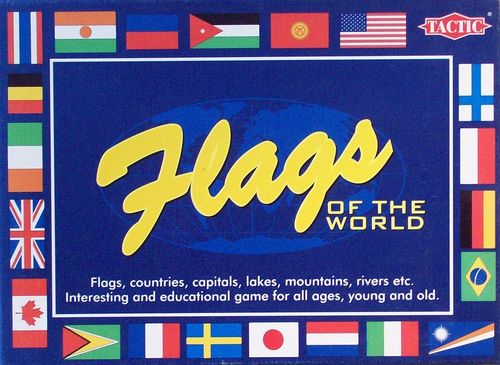
Flags of the World
Flags of the World Rulebook
Table of Contents
Table of Contents
Using the Cards
Use easy cards the first time you play and increase the level of difficulty gradually. The flags may be selected by using the numbers on the back of the cards. The most known flags are numbered 1-70, where number 1 is easiest to recognize. The numbered cards are chosen from a European point of view.
Game 1
2 - 7 players, ages 8 and up.
The Object of the Game
The object is to collect cards either by knowing or by guessing the country the flag belongs to. The player who has collected the most flags is the winner.
The Start
The number of the cards depends on the number of players: 2 - 3 players 40 cards, 4 - 5 players 50 cards, and 6 - 7 players 60 cards.
Shuffle the cards and deal four cards to each player. Place the rest of the cards in the middle of the table in two equal piles. All cards should be placed on the table with the flag side up.
The Game
The players place their cards next to each other on the table with the flag side up.
The first player A, to the left of the dealer, starts by pointing to any card which he knows in front of any opponent. If he does not know any of the flags, then he must choose one to guess.
The owner of the flag picks up the card to check the answer.
Then player A names the country he thinks the flag belongs to. (Only one guess.) If the answer is correct he keeps the card. If he can name the capital city he is allowed to take a bonus card from either of the piles in the middle of the table. The player collects these cards in a special pile.
4 cards should always be kept in front of each player. Each empty space should immediately be filled by a card from one of the piles.
If player A does not know the country of the flag or answers incorrectly, the owner of the flag gives the name of the country. If player A can now name the capital city, he gets the card. If A does not know the capital city, the owner of the card tells the name of the capital city out loud and places the card at the bottom of one of the piles. The game then passes on to the next player in a clockwise direction.
The End and the Winner
The player who has collected the most flags when the two piles are finished is the winner. The four cards on the table should not be added.
Game 2
2 - 5 children with a leader, simplified version of Game 1. Ages 6 and up.
The Start
The level of difficulty is adjusted to the ages and knowledge of the children by choice of flags and the number of cards in the pile.
The object of the game is to collect flags. The leader chooses suitable flags. You need 10 - 16 cards for the youngest children, depending on the number of players. All cards are dealt with the flag side up. Shuffle them and place two cards in front of each child and six in a pile on the table.
The Game
The youngest player starts the game and points to a flag he knows in front of another player and tells which country the flag belongs to. If the player does not recognize any of the flags, he must make a guess.
If the player answers correctly, he keeps the card in a pile of his own. The game then moves clockwise to the next player.
If the player does not know the answer or guesses incorrectly, the leader gives the correct answer and places the card under the pile. The next player continues.
There should always be two cards in front of each player. Take cards from the pile when necessary to fill the gaps. When the pile on the table is finished, collect two cards from each child, shuffle them and deal each player one card. The rest of the cards are placed in a pile on the table and the game continues as previously. The game is then continued until all the cards are finished, or until no one can name any more flags.
The End and the Winner
The player who has collected the most flag cards is the winner.
Game 3
5 - 9 players, ages 8 and up, 2 teams.
This game is played by 2 teams with a leader who is not a member of any of the teams. The object is to collect points, and team scores should be kept.
The Start
The leader chooses 20 flag cards in advance which remain concealed from the teams (e.g. the easiest ones, 1 - 70). Points 1 and 2 on the back of the cards are clues.
The leader can make it harder or easier by his choice of cards. (N.B. The easiest cards are numbered 1-70.)
The Game
The leader holds up one card for both teams to see the flag.
Team 1 tells which country the flag belongs to. If they don't know, or answer incorrectly, the leader reads the first of the two clues on the back of the card. If they still don't know or answer incorrectly, then the leader reads clue 2.
Points are scored as follows:
- Correct answer straight from the flag: 3 points
- Correct answer after 1st clue: 2 points
- Correct answer after 2nd clue: 1 point
If there is no right answer from team 1 after the second clue, team 2 may answer. If they answer correctly, they receive 1 point. If neither team gives the correct answer, the leader reveals the country. The leader then shows a new flag to team 2.
The End and the Winner
The game ends when the leader has shown all the cards. The team which has scored the most points is the winner.
Game 4 (Starplay)
A more challenging game for 2 - 6 individual players, or 4 - 6 players in teams.
Starplay for Individual Players
The Start
Use all the cards. Shuffle them and deal 5 cards to each player. The cards are placed in a pile in front of each player with the flag side facing upwards.
The rest of the cards are placed flag side up in 5 equal piles in the shape of a star in the middle of the table. (During the game you can send around an object, such as a pen, to show which player is currently playing.)
The object of the game is to collect flag cards by knowing or guessing the country they belong to. The other players can check the answer if they believe the answer to be incorrect. Thus you can either win or lose cards.
The Game
The youngest player starts the game and points at a flag in the star and tells which country the flag belongs to. After this he places the card in his pile without looking at the back. If a player doesn't know any of the flags, he must try to guess. The answer is regarded as correct if none of the players calls out "CHECK" (see the Check rules).
Capital City Supplement (Bonus)
When a player names the country the flag belongs to, he can ALSO CHOOSE to name the capital city. This must be done before the card is picked up. The Capital City supplement is a bonus card from the star. The answer is considered correct if no one opposes it.
Check Rules
If another player suspects that a player has given an incorrect answer, he calls out "CHECK" and checks the player's card. This must be done before the player, or the next in turn, has taken a new flag from the star.
It is possible that a "CHECK" is demanded on both country and capital. In which case the fine is paid if the country is wrong. The game then continues. If the country is right then the capital challenge can proceed (see Checking and Fines below).
Checking
A = the player to be checked. B = the player that demanded checking.
- If the answer is correct: A keeps the card and B must pay a fine to A (see Fines).
- If the answer is incorrect: A gives the card to B and pays a fine to B.
Fines
The fine is paid with the top card in the pile, BUT the receiver can only accept the card if he can name the flag on the penalty card. If necessary, both clues can be read.
The End and the Winner
If a player loses all his cards he is out of the game. The game finishes when the cards from the star are all used. The player who has collected the most flags is the winner.
Starplay for Teams
This game is played by 4 - 6 players in teams of 2, where the team members sit opposite each other. It is played the same way as Starplay for individuals, except the team members help each other by reading the clues to one another.
How to Play
Every time a player takes a new flag from the star, he may either answer directly, or read the clues to his team-mate. When using clues, the team-mate may not answer until the first clue has been read, even if he knows the answer.
The Game
If the team-mate answers correctly after the first clue, the player (the reader of the clue) keeps the card and continues with a new flag (once).
If the team-mate answers incorrectly after the first clue, then the next team is in turn to answer. If he answers correctly, he keeps the card; otherwise the game moves clockwise to the next player until someone answers correctly.
If no one knows the country after clue 1, the reader of the clue gives clue 2 and the same procedure is used as for clue 1.
If no one can answer the question after clue 2, the answer is read and the card is placed under one of the piles in the star.
The End and the Winner
The team-mates may help each other only by reading clues, and the winning team is the team with the highest total number of flags collected.
Good luck!