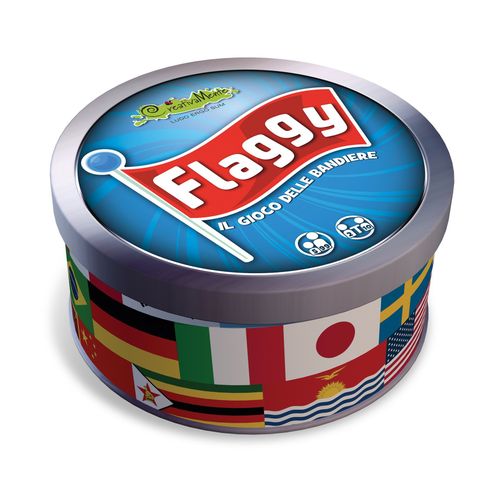
Flaggy
Flaggy Rulebook
Table of Contents
Table of Contents
Components
- 48 cards with flags
- 3 wooden dice
- this booklet with the rules of the 5 games
The 2 blue dice contain the 6 symbols of the game: vertical stripes, horizontal stripes, circles, stars, crosses and animals (mostly birds). The red die contains the 5 continents plus the wildcard "world".
All 48 cards have a snapshot of the flag on the front and some pieces of information about the state on the back, such as the name of the country and its capital city, for educational purposes. The symbols that are on the back of the card are the ones represented within the flag (e.g., the cross).
The 4 cards with golden border on the back are wildcards, because they match more than 2 symbols.
The 21 cards with red borders are used together with 2 blue dice in order to set one and only one card among them:
- if the 2 dice have different symbols they set the only flag with both symbols and red border (for instance both Brazil and Tunisia have a star and a circle, but only Brazil has the red border).
- if the 2 dice have the same symbol they set the only flag with just that symbol and red border (for instance two circles indicate Japan).
The two central pages of this booklet resume all the flags and their corresponding countries, with the exception of United Kingdom, whose flag is represented here.
Warm Up
Shuffle all the 48 cards and put the deck on the table, with the flag side visible. The player takes the last card from the bottom of the deck and puts it beside the deck, visible to all players. The first player who says the right name of the State with that flag does win it. The game ends when all cards have been taken and the winner is the player with the highest number of cards.
VARIATION: You can play by guessing the name of the capital city, rather than the name of the Country.
Game N°1: Find It
PURPOSE OF THE GAME: to be the first player to win the target number of cards (6 cards for 2 players, 5 cards if you play from 3 to 7 and 4 cards if you play 8 or more).
GAME SETUP: all the 21 cards with red border are randomly spread on the table, with the flag visible for all the cards.
GAME PLAY: a player rolls the 2 blue dice, that indicate a unique card (for example circle + horizontal stripes indicate the India flag). The first player who puts his finger on that card does win it: he takes the card from the table and he puts it covered on top of previously won cards. Then he rolls the 2 blue dice for the next card to find, and so on. If the card set by the dice is not visible on the table anymore, because it was already won in a previous round, the first player who reserves (for example by raising the hand or by saying "I know!") has the right to talk. He must remind and say who has that card (without looking at his cards). If he is right, he takes the card from the other player, otherwise as a penalty he loses one of his cards and puts it back on the table (if he has not won any card yet, he will pay the penalty as soon as he will win his first card).
REMARKS:
- the player who has got the right to talk can also indicate himself, in order to maintain the card, if he thinks he has it
- if none of the players reserves, the dice are rolled again.
END OF THE GAME: the game is won by the first player who gets his last card (for example the fifth one if you play 5).
GAME VARIATION: if the player who has reserved is wrong, a second reservation is allowed, and so on.
Game N°2: Sort It
PURPOSE OF THE GAME: Put your card in the right position with respect to the other cards.
GAME SETUP: All the 48 cards are shuffled and the deck is put at the center of the table, with the flag side visible for the top card. The youngest player starts the game, by taking the first card on the top of the deck. He puts the card on the table, on the back side, with the information of the Country size visible. The game continues clockwise.
GAME PLAY: The current player gets the first card on the top of the deck and must put it in the proper position on the table, without reading the information on the back. He has to choose where to put the card: on the left (the smallest Country), or on the right (the biggest Country), or even between 2 cards. Then he turns the card to check, by reading the size of the State, if it is in the proper position. If a player puts the card in the wrong position, he gets out of the round. He can stay in the game if and only if, by rolling the red die, he gets either the Continent of the card or the wildcard. In all cases the card is put in the proper position in order to continue the game. The game goes on until just one player is in the game. He wins the last card put on the table.
REMARKS:
- The second card is put just on the right or on the left of the first card.
- Since the third card the player can put his card on the right, on the left or between any 2 cards.
END OF THE GAME: The game is won by the first player who wins 3 cards.
GAME VARIATION: You can also play by sorting the States with respect to their population, rather than their size.
Game N°3: One-Two-Three
PURPOSE OF THE GAME: to be the first player to run out of cards.
GAME SETUP: all 48 cards are shuffled and every player starts with 11 cards (if you play more than 4, you distribute less cards, with the same number to all players). The rest of the cards (if any) are placed in a Draw Pile face down. You roll the 2 blue dice (more than once if needed) and who has the card set by the dice starts the game, that then continues clockwise.
GAME PLAY: the current player decides how many dice to roll, from 1 die to 3 dice. Then he may put one of his cards on the Discard Pile for each die he did roll (for instance Kenya for horizontal stripes and Switzerland for cross) and even some further cards for each combination of two dice (e.g., Germany). If you cannot play at least as many cards as the number of rolled dice, because there are no enough matches, you must draw as many new cards from the Draw Pile as the number of dice you rolled.
REMARKS:
- if you roll 1 die in the best case you can play 1 card
- if you roll 2 dice you can play up to 3 cards (2 for the 2 dice + 1 for their combination)
- if you roll 3 dice you can play up to 6 cards (3 for the 3 dice + 3 for all possible pairs)
- when the Draw Pile becomes depleted you take the Discard Pile and shuffle it, and then you turn it over to regenerate a new Draw Pile.
END OF THE GAME: the Game ends when a player, the winner, plays his last card.
Game N°4: Domino
PURPOSE OF THE GAME: to be the first player to run out of cards.
GAME SETUP: all 48 cards are shuffled and every player starts with 9 cards (if you play more than 5, you distribute less cards, with the same number to all players). The rest of the cards (if any) are placed in a Draw Pile face down. You roll the 2 blue dice (more than once if needed) and who has the card set by the dice puts it on the table, and the game then continues clockwise.
GAME PLAY: as in the traditional DOMINO game, the current player can put one of his cards on the table when it has either the same continent or the same symbol of any other card already on the table. If you play a card that connects to two (or more) cards on the table (for instance Japan has the circle as Macedonia and is in Asia as Mongolia), rather than only to one, as a reward you can continue your turn by playing a second card, and so on.
The booklet's diagram for this game shows an example chain starting from a first card (Kazakhstan), with the links labelled circle, Europe, Asia and vertical stripes, and a "Reward" marker on the card that connects to two cards at once.
REMARKS:
- the cards on the table can never set a line (row or column) longer than 5 cards
- the cards on the table can never build a square made of 25 (5 x 5) cards
- if you cannot play any card, you must draw a new card from the Draw Pile and pass the turn.
END OF THE GAME: the Game ends when a player, the winner, plays his last card.
Game N°5: Shout!
PURPOSE OF THE GAME: to win the highest number of cards.
GAME SETUP: all 48 cards are shuffled. The youngest player is the dealer, and he goes clockwise.
GAME PLAY: the dealer flips the first card of the deck and puts it visible in front of each player. When the last card that has been turned (e.g., Uganda given to David) has the same symbol of any other card, the challenge starts: David must say the name of the country of either Henry (South Korea) or Paul (Russia), whereas both Henry and Paul must say the state of David (Uganda). The first one who shouts the right name takes 2 cards from the other player. If a player says a wrong name (e.g., Simon says Uganda), as a penalty he must give one card to each player (clockwise if they are not enough). If just afterwords Paul shouts Uganda, Paul does not win the 2 cards anymore, because the round has finished with Simon's mistake.
REMARKS:
- after having lost your cards it may happen that the new card which is visible in front of you matches any card of some other players. Anyway, the game goes on by flipping the next card from the deck.
- in case two or more names are said at the same time, who has the state that comes first in alphabetical order wins.
END OF THE GAME: the game ends when all cards have been played, and the winner is the player with the highest number of cards. In case of draw the 2 blue dice are rolled as in Game n°1.
Card List
The flags on the cards, with the country names as printed on the booklet's card list. The list has 47 flags; the 48th card is the United Kingdom, which is shown on the booklet's Contents page and not in this list.
Afghanistan, Argentina, Australia, Belgium, Brazil, Cambodia, Cameroun, Canada, China, Cuba, Dem. Rep. of the Congo, Dominica, Ecuador, Egypt, Ethiopia, Fiji, France, Germany, Greece, India, Israel, Italy, Japan, Kazakhstan, Kenya, Kiribati, Macedonia, Malta, Mexico, Mongolia, Morocco, Nepal, Nigeria, Papua New Guinea, Russia, Samoa, South Korea, Spain, Sri Lanka, Sweden, Switzerland, Un. Arab Emirates, Un. States Of America, Tonga, Tunisia, Uganda, Zimbabwe