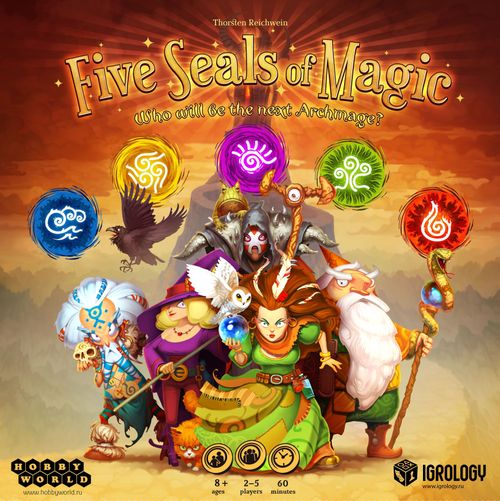
Five Seals of Magic
Five Seals of Magic Rulebook
Table of Contents
Table of Contents
Object of the Game
The players explore the dungeon of the Arcana Tower in search of powerful spells. The way to these scrolls is blocked by magical seals of the four elements. These elements are represented by dice of four matching colors. They can break seals of the same color to clear a path to the scrolls. Mages must also keep an eye on their opponents and use their own powers at the right time and at the right place. The collected scrolls can be used to manipulate dice and other elements of the game. This can break stronger seals and open the way to more powerful scrolls. The player who collects the most powerful scrolls wins the game.
Five Colors of Magic
In this game, there are five forms of magic: Fire (red), Water (blue), Air (yellow), Earth (green), and Mind (purple). Fire, Water, Air, and Earth are elements of nature; to harness their power, the players roll dice of matching colors. These four elements are subject to the power of the Mind. As there are no purple dice in the game, the players may use dice of any other color to break a Mind seal.
Components
- 5 mage figures
- First player marker
- 24 colored dice (6 for each element: Earth, Water, Fire, and Air)
- 5 guardian figures in different colors
- 125 scroll cards (25 spells for each magic circle: basic, first, second, third, and fourth)
- 120 magical seal tokens (30 seals for each element: 10 seals of strength 2, and 5 seals each of strength 3 through 6)
- 5 Binding scrolls
- 5 familiar figures
- 16 plastic stands for figures
- 6 two-sided board segments
Setup
Turn the board segments so that they show the number of players in the colored markings printed at the sides of each segment. Combine the segments so that the markings on adjacent segments match. The game board features a round dungeon with a central chamber, surrounding rooms and passages, lots of small circles for magical seals, and large boxes for scroll cards.
The game board has four large supply fields in red, blue, yellow, and green. In each field, place a number of matching-colored dice equal to one more than the number of players. For example, four dice of each color in a 3-player game.
Divide magical seal tokens into separate piles according to their strength and randomly fill all small circles on board with a seal token of matching strength. Do not place magical seals in rectangular scroll boxes.
In each game, you can use scrolls of two different magic circles: the basic circle and one additional circle (I – IV). You can choose the additional circle randomly or by the agreement of all players. To get acquainted with the game, it is recommended to start with the first circle, which contains the same scrolls as the basic circle. In future games, move on to the higher circles one by one.
- The Circle of Might is the first circle (and also the basic circle). It consists of spells that give you additional dice and allow you to reroll or adjust them.
- The Circle of Spaces is the second circle. These scrolls move seals and scrolls on the game board and even destroy magical seals.
- The Circle of Conflict is the third circle. This magic lets you trade dice and scrolls with opponents and also use their spells.
- The Circle of Movement is the fourth circle. Spells of this circle give you the ability to move through seals and other obstacles, as well as send guardians to block the way to certain scrolls.
Take all cards of strength 2-6 from the basic circle and one additional circle. Randomly fill all rectangular boxes on board with a scroll of matching strength. If you've placed Guardian scrolls of the fourth circle put the matching guardian figures next to the game board.
Each player takes a figure of the chosen mage, a figure of their familiar and the Binding scroll for this familiar.
The players place their mage figures onto any one of the purple circles in the central chamber. Next, they place their familiar figures and Binding scrolls in front of themselves.
The players choose who starts the game, e.g. by rolling dice. The first player takes the corresponding marker and puts it in front of him.
Any remaining game components will not be used. Return them to the game box.
The first player chooses any three dice from the supply and puts them in front of himself. The player on his left does the same. Repeat until all players have done so.
A Game Round
All players roll their dice at the same time and place them in front of themselves so that all other players can easily see them. Beginning with the first player, all players take their individual turns clockwise. At the start of their turn, the players may use their scrolls. Next, they must break any seal on the game board (a magical seal or a seal on a scroll) using their dice. If the players cannot break any seal, they take no more turns during this round.
Playing a Turn
-
At the start of your turn you may use your scrolls one after the other. To use a scroll, first carry out its effects and then turn the scroll over so that it lies face down. A scroll may not be used if its spell would have no effect at that moment.
Face-down scrolls cannot be used until the next game round. A description of all scrolls can be found in the magic compendium.
Examples: Renewal of Air allows you to reroll any number of yellow dice. You cannot use this spell if you have no yellow dice. Strengthening of Fire allows you to add 2 to the value of your red dice (to a maximum of 6). You cannot use this spell if all your red dice show sixes.
-
Check if you can break a seal on the game board with one or more of your dice (see step 3). If you can break a seal, then you must do so! If you cannot break any seals, you must put your remaining dice onto the supply fields of the same color, and then your turn ends (see step 5). You will take no more turns this round.
You are not required to use your scrolls to break a seal. In other words, if you are not able to break a seal with your dice, but some of your spells could make it possible (for instance, by swapping seals or increasing the value of a die), you are free to decide whether to use the scrolls, break the seal and continue playing, or not to use the scrolls, effectively ending this round.
-
You must break either a magical seal on the game board or the seal of a scroll on the game board. To do this, you must be able to reach the seal or scroll. That is, there must be a path from your figure to the seal token or scroll which is not blocked by walls, other magical seal tokens, or the other players' mage and familiar figures. It doesn't matter how long that path is. Furthermore, the seal token or scroll itself must not be blocked by any figure other than your own familiar.
To break a seal, you must use one or more of your dice. All these dice should be of the same color as the seal, and their combined value should be at least equal to the seal's strength. Note that you may not use more dice than necessary to break the seal. To break the seal of a Mind scroll (purple), dice of any one color may be used. After you break a seal, return used dice to the supply fields.
Example: You have three green dice showing 2, 3, and 4. A strength 4 Earth (green) magical seal is within reach. You may break the seal either by using the die with 4 or by using the other two dice. You may not break the seal by using the dice with 2 and 4 because the latter die alone can break the seal.
End of Game Round
If the game round is over for all players, they count remaining scrolls of strength 6 on the game board. If there are less than 4 (for 2–3 players) or less than 5 (for 4–5 players) such scrolls, the game ends and the winner is determined.
Otherwise, all players remove their familiar figures from the Binding scrolls and the first player gives his marker to the player on his left, who becomes the new first player, and a new game round begins.
Example of Game Turn
At the start of your turn you have a blue die showing 3, a yellow die showing 2, and a red die showing 1. Also you have Binding, Change of Air, and Strengthening of Fire scrolls. You are standing right before the Growth of Fire scroll, but the Renewal of Mind is also reachable at the moment. Let's consider two possible options for your turn.
Option 1
- Use Change of Air to exchange the yellow die with a red die showing 2 from the supply (assuming there is one lying there), then use Strengthening of Fire to upgrade one or both of your red dice by 2.
- Announce that you can break a seal using both of your red dice.
- Return the red dice to the supply and take the Growth of Fire scroll.
- Move your mage figure to the spot where the scroll has been lying.
- Wait for the other players to take their turns. On your next turn, use the Growth of Fire scroll and the remaining blue die to break seals.
Option 2
- Use the Binding scroll to place your familiar on the game board next to your mage, blocking passage for your opponents.
- Announce that you can break a seal using your blue die.
- Return the blue die to the supply and take the Renewal of Mind scroll.
- Move your mage figure to the spot where the scroll has been lying.
- Wait for the other players to take their turns. On your next turn, use your scrolls as in Option 1 to get the Growth of Fire scroll, and maybe use the Renewal of Mind first.
End of Game
To determine their score, all players add up the strengths of their collected scrolls and then add bonus points for their Synergy scrolls. The player with the highest score wins the game. If there is a tie, all tied players win the game.
Scoring Example
Assume a player has the following scrolls at the end of the game:
- Binding (1)
- Change of Air (2)
- Renewal of Fire (3)
- Renewal of Mind (3)
- Strengthening of Fire (4)
- Growth of Air (5)
- Synergy of Air (6)
The player scores 24 points for scrolls and 3 bonus points for three Air spells (due to Synergy of Air). His score is 27 victory points.
Magic Compendium
This Compendium contains detailed descriptions of all spells that can be found on the scroll cards. All spells are divided according to the magic circles, from the basic to the fourth circle. The number in the parentheses after the spell name indicates the strength of the scroll's seal and its victory point value.
Each magic circle contains five different spells with different strength (from 2 to 6). Each spell exists in five elemental variations: Fire (red), Water (blue), Air (yellow), Earth (green), and Mind (purple). The effect of each scroll is defined by its element (color). When using Mind scrolls, either the element for its effect can be chosen freely, or the scroll effects other Mind scrolls.
In each game, scrolls of only two magic circles are used: the basic circle and one additional circle. The first circle contains the same spells as the basic circle. Therefore, if the first magic circle is chosen for a game, each scroll may appear twice on the game board.
Familiars
Each mage has a familiar who accompanies and helps him, represented by a figure. At the start of the game, each player takes this figure and a Binding scroll for their familiar. All Binding scrolls are Mind scrolls with strength 1. The only difference between them is the name and picture of their familiar. Binding scrolls do not belong to any magic circle. At the final scoring, the Binding scroll is worth 1 point (or more with the Synergy of Mind scroll).
Mages and their familiars:
- Shaman of the North — Raven
- Witch of the East — Cat
- Seer of the West — Owl
- Sorcerer of the South — Snake
- Warlock of the Beyond — Toad
Binding (1). When using Binding, choose one of the following options:
Option 1. Place your familiar figure next to your mage figure, sharing the same space on the board. By doing this, your familiar will block the passage for other players even if you move away.
Option 2. Break one magical seal token with the help of your dice, but without moving your mage. You must be able to reach the seal. Place your familiar in the space formerly occupied by the seal. After using Binding this way, your turn is over. You cannot break a seal on a scroll using your familiar.
In both cases the familiar figure stays on the game board until it returns to you when the round is over for you.
The Circle of Might (Basic and First Circles)
Change (2). Return at least one die of the same color as the Change scroll to the supply. Take from the supply the same number of dice of one other color and turn them to show the same values as the returned dice. When using Change of Mind, you may choose the color of the dice to put away as well as the color of the dice to take, but the colors must differ.
Example: You have two blue dice showing 3 and 5. By using Change of Water or Change of Mind you may change both blue dice into yellow dice showing 3 and 5 (if there are at least two dice in the yellow supply field), or you may change the blue die showing 3 into a red die showing 3 (if there is at least one die in the red supply field).
Renewal (3). Reroll one or more of your dice of the same color as the Renewal scroll. When using Renewal of Mind, you may choose the color of the dice to be rerolled.
Example: You have two yellow dice showing 2 and 4 and a green die showing 3. By using Renewal of Mind, you may reroll one or both yellow dice or the green die, but not all three dice.
Strengthening (4). Add 2 to the value of one or more of your dice of the same color as the Strengthening scroll. Rotate the affected dice to display their new values. A 5 becomes a 6, and you cannot strengthen dice already showing 6. When using Strengthening of Mind, you may choose the color of the dice to be strengthened.
Example: You have two green dice showing 2 and 5, and one yellow die showing 4. By using Strengthening of Earth, you may upgrade the first die from 2 to 4, and the second die from 5 to 6. By using Strengthening of Mind, you may upgrade either the green dice or the yellow die, but you can not upgrade dice of different colors.
Growth (5). Take from the supply one die of the same color as the Growth scroll, immediately roll it, and put it next to your other dice. This gives you an additional die to spend in this game round. Growth may only be used if there is at least one die in the corresponding supply. By using Growth of Mind, you may choose the color of the die to be taken.
Synergy (6). At the end of the game, you gain 1 bonus point for each of your scrolls of the same color as your Synergy scroll (including the Synergy scroll itself). With two Synergy scrolls of the same color, the bonus points are cumulative. The Synergy of Mind scroll adds 1 bonus point for each of your Mind scrolls, including the Binding scroll.
The Circle of Spaces (Second Circle)
Swap (2). Swap one magical seal token on the game board for any other magical seal token on the game board. The seals must be of different colors but of the same strength. One of the swapped seals must be of the same color as the Swap scroll. The seals do not need to be reachable. Scrolls cannot be swapped. When using Swap of Mind, you may choose the colors of both seals, but the colors must differ.
Exchange (3). Exchange one magical seal token on the game board for any other magical seal token on the game board. Both of these seals must be the same color as the Exchange scroll. The seals do not need to be reachable. Scrolls cannot be exchanged. When using Exchange of Mind, you may choose the color of the seals, but the exchanged seals must be of the same color.
Absorption (4). During your turn, when you break a magical seal token of the same color as your face up Absorption scroll (by yourself or using your familiar), you may put the token onto the scroll. Any magical seal token already on the scroll is removed and returned to the game box. The absorbed seal token remains on the scroll until it is replaced or the scroll is used. Seals of any color may be put onto the Absorption of Mind.
When using Absorption, return a magical seal token on the scroll to the game box and add this seal's strength to the value of one of your dice of any color (to a maximum of 6). Rotate the affected die to reflect its new value.
Disintegration (5). Remove any magical seal token of the same color as the Disintegration scroll from the game. The seal does not need to be reachable. A seal on a scroll cannot be disintegrated. Disintegrating a seal is not the same as breaking it; you must still break a seal this turn if you can. When using Disintegration of Mind, you may choose the color of the magical seal to be disintegrated.
Rearrangement (6). Swap one scroll on the game board for any other scroll on the game board. These scrolls may be of any strength and at least one of these scrolls must be of the same color as the Rearrangement scroll. The scrolls do not need to be reachable. When using Rearrangement of Mind, at least one of these scrolls must be a Mind scroll. In any case, the colors of the rearranged scrolls may be the same.
The Circle of Conflict (Third Circle)
Please note: All spells of this circle affect other players in some way. Only opponents for whom the game round isn't over yet may be chosen as targets of Conflict spells. If a player's familiar figure stands on their Binding scroll (showing that the round is over for this player), this player cannot be affected with conflict magic. If the round is over for all your opponents, you cannot use scrolls of the third circle.
Deception (2). Take one die of the same color as the Deception scroll from another player and give one of your own dice of another color to the deceived player. Both dice are rotated to the other die's value. In other words, you trade colors of the dice, but not the values. When using Deception of Mind, you may choose the colors of both dice but the colors must differ.
Example: You have a blue die showing 3 and your opponent has a red die showing 5. By using Deception of Fire or Deception of Mind you may take the opponent's red die, changing its value to 3. Next, you give your blue die to the opponent, changing its value to 5.
Alteration (3). Add 1 to the value of any number of your dice of the same color as the Alteration scroll. In addition, subtract 1 from the value of any number of dice of the same color belonging to one opponent. Rotate the dice to reflect their new values. Alteration may only be used if at least one die would be changed by one of the two effects. When using Alteration of Mind, you may choose the color of the altered dice. In any case, the dice to be altered must be of the same color.
Transfer (4). Swap one of your face up scrolls for any opponent's face up scroll of the same color as the Transfer scroll. Both scrolls must have the same strength. The colors of transferred scrolls may be the same. Neither a Binding scroll nor scrolls lying facedown (i.e. scrolls which have been used this game round) can be transferred. When using Transfer of Mind, you may choose another player's Mind scroll only.
Theft (5). Take one die of the same color as the Theft scroll from another player. Put the die next to your other dice without rotating it. If the robbed player has more than one die of the same color, he decides which one of them to give. If the robbed player has no more dice after the theft, the game round ends immediately for him, and he turns his scrolls face up, puts his familiar figure on his Binding scroll and takes three dice from the supply before you continue your turn. When using Theft of Mind, the robbed player (not you!) may choose which of his dice to give.
Exploitation (6). Choose an opponent's face up scroll of the same color as the Exploitation scroll and use the chosen scroll as if it was your own. Turn the exploited scroll face down after use (along with the used Exploitation scroll). The opponent cannot use the exploited scroll in this game round. Neither a Binding scroll nor a Synergy scroll can be exploited. No scroll turned face down (i.e. already used this game round) can be exploited. When using Exploitation of Mind, you may only choose another player's Mind scroll.
The Circle of Movement (Fourth Circle)
Please note: Several spells of this circle block seals. A seal is blocked if a familiar or guardian figure is standing upon it. Nobody may break a seal blocked by a guardian, and only the familiar's owner may break a seal blocked by a familiar.
Dispatch (2). Place your familiar figure on one unblocked magical seal token of the same color as the Dispatch scroll. The seal does not need to be reachable. The familiar cannot be dispatched onto a scroll. When you break a seal token occupied by your familiar, take its figure from the game board and place it in front of you. You may play both Dispatch and Binding scrolls on the same turn in any order (except that after breaking a seal with your familiar, you cannot use any more spells). When using Dispatch of Mind, you may choose any unblocked magical seal token on the game board.
Leap (3). This spell allows your mage to leap over one unblocked magical seal token of the same color as the Leap scroll as if the token wasn't there. Your mage must be able to reach the seal. Immediately after the leap, you must use your dice to break any magical seal or seal on a scroll that is now reachable for you. You cannot use a Leap scroll if you are not able to break a seal afterwards. The seal to be broken must not be reachable without using Leap. After using Leap, your turn is over. When using Leap of Mind, you may leap over an unblocked magical seal of any color.
Teleportation (4). This spell allows your mage to move through another player's figure (mage or familiar, even blocking the seal) as if the figure wasn't there. Immediately after this, you must use your dice to break any magical seal or seal on a scroll that is now reachable for you. The seal to be broken must be of the same color as the Teleportation scroll. You cannot use a Teleportation scroll if you are not able to break a seal afterwards. The seal to be broken must not be reachable without using Teleportation. You cannot move through your own familiar. After using Teleportation, your turn is over. When using Teleportation of Mind, you may move through a figure in order to break a seal of any color.
Guardian (5). Place the guardian figure of the same color as the Guardian scroll onto any scroll of the same color on the game board. If the guardian figure is already on the game board, you may choose to place it next to the game board instead. As long as a guardian figure stands on a scroll, this scroll's seal cannot be broken by any player, including you. When using Guardian of Mind, the guardian figure may only be placed on Mind scrolls.
Speed (6). This spell allows your mage to break an additional seal of the same color as the Speed scroll without using any more dice. Immediately after using this spell, you must break any reachable seal with the help of your dice. After doing so, you must be able to reach the second seal. The second seal may be reachable without using Speed. You cannot use a Speed scroll if you are not able to break a seal with your dice or if there is no suitable additional seal. After using Speed, your turn is over. When using Speed of Mind, you may break a seal of any color without using any more dice.
Spells (Summary)
Binding (1). Choose one: place your familiar next to your mage, or break one reachable magical seal token with the help of your dice, but without moving your mage. When the round is over for you return the familiar onto your Binding scroll.
The Circle of Might (Basic and First Circles)
- Change (2). Replace your dice of this color (any color for Mind) with the same dice of another color from the supply.
- Renewal (3). Reroll your dice of this color (any color for Mind).
- Strengthening (4). Add 2 to the value of all your dice of this color (to a maximum of 6; any color for Mind).
- Growth (5). Take one die of this color (any color for Mind) from the supply and roll it.
- Synergy (6). Gain 1 bonus point for each of your scrolls of this color (including this one).
The Circle of Spaces (Second Circle)
- Swap (2). Swap a seal token of this color (any color for Mind) with a seal token of different color but with the same strength.
- Exchange (3). Exchange two seals of this color (any one color for Mind).
- Absorption (4). When you break a seal token of this color (any color for Mind) place it on this scroll. Remove the seal from the scroll to add its strength to the value of any one of your dice (to a maximum of 6).
- Disintegration (5). Remove one seal token of this color (any color for Mind) from the game board; it is not breaking the seal.
- Rearrangement (6). Swap two scrolls; at least one of them must be of this color.
The Circle of Conflict (Third Circle)
- Deception (2). Swap an opponent's die of this color (any color for Mind) for your die of another color (you trade colors, not values).
- Alteration (3). Add 1 to the value of all your dice of this color (any color for Mind) and subtract 1 from the value of all dice of the same color belonging to one opponent.
- Transfer (4). Swap an opponent's face up scroll of this color for your face up scroll with the same strength.
- Theft (5). Take one opponent's die of this color (any color for Mind, die is chosen by the opponent).
- Exploitation (6). Use one opponent's scroll of this color.
The Circle of Movement (Fourth Circle)
- Dispatch (2). Block a seal token of this color (any color for Mind) with your familiar.
- Leap (3). Leap over one unblocked seal token of this color (any color for Mind); you must break a seal immediately.
- Teleportation (4). Move through an opponent's figure (mage or familiar); you must break a seal of this color (any color for Mind) immediately.
- Guardian (5). Block a scroll of this color with a guardian of this color. No player can break the seal on the blocked scroll.
- Speed (6). Break a seal using your dice, then break a seal of this color (any color for Mind) for free.
Rules in Brief
Setup
- Assemble game board according to the number of players.
- Put into supply one more die of each color than there are players.
- Place the magical seal tokens and scrolls of two circles (basic and additional) onto corresponding spaces on board.
- Each player takes mage figure, familiar figure, and Binding scroll.
- Determine the first player.
- Each player, starting from the first one, takes any three dice from the supply.
Playing the Game
At the start of the round all players roll their dice. Beginning with the first player, all players take their turns clockwise until the round is over for all of them. During your turn:
- Use any number of your scrolls, turning them face down.
- Determine if you are able to break a seal (if not, return all your dice to the supply and see step 5).
- Break a magical seal token or a seal on a scroll. Return used dice to the supply. If you break a seal token, remove the token. If you break a scroll's seal, take the scroll.
- Move your mage to the broken seal's space.
- If you have no more dice left, the round is over for you. Turn all your scrolls face up, place your familiar on your Binding scroll and take any three dice from the supply.
At the end of the round, count remaining scrolls of strength 6 on the game board. If there are fewer than 4 (for 2–3 players) or fewer than 5 (for 4–5 players) such scrolls, the game ends. Otherwise, all players remove their familiar figures from the Binding scrolls, the first player gives his marker to the player on his left, and a new game round begins.
End of Game
Each scroll gives victory points equal to its strength, plus 1 bonus point for each Synergy scroll of the same color. The player with the highest score wins the game.