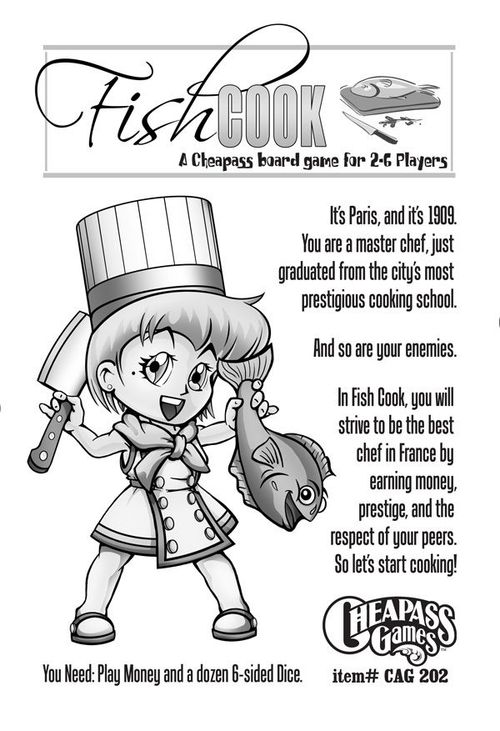
Fish Cook
Fish Cook Rulebook
Table of Contents
Table of Contents
Game Info
- Players: 2-6
- Playing Time: 45 min.
Components
Included in the Game:
- Fish Market Board (2 sections)
- Farmer's Market Board (2 sections)
- 36 Recipe Cards
- 102 Ingredient Tokens in 6 types
- One Leader Token (Chef)
- Five Day Markers (Cats)
You Also Need:
- Money in denominations of $1, $5, and $20 / $25, enough for about $250 per player.
- Twelve 6-sided dice.
Note: If you have at least one more 6-sided die, it will be easier to set up the Fish Market and the Farmer's Market at the same time.
At our house, we have a special die for each row in the Farmer's Market, so we can roll all the dice at the same time.
Setting Up
Give each player $100. Put the rest of the money in the bank.
Shuffle the recipe cards and deal two cards to each player, face down. These represent each player's "family recipes." You never just draw more cards, but you can buy cards, as described later.
Place the Fish Market and Farmer's Market in the middle of the table, with space for the Cooking School between them, as shown below. The Cooking School is just empty table space containing four face-up recipe cards, the deck of recipe cards, and the day markers.
Set out day markers (the tokens with cats) based on the number of players:
| Players | Days |
|---|---|
| 2 | 3 |
| 3 or 4 | 4 |
| 5 or 6 | 5 |
The player who has most recently cooked will take the chef token and the first turn. It's up to your group to decide what qualifies as "cooking." Putting milk on cereal probably doesn't count.
If you play another game with the same group, the winner of the previous game will go first.
On Each Day
A "day" consists of two parts: Morning and Evening. In the Morning, players can buy goods from the Farmer's Market, fish from the Fish Market, and cards from the Cooking School. In the evening, players will cook.
Preparing for the Morning
At the start of each day, refill the Fish Market, Farmer's Market, and Cooking School, as follows:
The Farmer's Market: Roll a die for each row in the Farmer's Market.
Each row in the market has small dice icons in some of the spaces, showing how to fill the row. Fill each row from left to right, up to the designated spot.
For example, in the row below (the Roe/Ginger row), if you roll a 2 or a 3, you fill the row to the third spot, because that spot is marked with a 2 and a 3.
If the row is already filled to that level or higher, then you will leave it as it is. You never have to remove anything when setting up the Farmer's Market.
The Fish Market: Roll the 12 Fish dice, and sort them into the appropriate spaces in the Fish Market. Fill each row from right to left. (This is backwards from the Farmer's Market, because both markets have the more expensive spaces towards the middle of the layout.)
Each row can only hold five fish. If you roll more than five fish of the same value, re-roll the extras.
The Cooking School: The School is between the Market boards. It contains four face-up recipe cards, and the deck. Each day, add new cards until there are four, leaving any cards from the previous day.
Playing the Morning
In the morning, the players can buy all the things they need for cooking.
Starting with the leader (the player holding the chef token), and proceeding clockwise, players take turns buying one item at a time.
With each buy, a player may do one of the following:
Buy a Fish. Take a fish from the Fish Market, and pay (to the bank) the price marked on that space.
Buy an Ingredient: Take an item from the Farmer's Market, and pay the price marked on that space.
Buy a Recipe: Buy a card from the School and put it in your hand.
The price for a face-up recipe is $5.
You may also buy the top card of the deck (keeping it face down) for $2.
Pass. Buy nothing. Passing does not take you out of play, but if everyone passes in turn, the morning will end.
Ending the Morning: The morning ends when any single row in the Farmer's Market is empty. For example, if someone buys the last Sake, this will empty that row of the Farmer's Market, and cause the morning to end.
When the last item in a row is bought, it's customary to ring a bell (not included). Every player then gets one more buy, including the player who bought that item.
When the bell is rung, pass the Chef to the next player (the player after whoever bought the last ingredient). This could move the Chef to anyone, even the player who currently has it.
The player holding the Chef will cook first in the evening, and will also go first on the next day.
Other Ways to End the Morning: The morning also ends if the Fish Market is completely empty (with the same Chef passing rules as above), or if all players pass in sequence. In the latter case, the chef marker goes to the next player in sequence, after the last player who passes. (This hardly ever happens.)
Playing the Evening
In the evening, players take turns making recipes. Players will make one recipe at a time, taking turns as they did in the morning, until all the fish are gone.
Basic Rules of Cooking: To make a recipe, you must spend all the ingredients shown on the card (one of each), as well as a fish of the appropriate value.
The ingredients must match exactly, but the fish can be any size of the required value or higher. Thus, for example, if your recipe calls for a size-4 fish, you can actually make it with a 4, 5, or 6.
Playing a higher value of fish does not change the dollar value of the recipe, but it does give you some flexibility with larger fish.
Note: Pay attention when you buy fish, because sometimes bigger fish are cheaper, and therefore strictly better, than smaller ones!
Each recipe has two cash values: a larger main value, and a smaller bonus value. When you cook a recipe, you always earn the larger number, but the bonus is awarded differently depending on who owns the recipe.
Details of Cooking
You can make any recipe you can see, anywhere on the table. It can be in your hand, in the school, or in anybody's menu. Here are the details:
Make a Recipe from Your Hand: Collect the money indicated on the card, including the bonus. The card is placed face up on the table in front of you, as part of your "menu." (Your menu represents the signature dishes for which your restaurant is known.)
Make a Recipe from the School: Collect the money indicated on the card, but not the bonus. Add the recipe to your menu, as described above.
Note: You do not have to pay for these recipes, as you would in the morning. You're basically "stealing" it from the School.
Make a Recipe from Your Own Menu: This earns you the money again, including the bonus.
Make a Recipe from Another Player's Menu: Collect the money for the recipe. The recipe's current owner gets the bonus.
Now you have a chance to steal the recipe, as follows:
Roll a die. If you roll equal to or higher than the bonus value of the recipe, steal it. Move the recipe card into your menu.
An example: if the recipe has a bonus value of 4, you must roll a 4 or higher to steal it.
Passing: In the evening, you must pass if you can't cook anything.
If you pass while you still have fish, you must throw one fish away.
Ending the Day
The day ends when all players' fish are either cooked or discarded.
At the end of the day, remove one day marker from the cooking school. If today was the last day, the game is over.
Otherwise, refill the Markets and the School, and play another day.
Market ingredients will keep from day to day, but all fish spoil. They must always be either cooked or discarded.
Ending the Game
At the end of the game, players will collect a "menu bonus" as follows:
For each rank of fish (size 1, size 2, etc), award a menu bonus to the player who has the most recipes of that rank.
The bonus is the same as the rank of fish: $1 for the size-1 recipes, $2 for the 2's, and so on.
If there is a tie for most recipes, all the tied players receive the full bonus.
After the bonuses are awarded, count up your money. The player with the most money wins!
Designer's Notes (James Ernest, 2013)
The current version of this game is set in a strange crossover universe between France and Japan. The dishes are clearly Japanese dishes, but thematic elements are also left over from the original French design.
There is an odd abstraction in Fish Cook that dates back to the original game, in which a "day" seems to have both the concrete length of one day (fish go bad at the end of each day) and a more abstract length of "part of one's career," which could represent a number of months or even years. We believe this is a charming artifact of the original design and have made no attempt to fix it.
It is delightful to see how much game design has evolved in the last 104 years.
Completely Untrue Background
This game, originally entitled "Claude Hubert la Criée," was designed and published by the French chef Jacques de Flandres in 1909, as part of his "Jeux Cuisines" series.
De Flandres went on to create other cooking games, but none was more successful than his earliest work.
In the 60's, 70's and 80's, there was a resurgence of the cooking genre, with several new cooking games that owed a debt to de Flandres.
In 1994, Shimizu-Leifan Holding Company (SLHC) released "Yum Yum Super Fish Delicious" which was a direct copy of de Flandres' original game. Cheapass Games has licensed this game, to be released in English as "Fish Cook."
Other False Historical Notes
Copies of the original game Claude Hubert la Criée are difficult to find.
The game was originally released in France in 1909 as the first in Jacques de Flandres' "Jeux Cuisines" series. All the games in the series were based on the same basic mechanics, with Fish Cook being the original and most popular. Some images from the game appear in catalogs of the time, and a very small number of intact copies survive in the hands of private collectors.
Throughout the 60's, 70's and 80's there was a revival of the fish cooking game genre, including Owen Pordland's Fishcraft, and Works and Sundry's game Beyond the Sea, both of which owed a clear debt to de Flandres. There was also a humorous cooking game called Bring your Fish to Work Day, published in the October 1997 issue of Parody Title Magazine.
There is some controversy over the intellectual rights in this edition, specifically whether the Japanese publisher, Shimizu-Leifan Holding Company (SLHC), who released Yum Yum Super Fish Delicious in 1994, had a clear right to the game mechanics. It appears that no French patent or trademark existed on the original game, and so in theory Shimizu-Leifan was within their rights to copy it with no legal obligations to the heirs of Jacques de Flandres, the game having fallen out of copyright.
Hoping to rise above such petty issues as copyright and trademark law, Cheapass Games is proud to release this English translation of Yum Yum Super Fish Delicious under license from SLHC. We hope that our cavalier attitude with regard to the true pedigree of this game will serve as an homage to de Flandres' original high concept of stealing fish recipes without giving due credit.