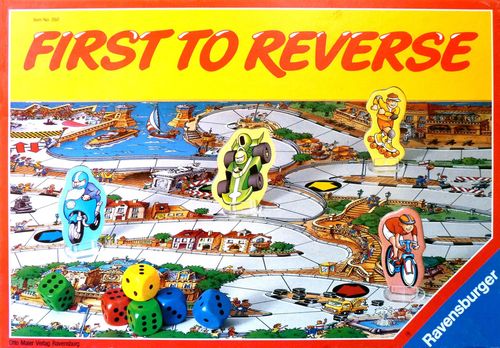
First to Reverse
First to Reverse Rulebook
Table of Contents
Table of Contents
Object of the Game
Four racing drivers hold a joint race. As soon as one racer reaches their turnaround point, everyone turns around. The first to race through the finish wins the race.
Contents
- 4 racer pawns in 4 colours (a race car driver, a motorcycle rider, a bicycle rider, a roller skater)
- 4 stands
- 6 dice in 4 colours (yellow: 1-3 points; red: 1-6 points; blue: 1-3 and 1-6 points; green: 2 x 1-6 points)
- 1 game board
Setup
The racer pawns are placed into the stands. Each player receives one racer pawn and the die or dice in the same colour. The racer pawns are placed on the start space, where the winner's podium also stands. The start space is at the same time the finish space. Play proceeds clockwise.
Because the roller skater always goes first, followed by the bicycle rider, then the motorcycle rider, and finally the race car driver, it is advisable to arrange the seating to match this order.
Turn Order and Dice
The "roller skater" begins. They roll their yellow die and move their pawn as many spaces as the die shows. Then the "bicycle rider" rolls their red die, then the "motorcycle rider" rolls their two blue dice, and finally the "race car driver" rolls their two green dice. The points of the motorcycle rider's dice and the race car driver's dice are each added together.
Turnaround Points
On the long road there are four colourful arrows in black circles. These are the turnaround points for the racer pawns. Each racer pawn heads for its own turnaround point (the roller skater the yellow turnaround point, the bicycle rider the red turnaround point, and so on).
If a racer pawn reaches a turnaround point that does not match its colour, this has no effect. In that case the space is just like any other space.
As soon as a racer pawn has reached its own turnaround point, this means for all players: all racer pawns turn around and head towards the finish, that is, take the opposite direction of travel and race back to the starting space (= finish space).
A turnaround point does not have to be reached with a matching number of points. Any surplus points can be used to move straight back towards the finish.
Example: A player who rolls a five three spaces before their turnaround point can immediately move two spaces back towards the finish.
Two racer pawns may never stand on the same space together. If a space is occupied by another player, the following player must skip one turn, i.e. their racer pawn stays on its space until the next time that player is up to roll the dice.
End of the Game
The player who reaches the finish first is the winner of this race and may stand at the very top of the winner's podium. The trophy is already waiting.
The game ends when all participants have reached the finish (surplus dice points are forfeited).
Equal Chances, Unequal Opponents
A player who feels disadvantaged, because they believe they received a slow racer pawn, or because they chose a fast racer pawn that unfairly had to cover a much longer route, should know that the dice points of the individual racer pawns and their routes are precisely balanced, so that everyone has the same chances.
Tip for Parents, Grandparents, Aunts, Uncles and Others
Small children can also take part if the youngest player gets the roller skater with the simple yellow die of 1-3 points.