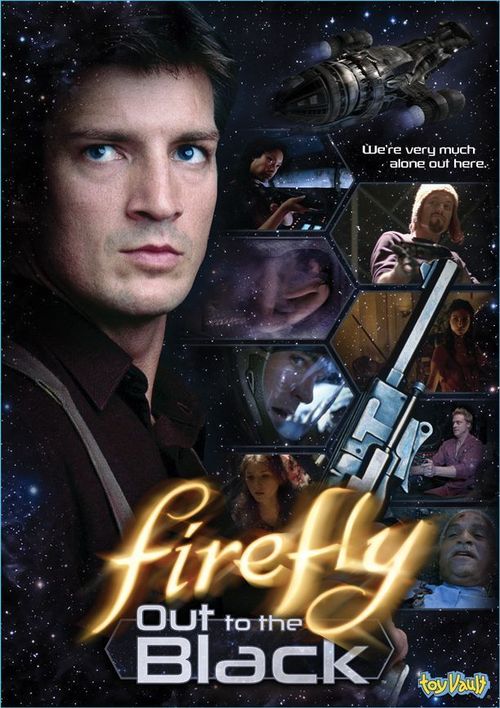
Firefly: Out to the Black
Firefly: Out to the Black Rulebook
Table of Contents
Table of Contents
Components
- 9 Character Cards
- 22 Event Cards
- 36 Serenity Cards
- 14 Alliance Cards
- 16 Gorramit Cards
- 15 Honor Tokens
- 15 Credit Tokens
- 1 set of rules
Players: 3-5 Game Time: 60 minutes
Definitions
Skill: There are three Skills in the game: Fightin, Flyin, Thinkin. Every Event will require the players to have a certain amount of Skill Points in those three skills.
Skill Points: Each Skill has a value called Skill Points. The players need an amount of Skill Points equal to the Target Number to be successful when completing an Event.
Target Number: The amount of Skill Points needed to be successful in the skill.
Active Player: Whoever's turn it is, is the Active Player.
Participating Player: A player participating in an Event, including the Active Player.
Result Number: This is the number in the box in the lower left corner of the Serenity cards. These numbers range from 1-6. They are used for randomizing results.
Result Card: When a Result Card is called for, draw the top Serenity card, and look at the Result Number. The rest of the card is ignored.
Specialty: Some characters have a specialty in one or more skills. This is denoted by the skill name being in Italics.
Example: Jayne's Fightin' Skill is in Italics, it is his specialty.
Setup
-
Remove the Event cards marked 5+ for a game with 3 or 4 players. Remove the Event cards marked 4+ for a game with 3 players.
-
Shuffle the Event and Alliance Decks, deal the amount of cards listed below face down to the center of the playing area. The rest are removed from the game without looking at them.
| Players | Alliance Cards | Event Cards |
|---|---|---|
| 3 | 4 | 8 |
| 4 | 5 | 10 |
| 5 | 6 | 12 |
-
Each player chooses a character that they will represent during the game. Each Character card has the character's abilities, Skills, as well as a hand size.
-
Shuffle and deal the Serenity Cards. Each player receives their Starting Hand Size. The remaining cards form the Serenity Deck.
-
Shuffle the Gorramit deck and place it next to the Event deck.
-
Place 8 Honor Tokens and 8 Credit Tokens in the middle of the playing area. These are the starting Honor and Credits for the crew. The rest are set to the side.
-
Choose the starting player, play continues clockwise from that player.
Sequence of Play
Each player in turn performs the following actions until the game ends.
-
Action Phase: The Active player chooses to activate an ability, play a Serenity card, take a Credit or Honor action, or pass.
-
Event Phase: The Active player turns over the top Event card. The Event cards represent challenges for the players to overcome during the game. After the Event is revealed, all players, beginning with the Active player, have an opportunity to play Serenity Cards to help successfully complete the Event.
-
Event Resolution Phase: Reveal a Gorramit card, and follow its effects. Then draw three Result Cards (Serenity Cards) and refer to the result number in the lower left corner. These are added to the total skills in each category, Fightin, Flyin, and Thinkin. Compare the results against the Event Target Numbers. Resolve the Event.
-
End Game Phase: Check for the end of the game.
Action Phase
An Active player can only do ONE action in the Action Phase. Taking an action in the Action phase doesn't prohibit an Active player from performing actions in other phases. Other players cannot perform Actions during the Action phase. There is one exception: a player may play the Sacrifice Serenity card during ANY action phase.
Game Abilities
Each character has a game ability on their character card. Each game ability can only be used once per game. This is per PLAYER, so if a player swaps characters at some point during the game, they do not get an additional game ability.
Serenity Deck Actions
Certain cards can be played during the Action phase, however most Serenity cards are played during the Event phase. Each card specifies when it can be used: Action Phase, Event Phase, or Resolution Phase.
Honor or Credit Actions
A player may spend Honor or Credits on any action listed on their character card. However, they can only perform ONE action in the Action Phase and only if they are the Active player. Each Action should specify when it can be used: (A): Action Phase (E): Event Phase (R): Resolution Phase.
Event Phase
Sequence
- Reveal Event Card
- Active Player chooses participating players
- Active player plays cards or uses Credit/Honor Actions
- Each participating player, in clockwise order, plays cards or uses Credit/Honor Actions
- Non-participating players may then play Serenity cards.
Event Cards
Once a player has done his actions, he must turn over the top Event card.
Title: This is the name of the Event.
Type of Event: There are Single Player Events and Multi-Player Events. If the Event is multi-player, then there is a number following the text that determines how many players will be involved in the Event. The Active player chooses which other players are involved.
Skills needed: Each Character has three skills, Fightin, Thinkin, and Flyin. Each Event has a Target Number associated with each skill. The characters need to achieve this amount or more to successfully complete the Event. This is called a Skill Check.
Victory Levels: Each Event has four levels of victory. Once the Event has been turned over, the Active player chooses which other players will participate in the Event if it is a Multi-Player Event.
| Successful Skill Checks | Level of Victory | Abbreviation |
|---|---|---|
| 0 | No level of Victory (Usually really bad results) | VL0 |
| 1 | First Level of Victory (Bad results, but not as bad as No Victory) | VL1 |
| 2 | Second Level of Victory (Generally neutral results) | VL2 |
| 3 | Third Level of Victory (Good results) | VL3 |
Example card: "Hands of Blue" (Multi-Player Event 3)
- Fightin 12, Flyin 6, Thinkin 9 (Target Numbers)
- VL0: 3 All
- VL1: 1 All, -2 Cr, -1 Ho
- VL2: +1 Cr, -1 Choice
- VL3: +3 Cr
The Active player then has an opportunity to play cards or use any Credit or Honor Actions. Any Serenity card that can be played in the Event phase can be used.
Most Serenity cards are placed face down in front of the player. Any skill card that matches the Specialty of the character is played face up. A character's specialties are printed in italics.
Example: Inara plays three Serenity cards, a +1 Flyin, +1 Thinkin, and +1 Fightin. Inara's specialties are Flyin and Thinkin, so she plays those two cards face up, and the Fightin card is played face down.
If the Event is multi-player, the participating players can play cards as well. Starting clockwise from the Active player, each participating player has the opportunity to play cards or take Credit or Honor Actions. This continues until each player that is participating in the Event has gone. Then each non-participating player, clockwise from the Active player, may choose to play Co-Pilot, Lend a Hand, or I Got an Idea cards. These are always placed face down.
Resolution Phase
Sequence
- Reveal and apply a Gorramit card
- Reveal Fightin' Result card
- Reveal Flyin' Result Card
- Reveal Thinkin Result Card
- Assign Wild bonuses
- Players may use any Game Abilities, Credit or Honor actions or Serenity Cards.
- Compare the Total Skill versus each Target Number to determine the Victory Level.
Once all cards are played, reveal the top Gorramit card. This will affect the current Event only.
After revealing the Gorramit card, the Result cards are turned over. Result cards are turned over sequentially: the first applies to the Fightin' Skill test, the second to the Flyin' Skill test, and the third to the Thinkin' Skill test.
Next, compare the total of the character's skills, any Serenity cards played, and the Result Number, to the Target Number on the Event card. If the total is equal to or higher than the Target Number, they have succeeded in that contest.
Wilds may be used as the Active player wishes, and he may assign these after seeing all the results.
Any participating player may play a "Last Minute Boost" or "Sneaky" card, or an ability that activates in the Resolution phase.
Once all players have performed all the actions they wish, count up the amount of successful skill checks made and refer to the level of victory chart on the card to determine the results of the Event.
Explanation of Level of Victory Chart
| Event Result | Effect |
|---|---|
| Alliance Card (All) | Draw the appropriate amount of Alliance cards. Each Alliance card resolves if more than one is drawn. If there is a negative number, then return any already played Alliance card to the bottom of the deck. You may not rearrange the order of the drawn Alliance cards. Alliance cards do not affect the Event that caused them to come into play. |
| Honor (Ho) | Gain or lose the amount of Honor listed. |
| Credit (Cr) | Gain or lose the amount of Credits listed. |
| -X Choice (Choice) | The Active player may choose to lose either Credits or Honor, or he may instead draw that many Alliance cards. |
| +X Choice (Choice) | The Active Player may choose to gain either Credits or Honor. He may not return Alliance cards. |
End Game Phase
Now it is time to check to see if the players have lost or won.
The players win the game by completing all the Events in the deck.
The players lose if they have zero or less Credits or Honor. The players also lose if they draw the last Alliance card.
If the game has not ended, the player to the left of the Active player is now the Active player and starts a new turn.
Character Cards
Each Character card shows the character's name, Skills (Fightin, Flyin, Thinkin), Starting Hand Size, Game Ability, and Credit and Honor Actions.
Example card: Mal
- Skills: Fightin 2, Flyin 1, Thinkin 1
- Starting Hand Size: 5
- Game Ability: Draw to Starting Hand Size, then give 3 cards to any other players.
- Credit Actions:
- A: 1 Credit: Draw one card, limit 5 in hand.
- A: 2 Credits: Draw one card, limit 5 in hand, and each other player draws 1 card.
- E: 1 Credit: Each Player draws one card, limit 0 in hand.
- Honor Actions:
- R: 1 Honor: Redraw all result cards.
- E: 2 Honor: Draw 2 result cards for any Contest. Use the higher result.
- A: 0 Honor: Trade 2 Credits for 2 Honor.
Game Abilities on Character Cards
Each Character in Firefly: Out to the Black has one Game Ability, listed on the left side of the Character card. Game Abilities can be used only in the phase which is listed at the bottom of the card. Shepard's [sic] ability is active as long as he is the Active character.
Unless stated otherwise in the ability, Game Abilities can only be used on the Active Player's turn.
Example: Mal can only draw cards during his Action Phase. However, Jayne, since the text says "participating," can use his power anytime he is participating in the Event, even if he is not the Active player.
Credit and Honor Actions on Character Cards
Each Character also has Credit and Honor actions. Each of these actions has an abbreviation of what phase the action can be taken in:
- A = Action Phase
- E = Event Phase
- R = Resolution Phase
Unless the character is the Active Player, he cannot use any (A) Honor or Credit actions. Unless the character is participating in the Event, he cannot use any (E) or (R) Honor or Credit actions.
Several of these abilities mention "limit X in hand." When this ability is used, if a player has X or less cards in their hand, they gain the benefit of the ability; if a player has more than X, then they do not gain the benefit.
Example: Mal has E: 1 Credit: Each a player [sic] draws one card, limit 0 in hand. During the Event phase (E), Mal may spend one Credit and any player with 0 cards in hand may draw 1 card.
Example: Inara has A: 1 Credit: Draw one card, limit 7 in hand, and Mal may draw one card, limit 2 in hand. During the Action Phase (A), if Mal has 1 card and Inara has eight cards, then only Mal would draw one card, as he is equal to or under the limit, but Inara is not.
Serenity Cards
Each Serenity card has a Title, a Wild or Serenity Card marking, a "When it Can be Played" line (Event, Action, or Resolution), a Text box, and a Result Number in the lower left corner.
- Regroup: This card can be played during your Action phase.
- Last Minute Boost: A Last Minute Boost card can be played on a Result card that was already redrawn during the Resolution phase.
- I Got an Idea, Lend a Hand, Co-Pilot: These are the only cards a player can play during the Event phase when not participating in the Event. These each add one to the total skill. They are NOT considered Fightin, Flyin, or Thinkin cards. They cannot be played by a participating player.
- Sneaky: You cannot choose an Alliance Card penalty as a Choice result, then use Sneaky.
- Strength, Psychic, and Maneuvers: When played during the Event phase, it allows the skill bonus cards of the right type to be treated as Wilds. This applies to all of those cards played, not just the ones played by the player who played Strength, Psychic, and Maneuvers. Note that this means the cards WILL be affected by the Gorramit Card Hwoon Dahn.
- Help: Choose a player not participating in the Event and choose one skill. That character's skill level is added to the skill total. If all players are participating in the Event, then the card cannot be played.
Example: The Event is Train Job, a Multi-Player 2 Event. Mal and River are participating in the Event. They've played no fighting bonus cards, and the Result card was "1". Adding up Mal and River's skill, they get a total of 5. They add the one for the result card and get a total of "6." They need a total of 7 to be successful at the Train Job, so River plays Help. River chooses Jayne to add his Fightin to the Event. Jayne's Fightin is 3, this is added to the total of 6 for a new total of 9. This is enough to be successful!
- Sacrifice: This card can be played during any Action phase. The player must have two cards to discard to play this card.
- Fightin +1, Fightin +2, Thinkin +1, Thinkin +2, Flyin +1, Flyin +2: These are skill bonus cards. They must be played face down during the Event phase, and are added to the skills of the participating characters. A character may play skill bonus cards that match his Specialties face up. Once played, they are used, whether or not they are needed.
- Wild +1, Wild +2: These are used a bit differently. They are played during the Event phase, but are not used till the Resolution phase. Wild cards are always played face down. The Active player may look at all the Result cards, THEN assign the Wild card to a skill of his choice. If there is more than one Wild card, each card can be assigned to a different skill. The Wild +2 card CANNOT be split between two different skills; it must be assigned to one skill.
If the Serenity deck runs out, reshuffle the discard pile to form a new Serenity deck.
Alliance Cards
The Alliance cards represent how close the Alliance is to catching the crew of Serenity. When an Alliance card is drawn, the Alliance gets closer to catching the crew, and following Events become harder to successfully complete. Each Alliance card has some effect on the game, but only the most recent card has an effect; previous Alliance cards have no effect on the game.
When drawing multiple Alliance cards, they are drawn one at a time. All Immediate Alliance cards will resolve before the next Alliance card is drawn. Next Event Alliance cards affect only the next Event, and DO affect the Event even if covered. Any Long Term Event will be covered before being resolved, except for the last card.
| Alliance Card Result | Effect |
|---|---|
| Credit Reward | Any Event with a positive Credit gain loses the amount listed, to a minimum of zero. Any Event with a Credit loss has the loss increased by the amount listed. If the Event has no Credit loss or gain, then no additional Credits are lost. |
| Honor Reward | Any Event with a positive Honor gain loses the amount listed, to a minimum of zero. Any Event with an Honor loss has the loss increased by the amount listed. If the Event has no Honor loss or gain, then no additional Honor are lost. |
| Next Event Result | These Alliance cards affect ONLY the next Event. They affect the Event, even if they are covered up. |
| Immediate Result | These happen immediately when the Alliance card is drawn, and there is no long-term effect while this is the active Alliance card. |
| Long Term Result | These effects continue to happen until this Alliance card is covered up. |
Gorramit Cards
Unexpected Shift: When this is drawn, the Active player is no longer the Active player, and chooses another non-participating player to take his place. If every player is participating, then this Gorramit card has no effect. Any cards played remain played, and the new Active player cannot play any Event phase Serenity cards. The game proceeds clockwise from the previous Active player.
Heavy Injuries: If this card comes up twice, it is within the rules to take a character that was previously chosen. Note, Game Abilities are done one per PLAYER, not character. So if you have already used the previous character's Game Ability, you are not allowed to use the new character's Game Ability. If Shepard [sic] is discarded through Heavy Injuries, he is considered to have used his Game Ability if he stopped the drawing of an Alliance card.
Hwoon Dahn: This card also affects Wilds produced by Psychic, Maneuvers, and Strength Serenity cards.
Life is Just Grand!: Yep, this is actually a good card for you!
Your Official Seal is out of Date: This ADDs one Alliance penalty regardless of whether one is there or not. So unless you achieve a VL3 result, you will draw at least one Alliance card. After resolving the Event, reshuffle the used Gorramit cards and the deck together. If the Gorramit card is canceled somehow, the Gorramit deck is NOT reshuffled.
Yolanda: The amount of players participating in the Event DO NOT CHANGE, so you could be running an Event with less players or more players. If the Gorramit card is canceled somehow, the Gorramit deck is NOT reshuffled.
Go-Se: If the Gorramit card is canceled somehow, the Gorramit deck is NOT reshuffled.
Playing Fair
Since the players are competing against the game, certain rules for player conduct must be followed.
- Players may never show each other their cards.
- Players may never discuss their individual cards other than the amount of cards they are holding.
- Players can only ask generally for help. You cannot say, "I need help flying!" You can say, "I'm not going to be able to complete this Event successfully!"
- Players may always choose to spend Honor or Credits. No other player can prevent another player from spending Honor or Credits. Players can discuss whether to spend it however.
- During the Resolution phase, the players may discuss the various actions they can perform before acting.
Example of Play
It is the start of the game, and Shepherd, Zoe, Inara and Kaylee are playing a four-player game. There are eight Credits and eight Honor in the starting pool. 10 Event cards in the Event deck, and five Alliance cards in the Alliance deck. Shepherd is the Active player.
Shepherd has a hand size of three cards:
- 1x Co-Pilot
- 1x Flyin +1
- 1x Fightin +1
Zoe is sitting to the right, and has a hand size of 7:
- 2x Flyin +2
- 2x Wild +1
- 1x Sacrifice
- 1x Lend a Hand
- 1x Thinkin +1
Inara is next, and also has a hand size of 7:
- 2x Fightin +1
- 2x Wild +1
- 1x Fightin +2
- 2x I Got an Idea
Kaylee is last, and has a hand size of 5:
- 2x Flyin +1
- 1x Fightin +1
- 1x Sneaky
- 1x Co-Pilot
Shepherd starts off with his Action phase. He could pass, but chooses to spend three Credits to draw a card for himself, Inara, Zoe, and Kaylee. He draws a +1 Fightin, Inara draws Lend a Hand, Zoe draws a +1 Flyin, and Kaylee draws a +1 Thinkin. Since he is only allowed one action during the Action phase, he is ready to move on to the Event phase.
He draws the Event: Grange Brothers. Grange Brothers is a Multi-Player Event with two players participating. Shepherd must participate, and he chooses Zoe to be the other participant. Next, Shepherd has to decide what cards he wishes to play. Between Shepherd and Zoe, they have a total of 4 Fightin, 1 Flyin, and 3 Thinkin. They need 9 Fightin, 7 Flyin, and 6 Thinkin. The tough ones are going to be the Flyin and Fightin. Shepherd chooses to play one of his Fightin +1 cards face down, and that's it. Zoe now looks to see what she would like to play. Zoe is a bit concerned with Shepherd only playing one card, and plays a +2 Flyin and a +1 Wild. Now Inara has an opportunity to play Lend a Hand, Co-Pilot, or I Got an Idea cards. She plays a Lend a Hand card. Kaylee now has the opportunity to play cards as well, but seeing the four cards already played, keeps her cards.
Shepherd moves to the Resolution phase. First he flips a Gorramit card and gets "Your Official Seal is Out of Date." It looks like an Alliance penalty is in the cards. Next, he turns over his cards and sees he now has 6 Fightin, 3 Flyin, and 3 Thinkin, plus one Wild. He draws a Result card for Fightin, Flyin, and Thinkin. He draws a 1 Fightin, 1 Flyin, and 5 Thinkin. This gives him a total of 7 Fightin, 4 Flyin, and 8 Thinkin. He aces the Thinkin, but fails both Fightin and Flyin. His +1 Wild won't help in either Flyin or Fightin, as he needs at least +2. This gives him a Victory Level of 1. Kaylee doesn't like the result, and decides to spend 2 Honor to use her Honor action to redraw the result cards. She draws another 1 for Fightin, but draws a five for Flyin. This makes the total 8 Flyin. This raises the VL to 2. Looking at the Event card, Shepherd takes 1 Credit and chooses to lose 1 Honor. If Kaylee hadn't spent 2 Honor on her Honor action, then Shepherd would have removed three Credits and two Honor, leaving just 3 Credits and 6 Honor. Because of the Gorramit card, one Alliance card would normally be drawn since he didn't hit VL3; however, Shepherd's ability activates, and no Alliance penalty is drawn. The Serenity cards are now discarded, and Inara begins her turn with her Action phase.