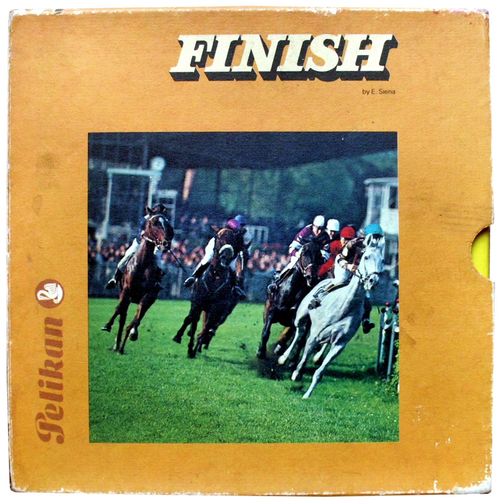
Finish
Finish Rulebook
Table of Contents
Table of Contents
What It Is About
With a certain amount of capital you buy horses at auction (or not), take part in one, several or all of the races on the programme (or none at all), and place betting wagers, as cautiously or as recklessly as you like. You will certainly have a lot of fun doing so, even as a passive spectator, but so far nobody has ever succeeded.
Start Immediately
Hand out the betting forms and pencils. Place the horses on the first spaces of the track (two spaces behind the actual starting line). Shuffle the horse cards and the jockey cards, and place them in separate, face-down piles on the table.
The Horses
At the top of each horse card is a row of numbers that tells you how quickly the horse will run the 6 races. Horses differ in nature. This is what you should consider when you want to buy a horse or make a bet.
At a glance you can see whether a horse's condition is such that it starts well, holds firm, and has the chance to win a fast race. However, nobody can tell how the race will actually develop.
The Jockeys
On the racecourse you meet Europe's best jockeys. Each has a tactic of spurring on his horse in certain phases of the race. This is indicated by numbers on the jockey cards.
There is also a red circle on the jockey card in which you can write your track number in pencil, to erase it after each race.
The Racecourse
The racecourse lies in front of you; the start and the finish are easy to tell apart. The tracks are numbered 1 to 6. On each track there is a space marked with a white cross. A horse that reaches it falls: it is eliminated and may no longer start in this programme. The card in question is set aside and the jockey returns to the jockey pile.
The Auction
Each player receives 10,000 for buying horses and for betting. Take the first six horse cards and sell them one after another at auction (naturally you may also bid yourself).
The minimum bid for each horse is 1,000. The horse goes to the last (highest) bidder. He takes the card and pays the sum to the bank, and at the same time notes it on his betting form. He then receives jockey cards: the top jockey card is placed on the horse card so that the two rows of numbers lie one above the other. The player places these paired cards in front of him. The first horse occupies track 1, the next one track 2, and so on, until all 6 horses have found an owner.
A player may also buy several horses, but not more than three — which means that you can be without a horse, especially with many players. This should not be prejudicial, especially after very high bids: you can catch up with the bets. Horses not sold return to the stable.
The Bets
You now know the horses on the track, and from the jockeys' techniques you can judge their chances and bet on them to win or to place.
Each player makes 3 bets: 1 for "win" (victoire) and 2 for "place". He enters them on his betting form. Example:
| Track | Horse | Win | Place |
|---|---|---|---|
| 1 | Katzenbuckel | ||
| 2 | Schlagobers | 300 | |
| 3 | Napoléon | ||
| 4 | Hallodri | ||
| 5 | Moskito | 1,000 | |
| 6 | Lady Skunx | 500 |
The "win" bet. Whoever believes that a horse will reach the finish first bets on it to win. If he is right, he wins his stake multiplied by the win odds at the finish. If not, he loses his stake.
The "place" bet. Whoever believes that a horse will take second or third place bets on it to place. If he is right, he wins his stake multiplied by the place odds at the finish.
The finishing odds. The closer the horses come together at the finish, the higher the winning odds. The odds therefore depend on the horse that takes second place. The odds are shown along the last 5 spaces of the track.
Example: The winner crosses the finish line. If at that moment another horse is on the last space before the finish, the odds are 20 for a win (20 times the stake) and 10 for a place (10 times the stake).
If the third horse arrives on the 4th space before the finish, the odds are 4 times the stake. If the third horse arrives 6 spaces before the finish or further back, nothing is won.
In case of victory, the player's own horses obtain 4 times their purchase price; the horse placed second pays double its purchase price, and the horse placed third pays the simple purchase price.
The Race
The Start
As in real races, the horses do not always get off to a good start. Roll all 6 dice. The horses whose track number has come up advance two spaces toward the starting line; those dice are set aside. Roll the remaining dice again: the horses whose track number now comes up advance one space. Horses whose track number has not come up stay on their initial space.
Example: The 6 dice show 1 – 1 – 4 – 5 – 6 – 6. The horses on tracks 1, 4, 5 and 6 advance toward the starting line; those on tracks 2 and 3 stay where they are. The dice are then rolled again and show a 2 and a 6. The horse on track 2 advances one space, while the horse on track 3 stays where it is (because no 3 was shown).
To mark the number of races run, place one of the dice with the 1 facing up on the "Runde" (round) space. At the next race it will show a 2, and so on.
On the Track
Roll 2 dice again, one for the "Bahn" (track) space and one for the "+" space. Roll the "Bahn" die and place it on the "Bahn" space. It indicates the horse that starts the race, and the order in which the other horses follow it.
Example: The die shows 4. The horse on track 4 starts the race, and the horses on tracks 5, 6, 1, 2 and 3 follow in turn.
At the same time, roll the third die for the "+" space. It indicates by how many spaces each horse may advance additionally in this race (a tailwind). This number of points is added to the rows of numbers of the horse and the jockey. The jockey cards are placed on the horse cards so that the jockey sits well in the saddle and the two rows of numbers can easily be added together: in the first race you add the figures of the first square of the jockey and horse cards; in the second race, the figures of the second square, and so on. This sum is then increased by the number of points on the "+" die in each race.
Example: On track 4, Ernö Lundquist rides Katzenbuckel in race no. 1 (8 + 0). The "+" die shows 5. Katzenbuckel (8 + 0 + 5) therefore advances 13 spaces.
Each Race
A game consists of several races. For each race:
- The die on the "Runde" space must show the number of the race.
- The dice are rolled again to fix the track on which the race starts.
- The value of the "+" die must be set again with one roll of the die.
This die also decides whether a race proceeds quickly or drags on in length.
At the Finish
When a horse crosses the finish line it is the winner. The other horses no longer advance and so mark their finishing places. Players can then proceed with the distribution of prizes according to the odds shown on the game board. If two horses are level, their owners must decide the better place by rolling the dice.
The first race is then finished and the jockeys return to their pile. The cards are shuffled again and the next race begins!