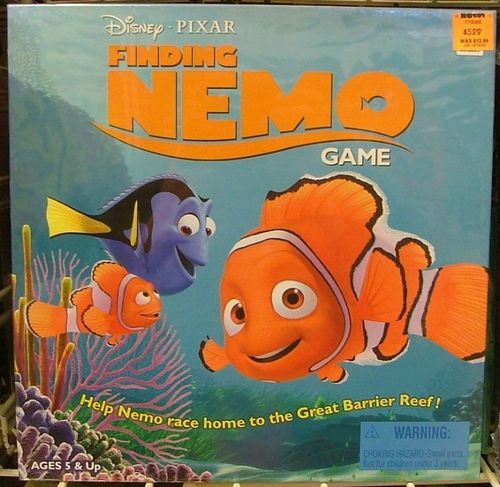
Finding Nemo
Finding Nemo Rulebook
Table of Contents
Table of Contents
Object
Be the first player to move your Nemo pawn from its START space to the HOME space.
Contents
- Gameboard
- 50 Path tiles
- 4 Nemo pawns and stands
- 2 Dice
- Label sheet
The First Time You Play
- Detach the Nemo pawns and path tiles from their sheets. Discard the waste.
- Fit each Nemo pawn into a stand.
- Apply labels to the Tile die and the Move die, as directed on the label sheet.
Let's Get Ready!
- Choose a Nemo pawn, and place it on any open gameboard START space. All players do the same.
- Place the path tiles facedown inside the box, and mix them up. Take 3 tiles from the box (no peeking!), and place them faceup in front of you. All players do the same. Leave the rest of the tiles in the box.
The 2 Gameboard Areas
The gameboard is divided into 2 areas: the Sewer and the Ocean. See Figure 1.
Figure 1 labels: Home Space, Ocean, Sewer, Start Spaces.
The Sewer: In this area, move your pawn along the sewer pipes toward the Ocean (where the HOME space is located). Place and remove path tiles in this area, to connect sewer pipes and open pathways for your pawn. Also place and remove tiles to block the paths of other pawns!
The Ocean: Path tiles are not allowed in this safe area. Once you reach the Ocean, you can quickly head for the HOME space!
Let's Play!
The youngest player goes first. Play then continues clockwise.
On Your Turn
Follow the 3 steps below, in order. Your turn is then over.
- Roll both dice.
- Follow the directions on the Tile die. See Placing and Removing Tiles.
- Follow the directions on the Move die. See Moving Your Pawn.
Placing and Removing Tiles
Place and remove tiles according to the Tile die, to create, destroy or change pathways along the sewer pipes.
- If you roll 0, do not place or remove any tiles.
- If you roll 1 or 2, place that many tiles.
- If you roll X, remove one tile.
- If you roll 1/X, place one tile, then remove a different tile.
How to place a tile: Place any one of your 3 tiles on a sewer space, or on top of a tile that's already been placed. Any number of tiles can be placed on a space.
You may place a tile on any gameboard space except an Ocean space, or a space with a pawn on it. After placing your tile(s), draw the same number of tiles from the box, and place them faceup in front of you.
Figure 2: On an opponent's turn, she places this tile to block your pawn.
Figure 3: On your turn, you place this tile on top of the tile that's blocking your pawn.
How to remove a tile: Take a tile off the gameboard, place it facedown in the box, and mix it up with the other tiles.
You can remove a tile from any space that does not have a pawn on it. Remove only the top tile from spaces with more than one tile. Figure 4 shows an example of removing a tile.
Figure 4: You rolled X on the Tile die. You remove a tile to open a path for your pawn.
Moving Your Pawn
- Move your pawn up to the number of spaces you roll on the Move die. If you roll 0, you can't move. If your pawn is blocked, you may not be able to complete your move, or to move at all!
- Move from one space to any space that's next to it (except diagonally). In the Sewer area, a sewer pipe must connect each space you move onto.
- Pawns can pass each other as they move, and can share spaces.
Figure 5 shows an example of moving your pawn.
Figure 5: You rolled 3 on the Move die. You can move only 2 spaces, because your path is blocked.
Reaching the Ocean
You can move directly from the Sewer area into the Ocean area, as long as a space or tile in the Sewer area connects to the adjoining Ocean space. In the example below, you rolled 1 on the Tile die and 2 on the Move die. You place a tile that connects to the ocean, as shown in Figure 6A; then you can move right in, as shown in Figure 6B.
Figure 6A and 6B: Illustrations of placing a connecting tile, then moving the pawn into the Ocean.
No tiles can be placed on the spaces inside the Ocean area. However, while your pawn is in the Ocean area, you must still roll both dice on your turn, and follow the directions on them.
How to Win
The first player to reach the HOME space (not necessarily by exact die count) wins the game!