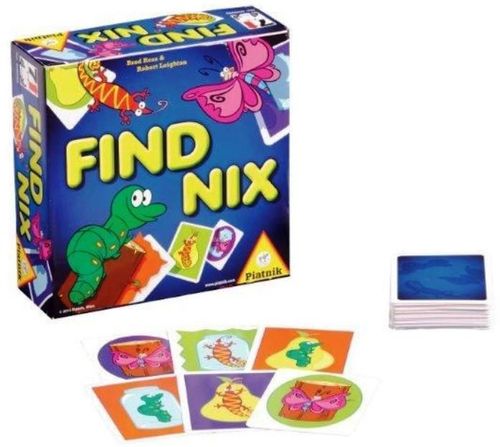
Find Nix
Find Nix Rulebook
Table of Contents
Table of Contents
Components
- 81 cards.
- 1 rules leaflet.
- Paper and a pencil for noting scores.
Each card shows four different elements:
- An animal: butterfly, caterpillar or salamander.
- A background: jar, tree stump or pear.
- A shape: oval, square or zigzag.
- A background colour: orange, green or violet.
Object of the Game
The player who scores the most points wins the game. Each player must get rid of their cards by finding the 2 or 3 elements in common between the elements of their card and the card lying on the pile.
Note: only the first player to finish their cards scores points.
Setup
- All the cards are shuffled and 5 are dealt to each player.
- The remaining cards are placed face down on the table to form the pile.
- The top card of the pile is turned face up.
- The player to the left of the dealer starts. Play then proceeds clockwise.
Translator's note: the source uses the single word "talon" both for the face-down stock of remaining cards and for the face-up pile that the played cards are placed on. Both are rendered here as "the pile".
Playing the Game
On their turn, the active player looks in their hand for a card that has either:
- 2 identical elements. They place this card on the pile, state the identical elements, and this card becomes the new reference card. It is then the next player's turn.
- 3 identical elements. They place this card, state the identical elements, and this card becomes the new reference card. The player gains the right to play a new card, which may let them play again if it again has 3 matching elements.
Example, 2 identical elements: the player says "I have Butterfly and Zigzag." It is then the next player's turn.
Example, 3 identical elements: the player says "I have Oval, Orange, and Pear." They may play again straight away.
If a player cannot play, they must draw a card. It is then the next player's turn.
A player who was allowed to play again because they had 3 identical elements is not obliged to play again if they have no card they can place.
End of a Round
As soon as a player has played their last card, the round ends and that player wins the round. The number of cards remaining in the other players' hands is added together, and the winner's score for the round is noted.
Example: Iris plays her last card and the round ends. Léa has 2 cards, Nicolas has 3 cards and Simon has 1 card in hand. Iris therefore scores 6 points, which are noted on a sheet of paper.
End of the Game
The game ends as soon as a player has reached the winning score:
- 2 players: 8 points
- 3 players: 10 points
- 4 players: 15 points
- 5 players: 20 points
- 6 players: 25 points
That player wins the game.
Translator's note: the box states the game is for 2 to 4 players, but the leaflet's table also gives thresholds for 5 and 6 players, which are transcribed as printed.
Remark: the number of points needed to win may be set at the start of the game, depending on whether you want a longer or shorter game.