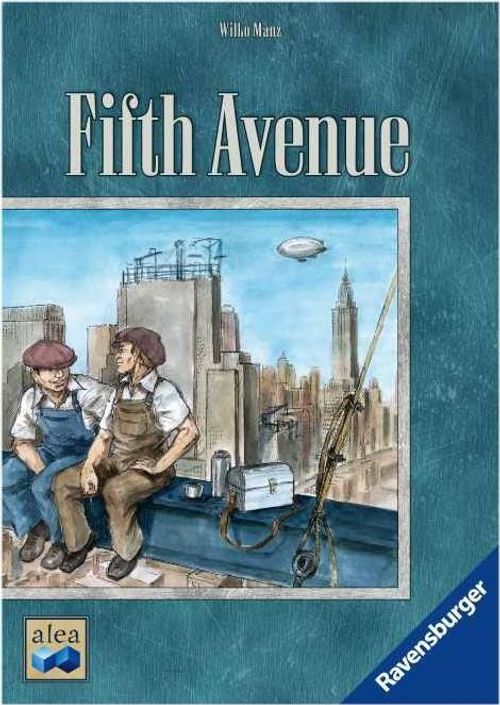
Fifth Avenue
Fifth Avenue Rulebook
Table of Contents
Table of Contents
Overview
Each player tries to earn the most victory points (VP). To earn victory points is not as simple as building the most skyscrapers. Rather, players score victory points by building skyscrapers in prestigious locations: those with many different businesses nearby. Thus, players will compete to build as many skyscrapers as possible in the best locations. This is the key to victory!
The players are offered four options for each turn, including, for example, placing a business or scoring a district. They may also choose to take the very important bidding cards. Only players who have the right bidding cards will succeed in the auctions when they come. It is only during the auctions that players have the possibility to build skyscrapers - and without skyscrapers, there can be no victory.
The game requires careful planning, sharp tactics, timely cooperation with your opponents, and wise placement of skyscrapers to find success on Fifth Avenue!
In the end, the player with the most victory points will be the winner!
Contents
- 1 game board (showing Midtown Manhattan, with City Hall, 7 districts, Central Park, a business supply row, and a scoring track)
- 60 colored bidding cards (5 of 4, 4 of 5, and 3 of 6 in each of 5 colors)
- 50 black bidding cards (20 of 4, 16 of 5, and 14 of 6)
- 72 skyscrapers (18 of each player color)
- 36 business tiles (9 each of boutique, jeweler, gallery, and perfume shop)
- 4 summary cards (one per player)
- 2 commissioners (to mark current districts)
- 6 commissioner markers (to mark visited districts)
- 2 building stop tiles (to mark the closed districts)
Preparation
Place the game board in the middle of the table. It shows 7 districts, each divided into 5 different colored building plots. On the left is City Hall (the starting space for the commissioners with 4 white and 4 beige colored spots). On the right is Central Park (the ending space for the commissioners). The scoring track runs around the board.
Note: on the back side of the game board, the map shows 6 building plots in each district. This allows another way for players to play the game (see special rules for this at the end of these rules).
Shuffle the business tiles face down, draw them one at a time, and randomly place one face up on one building plot in each district. When placing these business tiles, make certain at least one is placed on each plot color and none are placed so that more than two plots of a color are used.
Next, draw another 20 businesses, one at a time, and place them face up in the order drawn, from left to right on the 20 spaces of the business supply row near the upper edge of the board.
Place the 9 un-drawn businesses face down back in the box, without looking at them. They will not be used in this game.
Separate the colored bidding cards by color and shuffle each stack separately face down. Each player draws one card of each color as his starting hand. The players keep the cards in their hands secret from each other during the game. Next, place the remaining colored cards face up in 5 separate stacks next to each other near the game board. Place the stacks so only the top-most card in each stack can be seen. To be safe, you can also place the stacks face down, turning the top-most card face up each time one is taken.
Shuffle the black bidding cards face down. Each player draws 4 black cards, adding them to his hand. Place the remaining black cards in a face down stack next to the 5 colored stacks.
Each player takes one summary card, placing it face up in his play area (the area before him). On this side is a review of a player's turn options, the victory points players earn during scoring and building stops, and a skyscraper supply. On the back side is an example of the movement of the commissioners.
Each player chooses a color and takes, in that color:
-
1 skyscraper, placing it on the 0/80 space of the scoring track.
-
2 skyscrapers, placing them on the game board using these rules: the youngest (or starting player, chosen in any way the players want) first places one of his skyscrapers on any empty building plot. Next, his right neighbor places one of his skyscrapers on any empty building plot, and so on, until all players each have placed one skyscraper (in counter-clockwise order). Now, each player places his second skyscraper on the game board on any empty building plot, but this time in clockwise order, beginning with the player who placed his first skyscraper last.
Example: 1st placing round: Anna - Kevin - Ken - Alfonzo. 2nd placing round: Alfonzo - Ken - Kevin - Anna.
Small tip: if possible, players should try to place their 2 skyscrapers adjacent to the business tiles placed earlier.
-
3 skyscrapers, placing them on the supply space on his summary card. The skyscrapers in a player's supply are always visible to all players, so all know how many each player has in his supply.
Separate the remaining skyscrapers by color and place them next to the game board as a general supply. With fewer than 4 players, place the unchosen skyscrapers back in the box.
Place the 2 commissioners and the 6 commissioner markers on the appropriate colored spots on City Hall.
Place the 2 building stop tiles next to the game board.
Playing the Game
The following rules are for 3 or 4 players. The special rules for 2 players are on page 11 of the original rulebook (see "Special Rules for Playing with 2 Players" below).
The starting player begins and play continues from there in clockwise order. On a player's turn, he has four choices (A, B, C, or D), of which he must execute one completely on his turn: first, the 1st action, then, the 2nd action, and finally, the 3rd action.
The 1st action
A) Take 3 skyscrapers. The player takes 3 skyscrapers in his color from the general supply and places them in his supply on his summary card. There is no limit (except piece limit in the game) to the number a player can have in his supply.
B) Place a business. The player takes one business from the supply row near the edge of the board and places it on any building plot of his choice (see more on this under "The Businesses").
C) Take a black card and move a commissioner. The player takes the top-most card from the black stack, adding it to his hand without showing it to the other players. Next, he moves one of the two commissioners (see more on this under "The 3rd action").
D) Score a district. The player scores a district (see more on this under "Scoring Districts").
The 2nd action
A/B/C) Take 2 colored cards. If the player has chosen as his 1st action either take 3 skyscrapers, place a business, or take a black card and move a commissioner, he must take as his 2nd action take two colored cards. That means, he chooses any two of the 5 face up colored cards, takes them, and adds them to his hand. He must take cards of two different colors. He may not take a black card!
D) Take 2 black cards. If the player has chosen as his 1st action to score a district, he must take as his 2nd action take 2 black cards. He takes the top-most 2 cards from the face down black stack and adds them to his hand, without showing them to the other players.
Note: additionally, each player, who has no skyscraper in the scored district, now takes one black card from the face down black card stack, without showing it to the other players.
Example: Blue scores this district. He takes 2 black cards plus a third black card, as he has no skyscraper in this district. Green also takes 1 black card.
Note there is no hand card limit. A player may have as many black or colored cards as he can draw in his hand.
The 3rd action
A - D) Move a commissioner. Regardless of which action a player has chosen as his 1st action, he must move a commissioner as his 3rd action. When a player moves a commissioner, he moves either of the two, as he chooses. The players move the commissioners from left to right from City Hall, through the city to Central Park. On each move, the player either moves the chosen commissioner to the next (adjacent) district or Central Park (when that is next). If there are two or more possible adjacent districts (from City Hall, 34th Street East or West, and Times Square), the player may choose freely among them. After moving a commissioner from a district, the player places a matching commissioner marker (from City Hall) in the district just moved from to mark which districts the commissioner has visited.
Instead of moving a commissioner in the direction of Central Park, a player may move a commissioner already in Central Park (and only in such a case), back to City Hall. When this occurs, the normal game flow is immediately broken. The players now bid on building plots in the districts that were visited by the just moved commissioner (the commissioner markers show which ones) and build skyscrapers there (see more on this under "The Auctions").
A player may move a commissioner to any adjacent district, even if the other commissioner is there or if a marker for the other commissioner is there. In other words: players are not restricted in their choice of paths for a commissioner because of the presence or the path taken by the other commissioner. The two commissioners operate independently from each other.
Example: The player may either move the white commissioner from Central Park back to City Hall or the beige commissioner to Central Park.
Note: A player may not move a commissioner to a district with a building stop marker (see more on this under "Building Stop"). Instead, the player simply skips over the building stopped district (because of this, the path for a commissioner from starting space to Central Park may be fewer than four turns).
Example: The player may move the white commissioner to Central Park or to "52nd St. West". Or, he may move the beige commissioner to "42nd St. West" or "Times Square".
The Businesses
For the taking of a business tile from the supply row, the following applies: the supply row consists of 8 sets of spaces, each of which has 2 or 3 spaces. From these, the current set is always the left-most set in the supply that has at least 1 business tile in it. The player may take any business from the current set.
As soon as the second to the last business is taken from a set, the player immediately takes the last business in the set and places it face up in the area below Central Park. Now, the next set to the right becomes the new current set.
In other words: when a player places the 2nd business on a building plot from a 3 set or the 1st business from a 2 set, he immediately places the last business (in each case) face up in the area below Central Park.
Example: At this time, the player puts the boutique on a building plot and places the gallery face up in the area below Central Park. The player could, of course, have chosen the opposite way.
For the placing of a business tile on a building plot the following applies: a player may place a business tile on any empty building plot or on any building plot that has but one (identical or not) business. A player may never place a business on a building plot with 2 businesses or with one or more skyscrapers. Once a business has been placed, it remains in that place for the remainder of the game (exception: building stop).
Example: A player may place a new perfume shop only on the brown or the gray building plot.
Special scoring after the placing of certain businesses on building plots
Immediately after a player places the 3rd, 6th, or 9th business on a building plot (not the area below Central Park), there is a special scoring opportunity (these business numbers are also shown on the game board in the supply row):
- After the third business is placed on a building plot (that is, the first two sets are completely empty), each player immediately earns 4 victory points if he has at least 1 skyscraper in each of at least three different districts (not the area below Central Park). He moves his victory point marker 4 spaces forward.
- After the sixth business is placed on a building plot (the first four sets are completely empty), each player immediately earns 6 victory points if he has at least 1 skyscraper in each of at least four different districts (not the area below Central Park). He moves his victory point marker 6 spaces forward.
- After the ninth business is placed on a building plot (the first six sets are completely empty), each player immediately earns 8 victory points if he has at least 1 skyscraper in each of at least five different districts (not the area below Central Park). He moves his victory point marker 8 spaces forward.
- After the twelfth business is placed on a building plot (all sets are completely empty), the game ends. Here, there are no extra points for players.
Note: the area below Central Park is not a district. It does not count for the special scoring.
Scoring Districts
A player who chooses option D, must score a district as his 1st action. In the district he chooses, there must be at least one of the commissioners. A district with just a commissioner marker is not enough to be scored!
Neither City Hall nor the area below Central Park is a district, even though players may build in the area below Central Park. If one of the commissioners is either in City Hall or Central Park, a player choosing option D must score the district where the other commissioner is. If both commissioners are in City Hall or Central Park, a player may not choose option D.
Example: in fig. 03 (page 4), a player may score only "52nd St. East". In fig. 04 (page 5), a player may score either "34th Street West" or "Times Square".
Small tip: it is often not possible for a player to score a district where he scores more than his opponents. Thus, players should grab such an opportunity when it presents itself.
Each skyscraper in a scored district earns its owner victory points. The number of points earned is based on the number of directly adjacent different business types. If a skyscraper is adjacent to several businesses of the same type, only one counts toward the scoring. Each player with skyscrapers in the scored district calculates his victory points and moves his scoring marker accordingly on the scoring track. The victory points per skyscraper are:
- 0 adjacent business types: 1 VP
- 1 adjacent business type: 2 VP
- 2 adjacent business types: 3 VP
- 3 adjacent business types: 5 VP
- 4 adjacent business types: 8 VP
Example: Blue earns 2 x 2 VP = 4 VP; Yellow earns 1 x 2 VP = 2 VP. In another district, Blue earns 2 x 2 VP = 4 VP; Yellow earns 1 x 3 VP = 3 VP; Red earns 2 x 3 VP = 6 VP. In a third district, Blue earns 2 x 5 VP = 10 VP; Yellow earns 1 x 8 VP = 8 VP.
The Auctions
When a player moves a commissioner from Central Park back to City Hall, the game is immediately interrupted for a set of auctions in the districts recently visited by this commissioner (shown by the matching commissioner markers) and Central Park. The auctions occur in the districts one at a time, starting with the first district visited, and continuing in the order visited until the Central Park auction. After each auction, the players return the matching commissioner marker from that district to the appropriate spot in City Hall. After the Central Park auction, the auctions end (for now) and the game continues from the point where it was interrupted. The moved commissioner and his markers are now back in City Hall and ready to be used again.
Note: when a player chooses option C and moves a commissioner from Central Park to City Hall as his first action, his turn is immediately interrupted. This means that he does not take the 2 colored cards now, but must wait until the auctions he triggered are completed. Once the auctions are completed, the player continues with his 2nd and 3rd actions. If, as his 3rd action, he moves another commissioner from Central Park to City Hall, he triggers another round of auctions.
The players use their bidding cards to bid in the auctions. These cards contain three features relevant to the auctions:
- Color. There are colored and black cards. Each of the 5 colors match building plots in the districts. The black cards are jokers and can always be used with any colored cards without limit as to number of black cards.
- Number. The number on the card is the card's value (4, 5, or 6) in an auction. If a player bids several cards in an auction, he adds the numbers on the cards together to determine his total bid.
- Skyscraper(s). Each number 6 card has 1 skyscraper pictured on it. Each number 5 card has 2 skyscrapers pictured on it. Each number 4 card has 3 skyscrapers pictured on it. The number of skyscrapers shown on the card with the fewest in his bid, is the maximum number of skyscrapers the winner of the auction may build. The player does not add the skyscrapers shown on the cards together. He must use the card, among all the cards in his bid with the fewest skyscrapers.
In other words: if a player has only number 4 cards in his bid, he may build up to 3 skyscrapers. If he has at least one number 5 card (and no number 6 cards), he may only build up to 2 skyscrapers. And, if he has at least one number 6 card, he may only build up to 1 skyscraper.
Examples:
- Blue wins an auction with 2 gray and 2 black number 4 cards: he may build up to 3 skyscrapers on the gray building plot in the district.
- Yellow wins an auction with 2 violet number 4 cards, 1 black number 5 card, and 2 black number 6 cards: he may only build up to 1 skyscraper on the violet building plot in the district.
When a player wants to participate in an auction, he must decide which one bidding plot color he will use in bidding. With this color choice, he also decides which building plot in the district he will build on if he wins the auction. With this choice, there are three situations:
(1) The player already has at least 1 skyscraper in this district. In this case, he may only choose to bid with the color of the building plot where he already has skyscrapers in the district. Of course, he can always use black cards in addition to the colored cards.
(2) The player has no skyscrapers in this district and there is at least one empty building plot in the district. In this case, he may only choose one of the colors that matches one of the empty building plots in the district. Of course, he can always use black cards in addition to the colored cards. He may choose a color for the auction even if another player is bidding with the same color.
(3) The player has no skyscrapers in the district and there are no empty building plots in the district. In this case, he may choose one color that matches one of the building plots with businesses. He may never choose a color that matches the building plot where another player has skyscrapers. In this case, he is bidding for a building stop (see more on this under "Building Stop"). Of course, he can always use black cards in addition to the colored cards.
Note each player may only build skyscrapers in one building plot per district in the entire game. On this building plot, he may build any number of skyscrapers.
Examples:
- Red may only choose the orange color to bid. Yellow may only choose green. Blue and Green may only choose either the gray color or the brown color to bid (both can choose the same color). Violet is not allowed in this district. Of course, every player may use black cards in addition to the color he chooses.
- Red may only choose the orange color to bid. Yellow may only choose green. Blue may only choose brown. Green may only choose the violet color or the gray color, trying for building stop. Of course, every player may use black cards in addition to the color he chooses.
The play of an auction
An auction always begins with the player who triggered the auctions by moving a commissioner from Central Park to City Hall and continues from him in clockwise order until all players but one have passed. On a player's turn to bid or add to his bid if he bid on a previous turn in this auction, he either bids any number of cards, placing the cards face up in his play area, or he passes, remaining out of this auction for this district. The first card bid by a player in an auction must always be a colored (not black) card. All further cards bid by the player in the auction (on this turn or subsequent turns) must be either cards of this color or black cards. He can play them in any combination he chooses. The value of a player's bid is the sum of the numbers on all the cards he bid (in all turns of the auction).
When a player bids or adds to a previous bid, he must play cards that give him a total bid that is higher than the previous high bid in this auction. If a player cannot (or chooses not) to raise the bid, he must pass, taking any previously bid cards from his play area back into his hand. A player cannot re-enter an auction after passing.
Example: The player bids 19 for the brown building plot. The next player must bid at least 20 or pass.
The auction ends when all players but one have passed. The winner of the auction (the player with the highest bid) puts all the cards he bid face up under the corresponding color (or black) card stack. He may now build (add) skyscrapers on the building plot matching his bid color in the district. He may build up to 1, 2, or 3 skyscrapers, depending on the limit indicated by the cards he bid. He takes the skyscrapers from his supply (not the general supply) and places them on the building plot, where they remain for the remainder of the game (exception: building stop).
Note: as soon as the first face up card is encountered in the black stack, it is shuffled and placed face down. The colored stacks are never shuffled.
Note: a player may choose to build fewer skyscrapers than he is allowed (even none!). This means that a player may participate in an auction even when he has no skyscrapers in his supply. If no player bids in an auction, that district is skipped and the auction for the next district begins.
Building Stop
When all building plots in a district have skyscrapers or businesses on them before the auction, the winner of the auction may choose to either add buildings (also, fewer than allowed as normal) to his building plot in the district (if he has one) or to declare a building stop in this district. If the winner has no skyscrapers in the district, he must declare a building stop in this district.
When a player declares a building stop, the following occurs:
- He earns 1 victory point for each skyscraper (his and opponents') in the district.
- The other players earn half (rounded down) the victory points they would score if this district were scored normally (option D, 1st action).
Each player moves his scoring marker on the scoring track to record his victory points earned.
Very important: the player who declared the building stop may not decide to score half the victory points for his skyscrapers instead of 1 point for all the skyscrapers in the district.
Example: Red wins the auction and chooses building stop in this district (he could also have chosen to add skyscrapers to his building plot, but did not). Red earns 4 VP, Yellow earns 5/2 = 2 VP, and Blue earns 6/2 = 3 VP.
Next, all skyscrapers and businesses in this district are removed from the board and returned to the box - out of the game. The player then places a building stop marker on the district. For the remainder of the game, nothing more can occur in or to this district. It is as though it was never there. Commissioners will skip over it as they move through the city, no auctions can be held there, and no more skyscrapers or businesses may be built there.
Note: if the other commissioner is in the district, he remains until he is moved, but no commissioner marker is placed there when he does. Also, if the other commissioner marker is in the district, it is returned to City Hall without effect.
Auction in Central Park
The last auction in each set is for building in the area below Central Park. This auction differs somewhat from the district auctions. As with other auctions, the player who triggered the auction begins. This player begins the auction, as the others by selecting a colored card and playing it face up in his play area. He may follow this card with any number of other cards in this color and any number of black cards for his starting bid. The other players now follow in clockwise order, making their bids by playing cards in their play areas. However, for Central Park, all players must use the same colored cards as the starting player if they want to participate in the auction. If the triggering player does not want to bid, his left neighbor may start the bidding by selecting a color and so on.
As with district auctions, the player winning the auction returns his cards to the stacks and passing players take their bid cards back into their hands. The winning bidder now builds up to the normal maximum (based on the cards he bid) of skyscrapers, placing them from his supply in the area below Central Park.
Players with skyscrapers in the area below Central Park will earn victory points only at game end. During the game, there is no scoring in the area below Central Park. Also, a player cannot choose building stop in the area below Central Park.
Note: during the game, each player may build any number of skyscrapers (based on his bids) in the area below Central Park; to keep track of their numbers, skyscrapers of the same color should be grouped together.
Game End
The game ends when one of the following two situations occurs:
- A player places one of the last two businesses from the supply row on a building plot and, of course, places the last business in the area below Central Park. The game ends immediately (the player does not take his 2nd and 3rd actions).
- A player selects building stop and it is the second building stop in the game. The building stop is played through completely (with scoring, recording, etc.). The game ends immediately with no further auctions or other player actions.
In both cases, the players then execute a final scoring: each district, without a building stop marker, is now scored as described under "Scoring Districts".
Next, the players score the skyscrapers in the area below Central Park. To score Central Park, the players first turn all business tiles in the area below Central Park face down and shuffle them. Then, the players turn over three of these face down tiles. Finally, the players score their Central Park skyscrapers as described under "Scoring Districts", using the three face up businesses to determine the number of different business types when calculating the value of each skyscraper (lowest is 2 and the highest is 5).
The player with the most victory points is the winner. If players are tied with the most, the player among them with the most remaining cards in his hand is the winner.
Special Rules for Playing with 2 Players
When playing with 2 players, use all the normal rules, but with the following changes: there is a third, imaginary player, that we have named Alea (= "a lucky energetic adversary").
The preparation for 2 players is identical to that for 3 and 4 players. For Alea, there is no preparation, except that all the skyscrapers in one of the two unchosen colors are placed next to the board in the general skyscraper supply. These are Alea's skyscrapers.
Playing the game is nearly identical; only the auctions are played differently: and only here, Alea competes against the other players in each auction for building in the districts in the following way:
- First, the player who triggered the auctions begins the auction or passes as in the 3 or 4 player game.
- Next, the second player makes his first bid or passes as in the 3 or 4 player game.
- Always, as the third bidder, comes Alea: for Alea's bid, the players draw black cards, one after the other, placing each face up on the table until they draw and place a card with the same number as one already drawn and placed. This is Alea's complete bid for the auction and will total between 8 and 21. He will bid no higher!
- If Alea's bid is less than or equal to the highest bid so far, he is out of the auction and the auction continues with the two real players as in the 3 or 4 player game. If Alea's bid is now higher than the previous high bid, the auction continues with the two real players as in the 3 or 4 player game. If the others both pass with Alea's bid the highest, Alea wins the auction. If one (or both) real players overbid Alea's bid, then Alea is out of the bidding for this auction.
In any case, Alea's bid cards are put on the bottom of the black stack after the auction.
If Alea wins in Central Park, he does not build. If Alea wins in a district, he builds in the district using his skyscrapers from the general supply with these rules:
- Alea always builds 1 skyscraper on a building plot, regardless of the number of skyscrapers shown on his bid cards.
- Alea always builds on an empty building plot, even if he has already built skyscrapers in this district with a previous auction. As an exception to the real players, Alea may build in different building plots in a district.
- Alea always chooses the most valuable building plot (the one that would score the most points) to build his skyscraper. If there is more than one building plot that would tie for highest score, he builds 1 skyscraper in each such building plot!
Example: Alea (red) would build as shown above.
- If Alea wins an auction for a district with no empty building plots, he declares a building stop in this district. The 2 real players score points as in the 3 or 4 player game.
Note: Alea never scores victory points, neither when scoring districts, a building stop, nor at game end.
When a player wins an auction, he pays and builds as in the 3 or 4 player game. When a player declares a building stop in a district, he scores Alea's skyscrapers as well as those of the 2 real players.
The game ends as in the 3 or 4 player game when the business supply row is empty or the second building stop is completed.
Rules for the Side with 6 Building Plots
This side of the game board is especially designed for use with 4 players. Of course, players may choose to play this side with two or three players, but the competition for building plots in the districts will be much lower.
All rules are the same, with one exception: during preparation, the 7 business tiles are placed on the sixth building plot (with broken border) in each district. Of course, players may later place a second business on this building plot.
The author and publisher thank the many test players for their committed involvement in testing the game and making rules suggestions, especially: Christine & Peter Dürdoth, Ilka Dürkop, Uta Gruber-Balehr, Walburga Freudenstein, Dieter Habelitz, Markus Huber, Miriam & Peter Linner, Steffi Manz, Bernhard Manz, Karin & Albrecht Manz, Elisabeth Schiffer, Dominik Wagner, Britta & Volker Waßmuth, and the Rosenheimer game group.
If you have comments, questions, or suggestions, please send them to:
Rio Grande Games PO Box 45715 Rio Rancho, NM 87174, USA
E-Mail: [email protected]
You are invited to visit our website: www.riograndegames.com
© 2003 Wilko Manz © 2004 Ravensburger Spieleverlag/alea