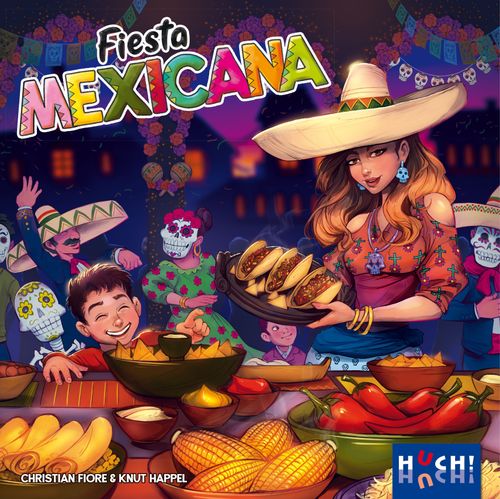
Fiesta Mexicana
Fiesta Mexicana Rulebook
Table of Contents
Table of Contents
Goal of the Game
Each of you is in charge of managing a table and strives to take care of the presentation of the delicious specialties. The aim is to best satisfy the varied tastes of Isabella, Miguel and all their friends and relatives who are starving. The one who does best will win this lively Fiesta Mexicana.
In turn, you bid on the dishes freshly out of the kitchen in order to serve them at your table. The subtlety of the game: the numbers shown on your table determine both the height of the bids you can make and the space where you must place the dish you win. Whoever is left empty-handed has the right to turn their table a quarter turn to obtain a new starting layout and new numbers! Who will manage to complete their table with the dishes bringing the most points? The player who succeeds in combining the right dishes through offers and a well-mastered placement, while respecting the guests' tastes, will have a strong chance of winning.
The Day of the Dead (in Spanish: Dia de los Muertos) is one of the most important holidays in Mexico. According to legend, at the end of the harvest season the dead return from the afterlife to celebrate with the living through music, dance and a good feast. This holiday is therefore not a funeral ceremony but on the contrary a joyful and colorful celebration in honor of the dead. On this occasion, besides colorful flowers, people wear jewelry symbolizing death, such as skeletons and skulls often painted in colors. In 2008, UNESCO decided to inscribe the Day of the Dead on the intangible cultural heritage of humanity.
Contents
- 4 tables (= individual player boards) divided into spaces that can hold 16 Mexican dishes
- 66 cards with Mexican dishes (= Dish cards)
- 24 Objective cards indicating the guests' favorite dishes
- 56 Point tokens shown as skull heads (20x 1, 20x 3, 12x 10 and 4x 30 points)
- 1 player aid
Setup
Each player takes a table (= individual board) and places it in front of them so that the maracas are in the bottom right corner.
Sort out the 12 starting cards among the Dish cards (they are recognizable by the piñata in the corner).
Sort the 12 starting cards by the color of the piñata and shuffle the two piles separately. Deal 1 card of each to every player. Each player places these dishes on the two Piñata spaces of their table. The orientation of the cards does not matter: each player may therefore turn them as they wish before placing them.
Put the remaining starting cards back with the other Dish cards. Shuffle them together to form a face-down draw pile.
Shuffle the 24 Objective cards and deal 5 to each player. Each player chooses the 3 they wish to keep: they must all have a different color (clothing or background).
Example: Daniel has the choice between the following 5 cards. The first two Objective cards are red (children's clothing + background). He therefore cannot keep more than one of the two. The same goes for the last two: they are both blue (the two blue ones). Once again, Daniel can only keep one of the two. He therefore chooses the 1st, the 3rd and the 4th Objective cards.
If a player is unable to choose because they have too many cards of the same color, they reveal them and draw 5 others.
Each Objective card is explained in detail at the end of this rulebook (page 14).
The remaining Objective cards are no longer used and are discarded from the game.
Form a common supply with the Point tokens.
Each player takes one Point token for each skull present on their two starting cards and places them in front of them.
The party can begin!
Course of the Game
The game is played in 2 alternating phases:
- Drawing a dish and bidding in turn order;
- Placing the dish on the table and awarding points.
1. Drawing a Dish and Bidding in Turn Order
The chef brings the delicious dishes out of the kitchen and each player must estimate whether they want to have this dish at their table or not. Then they must make a judicious offer.
The last player to have eaten Mexican food begins:
They turn over the first Dish card of the pile. They are then OBLIGED to make an offer for this dish, even if they do not want it. To make their offer, they may only use numbers that are visible in the right reading direction on their table.
Example: Maria turns over a salad and makes an offer of 9. The "9" on her table is not yet covered and is legible in the right direction for her. She cannot offer 13 because, even if it is in the reading direction, it is already covered by a dish.
It is now the turn of the next player clockwise to make an offer or pass. If they make an offer, it must be strictly higher than the previous one. The rules remain the same for them too: the value of their offer must correspond to a number legible in the right direction on their table. The bidding continues in this way until no one outbids any more. A player may take several turns.
Tip: It may be judicious to start with a lower offer rather than announcing clearly from the start to your opponents where you wish to place this card.
The player who made the highest offer wins the dish. All the other players share the pot of this round's bidding. In compensation, each of them may, if they wish, turn their table a quarter turn to the left or right.
Note: Turning the table changes the numbers available for the next bids: after a rotation to the left, the space with the 1, for example, becomes a 13. It is therefore an important tactical means of increasing your chances of winning a dish bringing more points.
Reserving a Dish
Each player has the possibility of reserving a dish. To do so, on their turn, they must begin by making an offer according to the rules described above. They then follow by forfeiting one of their Objective cards. That card is then discarded from the game. The player thus prevents the other players from continuing to bid and wins the dish at the announced price. It is up to each player to decide at which moment it is appropriate to sacrifice an Objective card in order to score more points!
2. Placing the Dish on the Table and Awarding Points
The player who made the highest offer and won the dish. They must now place it on their table so as to score the maximum number of points.
The player must place the dish on the space corresponding to the value of their offer. Every other space is FORBIDDEN.
They may turn the dish in the direction they wish. But once placed on the table, they can no longer change it until the end of the game.
Each new dish served at the table brings points according to the number of skulls and sauce bowls:
- Each skull brings 1 point.
- Each sauce bowl made of two halves of the same color joined together brings 3 points.
- Each sauce bowl made of two halves of different colors makes you lose 1 point.
- An incomplete sauce bowl, adjacent to another card, makes you lose 1 point. If the card is turned in such a way that the half-bowl is oriented toward the edge of the table, the player does not lose a point.
The player adds up all the points the new card brings. If the result is positive, they gain that many points from the supply of tokens. If the result is negative, they lose the number of points corresponding to those already won. If the player no longer has any tokens or does not have enough, they lose everything they have left.
Note: It is permitted to make change at any time, for example by exchanging 3 tokens of 1 point for 1 token of 3 points.
Example: Daniel places the salad on the table. He therefore scores the following points: 1 (skull) + 3 (complete sauce bowl) - 1 (sauce bowls of different colors) - 1 (incomplete sauce bowl) = 2 points. He therefore gains 2 points from the supply, which he places in front of him. (Illustrated annotations: +1 point per skull; -1 point per sauce bowl made of two halves of different colors; -1 point for the incomplete sauce bowl because a card is adjacent; +3 points for the complete sauce bowl of a single color.)
The player who won the previous bid then turns over the next Dish card from the pile and MUST make the first offer for it.
The game continues in this way until the end.
End of the Game
The game ends IMMEDIATELY as soon as ONE player has completed all the spaces of their table with dishes.
Each player scores points for their Objective cards whose conditions are met. The player who has the fewest points so far begins the count, then the second-to-last...
Each Objective card can only be counted once. A player therefore cannot score a second time for a card, even if they succeeded in lining up, for example, 2 times 4 dishes on their table.
Each Objective card whose conditions are not met brings no points.
The player who totals the most points wins the game.
In case of a tie, there are several winners.
The Objective Cards
The Children (red clothing, red background)
Valentina and Daniel are waiting impatiently for the party. But they do not like everything and do not eat certain dishes. The player who serves them plenty of what they like will also score plenty of points.
For each dish of the requested specialty on their table, the player scores 1 point.
The Teens (white clothing, white background)
Carmen and Xavier are convinced that their favorite dish is going to be a hit at the party. They intend to get more of it than their opponents!
The player who has the most dishes of the requested type scores 5 points, even if they are tied with another player.
The Seniors (blue clothing, blue background)
Dona Ana and Don Alberto like everything to be well ordered. They must be pleased by placing the dishes at their table according to a precise arrangement.
- The player scores 6 points for 4 IDENTICAL dishes arranged in a square.
- A line of 4 IDENTICAL dishes brings 6 points. It may be horizontal, vertical or diagonal.
- A line of 3 IDENTICAL dishes brings 4 points. It may be horizontal, vertical or diagonal.
The Masked Guests (green clothing)
Carlos and Anita love sauces. The player who gathers many sauces at their table will be particularly appreciated.
- For 6 complete sauce bowls of any color, whose two halves match, the player scores 6 points.
- For 4 complete sauce bowls of any color, whose two halves match, the player scores 4 points.
- For 3 complete sauce bowls OF THE SAME COLOR, whose two halves match, the player scores 6 points.
Scoring Example
Here is what Fernanda's table looks like at the end of the game. At the start of the game, she had chosen the following Objective cards:
- Her table has 4 plates of chilis, but Daniel collected 5 plates of chilis. Fernanda therefore scores no points for this Objective card.
- She fulfills the conditions for her second Objective card: she lined up 3 plates of burritos vertically on her table. Elsewhere, she also has a diagonal of 3 salads. As she can only score one single time per Objective card, she gains only 4 points once.
- The conditions of the 3rd card are also fulfilled: Fernanda has built 6 complete sauce bowls on her table.
In total, Fernanda therefore scores 4 + 6 = 10 points.
Variant for Confirmed Waiters
The back of the tables, with the chili in the bottom right corner, offers a variant that is played without starting cards and in which specific spaces must be covered so as not to lose points at the end of the game.
Shuffle all the dishes, including the starting ones, and begin with empty tables.
On the table are shown 3 spaces with a skull head and a red number. If such a space is not covered before the end of the game, the player loses as many points as the number indicated.
Mexican Dishes
During the game, you will encounter typical Mexican dishes:
- Tostada: A tostada is a crispy fried corn or wheat tortilla, topped with various ingredients: beans, cheese, sour cream, onion rings and different kinds of meat or seafood, for example.
- Elotes: Elotes are popular street snacks in Mexico. The ear of corn is grilled, smoked or cooked, then spread with butter, chili, mayonnaise or other ingredients.
- Burritos: A burrito is made of a wheat tortilla, filled with different ingredients such as minced meat, beans, rice, tomatoes, avocado and cheese, for example, then rolled.
- Chilis: Mexico is the country of the chili. About 90 different varieties exist there. They enter into the composition of many dishes that are not necessarily spicy.
- Salad: It may be composed of tomatoes, corn, onions, kidney beans, iceberg lettuce...
- Tacos: Tacos are folded tortillas, filled with many ingredients. Most of the time, the filling includes a mixture of meat and vegetables to which cheese is often added.
- Guacamole: Guacamole is an avocado-based sauce with tomato, onion, garlic and chili. It is served as an accompaniment to many dishes.
- Mole: In Mexico, this sauce is the national dish. There are many recipes. Chilis and very many spices (about 20) are mixed to form a sauce. Chocolate is very often added to it.
- Mole blanco: This is a particular recipe of mole. It is a thick sauce based on milk, white chocolate and water, containing among other things lightly roasted peanuts and almonds, chilis and other spices.
- Pico de gallo: This is a spicy sauce composed mainly of tomatoes, onions and finely chopped hot peppers.
Mexican cuisine is influenced by many traditions, including pre-Columbian, Spanish, French or even Caribbean cuisine. It should not be confused with the Tex-Mex cuisine of the United States: chili con carne and nachos are little known in Mexico.
Gratin Burritos Recipe
Ingredients (for 6 people)
- 200 g of canned tomato pieces
- 125 g of corn
- 1 red bell pepper, 1 green bell pepper
- 2 onions
- 4 tablespoons of oil
- 400 g of minced meat
- Salt and pepper
- 1 pinch of Cayenne pepper
- 1/2 teaspoon of ground cumin
- Optional: chili flakes
- 1 tablespoon of tomato concentrate
- 1 pinch of sugar
- 6 tortillas
- 6 tablespoons of crème fraîche
- 200 g of grated cheese
Preparation
Let the corn drain. Cut the bell peppers into small pieces. Cut the onions into fine dice. Preheat the oven to 200 C top and bottom heat.
After heating the oil in a pan, brown the minced meat in it. Add the onions and bell peppers and let the whole simmer for about 5 minutes. Season with salt, pepper, Cayenne pepper and cumin. Spice up more or less by adding chili flakes. Add the tomato concentrate and lightly grill the whole. To finish, add the tomato pieces and the corn and mix. Let cook the whole until almost all the liquid has evaporated. Season with spices and a little sugar.
Spread the tortillas with crème fraîche and spread the mixture with the meat on top. Sprinkle with a little grated cheese. Roll the tortillas, place them in an oven dish and cover them with the rest of the cheese.
Put in the oven and gratinate about 5 minutes until the cheese is melted.