Fields of Action
Fields of Action Rulebook
Table of Contents
Table of Contents
Players
Two.
Material
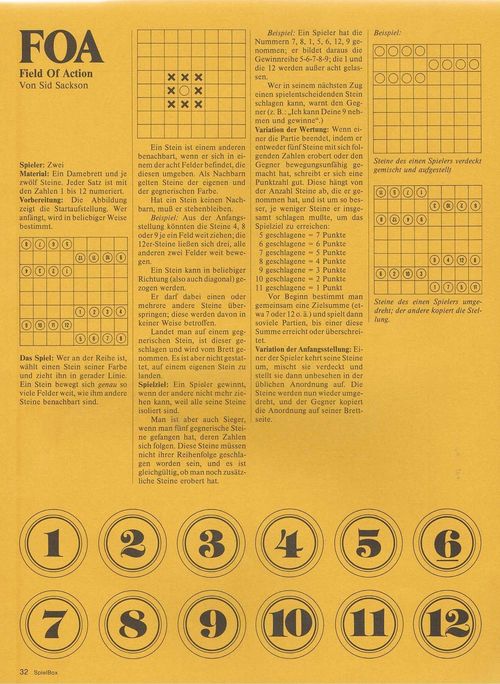
One checkerboard (8 × 8 squares) and twelve stones for each player. Each player's set of stones is numbered 1 to 12.
Setup
The starting diagram of the original is reproduced below as a grid. Rows run from the top of the board (row 1) to the bottom (row 8); columns run from left (column 1) to right (column 8). A dot means an empty square.
Row 1:  8  7  9  5  .  .  .  .
Row 2:  .  .  .  .  12 11 10 6
Row 3:  4  3  2  1  .  .  .  .
Row 4:  .  .  .  .  .  .  .  .
Row 5:  .  .  .  .  .  .  .  .
Row 6:  .  .  .  .  1  2  3  4
Row 7:  9  10 11 12 .  .  .  .
Row 8:  .  .  .  .  5  6  7  8
The player who goes first is determined in any manner.
Neighbours
A stone is adjacent (a neighbour) to another stone when it is located on one of the eight squares surrounding it. Stones of both your own colour and the opponent's colour count as neighbours.
If a stone has no neighbour, it must stand still.
Example: From the starting position, stones 4, 8 or 9 could each move one square. The 12-stones could move three squares, and all other stones could move two squares.
Playing the Game
The player whose turn it is chooses one stone of his own colour and moves it in a straight line. A stone moves exactly as many squares as there are other stones adjacent to it.
A stone may be moved in any direction, including diagonally. It may jump over one or more other stones while doing so; those stones are not affected in any way.
If a stone lands on an opposing stone, the opposing stone is captured and removed from the board. It is not permitted to land on one of your own stones.
Winning the Game
Immobilisation: A player wins if the other player can no longer move, because all of his stones are isolated.
Five in a row: A player also wins if he has captured five opposing stones whose numbers are consecutive. The captured stones need not have been taken in any particular order, and it does not matter whether he has captured additional stones.
Example: A player has captured stones 7, 8, 1, 5, 6, 12 and 9. He forms from them the winning sequence 5-6-7-8-9. Stones 1 and 12 are disregarded.
Warning: A player who can capture a game-deciding stone on his next move warns the opponent (for example: "I can take your 9 and win.").
Variant: Scoring
When one player ends the game either by capturing five stones with consecutive numbers or by making the opponent immobile, he scores points. The score depends on the number of stones he has captured, and is better the fewer stones he had to capture in total to reach the goal:
- 5 stones captured = 7 points
- 6 stones captured = 6 points
- 7 stones captured = 5 points
- 8 stones captured = 4 points
- 9 stones captured = 3 points
- 10 stones captured = 2 points
- 11 stones captured = 1 point
Before play begins, the players agree on a target total (for example 7 or 12, or something similar). They then play as many games as needed until one player reaches or exceeds this total.
Variant: Starting Position
One of the players turns his stones over, shuffles them face down, and then sets them up unseen in the usual arrangement. The stones are then turned face up again, and the opponent copies the arrangement on his side of the board.