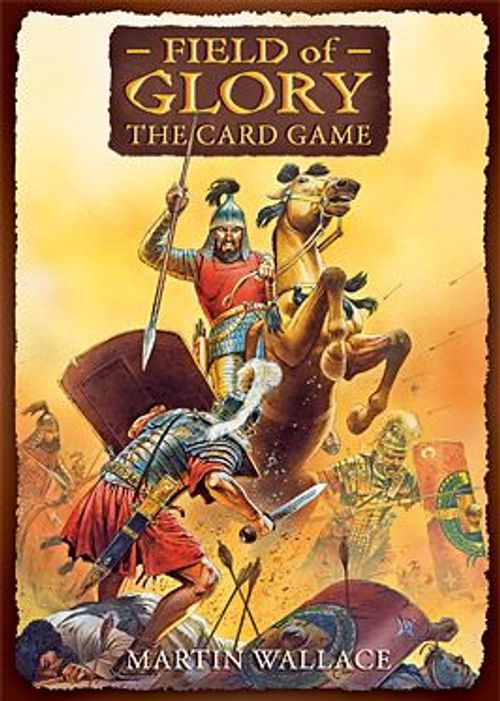
Field of Glory: The Card Game
Field of Glory: The Card Game Rulebook
Table of Contents
Table of Contents
Components
- Nine Terrain cards
- Forty-eight Red Army cards
- Forty-eight Blue Army cards
- COMMANDER cards — Commander cards only provide Command Points.
- ACTION CARDS — Only two types, which are Overlap and Reserves.
The Army Cards
Army cards consist of units, commander cards and action cards.
Unit card elements, from top to bottom:
- Movement Cost
- Flank Penalty
- Combat value
- Command Points
- Unit type
- Unit type total
- Modifiers and special rules
- Victory points
UNITS – Units contain the following elements:
Movement Cost – determines how many Command Points must be spent to place the card in the battlefield. If it's placed in a Flank column, the cost is increased by the Flank Penalty.
Combat Value – ranging between 0 and 5; the higher the value, the more effective the unit is in combat.
Command Points – are used to place units into battle, to increase Combat Value, and to draw cards at the end of a turn. Note that Command Points bear no relationship to Unit type, so will vary between units of the same type.
Unit Type Total – how many units of this type are in your deck.
Modifiers and Special Rules - additional powers that usually help differentiate Unit types.
Victory Points – earned by the vanquisher of the card. Only count if there is a tie at the end of the game.
Starting the Game
Shuffle the Terrain cards and place them face-down to make a deck. Draw five Terrain cards, one at a time, to create a battlefield. The battlefield consists of five columns and each column will contain one Terrain card, forming a row of Terrain cards across the centre of the five columns. If a Plain Terrain card is drawn, place it in the centre column – or if that's filled, a column as close to the centre as possible. If a non-Plain Terrain card is drawn, place as far from the centre as possible (i.e. the end-columns will be filled first). Arrange the Terrain cards so that their short sides face each other, indicating that neither player controls them.
The two end-columns will be referred to as Flank columns from now on.
Each player selects a set of Army cards (the sets are identical apart from colour) and each performs the following steps:
- Locate your First/Second Shuffle card and place it to one side.
- Shuffle the remaining Army cards and place them face-down on the table to form your deck.
- Draw the top four cards from your deck, choose two of these cards to retain and discard the other two cards face-down. This process is repeated until you've been through your deck of forty-eight cards once, thus retaining an army of twenty-four cards. The discarded cards play no further part in the game and are returned to the box.
- Shuffle your retained cards and place them face-down on the table to form your draw deck. Place your First/Second Shuffle card at the bottom of this deck, with the side marked 'First Shuffle' upmost.
- Draw the top nine cards from your deck to form your starting hand.
The first player should be determined randomly, using a method agreeable to both players.
DECK MANAGEMENT – As the game progresses, players will need to discard cards. Each player should create their own discard pile next to their draw deck. Discards are done one-by-one, and face-up. A discard pile can be perused at any time, but only by its owner.
If a player needs to draw a card and his draw deck is exhausted, he shuffles his discard pile to create a fresh draw deck. The first time this is done his Shuffle card is flipped to the other side, marked 'Second Shuffle.' The second time this is done remove the Shuffle card from the deck and place it to one side.
Playing the Game
'Field of Glory: the Card Game' is played over an unspecified number of turns. Players alternate taking turns, starting with the first player, until one of the end game conditions has been met.
During a player's turn he must complete each of the phases shown below, in the listed order. Each phase must be completed before proceeding to the next phase.
- Victory check
- Advance
- Flank attacks
- Player actions
- Draw cards
Phase one: Victory check
If the active player has control of three or more Terrain cards then he immediately wins the game.
The orientation of the Terrain card indicates who controls it, the word 'CONTROL' being closest to the controlling player.
Phase Two: Advance
The active player takes control of every column where he has unopposed units (i.e. the opponent has no units in that column). Turn the Terrain card so that the 'Control' side is closest to the active player. If the active player has two units in that column then one unit (owning player's choice) is discarded.
Example: It is the red player's turn. His heavy infantry unit is unopposed in the central column. He turns the Terrain card so that the side marked 'Control' is closest to him. Note that the blue player does not automatically gain control of the column containing his medium infantry. He will need to wait until his turn to see if he can take control of it.
Phase three: Flank attacks
An opponent's unit(s) are eligible to be flank-attacked if all the following conditions are true:
a) The active player has one or more units in that same column (the opposed column). b) The active player has one or more unopposed units in an adjacent column (the flanking column). c) The next column along from the flanking column either has no enemy units or is beyond the edge of the battlefield.
Note that these conditions have to be met at the beginning of the phase – a flank attack cannot be performed if the conditions only come true due to a successful flank attack on another column.
The attacker must decide whether he wishes to attack from the opposed column or the flanking column/s. He must then select a unit to lead the attack from that column.
Once a flank attack has been declared, the defender still has the option to withdraw. Only units whose Movement Cost is lower than that of the lead attacking unit can withdraw.
If the defender hasn't withdrawn all of his units then combat is performed as per the rules described in the section headed 'Attack', with the exception that a bonus of +2 combat strength modifier is added to reflect the effectiveness of a flank attack.
Example: The blue pike unit is open to a flank attack. It is opposed to its front, there is an unopposed enemy unit in the adjacent column, and there is no friendly unit in the column after that. The red player has the choice to attack with the medium infantry or the heavy infantry. It makes sense to attack with the heavy infantry as it has the higher combat strength. Red will attack with a combat strength of six, against blue's strength of four.
It would only take one friendly unit in the next column along to stop a flank attack situation from arising, as can be seen here. In this case there are no flank attack situations. The blue light infantry would have to be engaged to its front to be vulnerable to a flank attack.
It is easier to create a flanking attack from one of the two Flank columns. In this example here the blue pike unit is flanked by the red cavalry.
Phase four: Player Actions
The active player may now perform as many actions as desired or able. There are three types of actions available:
- Place Units
- Attack
- Play Reserve card
These actions can be performed in any order and repeated as desired, e.g. a player may place a unit, attack, place two units, then make more attacks, and so on.
ACTION: PLACE UNITS
The active player places one or more units from his hand into one or more of the five columns of the battlefield, on his side of the Terrain cards. After placing units he must discard one or more cards from his hand whose total Command Points equals or exceeds the sum of the Movement Costs and any additional costs of the units just placed. He does not receive any change for spending more than the required cost.
Additional costs include:
If a unit with a Flank Penalty is placed in either Flank column, its cost is increased by the value of its Flank Penalty, e.g. heavy infantry and spears.
If a unit is placed in a column containing a Rough Terrain card, its cost is increased by one.
A player can have up to two units in one column on his side of the battlefield. Both of these units must be the same type. There are two exceptions:
- A light infantry unit can be placed in the same column as an elephant.
- An archer unit can be placed with any other unit.
The order of the units in the column is not important.
Before placing a unit in a column the active player can discard any of his units already in that column.
Note: Commander and Action cards cannot be placed on the battlefield.
Example: Red is the first player and in his first turn places the four units shown here. The total Movement Cost is nine, as it costs one extra point to place the medium infantry unit in the Flank column. Red discards a Commander and a cavalry card to pay for these placements, the total number of Command Points on the cards equaling the cost. Note that the light cavalry costs zero points to place down.
ACTION: ATTACK
The active player declares the column in which he wishes to attack. This attacked column must have units belonging to both sides in it. If the attacker has two units in the column then he must choose one unit to lead the attack, moving that unit to the front as a reminder.
The attacker must either select one card from his hand or draw the top card from his deck. This card is called the Bonus card and remains hidden from the defender.
The defender now has the option to withdraw units from the column. Any defending units whose Movement Cost is lower than the Movement Cost of the lead attacking unit can withdraw, which means placing them on his discard pile. If the defender withdraws all of his units then the attacker:
- Discards his Bonus card.
- Discards one attacking unit of his choice if he has two units in the column.
- Does not take control of the Terrain card.
If the defender does not withdraw all of his units then he has the option to gain a Bonus card by either selecting a card from his hand or drawing the top card from his deck. If the defender has two units in the column then he must choose one to be his leading unit, moving it to the front. Each player then reveals their Bonus card and determines their combat strength, which is the sum of:
- The Combat Value of their leading unit in the column.
- The Command Point value of their Bonus card.
- +1 if they have two units in the column.
- Combat modifiers on the column's Terrain card (i.e. hills and woods).
- Combat modifiers on your leading unit if you are the attacker – the defender does not get theirs!
COMBAT MODIFIER CLARIFICATIONS
Only the lead attacking unit gains any combat modifiers marked on it. Only the opposing leading unit counts for determining which modifiers apply. If the attacker has two pike units in the column then he gains +2 in all (+1 for having a second unit and a further +1 for that being a pike unit). Cavalry and light cavalry are separate unit types.
The player with the highest combat strength wins. The losing units in the attacked column are eliminated and handed to the winning player, who places them in his victory point pile.
If the attacker won then he takes control of the Terrain card, rotating the card so that the 'Control' side is closest to him (if he already has control of the Terrain card, nothing changes). He must then discard the non-leading unit if he has two units in the column.
If the defender won and the Terrain card was controlled by the attacker then it becomes neutral, otherwise nothing changes.
He must then discard the non-leading unit if he has two units in the column.
If it's a tie then the Terrain card is turned to its neutral position and all units on both sides in the attacked column are discarded.
Example: Red launches an attack against Blue's pike unit. Red has a combat strength of five (four plus one for having a second unit in the column). Blue has a strength of four. Red secretly selects one card. Blue selects a Commander card to play. Red reveals his card, which is also a Commander card. That means each player adds five to their strength. Red has the higher total, ten versus nine, and so wins. The pike unit is eliminated, so handed to the Red player. Red has to discard his rear heavy infantry unit. The Terrain card is turned to show that it is controlled by the Red player. Both players discard the Commander cards they played.
WOODS CLARIFICATION
Heavy infantry, pike, spear, cavalry, and elephant units all suffer a -2 combat modifier if they are the lead attacking or defending unit in woods. Light infantry gains a +1 combat modifier when attacking and defending in woods.
OVERLAP
The active player can play this after declaring an attack but before selecting a Bonus card. The attacker increases his combat strength by one for every unit he has in an adjacent column that a) is not opposed and b) has a Movement Cost of three or less. The rules for withdrawal remain unchanged and only apply to the lead unit in the attacking column, not the adjacent columns.
Example: Red declares an attack with his cavalry unit against the heavy infantry unit. He then plays an Overlap card. He will gain an additional two strength points for the medium infantry and archer units in the adjacent columns, as both are unopposed.
ELEPHANT RAMPAGE
If a player is defeated in combat and has to lose one or more elephant units then he must also draw the top card from his deck and lose that as well, with all of these cards ending up in the opponent's victory point pile. This penalty does not occur if the unit is discarded for any other reason.
ACTION: RESERVE CARD
Draw three cards. You can hold more than nine cards during your turn.
Phase five: Draw Cards
The active player either draws three cards or discards one card and draws a number of cards equal to its Command Points.
If the active player has more than nine cards in his hand, he must discard down to nine, choosing which cards he wishes to discard.
Ending and winning the game
The game ends when:
- The active player controls three Terrain cards during their Victory Check phase, with that player winning the game,
OR
- at the end of the turn in which both Shuffle cards are placed on display (indicating that both players have shuffled their decks twice during the game). In this case the player who controls the most Terrain cards wins.
In the case of a tie the player with the most victory points (from units they've vanquished in combat) wins the game. If it's still a tie, the game is drawn.