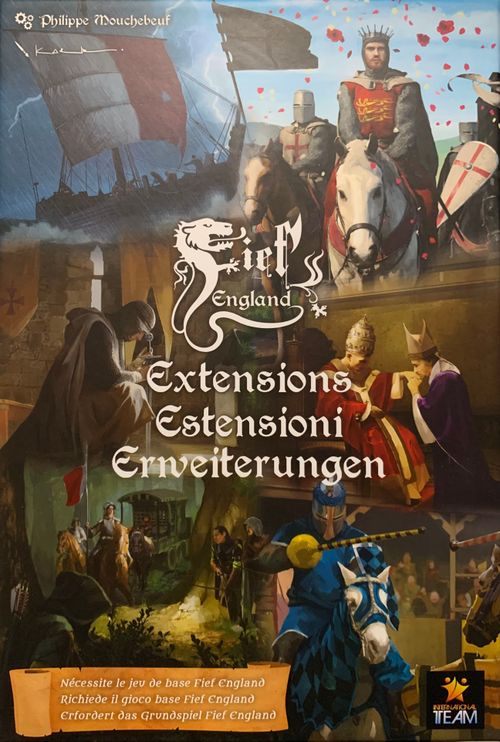
Fief: England – Expansions
Fief: England – Expansions Rulebook
Table of Contents
Table of Contents
Crusade to Jerusalem
Return of Richard the Lionheart
Nobles crusade to Jerusalem to secure the lands for Christian rule. On the way, they may:
- Reconquer Fiefdoms for Christianity: the Principality of Taranto (1VP) and the Kingdom of Sicily (1VP).
- Plunder caravans in Palestine, which yield 10 or 15 Shillings. But they risk being taken captive or even being slain.
- Join King Richard the Lionheart and his Knights Templar when he returns to England to retake Cities and Strongholds from treacherous opponent Nobles.
Components
- 1 Jerusalem Board
- 9 Jerusalem Cards
- 3 Crusade Markers
- 4 Knights Templar Counters
- 1 King Richard the Lionheart Standee
Setup
Place the following on the Jerusalem Expansion Board:
- Shuffle the 9 Jerusalem Cards and place face-down on the Draw Deck space.
- Place the 3 Crusade Markers, 4 Knights Templar Counters, and Richard the Lionheart Standee on the board as shown.
Rules
Starting the Journey
A Nobleman (neither Bishop nor Archbishop) begins his journey to Jerusalem on Phase 5: Movement. He can take all or some of his Troops present with him as an escort.
- The Noble must begin his move in a Port City. The Noble's Standee and escort Troops are moved onto the Jerusalem Board and a Crusade Marker is placed on the relevant Noble Card located on their Family Board.
- Crusading Nobles may not vote on Royal Taxes, nor may they be selected as candidates nor vote in the election of a King or Sovereign Queen.
- Crusading Nobles may not marry while away from England.
- Up to 3 Nobles, from all Families combined, may travel to Jerusalem at any one time.
Escort Troops are immediately destroyed if their Noble is slain or taken captive.
Draw Jerusalem Cards
Messenger with News: On Phase 1: Hear Ye, Hear Ye, each crusading Noble's Player draws, in Turn order, a Jerusalem Card for news about that Noble. Each card's content is immediately revealed, and then placed face-up in front of the Player or discarded face-up to the bottom of the Draw Deck.
The Retainers Esmeralda, Salim, and Gaglio may affect a card if their abilities allow them to (see Retainers - New Powers below).
Add Troops
Up to 4 additional Troops may be purchased for Nobles who have left for Jerusalem and are not captives. These are placed with their Noble on the Jerusalem Board.
Return to England
During Phase 5 Movement of the Round following a Noble's arrival, they can:
- Either return to England to a Port City of their choice and may then take one Road move (their Crusade Marker is returned to the Jerusalem Board), OR.
- Decide to stay a second and final time in Jerusalem to draw a second Jerusalem Card during the next Phase 1: Hear Ye, Hear Ye. They must then return to England in the following Movement phase.
Jerusalem Cards
No News Yet (2) Nothing happens. This card is discarded.
Taken Captive (1) Your Noble is a captive of the Saracens in Palestine who demand a ransom of 10 Shillings.
- If he had Escort Troops, they are returned to the Player's Supply.
- This card is placed next to the Jerusalem Board and the captive Noble's Standee is placed on top of it.
- The Noble remains in Palestine until the Ransom is paid and draws no more Jerusalem Cards.
- Once a Ransom has been paid, this card is discarded, the Noble's Standee is returned to the Jerusalem Board and must return to England during the next Movement Phase.
Slain in Battle (1) Your Noble was slain in battle.
- Remove his Card and Standee from the game.
- Any escort Troops are returned to the Player's supply.
- This card is discarded.
Prince of Taranto (1) Your Noble has retaken the Tarantine lands from the Byzantines!
- This card is placed under your Noble's Card.
- This Title gives your Family 1VP.
King of Sicily (1) Your Noble has retaken Sicily and a golden age of French and English immigration, religion, and language begins!
- This card is placed under your Noble's Card.
- This Title gives your Family 1VP.
Caravan Plunder (2) Your Noble has plundered a caravan of great wealth!
- You immediately receive 10 or 15 Shillings.
- This card is discarded.
King's Return (1) Richard the Lionheart (King Richard) returns to England from the Third Crusade to regain his throne!
- Roll the d6 to determine the Region where he arrives.
- Place this card into the Region's Sea Zone.
- Place Richard's Standee and 4 Knights Templar on the Port City.
Richard the Lionheart
When King Richard arrives in England, all Nobles of the current King's and Queen's Families are considered Rebels. All other Families are considered loyal. If there is no King or Queen, all Families are considered loyal. The election of a Sovereign King or Queen is always possible, and they are then designated as Rebels.
The first Noble (male or female) of a loyal Family that occupies the same City as Richard may pledge loyalty and become his Advisor. The Advisor recognizes Richard as King of England and follows him wherever he goes. The King Richard Card replaces the Advisor's current Retainer, which is removed from the game. The Advisor Player manages and moves Richard and his Knights Templar, like his other Nobles. King Richard cannot be moved until his Advisor has joined him.
Members of the Advisor's Family may not betray King Richard by declaring a Candidate for the election of the Sovereign of England (9.1).
If the Advisor dies, King Richard is no longer controlled by any Player and his Card is placed on the Sea Zone of the Region he occupies. The first Noble that then joins and pledges loyalty to King Richard becomes his new Advisor.
King Richard's four Knights Templar each have 3 Strength Points (7.3), and take 3 Hits to be destroyed (7.5). The Knights Templar never leave King Richard's side and once destroyed, are removed from the game.
ASSASSINATION (10.3) and AMBUSH (10.5) cannot be used against King Richard, but he can be targeted by Archer or Crossbowman Projectile Attacks (7.2).
If King Richard dies, his Standee, Card, and Knights Templar are removed from the game.
Historical Note: In the spring of 1199, Richard the Lionheart laid siege to the Châlus Chabrol Castle, in the Limousin region of France, to recover a treasure. On March 26, during an inspection tour, he was shot with a crossbow. Poorly treated, he died 9 days later, on April 6, 1199.
Phase 5: Movement
King Richard, his Knights Templar, and his Advisor (and Troops) can pass through loyal Cities without asking permission (5.0).
Rightful King: When King Richard arrives in a City occupied by Rebels, he tries to be recognized as the rightful King by the Troops occupying the City. Roll the d6:
- 1 or 2: The Rebel Troops recognize Richard as the rightful King and switch sides. Their counters are replaced with those of the Advisor's Family, if available. Any Rebel Nobles present are taken captive.
- 3 - 6: Richard is not recognized as the rightful King. He and all Knights in his retinue may then immediately begin a Cavalcade Battle (5.2), or continue moving to another City, or stop and battle during Phase 7 - Battles.
Phase 7: Battles
King Richard has 1 Strength Point (SP), and each of his Knights Templar has 3 SP. The Advisor may convince King Richard to attack a loyal Family's Cities and Troops. King Richard is the last to take Hits, just like all Nobles (7.5).
Kings Will: If King Richard takes a Fiefdom's Fortified City, he may give its Title to the Noble of his choice (4.5).
Marriage
During Phase 1: Hear Ye, Hear Ye, it is possible to marry King Richard to a Noblewoman of his Advisor's Family. She can then give birth to the Prince of Wales if a space is available for a new male Noble and this Title has not already been allocated. She does not receive a Royal Guard (13.1).
Retainers - New Powers
Esmeralda the Gypsy During Draw of Jerusalem Cards (see Phase 1 above) in Phase 1, Esmeralda allows her Noble to Reveal or Discard the drawn card. If Discarded, the player must draw a second card and reveal it. The Player may keep this card or discard it and draw another. Esmeralda is marked as spent by turning her card face-down (2.12).
Gaglio the Lombard Banker Gaglio may take care of the 10 Shilling Ransom demanded by the Saracens for any Noble TAKEN CAPTIVE by them. (The Family does not need to pay 10 Shillings.) The Noble is immediately freed (Standee is placed back on the Jerusalem Board), but does not get his Escort back, which has already left. He can return to England during the next Phase 5 - Movement. Gaglio is marked as spent.
Salim the Bodyguard Salim will save his Noble from the Jerusalem Cards: TAKEN CAPTIVE and SLAIN IN BATTLE. When one of these cards is drawn by his Noble, it is discarded and Salim is removed from the game and the Player does not draw a new Retainer (2.12).
Journey to Rome
A Nobleman or Noblewoman may travel to Rome to visit the Pope. During the visit the Pope may grant one of the following blessings:
- For financial support to fight the England Invaders.
- To grant an annulment.
- To bestow a Cardinal Title to a Bishop or Archbishop, which gives their Family 1 Victory Point.
The Pope can also entrust the Noble with the Relic of the Holy Lance, which can galvanize Troops in battle.
The Noble may begin importing Italian Almond Paste, a delicacy much appreciated by the King and Queen.
Components
- 1 Rome Board
- 9 Rome Cards
- 3 Rome Markers
- 1 Holy Lance Relic Counter
- 1 Cardinal Robe Overlay Card
Setup
Place the following on the Rome Expansion Board:
- Shuffle the 9 Rome Cards and place face-down on the Draw Deck space.
- Place the Holy Lance Relic and the 3 Journey to Rome Markers on the board as shown.
- Add the Cardinal Robe Overlay Card face-up on the Titles space.
Rules
Journey to Rome
A Nobleman or Noblewoman (can be a Bishop, Archbishop, or Abbess) begins their journey to Rome on Phase 5: Movement. Each Noble may take all or some of their Troops present with them as an escort.
- The Noble must begin their move in a Port City. The Noble's Standee and escort Troops are moved onto the Rome Board and a Rome Marker is placed on the relevant Noble Card located on their Family Board.
- Nobles journeying to Rome may not vote on Royal Taxes, nor may they be selected as candidates nor vote in the election of a King.
- Nobles journeying to Rome may not marry while away from England.
- No more than 3 Nobles, from all Families, may journey to Rome at any one time.
Troops are immediately destroyed if their Noble is slain or taken captive.
Draw Rome Cards
Messenger with News: On Phase 1: Hear Ye, Hear Ye, each journeying Noble's Player draws, in Turn order, a Rome Card for news about that Noble.
Rome Cards must not be revealed immediately and can instead be placed under the affected journeying Noble's Card on their Family Board. They may play the cards as detailed on page 11 (see Rome Cards below). Rome Cards do not count towards Player's Card Hand-limits.
Return to England
During Phase 5 Movement of the Round following the Noble's arrival, all Nobles must return to an England Port City of their choice and may then take one Road move. Note: This is unlike Crusade to Jerusalem where Nobles may choose to remain one extra Round.
Once a Noble has returned to England, they return the Rome Marker to the Rome Board and can play their Rome Opportunity Cards (2.0) at any time.
A Rome Card can be exchanged between Players via CARRIER PIGEON (2.15).
A Rome Card is lost if the Noble who drew it dies, in which case the card is reshuffled into the Rome Draw Deck.
Rome Cards
Annulment (1) The Pope grants an Annulment. The Player may annul ANY marriage, whose Rings are returned, and its Family alliance is broken. This card is then discarded.
Almond Paste (1) The delicious Almond Paste is sold to the Sovereign Queen or Queen wife of the King when the Noble has returned to England. She and the Noble need not occupy the same City to play this card.
The Player receives a number of Shillings equal to the result of 2d6 rolls (2 to 12 Shillings). This amount must be paid immediately by the Player who has the Queen in their Family. They must pay, even if they have to sell Mills and Troops at purchase price to cover the debt.
Cardinal (1) Only a Bishop or Archbishop can be appointed Cardinal by the Pope.
The Cardinal Card can be played at any time, even before the Noble returns to England. The Cardinal's Robe-Overlay replaces the (Arch)Bishop Robe-Overlay which is returned to the Titles Deck. The CARDINAL Card is slid under the (ARCH)BISHOP Card with his powers showing on the bottom.
A Cardinal has the following powers:
- He can play a TAX Card to levy a Church Tithe on all Mills in all Regions (2.8). Place the TAX Card on Scotland.
- Adds 3 Votes when electing a Sovereign (9.1) or levying the Royal Tax (9.2).
- Counts as 1 Victory Point (1VP) as long as the Cardinal is alive (8.1).
- If the Cardinal is slain, the (Arch)Bishop and Cardinal Cards are discarded, and Cardinal Robe-Overlay is returned to the Titles Deck.
Hearing Refused (3) The Pope is not available to receive you. This Card is discarded and you must return to England empty-handed.
Invader Combat Subsidies (2) 7 or 15 Shillings are donated by the Pope to help fight the heretic Invaders. This card is removed from the game after being played. Note: The Noble might use these funds for something else - who would ever know?
Relic of the Holy Lance (1) The Noble takes the Holy Lance Relic Marker and places it on his card. When the Noble is part of a Melee Battle, they may choose to double one of their side's Battle Dice after it has been rolled.
Retainers - New Powers (Journey to Rome)
Retainers accompany their Nobles to Rome, where their normal abilities can no longer be used. Ex: When in Rome, Triboulet cannot prevent a Lord from voting, Rohaise cannot receive Shillings, and Arsène cannot steal.
In Phase 1 - Hear Ye, Hear Ye, before Rome Cards have been drawn by the Nobles, the Pope makes the following requests for the Retainers listed below, if they are located in Rome:
Rohaise the Weaver The Pope is very impressed by Rohaise's skills and wants to keep her in his service. If her Noble agrees, the Noble will receive 4 Shillings during each Income Phase, provided they do not forget to ask for the coins. Rohaise is placed on the Rome Board and is marked with one of her Noble's Men at Arms.
Triboulet the Jester The Pope has a good laugh and loves Triboulet's antics. He wants to add him to his court and offers the Player 15 Shillings to keep Triboulet in Rome. If his Noble agrees, they will receive the 15 Shillings from the game reserves and Triboulet is removed from the game.
If the Noble refuses the Pope's offer, Triboulet remains with his Noble, who does not receive the 15 Shillings.
Arsene the Thief The Pope refuses to receive a Noble who employs a thief! He will not grant you an audience. You do not draw a Rome Card and must leave Rome during the next Movement Phase.
Instead of drawing a Rome Card, you roll 1D6:
- 1 - 4 = Success. Arsene succeeds in stealing 15 Shillings from the Pope as well as the Relic of the Holy Lance if it is still available. Find RELIC OF THE HOLY LANCE from the Rome Deck and place the Holy Lance Marker on the Noble's Card. The remaining cards and discards are reshuffled.
- 5 - 6 = Failure. Arsene is caught by the Pope's guards. The ARSENE Card is removed from the game (he remains in Rome in prison). The Noble does not draw a new Retainer Card when they return to England.
Robin Hood
Robin Hood is a dispossessed Nobleman looking to right the wrongs done to him and his people. With his 'Merry Men', a group of expert archers, he captures and robs the rich, returning the money to those in need.
Robin Hood represents a real calamity for all Players' Nobles in the Kingdom who try to shorten their route by traveling through the Sherwood Forest.
Components
- 1 Robin Hood Card
- 1 Robin Hood Standee
- 8 Archer Counters (Robin Hood's Merry Men)
Setup
Robin Hood Card: The Robin Hood Card is a Disaster Card (with a red backside). Shuffle Fortune & Disaster Deck, then divide it into 2 decks of approximately the same size. Place the Robin Hood Card on top of one of these decks and place the second on top of the Robin Hood Card.
The Fortune & Disaster Draw Deck is now ready for play.
Merry Men: Place the Robin Hood Standee on the game board's Robin Hood space and the Merry Men Archers next to the game board with the other Stockpile counters.
Rules
The Sherwood Forest rules (13.4) from the main Rulebook are still in effect. In addition, the following rules are implemented.
ROBIN HOOD Arrives
When the ROBIN HOOD Disaster Card is drawn, it is not placed on the Disaster Cards Track. Instead it is placed on the 4th Space of the Active Player's Family Board. If the space is already occupied by a MERCENARY or BURGHER card, that card is discarded and replaced by ROBIN HOOD. Like the Disaster Cards, ROBIN HOOD does not count towards the number of cards drawn.
The Active Player's Family is now allied with Robin Hood, they control his moves and battles. The Allied Family is not obliged to accompany Robin Hood with one of their Nobles, but without anyone by his side he may switch alliance!
Robin Hood and his Merry Men
When ROBIN HOOD is drawn, place the Robin Hood Standee and 2 Merry Men Counters in the Sherwood Forest. All three are considered Archers. Robin and his Merry Men can move out of Sherwood as an Army with Robin Hood acting as the Noble.
- Robin Hood cannot be ASSASSINATED. He is too hard to find!
- Robin Hood can be AMBUSHED (10.5). His Standee and 2 Merry Men are placed on the capturing Noble's Card with the remaining Merry Men returned to the Stockpile. Robin is released at no cost during the next Purchase Phase and his Standee and two Merry Men are immediately placed in the Sherwood Forest.
- Robin Hood and his Merry Men are affected by the PLAGUE. Treat Robin as a Noble.
- If Robin Hood is slain during a Battle or if he dies of the PLAGUE, the ROBIN HOOD Card, his Standee, and his Merry Men are all removed from the game.
- Bribe: Any time during the Battle Phase, one or more Players can pay a total of 10 Shillings to bribe Robin Hood and his Merry Men to return to Sherwood. The money is paid to the bank, ROBIN HOOD is discarded to the Fortune & Disaster Discard Pile, and his Standee and Merry Men are returned to the Stockpile.
Movement
Robin never moves via Naval Movement. Robin never leaves his Merry Men behind when moving. They remain together as an Army.
Discreet: Robin and his Men's movement is not affected by STORMS or opponent Troops. Robin needs no permission to move through Cities controlled by other Families. He moves in, can Sneak Attack, and then continue on his way if he wishes. Robin's presence in a City does not block an Opponent's movement. However, as soon as they move into the City, if they are moving through, Robin and his Merry Men can still conduct a Sneak Attack.
Nobles and their Troops of the Family allied with Robin Hood can pass through Sherwood Forest without being attacked or captured.
More Merry Men
When Robin moves into, within, or leaves a Region affected by FAMINE, REBELLION, or TAXES, another Merry Men Counter is added to his Army, up to a limit of 8 Merry Men. 2 Merry Men are added if the Region is affected by both FAMINE and TAXES.
Sneak Attack
When an Opponent moves into a City occupied by Robin and his Merry Men, Robin and his men are allowed one immediate Sneak Attack. He and his Army of Merry Men are all Archers, and can make one Projectile Attack (7.2) during the Opponent's Movement Phase.
Robin and his Merry Men can also move into an Opponent's City, Sneak Attack, and move on. Ex: Robin and 2 Merry Men projectile attack an Opponent with 1 Battle Die. They get a +1f damage bonus since they are firing with 3 or more Archers (10.5). Reminder: Robin and his 2 Merry Men are all considered Archers.
The attacked Opponent cannot react to the Sneak Attack since Robin and his Merry Men immediately hide once the Sneak Attack is carried out. Robin can then remain in the City or continue moving.
Robin and his Men can only be attacked by Opponents during the Battle Phase.
BATTLES
The Player that controls Robin Hood can attack the Troops present in the City where he is located. Robin and his Merry Men battle in both the Projectile and Melee Attacks, just like regular Archers and Crossbowmen.
Melee Attack: Robin Hood and his Merry Men each have 1 Strength Point (SP) in the Melee Attacks.
The Merry Men each increase their Strength (7.3) by 1SP Bonus for each of the following that they attack:
- +1SP Bonus per Opponent Titled Noble (Lords, Bishops, Archbishops, etc)
- +1SP Bonus if attacking a Stronghold or Fortified City
Up to a maximum of +2SP Bonus per Merry Men Counter. This could increase their Strength up to 3SP per Counter.
Against Invaders, the Merry Men each automatically have 3SP in all Battles.
Ex: Robin and 4 Merry Men attack a Stronghold occupied by the Earl of Plymouth and his brother the Bishop of Exeter. The Stronghold (+1SP) + Earl (+1SP) + Bishop (+1SP) - a total of +3SP Bonus. However, they can only gain up to +2SP Bonus, increasing the Merry Man to 3SP each. Their group SP total is 4 Merry Men x 3 = 12SP, plus 1SP for Robin, totalling 13SP equaling 3 Battle Dice. The Stronghold imposes 1 Battle Die Penalty (7.4), so Robin rolls 2 Battle Dice.
Local Support: Robin can benefit from one or more REBELLION Cards (10.1) played on the City he occupies (without FAMINE or TAX conditions). The rebel peasants join Robin and his Merry Men in the first melee roll of the Battle, adding 1 Battle Die (+1f Bonus Hit to Robin's Battle Dice), up to a combined total limit of 3 Battle Dice.
Hits: It requires 3 Hits to defeat Robin and each of his Merry Men, just like Knights.
During Battles Robin Hood:
- Can join forces with the Troops of another Family during Battle.
- Can take captives and demand a Ransom (7.7). Ransoms are paid to the Player controlling Robin. The captive Noble's Standee is placed on the ROBIN HOOD Card. A Merry Men Counter is taken from the Stockpile and placed on the captive Noble's card.
- Does not lay siege.
- Can occupy a City, Stronghold, or Fortified City, but once he leaves the City it reverts to Independent (5.1) unless an Allied Troop occupies it.
- Does not pillage and destroy (7.10) Mills, Strongholds, Fortified Cities, Abbeys, or Relics.
- Can use a PASSAGE Card (10.2) to enter a Stronghold or Fortified City.
Captured: If Robin is captured, he is released at no cost during the next Purchase Phase and his Standee and two Merry Men are placed in the Sherwood Forest. If Robin was holding captives, they are released.
Slain: If Robin is slain, his Card is discarded, and his Standee and Merry Men are removed from the Map.
City Control
If Robin controls a City, its income is not collected by its owner. Robin has distributed the income to the needy!
Robin Hood Changes Alliance
During the Movement Phase, a non-allied Noble, located in the same City as Robin, can attempt to change his alliance if no currently allied Noble is present. The Player rolls 1d6.
If a Nobleman, a result of:
- 1-3: the Nobleman's Family becomes Robin's new Ally.
- 4-6: Robin remains with his current Ally and takes the Nobleman captive.
If a Noblewoman, a result of:
- 1-4: the Noblewoman's Family becomes Robin's new Ally.
- 5-6: Robin remains with his current Ally. The Noblewoman remains with Robin, becoming his companion. She will remain at his side, temporarily leaving her Family until Robin Hood disappears. Turn this Noblewoman's Card over on its Family Board and place her Standee on the ROBIN HOOD Card. If she is married, the marriage alliance is broken. If she had an Escort, these Troops are lost and returned to their Stockpile.
If successful, the ROBIN HOOD Card is moved to the new allied Player's 4th space on their Family Board. Robin Hood comes under the control of this new Family.
Playing with the 'Crusade to Jerusalem' Expansion:
If King Richard returns to England, and Robin Hood is allied with a Rebel Family. Then: ROBIN HOOD is discarded and his Standee and all Merry Men are returned to the Stockpile. Note: Robin would never betray and fight against King Richard!
Knights Templar
The Order of the Templar is a religious and military order of medieval Christian chivalry, whose members are known as the Knights Templar. Founded on January 13, 1129, its mission is to protect pilgrims on their way to Jerusalem. To finance this mission, the Knights Templar set up a network of monasteries, known as Commanderies, throughout Catholic Western Europe, using donations of land and numerous privileges, including tax privileges. The Knights Templar play an active role in the battles of the Crusades.
The Templar path will enable your family to benefit from the Order's protection and increase your income.
Components
- 4 Lord Templar Robe Overlays
- 1 Grand Master Robe Overlay
- 8 Knights Templar Counters
- 5 Templar Commandery Counters
- 1 Vox in Excelso Disaster Card
Setup
- The VOX IN EXCELSO Disaster Card is added to the Fortune & Disaster Draw Deck, 7th from the bottom.
- Add the 4 Lord Templar Robe and 1 Grand Master Robe Overlay Cards to the Titles Deck.
- Place the 8 Knights Templar Counters and the 5 Templar Commandery Markers next to the Game Board.
Rules
Joining the Knights Templar
Instead of drawing a Character or Fortune Card, a Player may choose to take an available LORD TEMPLAR Robe Overlay Card from the Title Deck and place it on one of their unmarried, untitled Noblemen. He is now a Lord Templar.
When a Templar dies, his Templar Card is returned to the Titles Deck.
A Lord Templar:
- Cannot marry or hold any other Title (Baron, Count, Duke, King, (Arch)Bishop, or Cardinal). He cannot inherit a Title (4.8) unless he renounces his Templar Title.
- Can found a Templar Commandery.
- Cannot sponsor an ASSASSINATION (10.3), nor can he attack English Nobles or Troops on his own.
- Can request a secret meeting, once per Round, with another Player who has a Lord Templar in their Family without spending a Carrier Pigeon.
Electing the Grand Master of the Knights Templar
The election takes place after Marriage Alliances and before the Election of a King or Sovereign Queen.
Only non-captive Lord Templars may be candidates. Each Lord Templar has one vote. A candidate is elected by relative majority, i.e. more Votes than each of the other candidates and at least 2 Votes.
The Grand Master:
- Receives 2 Shillings for each Templar Commandery in the Kingdom during the Income Phase.
- Increases Melee Attack Hits by +1f for each Templar Knight Counter.
- Cannot participate in a Tournament if playing the Ivanhoe Expansion.
- Automatically finds the Templar Treasure when searching for it.
Templar Treasure Location and Funding
During the first Hear Ye, Hear Ye Phase, following the creation of at least one Lord Templar, the Starting Player randomly determines which of any existing Fortified Cities on the game board will house the Templar Treasure. A 1 Shilling Coin is placed on this Fortified City to mark it as the Templar Treasure Location.
The Starting Player then randomly draws from the Shillings Stockpile one Coin per existing Lord Templar and places these, without looking, under the Fortified City Marker housing the Templar Treasure. Nobody knows the value of the Templar Treasure! If playing with miniature buildings, place the Templar Treasure in one of the empty game storage boxes that represents the Fortified City's Treasure Vault.
During each Hear Ye, Hear Ye Phase, when there are Templars in play, the Starting Player randomly draws as many Coins as there are Lord Templars and, without looking at them, adds them to the growing Templar Treasure.
Looting the Templar Treasure
Only a Knight Templar or a member of a Knight Templar's Family can attempt to find the Templar Treasure. They must be in the Fortified City where the Treasure is located. During the Movement Phase, in lieu of moving, a Noble may search by rolling 1d6. A result of:
- 1-2 = Success - the Treasure is found! Your Family gains the entire Templar Treasure.
- 3-6 = Failure - our information was wrong, the search continues.
Each searching Noble may make one search attempt per Movement Phase.
- The Treasure can be found only once, NO additional Shillings are added in Phase 1.
- Any member of the Grand Master's Family automatically finds the Templar Treasure if they survive their move into the Fortified City where the Treasure is hidden.
Templar Commandery
A Player can build up to one Templar Commandery per Lord Templar in their Family per Purchase Phase.
Historical Note: A Commandery is a fortified compound where Knights Templar were housed to administer an area.
- Commandery Cost: 2 Shillings.
- Placement: On a City with no Stronghold, Fortified City, or Abbey, and with the permission of the Player who controls the City.
Commandery Income
- During the Income Phase, each Templar Commandery produces 2 Shillings income for the Lord of its Region. Or the Lord can instead decide to place an available Templar Knight from the Stockpile on the Commandery.
- GOOD WEATHER and BOUNTIFUL HARVEST each increase Commandery income by +1 Shilling.
Commandery Effects
- A REBELLION cannot be played on a Commandery City.
- PLAGUES do not affect Commandery Cities. The Lords and Troops there are well cared for, but are affected by the PLAGUE if they leave the City.
- TAXES do not affect Commandery Cities.
Excalibur
A Templar can attempt to draw Excalibur from its stone (13.2). If he succeeds and becomes King, he must renounce his Templar Title and his Templar Robe Overlay Card is discarded.
Knights Templar Battles
Knights Templar can only move with a Lord Templar or Clergy (Abbess, Bishop, or Archbishop).
A Lord Templar, without another allied Noble leading, may not attack an opponent's Noble. A Lord Templar and his Knights Templar may defend themselves when attacked. Trying to leave a Besieged City (7.9) and having to Battle is considered a defensive act.
A Lord Templar may always attack Invaders on his own.
A Lord Templar never surrenders (7.8) and fights until he is slain or captured.
Strength Points
A Knight Templar adds 3SPs to their Strength Point (SP) Total when determining their number of Battle Dice (7.3).
Knights Templar Groups of 2 or more receive:
- 1SP Bonus to their SP Total.
- Ex: A Lord Templar (1SP) and two Knights Templar (3SP) have a SP Total of: 1SP + 3SP + 3SP + 1 SP Bonus = 8SP. They will roll 2 Battle Dice.
- +1f Hit Bonus during Melee Attacks.
- Ex: In their Melee Attack, the Knights Templar's 2 Battle Dice results in: 1f + 3f + 1f Hit Bonus = 5 Hits against their Opponent.
- Ex: These same two Knights Templar are led by the Grand Master resulting in: 1f + 3f + 1f Hit Bonus + 2f Grand Master/Knight Hit Bonus = 7 Hits.
Each Knight Templar requires 3 Hits to defeat it (7.5).
VOX IN EXCELSO
Historical Note: The Vox in Excelso was the Papal bull that revoked the Knights Templar in the year 1312.
When the Vox in Excelso Disaster Card is drawn, it is placed on one of the Disaster Cards Track spaces. If all Disaster Card spaces are filled, this card replaces the last placed Disaster Card.
When the Disaster Cards are resolved (2.4), the King or Sovereign Queen decides whether or not to declare this edict and apply it to the Templars in the Kingdom. The decision is immediate and the card is discarded.
If there is no King or Sovereign Queen at this time, the card remains on the Disaster Cards Track and cannot be replaced by another Disaster Card until a King or Sovereign Queen is seated who can make the decision.
NO - If the King or Sovereign Queen decides not to declare the Vox in Excelso, nothing happens and the card is removed from the game.
YES - If the King or Sovereign Queen decides to declare the Vox in Excelso, the consequences are as follows:
- The Knights Templar are disbanded and their counters removed from the game.
- The Templar Robe Overlay Cards are removed from all Templar Nobles. Then:
- Burn - One of these Nobles is burned to death (4.8),
- Heresy - One receives the Heresy Marker and is subject to Justice (10.4),
- Prison - All remaining are made captive (imprisoned) with their Standees placed on the King's or Sovereign Queen's Noble Card.
The King or Sovereign Queen chooses which ex-Templar gets which punishment in the above list order. Burn > Heresy > Prison.
- The revenues of Templar Commanderies go to the Sovereign King or Queen. If there is no current Sovereign the revenue goes to the Region's Lord.
Note: If the Templar Treasure has not yet been claimed, it is given to the Knights Hospitaller by returning it to the Bank.
Historical Note: By 1291, the Christians no longer controlled Jerusalem and the Templars had lost one of their main precepts - defending pilgrims in the Holy Lands. However, they still had great financial power, having built a network of 'banks' and letter of credit loans. In 1139, Pope Innocent II also issued a papal bull granting their armies free passage through all lands, that they owed no taxes, and answered only to the pope. King Philip IV, afraid of the Templars' power and the debts he owed them, persuaded Pope Clement V to charge the Templars with heresy by issuing the Vox in Excelso on March 22, 1312. Many of the Templar leadership were captured, tortured, and burned at the stake. Their wealth was to be transferred to the Knights Hospitaller, but much of the Templar lands and wealth was instead taken by the English and French Nobles and Monarchs.
Fortunes at Sea
Set sail to reach far away harbors and become rich raiding and plundering French ships.
But you may also encounter windstorms that could divert you to an unplanned Port or becoming shipwrecked on a foreign land.
Even worse, you could lose passengers overboard or have your crew rise up in mutiny!
Components
- 1 Sea Board
- 9 Sea Cards (6 unique)
Setup
Sea Cards Draw Deck: Shuffle the 9 Sea Cards and place them face down on their Sea Board location.
Rules
Naval Movement
When a Noble or group of Nobles and their Troops initiate a Naval Move (4.8), the Player announces the destination Port and which Troops are escorting the Noble(s). The Player then draws a Sea Card from its Draw Deck and resolves its effects immediately. The Card is then discarded unless stated otherwise.
Travelers to or returning from the Rome or Jerusalem Expansions do not draw a Sea Card.
Sea Cards
Calm Crossing (2) The Seas are calm and you reach your destination.
Dead Calm (1) Lack of wind in the open Sea and the ship is not moving. The Dead Calm Card is placed on the destination Port's Sea with the Noble Standee and Troops placed on it. They complete their naval move in next Round unless that Region is then subject to STORMS.
When accompanied by Morgane the Sorceress, the Dead Calms' effect is negated.
Mutiny (1) Mutineers take control of your ship. You arrive safely to your destination if you pay a Ransom of 5 Shillings, plus 2 Shillings per Noble on board. Note: You may remove any number of your Troops from the map and collect their purchase costs to cover this Ransom. Otherwise, all Nobles are slain and the ship is lost with all Troops on board.
When accompanied by Sanson the Executioner, the Mutiny is suppressed.
Plundered Ship (2) During your voyage you spot and seize a French merchant vessel. You confiscate its cargo and gold! Collect the following amount of Shillings:
Roll the d6 three times for a total of 3 to 18 Shillings.
You arrive safely at your destination Port.
Shipwreck (1) Rocks! Your ship has run aground and spring a leak. Half of your Troops are destroyed (rounded down). Each Noble rolls the d6. A result of: 1-3 = Saved. 4-6 = Dies.
Survivors arrive at their destination Port, but may not continue to move this Round.
When accompanied by Nelson the Admiral, the Shipwreck is avoided.
Windstorm (1) You encounter a windstorm that diverts you to another Port City. Roll 1d6 to determine the Region's Port City where you disembark.
When accompanied by Morgane the Sorceress, the Storm's effect is negated.
Retainers - New Powers (Fortunes at Sea)
Retainers accompany their Nobles during a Naval Move, unless otherwise specified. The following Retainers have these new Powers:
Morgane the Sorceress Morgane prevents a WINDSTORM or DEAD CALM when present on a Naval Move OR even if her Noble is on land anywhere in England. Her Noble can use her powers for any Region on the map, including all Sea Zones, even if none of the Player's Family are present. Once she has used her power, the WINDSTORM or DEAD CALM Card is discarded and the ship arrives safely at its destination Port.
Nelson the Admiral Nelson prevents a SHIPWRECK when present on a Naval Move. The SHIPWRECK Card is discarded and the ship arrives safely at its destination Port.
Sanson the Executioner Sanson prevents a MUTINY when present on a Naval Move. The MUTINY Card is discarded and the ship arrives safely at its destination Port.
Ivanhoe
In 1194, Wilfrid of Ivanhoe secretly returns to England from the Third Crusade. He is son of Cedric the Saxon who disinherited him for following the Norman King Richard the Lionheart. Wilfrid takes part in a tournament at Ashby under the name of 'The Disinherited Knight' where he faces Brian de Bois-Guilbert, a Norman and Knight Templar who was given pronounced the Lord of Ivanhoe.
Ivanhoe challenges other Nobles to legendary jousts. If your Noble beats him, you gain one or more ½ VPs Markers! However, be careful since your Noble could be slain during the joust.
Historical Note: A Tournament is a martial festival where noblemen fought with courtly weapons and on horseback, either one against one or in groups. A Joust is a single combat between nobles with lances and on horseback.
Components
- 1 Ivanhoe Character Card
- 1 Ivanhoe Standee
- 5 '½VP' Markers
Setup
Ivanhoe Character Card:
- Draw off the top 8 cards of the Character Deck without looking at them.
- Draw two more cards, add the Ivanhoe, shuffle these three cards, and place them on top of the Character Deck.
- Place the original top 8 cards on top of the Character Deck.
- This deck is now placed on the Character Draw Deck space.
The Ivanhoe Standee and ½VP Markers are placed with the game's other Stockpile Items.
Rules
Tournament Preparation
The Player who draws the Ivanhoe Character Card can reveal it during the Play Cards phase (2.6). They choose a City occupied by at least one non-clergy Nobleman, mark the City with a 5 Shilling Coin from the Stockpile, and loudly announce their opponent Noble's name and your challenge to Joust. This Nobleman can be from the announcer's own Family!
Ex: "Hear Ye, Hear Ye, fair Lords and Ladies. Lord Ivanhoe challenges Baron Edward of The Marsh to a duel to the death in this fair City of Lincoln!"
This Opponent will have to face Ivanhoe in one or more Joust runs. The Ivanhoe Card is placed on the Map's Phase 5- Move Graphic as a reminder that the Tournament will take place at the beginning of that Phase. Place the Ivanhoe Standee on the designated Noble's Card.
The Tournament generates 5 Shillings of income for the Player that controls the City where it takes place. That Player collects the 5 Shillings when the Joust begins, unless the designated Opponent has died or been captured before that time, in which case the Coins are returned to the Stockpile. Tournaments are very profitable, attract contestants, spectators, and merchants from all over the Region.
The Joust Challenge
At the beginning of Phase 5: Movement, the Jousts are held. To win a Joust, a Knight must roll highest Battle Dice result without going over 5f-Hits.
- The Noble who faces Ivanhoe rolls the 3 White Battle Dice.
- The Ivanhoe Player rolls the 3 Black Battle Dice.
A Joust Begins with the First Run:
- Each Knight (Player) secretly chooses to roll between 1 and 3 of their Battle Dice, which are revealed and then rolled simultaneously.
- Both Knights roll at the same time.
Winner: The Knight who rolled the highest number of f-Hits, without rolling over 5f-Hits, WINS the Joust!
Death: A Knight that rolled 6 or more f-Hits was too reckless and was struck down - succumbing to their mortal wounds.
Tied Roll - The Joust Continues: If the Knights tied in the first Run (both rolling the same number of f-Hits under 6 total), then neither won, both are still alive, and they refit with new lances to begin another Run. On the next Run:
- A Knight that rolled less than 3 Dice the previous Run must roll another Die.
- A Knight that rolled all 3 Dice the previous run must re-roll one of these Dice.
The Dice Totals are totaled to determine if there is a winner.
New Runs continue until one Knight has won or died. Note: Both Knights could die! Dead Nobles are removed from the game (2.6).
If Ivanhoe dies, his Standee and Card is removed from the Map.
Joust Winner
If Ivanhoe's Opponent won, that Nobleman receives:
- One '½ VP' Marker if Ivanhoe still lives.
- Two '½ VP' Markers if Ivanhoe is slain or if the f-Hits difference between the Knights is greater than 1f. Ex: The first Run results with the Noble rolling 2 dice totaling 4f and Ivanhoe rolling 3 dice totaling 2f. The Noble rolled 2f more than Ivanhoe and receives 2x ½ VP Markers totaling 1VP!
The '½VP' Markers belong to the winning Nobleman and count towards his Family's VP total at the end of the game (8.2 or 8.3). If the Nobleman dies before game end, his Tournament VPs are lost to his Family and removed from the game. Note: When checking for Game-End Victory, ½VP Markers are added to Family's VP total.
If Ivanhoe won or if he did not die, a new Tournament will be announced in the next Round. The Ivanhoe Card and Standee are placed on the Map's Phase 1- Hear Ye, Hear Ye graphic.
New Joust Challenge
In the next Round, during Phase 1: Hear Ye, Hear Ye, the Starting Player (who could be different from the Player that drew Ivanhoe) designates a new Tournament by choosing any City occupied by a secular Nobleman who will next fight Ivanhoe. The IVANHOE card is placed on the Map's Phase 5 space. 5-Shillings (Stockpile) are placed on the City. The Ivanhoe Standee is placed on the chosen Nobleman's Card.
The Starting Player can decide to stay in the same City. A City under Siege cannot be chosen.
Notes
- Ivanhoe does not participate in any Battles.
- He is not affected by REBELLIONS but can be affected and die from the PLAGUE.
- STORMS postpone a Tournament until the next Round.
Retainers - New Powers (Ivanhoe)
Grimhilde the Witch A Player may request Grimhilde's Noble, wherever they are, to have Grimhilde re-roll 1 Battle die, white or black, during the second Joust Run.
Knut the Squire Knut can replace his Noble at the Tournament. If he wins, the VPs go to his master. If he dies, Knut is removed from the game. If Ivanhoe survives, the same Noble can be challenged again.
Orderic the Captain of the Guard Orderic can replace a Noble of his master's Family during the Tournament. If he wins, the VPs go to the Noble he is replacing. If he dies, Orderic is removed from the game. If Ivanhoe survives, the same Noble can be challenged again.
Playing with the 'Crusade to Jerusalem' Expansion:
A Lord Templar crusading to Jerusalem:
- Collects an additional 2 free Knights Templar Counters when he departs England. If no more Knights Templar are available, the Lord Templar may take two of King Richard the Lionheart's Knights from the Jerusalem Board.
- If he regains the Lord Titles of Prince of Taranto or King of Sicily, he may accept it by renouncing his Templar Title or give Lord Titles to another member of his Family or allied Family. The Knights Templar Counters escorting the Lord Templar are returned to the Stockpile if he renounces his Templar Title.
- The TAKEN CAPTIVE Card does not apply, as the Order of the Templar immediately pays the ransom, and it is discarded face-up under the Jerusalem Draw Deck.
- If the SLAIN IN BATTLE Card is drawn, roll all six Battle Dice. If the roll result total of the White Dice is greater than the roll of the Black Dice, the Templar Lord is not affected by the card.