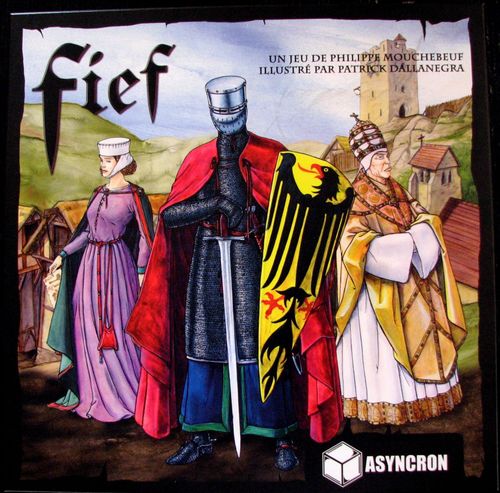
Fief
Fief Rulebook
Table of Contents
Table of Contents
Publisher's Preface
You have just acquired Fief*, and we thank you for it. The game you hold in your hands was born from our meeting with Philippe in 2008 at the Parthenay games festival. This game was first published in 1984 and is considered a great classic of the hobby.*
A monument like Fief deserved a rejuvenation, and that is the challenge we set ourselves. It took us 3 years of development and close collaboration with Philippe to reformat Fief while keeping its spirit intact.
This edition is the fruit of that work, and we hope it will give you as much pleasure to play as we had making it.
We took particular care with the writing and presentation of these rules. Nevertheless, a list of frequently asked questions (FAQ) is available on page 23 of this booklet, and this FAQ will be updated on our website at: http://www.asyncron.fr/fief/faq
If you have questions or remarks about Fief*, or medieval schemes to submit to us, you can write to us at: [email protected]*
Have good games!
A Word from the Author
Fief is not just a board game, it is also a simulation game about the life of lords in the Middle Ages. All the elements on offer have a historical reality: the election of the king, the tithe, the taille (tax), peasant revolts, plague and famine, bad weather that prevents waging war, siege engines, and secret tunnels used to seize a castle through treachery.
Fief is also a role-playing game in which you will embody different characters: a prince of the church, a king, a queen, Joan of Arc, a kind lord, or an assassin.
All the elements of this adventure — settings, main characters, and extras — are offered to you. It is up to you to bring them to life, up to you to write the scenario. Each game, you will live a new story, often close to great History.
My inspiration for creating this game came both from historical studies begun at the Faculté des lettres de Bordeaux and, above all, from Maurice Druon's great historical fresco: "Les Rois Maudits" ("The Accursed Kings"). A seven-volume work that I devoured in a few weeks as a teenager. Two television series, in 1972 and 2005, were drawn from that masterful fresco. Without a doubt, with this game I have tried to give you all the elements to write a new chapter in the spirit of that saga.
The first version of the game won the Pion d'Or awarded by the magazine Jeux & Stratégies in 1981, as part of the famous Boulogne-Billancourt game designers' competition. The game was released by International Team France in 1984 under the name "Fief," and a new edition with new female characters appeared in 1989 under the name "Fief 2," published in six languages by Eurogames.
The 2011 version, simply called Fief*, is a completely reworked edition aiming to make it a modern game, with simplified mechanisms and top-quality components.*
Thanks to the ASYNCRON team for the superb work accomplished.
Quick Overview
Fief is a game of conquest and diplomacy played by 3 to 6 players. Each player embodies a noble family trying to become the most powerful in the kingdom.
The game unfolds on a board representing a fictional kingdom in the Middle Ages. It contains villages linked by roads; each village belongs to a fief but also to a bishopric.
The players will seek to obtain the titles tied to fiefs, as well as high titles such as king, queen, or pope.
Each player starts with a lord, a castle, and a few troops, which they place on a village.
Each turn unfolds in several phases. Each phase is carried out by every player, and then play moves to the next phase. At the end of each turn, the game checks whether one or more players have won. It is possible to win as a team by allying with another player through marriage.
It is difficult to win alone; players will have to negotiate, strike deals, and form alliances. To do this, each player has 3 Embassy tokens. Each token may be played at any moment and allows a private 3-minute discussion to be started with the player or players of one's choice. These negotiations must therefore be managed carefully, since only 3 tokens are available!
Each turn, players draw cards. These cards are either character cards, which allow new lords to be brought into play, or event cards, such as good harvests, taxes, or fine weather. Players may then play cards they hold to apply their effects, most often to a fief or a bishopric.
Certain special cards may be played at any moment of the turn, triggering unexpected events: assassination, or a secret tunnel that allows a castle to be seized by treachery. Surprise guaranteed!
Players then receive income: each controlled village or mill yields coins. Certain bonuses can be obtained via cards, such as taxes, or via titles, such as the king's.
With this income, players may buy troops and buildings, which they place on the map.
They then move their lords from village to village, following the roads. Lords may take troops and siege engines with them, but troops cannot move alone without a lord.
Once all players have made their moves, battles take place in villages where troops of different players cohabit, if one of the players decides to attack.
Combat unfolds over several rounds; each round the strength of each army is calculated, setting the number of combat dice it throws. Losses are applied directly to the opposing troops. Combat stops when one side is wiped out or surrenders. Castles and cities grant defensive bonuses.
When players control all the villages of a fief and hold at least one castle on one of those villages, they may buy the fief's title and assign it to one of their lords. Once assigned, a title can only be conquered by force by taking the fief's capital, or if the lord dies without an heir.
Votes assign the titles of bishop, king, and pope. These various titles grant varied advantages.
A fief title yields 1 Victory Point (VP); the king's title and the pope's title yield 1 VP each. A player wins with 3 VP, or an alliance of 2 players wins with 4 VP together.
Components
- 90 Sergeant tokens (15 per color)
- 48 Knight tokens (8 per color)
- 18 Lord tokens (6 women and 12 men)
- 12 Siege Engine tokens
- 18 Tax tokens
- 6 Marriage tokens
- 12 Vote tokens
- 18 Embassy tokens
- 12 Castle tiles
- 8 City tiles (with a besieged reverse side for both Castle and City tiles)
- 8 special two-color combat dice
- 15 Mill tokens
- Coin tokens of value 1, 2, and 5
- 2 Assassin tokens
- 1 Heir Prince token
- 1 Excommunication token
- 1 game board
- 2 shared player aid boards
- 6 individual player aid boards
- 18 plastic stands
- 1 classic wooden die
- Title cards: 8 fief titles, 5 bishop titles, the King title, the Queen title, the Pope title, and the Cardinal title
- 1 First Player title card
- Character cards: 18 Lord cards, 1 Joan of Arc card, and 3 Cardinal cards (22 cards total, forming the character deck)
- Event cards: 5 Good Harvest cards, 5 Fine Weather cards, 5 Tax cards, 4 Revolt cards, 1 Assassination card, 1 Justice card, and 3 Secret Tunnel cards (24 cards total)
The Game Board
It represents a kingdom in the Middle Ages. Villages form spaces, linked by roads that allow troops and lords to move.
These villages are grouped into 8 zones of different colors. Each zone represents a fief.
Another division of the map is superimposed on the fiefs: the bishoprics, whose borders are shown by borders of 5 colors. They are numbered 1 to 5.
Each village belongs at once to a fief and to a bishopric. The 5 villages that have a cathedral are the bishopric seats.
Game Setup
1. Place the game board on the table with the two shared player aid boards on either side of the board.
2. Place the "purchasable" Cardinal card on its space.
3. Take all the event cards (grey backs) and calamity cards (black backs). Shuffle them together to form a pile and place it on the player aid.
4. Make another pile with the character cards (brown backs), shuffle it, and place it next to the event pile.
5. Place the title cards on the player aid: 8 fief titles, 5 bishop titles, the King title, the Queen title, and the Pope title. Place the Heir Prince token under the Queen title.
6. Set aside, in separate piles, the coin tokens, mill tokens, siege engine tokens, assassin tokens, the EXCOMMUNICATION token, the City and Castle tiles, and the Lord tokens.
7. Each player chooses a color and takes the tokens that go with it:
- the troop tokens (8 Knights and 15 Sergeants), which form their reserve,
- their Marriage token,
- their 3 Tax tokens,
- their 2 Vote tokens,
- 3 Embassy tokens,
- 5 coins.
They begin the game with:
- their Lord token,
- 1 Knight token taken from their reserve,
- 3 Sergeant tokens taken from their reserve,
- 1 Castle.
8. Each player draws a character card, which they place in front of them. If it is a Cardinal card or the Joan of Arc card, they put it back in the deck and draw another one instead. They then take the Lord token that corresponds to the card.
9. Placement. The last player to have visited a castle is designated first player (it may also be determined randomly). That player takes the First Player card, then chooses the village where they wish to start. They place their Lord, their troops, and their Castle there. The other players then do the same, in clockwise order. They may choose any unoccupied village.
Example: the white player (first player) decides to start the game at St Médard. They place their Castle tile there, 3 Sergeant tokens, 1 Knight token, and their Lord token (Aliénor).
Rules of the Game
1. Victory Conditions
Victory conditions are checked at the end of every turn.
- Each controlled fief yields 1 Victory Point (VP).
- The titles of king and pope each yield 1 VP.
1.1. Solo Victory
A player wins if they have 3 VP.
A player may therefore win by controlling, for example, 3 fiefs at the end of a turn, or else 2 fiefs and the title of king or pope.
Careful! A player cannot win alone if they are allied — see below.
1.2. Alliance Victory
Special case: in a three-player game, there is no alliance victory, only solo victory.
With four or more players, players may ally with one another and win together.
A player may only be allied with 1 other player at a time.
In that case, they win as a team if together they have 4 VP, regardless of how the points are split between them.
A player cannot win alone if they are allied.
1.3. Tie-breaking Rules
If several players satisfy the victory conditions, they are ranked as follows:
Careful! Solo victories take priority over alliance victories.
So if some players satisfy the alliance victory conditions while other players satisfy the solo victory conditions, only the solo players may win.
The winner is the player or side who, in decreasing order of importance:
- Holds the title of king.
- Holds the title of pope.
- Holds the title of regent.
- Controls the most fiefs.
- Controls the most duchies.
- Controls the most counties.
If none of these conditions is met, the game ends in a final tie.
Example 1: at the end of the turn, no alliance is active. Paul controls 3 fiefs, Jacques 1 fief, Carine 1 fief, and Lucie 2 fiefs and the title of king. Paul and Lucie satisfy the victory conditions. We check whether one of them holds the crown. That is the case for Lucie, so Lucie wins.
Example 2: at the end of the turn, Paul and Jacques are allied. Paul controls 3 fiefs, Jacques 1 fief and the title of king, Carine 1 fief, and Lucie 3 fiefs. Paul is allied, so he cannot win alone despite his 3 fiefs. The Paul–Jacques alliance has 5 VP: 3 for Paul's fiefs, 1 for Jacques's fief, and 1 for the king's title. The alliance victory conditions are therefore met (4 VP). But Lucie has 3 VP, and therefore satisfies the solo victory conditions. Since solo victories take priority over team victories, Lucie wins!
Author's note: most of the time the situation is much simpler, and only one player or one alliance has the required number of points.
2. Diplomacy
Fief is a game of diplomacy. Players may talk among themselves, form alliances, and agree on this or that action.
To limit the length of negotiations, each player has 3 Embassy tokens to negotiate with the other players.
At any point in the game, a player may spend one of their Embassy tokens to start a discussion with one or more other players of their choice.
The other players cannot refuse the discussion (but nothing obliges them to accept the requester's proposals!).
Players may withdraw to talk privately, for example by going to another room.
Each Embassy token spent grants a 3-minute discussion. If that is not enough time, another Embassy token may be spent to continue the discussion.
During this discussion, the game is paused. The other players may talk among themselves, but not in private.
While an embassy is in progress, no other Embassy token may be played; you must wait for the current embassy to end before doing so.
An embassy discussion allows:
- Talking freely.
- Showing, giving, and/or exchanging cards, without limit.
- Secret money transfers (a public money transfer is otherwise possible without an embassy).
Careful! Players who stayed around the board may talk freely but may not show each other cards or give and/or exchange them.
When the embassy ends, the game resumes normally where it left off.
3. Turn Sequence
This chapter briefly presents the turn sequence, which will be detailed afterward.
Each phase is carried out player by player, starting with the first player, then proceeding clockwise. Once all players have carried out a phase, play moves to the next one.
3.1. Phase 1: "Hear Ye, Hear Ye"
This phase is broken down into sub-phases, which must be carried out in this order:
- Marriages and alliances. Players announce the marriages that concern them. A marriage between 2 lords of 2 players is the only way to form an alliance.
- Election of bishops. Available bishop titles are assigned by vote. The corresponding title card is placed under the elected lord.
- Election of the pope. If the conditions are met and the title is vacant, a pope is elected. The pope card is placed on the elected lord.
- Election of the king. If the conditions are met and the title is vacant, a king is elected. The king card is placed on the elected lord.
3.2. Phase 2: Cards
If calamities are still in place on the board, they are removed. Then 3 sub-phases are carried out:
- Discard and Draw.
- Resolving calamities.
- Playing cards.
Players rebuild their hand by drawing character and/or event cards.
If a calamity is drawn, it is set aside face down and will be resolved during the calamity resolution phase.
Only 3 calamities maximum can occur during a turn. Other calamities are discarded.
- Resolving calamities. Calamity cards that were drawn are revealed and resolved.
- Playing. Players play cards if they wish. Different cards can be played at this phase: Lord cards to bring new lords into play, cards to cancel calamities or to grant income bonuses, and Tax cards to collect extra income from a fief or bishopric that the player controls.
3.3. Phase 3: Income
Players collect their income, which depends on the villages and mills they control, on tax cards played this turn, as well as on titles held (king, queen, and pope).
Tax and bonus cards (fine weather, good harvest) are discarded at the end of this phase.
3.4. Phase 4: Purchases
Players make their purchases. They may buy, within the limits of what is still available:
- Fief titles, if conditions are met.
- Troops, placed as reinforcements on the board.
- Siege engines, placed as reinforcements on the board.
- Castles, placed on controlled villages.
- Mills, placed on controlled villages.
3.5. Phase 5: Movement
Players move their lords. Lords may take troops and siege engines with them. A special move called a charge, which can only be made by knights and/or lords, allows combat to take place during movement, in an attempt to cross a space occupied by an opponent.
3.6. Phase 6: Combat
Combat between armies and lords of opposing players present on the same village is resolved. The lords involved can sometimes be killed or taken prisoner.
At the end of this phase, a player may pillage the mills they control.
3.7. Phase 7: Victory Conditions
The game checks whether one or more players have won.
If no player has won, the game continues. The first player passes the First Player card to their left-hand neighbor, and a new turn begins.
4. Detailed Turn Sequence
Let us now go through each phase in detail.
4.1. Phase 1: "Hear Ye, Hear Ye"
4.1.1. Marriages and Alliances
Players who have agreed on a marriage announce it publicly.
Author's note: a last-minute change of heart is allowed!
Marriage is the formalization of an alliance between two players.
No alliance is possible without marriage.
A marriage necessarily creates an alliance between the two players involved.
A player can only have one marriage in progress.
Author's note: these are political marriages — it is assumed that other family members have unions with no political effect, which are not represented in the game.
A marriage unites two lords belonging to two different players. One of the two lords must be an unmarried woman who does not hold the title of Joan of Arc; the other must be an unmarried man who is not in holy orders — that is, neither bishop, cardinal, nor pope.
If the husband is king, the wife immediately becomes queen.
If the wife is queen regent (the case where the previous king has died and the queen has become regent), the husband does not become king; there will be an election instead.
To symbolize the alliance, each player's Marriage token is placed on their spouse's Lord card.
Example: Quentin, controlled by the blue player, is married to Jeanne, controlled by the magenta player.
The marriage and the alliance between the two players last until one of the two spouses dies, or the marriage is annulled by the pope (see the chapter on the pope).
When two players are allied, they can no longer win alone as long as the alliance lasts. If they win, it will be together!
Author's note: it often happens that you find yourself with an inconvenient alliance. In that case you must find a way to break it. There are only two ways to do this: cause one of the two spouses to disappear, or obtain an annulment of the marriage from the pope.
4.1.2. Elections and Votes
Several titles are assigned by election: bishops, the king, and the pope.
Every election follows the same procedure:
- In turn order, each player announces whether they wish to put forward a candidate from among their eligible lords. Eligibility conditions differ for each title, see below.
- Once all candidates are declared, voting takes place: each player has 2 Vote tokens, 1 "for" (white ball on the reverse) and 1 "null" (black ball on the reverse). In turn order, each player who has votes places one or both of their VOTE tokens (face down) on the candidate or candidates of their choice.
- Once all players have placed their tokens, they are turned face up and the votes are counted.
Each "FOR" token gives the candidate its owner's votes. "NULL" tokens do not count.
Example: an election for king is held. 2 lords are candidates: Arthur and Henri. The player Vincent has 3 titled lords, each of which gives him 1 vote, so he has 3 votes in total. He decides to vote for Arthur, placing his vote tokens accordingly.
Titles
There are various titles in Fief, which are assigned to lords.
Fief-linked titles: baron or baroness, count or countess, duke or duchess.
Religious titles: bishop, cardinal, pope.
Royal titles: king, queen or regent, heir prince.
A "titled lord" refers to any lord who holds at least one of these titles.
Note: NULL tokens allow bluffing, and in some cases this can be decisive in the outcome of a vote — for example, by causing a tie, which means the title is not assigned this turn.
Election conditions depend on the title being contested, see below. If a candidate is elected, the corresponding title card is placed under or on their Lord card.
4.1.3. Election of Bishops
The board is divided into 5 bishoprics, numbered 1 to 5. Each bishopric has a corresponding bishop title.
At the start of the game, no bishop title is assigned. It can only be assigned once every village that makes up the bishopric is controlled by players (see the "Controlling a Village" box, below). If that is the case, an election is held.
Elections are carried out in ascending order of bishopric number. Bishopric no. 1 goes first, then no. 2, and so on.
Candidates: any unmarried male lord who is not the king, not a prisoner, and does not already hold a bishop title may run.
Votes: each controlled village gives 1 vote, and the bishopric's seat gives 2 votes instead of 1. Each bishop already in place at the start of the turn gives 2 votes; each cardinal (and the pope) gives 3 votes.
Election conditions: a candidate wins if they have a relative majority (more votes than each of the other candidates). In case of a tie, the title is not assigned this turn, and a new vote will be held next turn.
A bishop keeps the title for life unless excommunicated (see "The Pope," below).
If the title becomes vacant again and the election conditions are still met (all villages controlled by players), an election to name a successor will be held at the next election phase.
The Bishop
- He may collect the tithe by playing a tax card on his bishopric (see the Income phase).
- He may attempt to calm revolts. For each revolt card he wishes to calm, the player who controls the bishop rolls 1D6 and applies the result before attempting to calm another revolt. On a result of 3 or more, the revolt is calmed: the revolt card is discarded. On a result of 1 or 2, the bishop fails in his attempt: he is stoned (the lord dies and his card is discarded). The revolt card may then be played.
- He gives 2 votes for the election of other bishops.
- He is eligible to become cardinal or pope.
- He cannot marry.
Example: François, Bishop of Sigy.
The Cardinal
Unlike the titles of bishop and pope, cardinal titles are not obtained by election.
There are two ways to obtain one: 3 cardinal titles exist as character cards. A player who draws one of these cards may place it on any bishop in play, which immediately makes him a cardinal. A fourth title can be bought for a price of 5 coins. This card is placed at the start of the game on the player aid. A player may only buy it if they immediately assign the title to a bishop in play. If the lord holding the purchased title dies, the card is placed back on the player aid and can be bought again.
Author's note: a generous contribution to the offertory often helped win the favor of the religious authorities. Nothing better for advancing a protégé's career!
- He may collect the tithe on another bishopric in place of the sitting bishop. The first cardinal to do so has priority over other cardinals and the pope, but the sitting bishop has priority over a cardinal.
- He may attempt to calm revolts. For each revolt card played, the player who controls a cardinal and wishes to quash the revolt must immediately announce that they are attempting to calm it. They must pay 3 coins, then roll 1D6. On a result of 3 or more, the card is discarded without effect; on a result of 1 or 2, the attempt fails and the revolt applies normally.
- He gives 3 votes for the election of other bishops, but only if he was in office at the start of the turn.
- He gives 1 vote for the election of the pope, and only cardinals may take part in that vote.
4.1.4. Election of the Pope
Electing a pope requires the presence of 2 cardinals.
As long as there are not 2 cardinals in play, no pope can be elected.
Once at least 2 cardinals are present, and if the title of Pope is not yet assigned, an election is held if at least 1 candidate comes forward.
Candidates: only bishops and cardinals may run.
Votes: each non-prisoner cardinal gives 1 vote.
Election conditions: a candidate wins if they have an absolute majority (more than half the votes of those voting).
Author's note: there are only 4 cardinals in the game (3 in the Lord card pile and 1 available for purchase).
A pope keeps the title for life. On his death, if the election conditions are still met (2 cardinals in play), an election to name a successor will be held at the next election phase.
The Pope
- He appoints cardinals: Cardinal cards can only be played with his agreement.
- He may collect the tithe on ALL constituted bishoprics (those with a sitting bishop), but is not given priority over cardinals or bishops.
Example: the pope collects a tithe. The sitting bishop of bishopric no. 3 also collects a tithe. The bishop has priority and receives the tithe for bishopric no. 3; the pope receives the tithe for the other bishoprics.
- He gives 3 votes for the election of bishops.
- He may annul a marriage at the request of one of the two spouses.
- He may excommunicate a lord: that lord can no longer vote or run as a candidate in an election for as long as the excommunication lasts. Furthermore, if he was a bishop or cardinal, he is defrocked and immediately loses his religious titles. The excommunication token is placed on his Lord card. The pope may lift the excommunication whenever he decides to. If the pope dies, the excommunication ends. There can only be 1 excommunicated lord at a time.
- He collects 5 coins during the Income phase.
- He gives 1 VP.
Historical note: in 1305, Bertrand de Got, Bishop of Bordeaux but not a cardinal, was elected pope under the name Clement V. He would be the first pope in Avignon. Born in Villandraut in Gironde, he died in 1314 at the age of 60. During his pontificate, the Order of the Templars was dissolved.
4.1.5. Election of the King
If the title of king is not assigned and at least 1 candidate comes forward, an election is held.
Candidates: any non-prisoner, titled male lord who is neither bishop, cardinal, nor pope may run.
Votes: each non-prisoner titled lord (man or woman) gives 1 vote, regardless of how many titles they hold. This includes religious titles.
Historical note: on July 1, 987, the Count of Paris, Hugh Capet, was elected king of the Franks under the name Hugh I. He was crowned by the Bishop of Reims two days later. A few months after his election, he had his son Robert elected as his successor.
The King
- He may freely grant fief titles: if a lord meets the conditions to buy a fief title, the king may decide to give it to him for free during the Purchases phase.
- His wife is titled queen.
- He inherits the titles of fiefs that have no heirs, and may assign them to whomever he wishes during the Purchases phase.
- He may collect the taille (tax) on a fief that has not been constituted (whose title is not assigned).
- He collects 5 coins during the Income phase.
- He gives 1 VP.
Condition for the King's Election
To be elected, a candidate must obtain at least 3 votes, have a relative majority (more votes than each of the other candidates), and the votes of at least 1 cardinal or 2 bishops.
- If no candidate meets these conditions, the title stays vacant.
- If a candidate is elected, the king card is placed on his Lord card.
- If he was married, his wife becomes queen.
- If he marries later, his wife immediately becomes queen.
A king keeps the title for life.
If he dies and there is an heir prince, the heir prince immediately becomes king. Otherwise, if there is a queen, she becomes regent and takes back all the king's powers until a new king is elected. A new king may be elected normally while there is a regent.
Holding the title of king yields 1 VP. The title of regent yields no VP.
The Queen
- She collects 3 coins during the Income phase.
- She may become regent.
- She may give birth to the heir prince.
Example: Queen Mireille, married to the king controlled by the magenta player.
4.2. Phase 2: Cards
Several types of cards exist in Fief. Players may hold character cards, as well as event cards.
Title cards are only used to represent the titles obtained by lords; they are not drawn.
A player can never have more than 3 cards (character and/or event) in hand.
At the start of this phase, any calamities still in place are removed. Then, in turn order, each player carries out the Discard and Draw sub-phase. Then calamities are resolved. Then, in turn order, each player carries out the Play sub-phase.
4.2.1. Discard and Draw
4.2.1.1. Discard
Before drawing cards, a player may discard all or part of the cards in their hand. Discarded cards are placed face up on the corresponding discard pile.
Careful! Only SURPRISE cards may be played during this phase (instead of being discarded).
4.2.1.2. Draw
The player then draws cards from the character and event piles.
Careful! It is forbidden to play cards during this phase.
Each player may draw up to 2 new cards, of which only 1 may be from the character pile, without exceeding the 3-card hand limit.
If a player draws a Calamity card from the Event pile, they place it face down on an empty calamity space of the player aid. Calamity cards are present in the event pile and are distinguishable from other cards by their black back and white symbol.
There are 3 numbered calamity spaces (1, 2, and 3); if they are all occupied (meaning 3 calamities have already been drawn this turn), the new calamity card is discarded (the discard pile is indicated by a red arrow).
The drawn calamity card does not count toward the limit of cards drawn by the player, so they may keep drawing until they have drawn 2 cards.
You are never obliged to draw cards — you may choose to draw none, or only one.
4.2.2. Resolving Calamities
There are 3 types of calamities: bad weather, famine, and plague.
When resolving calamities, the cards present on the calamity resolution area of the player aid are turned over one after another.
First, the affected zone is determined by rolling 1D6. The number obtained indicates which bishopric the calamity strikes. The CALAMITY card is placed on the edge of the game board opposite the affected bishopric.
A roll of 6 corresponds to a false alarm — the calamity is discarded with no effect. Otherwise, its effect is applied to the affected bishopric.
4.2.2.1. Bad Weather (4 cards)
In the affected bishopric, no movement and no battle are possible (exception: IV.4. Secret Tunnel card). This applies to all the villages of the bishopric.
No movement leaving from or arriving in a village of the bishopric may take place.
4.2.2.2. Famine (4 cards)
Mills present in the bishopric no longer yield any income during the Income phase.
Careful! This card can trigger revolts, see the Revolt card.
4.2.2.3. Plague (2 cards)
All villages of the bishopric are affected.
Roll 1D6 for each lord present; they die on a result of 1, 2, or 3.
Armies present lose half their troops, counted in number of tokens, rounded down. The owner chooses which tokens to remove.
Example: Paul has an army present in a village hit by the plague; this army has 3 Sergeant tokens and 2 Knight tokens. Paul must remove 3 + 2 = 5 / 2 = 2.5, rounded down to 2 tokens. He chooses to remove 2 Sergeant tokens. In another village, he has only 1 Sergeant token. Paul must remove ½ = 0.5, rounded down, so 0 tokens. He removes no tokens in that village.
Author's note: crowded populations favored the spread of the epidemic. The more concentrated the troops, the greater the losses.
The plague continues to be active until it is discarded.
Any lord who enters a bishopric affected by the plague must also roll the D6 to see if they succumb to the disease. A lord who leaves the bishopric and returns (round trip) does not have to re-roll. Any army entering a bishopric affected by the plague loses half its troops, counted in number of tokens.
4.2.3. Playing Cards
In turn order, players may play cards.
Careful! Some cards bear a green lightning-bolt symbol — these are SURPRISE cards (see cards, p.20). These cards can be played at any time; they do not need to be played during the Play sub-phase.
LORD cards, as well as EVENT cards that bear the card symbol, may only be played during this phase; if a player decides to keep them, they cannot play them before the Play sub-phase of the next turn.
Here are the various cards that can be played, and how to play them.
Cards played on a bishopric are placed at the edge of that bishopric.
It is forbidden to place 2 identical cards in the same spot.
4.2.3.1. Lord Card (18 cards)
Playing a Lord card allows a new lord to be brought into play in one's family. A player cannot have more than 4 lords in play at the same time.
The player places the Lord card in front of them, takes the corresponding token, and places it in a castle or city they control, or otherwise in a village where one of their lords is, or otherwise in a village they control. The new lord is immediately active.
If the lord is a man, if the player controls the queen, and the king is alive, then the player may decide that this new lord is the Heir Prince, son of the king and queen. The Heir Prince token is placed on this lord.
From then on, if the king dies, the Heir Prince is immediately named king. In that case, the queen loses her title.
4.2.3.2. Good Harvest Card (5 cards)
Played on a bishopric. The card is placed on the board, at the edge of the chosen bishopric. It cancels an ongoing famine, or grants an extra income of 1 coin to all mills of the bishopric if no bad weather is present. The card is discarded at the end of the Income phase.
4.2.3.3. Fine Weather Card (5 cards)
Played on a bishopric. The card is placed on the board, at the edge of the chosen bishopric. It cancels ongoing bad weather, or grants an extra income of 1 coin to all mills of the bishopric if no famine is present. The card is discarded at the end of the Income phase.
4.2.3.4. Tax Card (5 cards)
It can be played on a fief (as the taille) or on a bishopric (as the tithe).
As a tithe, this card may be played by a bishop on his bishopric, and by a cardinal on a constituted bishopric of his choice (whose bishop is in office). The player places one of their tax tokens on the board on the miter of the affected bishopric, and the card is discarded.
The pope may play it on any constituted bishopric. The player places one of their tax tokens on the space provided for that purpose on the player aid, and the card is discarded.
The tithe allows collecting the income from all affected mills in place of their usual owner.
If several tithes are played on the same bishopric, only one is collected, by decreasing priority:
- The bishop.
- A cardinal.
- The pope.
A cardinal cannot claim the tithe on a given bishopric if another cardinal has already done so this turn.
As the taille, this card may be played by a lord on one of his fiefs, and by the king on a non-constituted fief (whose title is not assigned) of his choice. The player places one of their tax tokens on the affected fief, and the card is discarded.
The taille yields an extra income of 2 coins per controlled village of the fief.
Example: Lucie, who has the king in her family, requests the royal taille on the zone of the duchy of Bourg, which has not yet been constituted as a fief but all of whose villages are controlled by Paul. Lucie collects 8 coins (4 × 2) and Paul will receive 4 coins (4 × 1), since he controls the 4 villages of that zone.
Careful! This card can trigger revolts, see the Revolt card.
4.3. Phase 3: Income
Each player collects income:
- 1 coin per controlled village (see the "Controlling a Village" box, below).
- 2 coins per controlled mill, plus any bonuses from fine weather and/or a good harvest (+1 per mill, per card).
- the taille yields an extra 2 coins per controlled village of the affected fief.
- the titles of king and pope each yield 5 coins.
- the title of queen yields 3 coins.
Author's note: the tithe does not provide extra income, but allows collecting the income of the mills present in the zone in place of their usual owner.
Each player takes coin tokens equal to the total value of their income. It is possible to make change.
Once all players have taken their income, they recover their TAX tokens, and the FINE WEATHER and GOOD HARVEST cards that were played are discarded.
4.4. Phase 4: Purchases
Each player may now make purchases, within the limits of the money they have and the tokens available.
4.4.1. Troops
- Sergeant token. Cost: 1 coin. A SERGEANT token is worth 1 combat point.
- Knight token. Cost: 3 coins. A Knight token is worth 3 combat points.
Purchased troop tokens are placed immediately on villages where the player has a castle, a city, or a non-prisoner lord. The number of troop tokens placed as reinforcements cannot exceed 4 per village.
Example: Vincent controls the village of St Médard, with the lord Thierry, 3 Knight tokens, and 4 Sergeant tokens. He wants to reinforce his army. He buys 3 Sergeant tokens and 2 Knight tokens for a total cost of 9 (3 × 1 + 2 × 3). He can only place 4 tokens as reinforcements per village. He chooses to place the 2 Knight tokens and 2 Sergeant tokens at St Médard. 1 Sergeant token remains, which he will have to place on another village. His army at St Médard now has 5 Knight tokens and 6 Sergeant tokens.
4.4.2. Siege Engines
Siege Engine token. Cost: 5 coins.
A Siege Engine token must be placed like troops, on a village where the player has a castle, a city, or a non-prisoner lord.
Siege engines only move 1 step per turn.
A SIEGE ENGINE token cancels one penalty die owed to defenses when attacking a castle or a city. Siege engines have no effect in defense of a castle or city, nor in a battle in open field.
During a battle, siege engines do not take damage, but the siege engines of the defeated side are automatically destroyed at the end of the battle.
4.4.3. Mills
Mill token. Cost: 3 coins.
A Mill token must be placed on a village controlled by the player. There can only be 2 mills maximum per village.
Mills produce extra income (see 4.3 Income).
4.4.4. Castles
Castle tile. Cost: 10 coins.
A Castle tile must be placed on a village controlled by the player. There can only be 1 castle (or city) per village.
4.4.5. Fief Titles
The title of an unassigned fief may be bought by a player if they control all the villages of the fief and hold at least 1 castle in one of those villages.
The cost of the title is 2 coins per village of the fief:
- Barony. Cost: 4 coins (2 villages).
- County. Cost: 6 coins (3 villages).
- Duchy. Cost: 8 coins (4 villages).
Careful! If there is a king in office, he may choose to give the title to the player; in that case, the player pays nothing!
The card corresponding to the purchased title is then placed under one of the player's lords.
Example: Charles, Duke of Bourg.
One of the castles present in the fief, chosen by the player, is turned into a city. It is now the fief's capital.
If another player takes control of that city, they also seize the title.
A lord may hold several titles.
A lord who holds a title normally keeps it until death, except if the city is taken by force.
There is one exception: if a lord holds several titles, he may give one to another lord of his family (another lord belonging to the same player), but he must always keep the title of the highest rank he holds.
Order of importance of ranks: baron < count < duke.
Example: the player Vincent has in his family the lord Arthur and the lord Mireille. Arthur holds 1 county title, 1 barony title, and 1 duchy title. Vincent may choose to give the barony and/or county titles to Mireille, but Arthur must keep his highest-ranking title, the duchy title.
Another example: this time, Arthur has 2 county titles. He may give away 1, but must keep 1.
When a titled lord dies, the fief passes to another member of his family, man or woman, who takes the Fief card. If he was the last lord of that family and was married, the fief passes to his spouse; otherwise the title reverts to the king (or the regent), who assigns it to the lord of their choice.
This assignment takes place at the next Purchases phase (this only concerns assignment by the king, not the change of ownership in the cases mentioned above).
4.4.6. Cardinal Title
Cardinal card. Cost: 5 coins.
There is only 1 cardinal title available for purchase. The card is placed at the start of the game on the player aid. A player may only buy it if they immediately assign the title to a bishop in play.
If the lord holding the purchased title dies, the card is placed back on the player aid and can be bought again.
Controlling a Village
A village is always either free (no player controls it) or controlled by 1 player — never several!
At the start of the game, villages not occupied by a player are free.
A village occupied by only 1 player is controlled by that player. This control takes effect as soon as the player arrives in the village.
If several players are in a village, whoever arrived first controls it.
To show this, the player places their troops on the space that frames the village.
Example: Franck controls the villages of Charolles and L'Épervier after his move, but no longer controls Blaye (empty).
If another player later brings troops there, they are placed alongside the village, on the road they arrived by. This shows they are present but do not control it.
When a fief is constituted, all its unoccupied villages are considered controlled by the fief's owner.
Example: Sabine (white player) does not control the village of L'Épervier: it is controlled by Olivier (blue player). To take control of a village already controlled by another player, you must end up there alone, either by getting the other player to leave, or by defeating their army present there.
4.5. Phase 5: Movement
Each player may move all or some of their non-prisoner lords.
Movement is carried out from village to village, necessarily following a road.
A move between 2 villages is called a step.
A lord can make at most 2 steps per turn, except for a female lord who holds the title of Joan of Arc: she may move up to 3 steps.
Example: Franck moves Beaudoin and 3 Sergeant tokens from Blaye to Charolles (first step), where he leaves 1 Sergeant token and continues his move to L'Épervier (second step).
A lord may go to a village and then retrace their steps, or advance 2 villages.
During their move, they may bring troops and siege engines that are with them. Units can be left behind or picked up along the way.
Each unit cannot make more than 2 steps during the turn (3 accompanying Joan of Arc). A unit cannot be walked across the whole map by handing it off from lord to lord!
You may move freely across empty villages (with no troops or lords).
You may leave a village where troops and/or lords of other players are present, but not in the direction from which a lord arrived at that village this turn.
Note: Siege engines are slow! Siege engines can only move 1 step per turn. An army that has one must therefore only move 1 step, or leave the siege engine behind to continue advancing without it...
You cannot leave a besieged castle or city (see 4.6.4. Sieges).
If you wish to peacefully cross a village where another player's tokens are present, you must ask their permission. The player moves their units to the village, then asks the other player for permission to pass.
If the other player agrees, the moving player may continue their move wherever they like.
If they refuse, the moving player may retrace their steps (this counts as a new step) or stop in the village. They may end up fighting during the combat phase.
4.5.1. Charges
Rather than asking for permission, it is possible to try to force passage by giving battle. This is a special kind of move, and the only case where a battle takes place during the movement phase.
A charge can only be carried out by a unit made up solely of lords and/or knights.
The unit can fight any unit present in the destination village of its first step and/or, for Joan of Arc, of its second step. Combat is resolved immediately (see 4.6. Combat), with a bonus of +1 to each die for the defender.
If the charging unit wins the battle and at least 1 lord remains, it may continue its move and take a new step.
It is forbidden to make a charge into a village where there is a castle or a city.
A charge can also be made against the departure village of the unit, to force passage toward a village from which an enemy unit arrived this turn.
Example: Sabine charges with Beaudoin and 2 Knight tokens toward Charolles (first step). The battle is resolved immediately. Her army is worth 7 points; she rolls 2 combat dice and gets 2 hits + 2 hits = 4 hits. Olivier (the blue player) defends with 1 combat die (2 hits), to which he adds his bonus (+1 hit), for a total of 3 hits. Olivier's Sergeant token is eliminated, along with one of Sabine's Knight tokens. She decides to continue her move to L'Épervier (second step).
4.6. Phase 6: Combat
Each player, in turn order, states whether they engage battle for each village where their troops cohabit with the troops of other players.
It is possible to attack the troops of one's own ally!
If more than two players have troops in a village, they may fight together as one side in a battle if they wish. In that case, they pool their troops and must agree on how to share the losses.
The player chooses the order in which they resolve their battles in the different villages.
4.6.1. How a Battle Unfolds
The battle unfolds over successive rounds.
It ends when one of the two sides is eliminated, or one of the two sides surrenders, or 3 successive rounds have taken place with no losses.
4.6.2. How a Round Unfolds
Each side counts its combat points:
- 1 point per Sergeant token.
- 3 points per Knight token.
- 1 point per lord if he is a man, or a woman if she is titled.
Untitled women give no combat point, but they can decide a battle (asking their escort to attack) and be killed during a battle.
The number of combat points determines the number of combat dice rolled:
- 1 to 6 points: roll 1 die.
- 7 to 12 points: roll 2 dice.
- 13 points or more: roll 3 dice.
Modifiers:
- −1 die for the attacker if the defender is in a castle.
- −2 dice for the attacker if the defender is in a city.
Careful, a player who controls a village with a castle or a city and who decides to provoke a battle against an opponent does not benefit from these defensive bonuses! They are considered to be sallying out of the castle to attack. These bonuses only apply if it is the opponent who triggers the battle.
These penalties can be cancelled by siege engines: each Siege Engine token can cancel a 1-die penalty.
A Secret Tunnel cancels all penalties!
Joan of Arc allows an extra die to be added. This is the only case in which 4 dice may be rolled!
Losses are applied simultaneously.
Example: Vincent attacks a city with an army of 15 combat points and 1 Siege Engine token. He rolls 3 dice (13+) minus 1 die (−2 dice penalty since the defender is in a city, but 1 of those 2 penalties is cancelled by the Siege Engine token). So he rolls 2 combat dice.
Combat dice are special six-sided dice. Each symbol corresponds to 1 loss point.
The opponent chooses which troops they lose, so as to eliminate, if possible, the equivalent number of combat points.
Example: continuing the previous example. Vincent rolls his 2 dice. He gets 1 hit and 3 hits. He therefore inflicts 4 loss points on his opponent. His opponent's army consists of 3 Knights and 2 Sergeants. He must therefore eliminate 1 Knight token (3 points) and 1 Sergeant token (1 point) to reach the 4 loss points. The opponent also rolls dice: at the start of the round they had 3 Knights and 2 Sergeants, i.e. 11 combat points, i.e. 2 dice. They roll the dice and get 3 hits and 2 hits = 5 loss points. Vincent chooses to eliminate 1 Knight and 2 Sergeants. Troops remain on both sides, no one wants to surrender, the battle continues!
New round: Vincent now has only 10 combat points left (15 − 5 losses) (2 dice) and 1 Siege Engine token. Against the city, he now rolls only 1 die! His opponent still has 7 combat points (11 − 4 losses), so he still rolls 2 dice!
When removing losses, lords are only eliminated once all soldiers have been eliminated.
Example 1: if on one side there is the lord Gauvain with 1 Knight token and 1 Sergeant token. If the opponent rolls 1 or 2 hits, only the Sergeant token is eliminated. If they roll 3 hits, the Knight token is eliminated. If they roll 4 hits, the Knight token and the Sergeant token are eliminated and Gauvain is taken prisoner. If they roll 5 hits or more, Gauvain is eliminated as well.
Example 2: if, in addition to these three tokens, Blanche is also present and is untitled. With 5 hits, all combatants are eliminated and Blanche is taken prisoner. With 6 hits or more, everyone is eliminated, Blanche too.
Example 3: in the case where Blanche is titled (for example, Baroness of St Paul or queen), she fights and gives her side 1 extra combat point. If the opponent rolls 5 hits, they may choose to eliminate either Gauvain or Blanche, whichever remains being taken prisoner. At 6 hits, everyone is eliminated.
4.6.3. End of Battle
At the end of each round, after losses have been applied, a side may choose to surrender.
All lords present on the side that surrenders are taken prisoner, and all remaining troops are eliminated.
If, at the end of a round, only lords remain on one side, they are taken prisoner.
If 3 successive rounds take place with no losses on either side, the battle ends in a stalemate. Troops remain in place, and control of the village stays with whoever had it before the battle.
4.6.4. Sieges
If troops belonging to several players are present at the end of a Movement phase on a castle or city space, the player who controls it is considered sheltered behind the walls. The other player(s) are outside. They may then decide to besiege during the Combat phase.
The castle or city tile is then flipped to its besieged side (red background).
Example: Sabine's army is no longer powerful enough (because of the loss of a Knight token during her charge) to attack the castle. She decides to lay siege instead.
Effects of a Siege
- The village is still controlled by the besieged player.
- The income associated with that village and any mills present is no longer collected by the besieged player.
- Besieged troops cannot move during the Movement phase (exceptions: IV.4. Secret Tunnel card, 4.5.1. Charges).
- No recruited troops can be placed to reinforce the besieged player during the Purchases phase. New lords, however, may be placed.
- The besieger may place reinforcements on the space, under the usual conditions.
- The besieger may pillage the mills during the Pillage phase.
- Troops arriving as reinforcements for the besieged player automatically enter the city or castle.
A siege may be lifted at any time, in which case the tile is flipped back to its normal side.
A player whose troops are besieged may choose to engage in combat to try to break the siege. A normal battle takes place, but the protection of the ramparts does not apply!
Author's note: this represents the besieged sallying forth.
4.6.5. Prisoners
When a lord is taken prisoner, their token is laid on its side on the board and their Lord card is rotated a quarter turn. Their token is now controlled by the player who captured them, who may move it normally.
As long as they remain with troops or lords of their captor, they stay a prisoner.
They may escape via a Secret Tunnel card, be freed by their captor whenever the captor wishes — notably in exchange for a ransom or a diplomatic agreement — or be freed if the troops they are with are defeated.
A prisoner lord keeps their title and their income, but can no longer be a candidate nor vote in elections.
If the king is a prisoner, the player who controls the queen cannot bring the Heir Prince into play.
Author's note: eh, no, nothing to add.
A prisoner lord counts toward the limit of 4 lords in play.
4.6.6. Pillage
Once combat is finished, players may choose to pillage the mills present on spaces they control or besiege. Each pillaged mill is destroyed. Its destruction immediately yields 1 coin to the pillager.
Author's note: this allows for tactics of economic warfare, where raids are carried out on the enemy's territory to destroy their resources, but also "scorched earth" tactics, where one destroys one's own resources before they fall into enemy hands!
4.7. Phase 7: Victory Conditions
Each fief title held yields 1 VP. The titles of king and pope each yield 1 VP.
- First, the game checks whether one or more players meet the solo victory conditions: not being allied, and having 3 VP. If so, that player or those players win! There can be several winners.
- If, and only if, no player wins solo, the game checks whether players meet the team victory conditions: being allied (by marriage) and having 4 VP between the two of them. How the points are split does not matter: it can be 4 VP for one player and 0 for the other, 3 and 1, or 2 and 2. In that case, the entire team wins.
In very rare cases, there can be 2 winning teams at the same time — so 4 winning players!
- If no player wins, the first player passes the First Player card to their left-hand neighbor, and a new turn begins.
5. Optional Rules
5.1. "Diplomatic" Games
Experienced players who want to give pride of place to diplomacy, and who are willing to lengthen the game, can play with one of the following options:
5.1.1. Framed Diplomacy
Embassy tokens are not used. Every turn begins with a diplomacy phase of fixed length, for example 15 minutes. During this phase, players may talk freely among themselves.
No diplomacy is possible outside this phase.
The length of the game will be extended, since there will be 15 minutes of diplomacy per turn, versus a maximum of 54 minutes (18 Embassy tokens of 3 minutes each) for the whole game under the base rules.
5.1.2. Free Diplomacy
Embassy tokens are not used. There is no limit on diplomatic discussions.
Careful! The game risks dragging on forever...
5.2. Fog of War
It is forbidden to inspect other players' troop stacks.
TROOP tokens are placed face down, so as to hide the quality (sergeants or knights) of the troops making up the army (the stack).
Cards
I. Lord Cards (18 cards)
The Lord cards depict the noble families' lords and ladies, each illustrated in period-accurate medieval costume, spanning the 11th through the 15th centuries (haubergeons and conical helms of the Norman knights, richly brocaded silk gowns and steepled hennins of the great ladies, and the plate and "grand bacinet" armors of the Hundred Years' War). The 18 lords are:
Women: Aliénor, Mireille, Guenièvre, Isabelle, Jeanne, Blanche.
Men: Beaudoin, Quentin, Eric, Philippe, Charles, Lambert, Henri, Gauvin, François, Othon, Arthur, Thierry.
II. Joan of Arc Card (1 card)
The Joan of Arc card is a SURPRISE card. It can be played at any moment on an unmarried woman, including an unmarried woman belonging to another player. The card is then placed on the affected Lord card. This woman becomes Joan of Arc (a reference to Joan of Arc, of course), which grants her extra powers:
- She may move 3 steps instead of 2, as may the troops accompanying her.
- She grants 1 extra combat die during battles. This is the only bonus that allows, in some cases, 4 combat dice to be rolled.
If the character who holds the Joan of Arc card dies, the card is placed in the character card discard pile.
Joan of Arc wears a full suit of armor known as "white harness," typical of the first third of the 15th century. Under her helmet she wears a padded coif.
III. Cardinal Cards (3 cards)
A Cardinal character card is a SURPRISE card. It can be played at any moment on any bishop in play, including a bishop belonging to another player. The card is placed under the Lord card, with the cardinal's hat showing above it. The affected lord immediately becomes a cardinal.
- He may collect the tithe on another bishopric in place of the sitting bishop. The first cardinal to do so has priority over other cardinals and the pope, but the sitting bishop has priority over a cardinal.
- He may attempt to calm revolts. For each revolt card he wishes to counter, the player controlling the cardinal pays 3 coins, rolls 1D6, and applies the result before attempting to calm another revolt. On a result of 3 or more, the revolt is calmed: the revolt card is discarded. On a result of 1 or 2, the cardinal fails in his attempt, and the revolt card may be played.
- He gives 3 votes for the election of other bishops.
- He gives 1 vote for the election of the pope, and only cardinals may take part in this vote.
If the lord dies, the Cardinal card is placed in the character card discard pile.
IV. Event Cards
IV.1. Revolt Card (4 cards)
Revolt cards are SURPRISE cards. A revolt may be played at any moment on a village that is in a zone where a cause of revolt is ongoing. The causes of revolt are:
- Taxes (taille, tithe).
- Famines.
A player cannot play a Revolt card citing an event that they themselves played as its cause.
Example: a player imposes a tithe on a bishopric. He cannot then play a Revolt card on one of the bishopric's villages using that tithe as the pretext. However, he can do so if another cause is present, for example a famine played by another player.
A played revolt is immediately resolved as a one-time attack of 1 combat die + 1 hit. The combat modifiers from castle and city defenses apply. Revolters may use SECRET TUNNEL cards. They can fight even during bad weather.
Other Revolt cards may be played by the same player or by other players before combat begins, to increase the strength of the attack. Each extra card adds 1 combat die + 1 hit.
If the attack destroys all the troops present on the space, or if no troops were present, the revolters destroy the mills and castles found there (but not cities).
The revolters take no prisoners; once all soldiers are eliminated, the lords are eliminated too.
Once the attack is resolved, the Revolt card(s) are placed in the event card discard pile.
Example: Paul plays a Revolt card on the village of Mazilles, where a castle stands with a garrison of 2 Sergeant tokens. The Revolt card grants 1 combat die, but the castle's defense removes 1 die, leaving 0 dice. This revolt therefore has no effect as it stands. But Jacques (who had arranged this beforehand with Paul) adds another Revolt card! The attack then rises to 2 dice, −1 for the castle's defense, so 1 die in the end. Paul rolls the die and gets 1 hit + 1 hit = 2 hits; the 2 tokens are eliminated (total combat value of 2), the revolters seize the castle and destroy it! The 2 Revolt cards played are placed in the event card discard pile.
IV.2. Assassination Card (1 card)
The Assassination card is a SURPRISE card. It can be played at any moment on any lord, including the king, the pope, or the queen. The targeted lord is assassinated; he dies immediately.
It is possible to assassinate a lord belonging to one's own ally!
The player who played the Assassination card must designate one of their own lords as the one who ordered the assassination. An assassin token is placed on this lord as a reminder. This lord may be caught by justice at any time — see the Justice card, below.
Once played, the Assassination card is placed in the event card discard pile.
IV.3. Justice Card (1 card)
The Justice card is a SURPRISE card. It can be played at any moment on an assassin — that is, a lord who has ordered an assassination (see the Assassination card, above).
The lord-assassin is caught by justice and executed. He dies immediately (beheaded!).
Careful! The king, the queen, the heir prince, and the pope have immunity — they cannot be targeted by the Justice card!
Once played, the Justice card is placed in the event card discard pile.
IV.4. Secret Tunnel Card (3 cards)
The Secret Tunnel card is a SURPRISE card. Its effect depends on when it is played.
IV.4.1. During a Move
If played during the Movement phase, the player chooses one of the following 4 effects:
IV.4.1.1. Escape
Allows a prisoner or a group of prisoners (present at the same location) to escape. They are immediately placed in a village 1 step from their place of detention. The Escape effect can be combined with one or more other effects, for example with the Movement in Bad Weather effect or the Flee a Besieged Castle effect.
Example: Henri and Othon are prisoners in the castle of Tournus. The castle of Tournus is in a bishopric affected by bad weather. With a single SECRET TUNNEL card, at any point during the Movement phase, a player frees both prisoners, who are placed (by the player who played the card) in one of the villages adjacent to Tournus: St Androny or Pugnac. They will then move normally when it is the turn of the player who controls them. Respecting the rule of 2 steps maximum per turn, they will only be able to move 1 further step.
IV.4.1.2. Movement in Bad Weather
Allows a lord, and the troops (and other lords) accompanying him, to make a move within a bad-weather zone. This can be to move within that zone, to enter it, or to leave it. This movement is not an extra movement — it is simply a normally-impossible movement that is allowed.
IV.4.1.3. Flee a Besieged Castle or City
Allows a lord, and the troops (and other lords) accompanying him, to leave a besieged castle or city without having to fight the besiegers. The movement counts as a normal movement.
IV.4.1.4. Avoid a Troop in the Field
Works the same way as Flee, above, except that here it is about avoiding a troop present in a village that might otherwise block a move.
IV.4.2. During a Battle
If played during the Combat phase, the player may use this effect:
IV.4.2.1. Attack via the Tunnels
Allows an assault on a castle or city via a secret tunnel, which cancels the fortification's defensive bonuses!
Example: a unit with 5 combat points attacks a castle. Normally, the attack is 1 combat die − 1 die for the castle's defense. The attack therefore has no effect. But the attacker plays a Secret Tunnel card, which cancels the defensive penalty, so the attack can go ahead, with 1 combat die for the attacker.
Once played, the Secret Tunnel card is placed in the event card discard pile.
FAQ
A player who has no more lords or tokens on the board — are they eliminated? No, they can keep playing: drawing cards, playing them, negotiating, etc. They cannot buy troops or buildings, since they cannot place them on the board. If they play a new lord, they must place it on an unclaimed village of their choice, or on a village controlled by another player with that player's agreement. As soon as they have a lord placed on the board, they play normally again.
Is players' money visible or hidden? It is visible. If all players agree, you can play with hidden money.
Phase "Hear Ye, Hear Ye"
Can an alliance be broken? Not directly. To break an alliance, you must break the marriage! Either by causing one of the spouses to die, or by obtaining an annulment from the pope.
Can you attack your ally? Take a castle, a city, and the title that goes with it? And assassinate him? Yes to all of this, but the alliance stays in place as long as the marriage is not broken (by the death of one of the spouses or annulment by the pope)!
Are there marriages in 3-player games? Yes, marriages can happen.
What's the point, since there can be no alliance victory!? This allows the rules linked to marriage to apply: transmission of titles, the king's wife becoming queen, etc. But no alliance counts toward the victory conditions — only one of the two players can win.
Can you abstain during a vote? Absolutely, by placing only your NULL token, or no token at all.
How are abstentions counted when calculating majorities? Abstentions do not count; the majority (relative or absolute, depending on the vote) is calculated only on the votes cast.
A bishop becomes cardinal; what happens to his bishop title? He keeps it. Likewise for the election of the pope: the elected lord keeps his religious titles. He remains the priority collector of the tithe on his own bishopric.
Can a character hold several bishop titles? Or several cardinal titles? No, a lord cannot hold several bishop titles, nor several cardinal titles. But a cardinal lord necessarily also holds a bishop title.
Does the queen yield 1 VP? No.
And as regent? Not either.
Cards Phase
Can you play a SURPRISE card during the discard phase? Yes, to use it instead of discarding it.
Can you play a SURPRISE card during the draw phase? No.
Purchases Phase
What happens if I want to buy something but there are no tokens left available? The purchase is simply impossible! This applies to all purchasable tokens: mills, castles, siege engines, knights, and sergeants. This happens regularly with mills — be careful to invest while there are still some left!
Movement Phase
Several players are present on a space I want to cross. Whom do I have to ask permission from? One of the players controls the space (their tokens are on it), the other players are placed alongside, on one of the access roads. You must ask permission from the player who controls the space, and from those present on the road you want to use. If even one refuses, the way is blocked.
Can you declare a charge, fight a battle, and then choose to stay put instead of continuing your move? No, you must continue your move, though this can be by turning back.
Can you fight a charge battle on the final destination space of your move? No, such a battle will take place normally, during the Combat phase.
How many battles can you fight during a charge? Within a normal move of 2 steps, at most 2: 1 on the departure space, 1 on arrival at the first step. Joan of Arc may exceptionally fight 3: on departure, on arrival at the first step, and on arrival at the second step.
Can you make a charge starting from a besieged castle? Yes! The unit that sallies out (only lords and knights, as part of a charge) immediately fights a battle against the besieger. If victorious, it MUST leave the castle and move to an adjacent space.