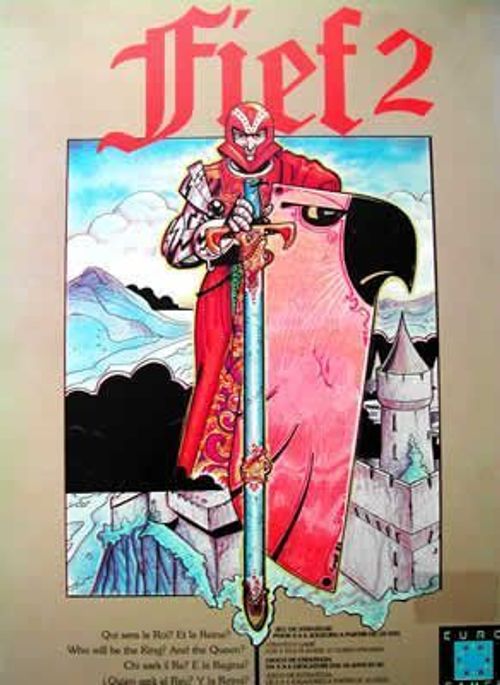
Fief 2
Fief 2 Rulebook
Table of Contents
Table of Contents
1. Components
Each box of Fief 2 includes:
- A map board showing a medieval kingdom
- 120 Soldier tokens of six different shields (20 per player)
- 9 King's Guard tokens
- 6 Queen's Guard tokens
- 7 Revolting Peasant tokens
- 16 Lord tokens (12 men and 4 women), each bearing a different initial
- 1 King token
- 1 Queen token
- 12 Castle tokens
- 6 City tokens
- 12 Mill tokens
- 12 Wine Press tokens
- 70 playing cards (57 blue backed and 13 red backed), including the First Player card
- 60 bank notes (10 of 1000 florins, 20 of 500 florins and 30 of 100 florins)
- 2 reference sheets
- 3 dice
- A rule book (of which this is a translation)
2. Game Theme
Fief 2 is a three to six player game which simulates the rivalries between Lords in a small medieval kingdom. The game takes place in what could have been XIIth century Bordelais or Burgundy. At that time, Lords and Bishops share absolute power between themselves. They elected weak Kings who couldn't endanger their privileges. One must wait for the XIIIth century to see the European monarchies consolidate their power over the Church and the feudal Lords. Initially elective, the monarchy quickly became hereditary and later absolute. It is this intense struggle for military and political power which serves as the game's theme.
In the game, each player directs the destiny of a noble family made up, in variable numbers, of men and women, titled nobles, bishops and cardinals. So as to become dominant and impose a King which suits its interests, each family has three assets:
- Economic strength: The revenues of taxes, mills and wine presses.
- Military strength: Soldiers.
- Political strength: Negotiated alliances, marriage unions and votes.
3. The Kingdom
The map is divided into six fiefs and, simultaneously, in four bishoprics. The fiefs are identified by the map board's coloured margin, whilst the bishoprics have their component Villages listed there. The fiefs are either Baronies (three Villages), Counties (four Villages) or Duchies (five Villages).
4. Object of the Game
Normal Game
This game can be won by a single player or by a team of two players. To win alone, your family must include a King or Queen and own three fiefs. To win as a team, the two families must be united by marriage and include the King and Queen and own four fiefs.
At the end of any game turn, if either of the above victory conditions is met, the game is over.
Scored Game
The goal of each player is to make his family the kingdom's most powerful one. This power is scored as follows:
| Title | Points | Title | Points |
|---|---|---|---|
| King, Duke | 50 points | Bishop | 20 points |
| Count | 40 points | Prince, Cardinal | 10 points |
| Queen, Baron | 30 points | Each 50 florins | 1 point |
Scores are tallied up every 5 turns. The game lasts for 10, 15, 20 or 25 turns (as determined by mutual agreement at the onset). At game's end, high score wins.
5. Set Up
Assemble the map board. Leave enough space around it for each player to arrange his money and cards.
Pick a player to be the kingdom's Treasurer. He will deal money, tokens and cards to the players.
Each player rolls the dice. The high roller is the initial First Player; he picks his shield (for the Soldier tokens), his first Lord (from the blue card deck) and places 8 Soldiers, a Castle and the Lord's token on a Village on the map. The Treasurer also gives him 300 florins. The second high roller picks next and sits down to the first player's left, and so on.
6. The Game Turn
Each game turn is broken down into six phases. Each phase must be played out before moving on to the next one. Within a phase, start with the player holding the First Player card and move clockwise, until everybody has gone. The phases are:
- Cards
- Income
- Purchases
- Movements
- Combat
- Negotiations
Once the turn is completed, the First Player card passes to the next clockwise player.
7. Cards
The Treasurer shuffles the blue deck and deals enough cards to bring each player's hand back up to three. On his turn, each player may play, discard or exchange with another player up to three cards. The order of play is important: once a player's turn is passed, he may not defend against an attack card!
Cards may be exchanged with another player only if their two families are united by marriage.
Lord/Lady
Reveal this card in front of you. Receive the corresponding Lord/Lady token from the Treasurer and place it in one of your Castles or Cities. If you do not own a Castle or City, place it, in order of preference, on a Village you occupy, an allied Village or an unclaimed one.
As soon as the Lord/Lady dies, the card is returned to the Treasurer along with its token. Soldiers can only move under the direction of a Lord/Lady. A family cannot have more than 4 Lords and Ladies on the board at once.
There are 12 Lords and 4 Ladies.
d'Arc
Place this card underneath a Lady's, so that only "d'Arc" shows below the Lady's surname. To be eligible, the Lady must be unwed (or widowed) and untitled.
The Lady d'Arc cannot marry but can be enfeoffed. Soldiers move up to three spaces under her command; she is also worth 6 points in Combat. If the Lady d'Arc dies, the card is returned to the Treasurer.
There is only one d'Arc card.
Bishop
Place this card underneath a Lord's, so that only the bishopric's name shows off to the right. A Lord can only hold one bishopric.
A Lord Bishop can play a Tithe card and can vote to elect the King. Bishops cannot marry nor become King. Two Bishops may anoint the King. A Bishop may become Cardinal. A Bishop may attempt to put down a Peasant Revolt. If the Lord Bishop dies, the card is returned to the Treasurer.
There are 4 bishoprics.
Tithe
This card can only be played by a Bishop on his own bishopric. Only one Tithe may be played on a bishopric per turn.
During the Income phase, the Bishop will receive the bishopric's Mills and Wine Presses revenues in their Lords' stead; the Tithe is then discarded. If the Bishop dies before the Income phase, the Tithe is discarded.
There are 4 Tithe cards.
Tax
This card can only be played by a Baron, Count or Duke on his own fief. Only one Tax may be played on a fief per turn.
During the Income phase, the fief's Lord receives 200 florins per Village/City in the fief; the Tax is then discarded. Villages occupied by enemy Soldiers do not pay the Tax. If the Lord dies before the Income phase, the Tax is collected by his heir, if any.
There are 5 Tax cards.
Escape
This card allows a prisoner (or group of prisoners held in the same location) to Escape.
The prisoner(s) are immediately moved to a Village of their choice, anywhere on the board; the card is then discarded.
There are 2 Escape cards.
Plague
This card is played on a fief.
Throughout the fief, half the Soldiers die. Count the number of Soldiers in each Village and remove half (rounding down). For each Lord/Lady in the fief, roll a die; on a 4+ (s)he survives, on a 3- (s)he dies. The card is then discarded.
There are 2 Plague cards.
Assassin
This card kills a Lord of the player's choice; it is then discarded.
There is only one Assassin card.
Justice
This card is the only one that can be played out of sequence: it is played immediately after an Assassin card is played, on one of the assassinating player's Lords or Ladies. That Lord/Lady is then executed. The King and Prince are immune from Justice; the Queen is immune only if Regent.
There is only one Justice card.
Bad Weather
This card is played on a fief. Only one Bad Weather card may be on a fief at any time.
It prevents any Movement and Combat within the fief, except that tokens may still move into the fief (they stop immediately). The Bad Weather remains on the fief until dispelled by a Good Weather card; both cards are then discarded.
There are 3 Bad Weather cards.
Good Weather
This card dispels the Bad Weather affecting a fief: both cards are immediately discarded.
There are 6 Good Weather cards.
Famine
This card is played on a fief. Only one Famine card may be on a fief at any time.
It prevents any income from Mills and Wine Presses within the fief (including Taxes and Tithes); it also makes the fief susceptible to a Peasant Revolt. The Famine remains on the fief until dispelled by a Good Harvest card; both cards are then discarded.
There are 2 Famine cards.
Good Harvest
This card dispels the Famine affecting a fief: both cards are immediately discarded.
There are 6 Good Harvest cards.
Peasant Revolt
This card can only be played on a fief suffering from Famine. There can only be one Peasant Revolt on the board at any time.
The card's player picks a Village within the fief and rolls three dice. This is the number of Revolting Peasants that appear. If there are any other tokens on the Village, there is immediate Combat. If the Peasants win, the Village loses any Mills, Wine Presses and Castle it may have had. If they lose, the Castle is spared.
During subsequent Purchase phases, any player may buy more Revolting Peasants (same price as Soldiers) to add to the revolt.
During subsequent Movement phases, the controlling player (the one who played the card) may move the mob up to two spaces. The mob may move out of its starting fief; it may not split up nor ally itself with a player's Soldiers.
If the mob takes another Village, it destroys its Mills, Wine Presses and Castle as before. If the mob takes a City, the fief will belong to the Lord who flushes them out or to the Bishop who puts down the revolt.
A Bishop may attempt to calm the Revolting Peasants. He must travel to the Village occupied by the mob and speak to them. Roll a single die. On a 4+, the revolt is over; on a 3-, the Bishop is stoned to death. The Bishop may improve his odds of succeeding by giving money to the Revolting Peasants. For each 500 florins he gives them, he has a +1 on the die (which means 1500 florins guarantee success). The money goes to the Treasury.
The Peasant Revolt card is discarded when the last Revolting Peasant is eliminated.
There are 4 Peasant Revolt cards.
8. Income
Each turn, each family receives income from its properties:
| Property | Income | Property | Income |
|---|---|---|---|
| Castle | 100 florins | City | 200 florins |
| Wine Press | 100 florins | Mill | 200 florins |
Extra income may be raised by the Tax and Tithe cards. The royal family also receives a pension: 500 florins for the King and 300 florins for the Queen.
A City, Castle, Mill or Wine Press earns income only if occupied by the owning family; at least one Soldier or Lord/Lady must be left on each. However, once a Lord/Lady is enfeoffed, only the fief's capital need be occupied. Whilst a Lord/Lady is prisoner, his income is put aside by the Treasurer until such time as he should be freed, Escape or die.
9. Purchases
During this phase, players hire Soldiers (and/or Revolting Peasants), build improvements and purchase titles.
- Soldiers cost 100 florins each. They appear on any of the family's Cities or Castles, or with any of the player's Lords/Ladies.
- Revolting Peasants cost 100 florins each. They are added to the mob already on the board.
- Wine Presses cost 200 florins each. They appear on any Village controlled by the player. There cannot be more than 3 Mills and Wine Presses on any one Village.
- Mills cost 300 florins each. They appear on any Village controlled by the player. There cannot be more than 3 Mills and Wine Presses on any one Village.
- Castles cost 1000 florins each. They appear on any Village controlled by the player. There cannot be more than one Castle on any one Village.
500 florins will purchase a Cardinal title for a Bishop. Place the card underneath the Bishop's, so that only the Cardinal's hat shows over the top. A Cardinal can anoint the King by himself.
There are 3 Cardinal titles.
600, 800 or 1000 florins will purchase a Baron, Count or Duke title, respectively, for a Lord or Lady. The family must occupy all the Villages of the fief and have at least one Castle in it. Place the card underneath the Lord's or Lady's, so that only the crown shows over the top. Also replace the Castle by a City.
A Lord/Lady, Bishop, Cardinal, King, Queen or Prince may hold several titles. When the King is elected, only the crowned heads and Bishops can vote (one vote per Lord/Lady, regardless of the number of crowns worn). Once crowned, a Lord may be elected King.
When a new Lord/Lady is born, a title may be transferred to him/her, as long as the previous holder of the title continues to hold a higher one. For example, a Baron and Count could give up his Baron's crown but not his Count's. All of a family's titles revert to the King (or Regent Queen) if the family becomes extinct. If there is no King or Regent Queen, the extinct family's player retains the titles until he can reveal an heir or a King is elected.
There are 2 titles each of Baron, Count and Duke.
9.5 The Royal Family
The King
Place this card on top of the elected and anointed Lord, so that only his surname shows. The Lord's token is replaced by the King's (crown on yellow background). He receives a pension of 500 florins per turn, inherits any heirless fiefs and is accompanied by the King's Guard.
When the King dies, the Prince succeeds him. If there is no Prince, the King card is returned to the Treasury.
The Queen
Place this card on top of the wife of the King, so that only her surname shows. The Lady's token is replaced by the Queen's (crown on pink background). She receives a pension of 300 florins per turn and is accompanied by the Queen's Guard. When the King dies, she assumes the Regency until the Prince is old enough (four turns) or a new King is elected and anointed. During that time, she is accompanied by the King's Guard, collects the King's pension and inherits heirless fiefs (or passes them on to her son). If her son ascends the throne, she retains her crown (as Queen Mother) until he marries.
The Prince
The King and Queen can, once enthroned, give birth to a Prince. Either player may reveal a Lord and place him beside the King. Place the Prince card underneath the Lord's, so that only the crown shows. When the King dies, the Prince ascends the throne automatically, without an election; he assumes the King's powers and privileges once the Regency is over. He may beget a Prince of his own only once his wife becomes Queen in her own right.
10. Movements
Generalities
All tokens can move except the Cities, Castles, Mills and Wine Presses.
All tokens move from Village to Village.
Lords and Ladies may move alone but Soldiers must be accompanied (led).
A Lord/Lady may lead any number of Soldiers.
A token may not move more than twice per turn (exception: the tokens accompanying the Lady d'Arc may move three times).
A Lord/Lady may pick up and drop off Soldiers at each Village, but a Soldier may not move more than its allowance by being transferred from Lord to Lord.
A player may stack his Soldiers so as to hide their exact number from the other players.
Taking Villages
A Village belongs to the first family to occupy it with at least one Lord/Lady or Soldier, unless another family has already been enfeoffed with it.
Right of Way
Tokens may stop at or travel through an occupied Village only with the Village owner's consent. When consent is withheld, the newcomer may turn back or attempt an assault. He then places his tokens on the road leading into the Village, exactly like a player whose initial intent was assault. The assault is resolved in the following phase.
When the Village comprises a Castle or City token, consent signifies the newcomer enters the Castle/City by one gate and leaves it by another. The Castle/City owner may let the newcomer in and then refuse to let him out. Likewise, the newcomer may decide to stay in the Castle/City and assault it! In either case, both players would benefit from the Castle's or City's protection.
Evacuation/Retreat
If the Village owner decides to give it to a newcomer (or wishes to avoid poor odds), he may evacuate/retreat by any road other than the one(s) the newcomer used, even out of turn.
11. Combat
Combat is resolved one Village at a time and is further broken down into successive rounds. On each round, each player totals his forces: each Soldier, Lord or crowned Lady is worth a point; the Lady d'Arc is worth six points. Uncrowned Ladies (except the Lady d'Arc) do not fight. The number of dice rolled depends on the player's score: 1-6 = 1 die; 7-12 = 2 dice; 13+ = 3 dice. On the Combat Table, cross-index the number rolled with the type of terrain in which the combat is occurring to obtain the losses inflicted on the opponent.
Combat Table
| Number rolled | 1 | 2 | 3 | 4 | 5 | 6 | 7 | 8 | 9 | 10 | 11 | 12 | 13 | 14 | 15 | 16 | 17 | 18 |
|---|---|---|---|---|---|---|---|---|---|---|---|---|---|---|---|---|---|---|
| …in a City | 0 | 0 | 0 | 1 | 1 | 1 | 1 | 2 | 2 | 2 | 2 |
Losses are withdrawn simultaneously. Combat is immediately over if either faction is eliminated. Either faction may also surrender; in that case, the surrendering Soldiers are eliminated and the Lords/Ladies captured. Otherwise, a new round is resolved.
When more than two players are involved, alliances are possible. Allied players may throw the dice once, after adding up their forces. Alternatively, allied players may attack individually. Reinforcements received from other players after an initial assault was announced must attack separately and do not benefit from a City's or Castle's protection. Allied players must agree on how to divvy up losses, spoils and prisoners.
Targeting Lords
Before throwing the dice, if the battle is in the open, a player may announce he is targeting an enemy Lord (or several of them). One or more dice are then redirected against that Lord (or those Lords); the Lord is struck down if the player throws a 6. Thus, a player could forego up to three dice and aim them at up to three different Lords.
Aftermath
If the Village changes hands, the Mills and Wine Presses are destroyed. Dead Lord, d'Arc, Bishop, Cardinal, King, Queen and Prince cards return to the Treasury. Crowns that belonged to dead Lords or Ladies pass on, in order of preference, to their heirs, the King, Regent Queen or the Treasury.
Prisoners are moved by their captors as if they were Soldier tokens. If the force escorting them is eliminated in combat, the Prisoners also die. The captor force could also surrender the Prisoners along with itself. Prisoners may not be executed and may not be stripped of any of their titles. Prisoners can recover their freedom in two ways: by Escape or by ransom. Once ransomed, a Lord or Lady may be moved by its player away from the captor's holdings.
Prisoners may not vote, may not anoint the King nor be elected King, and do not collect Pensions, Taxes or Tithes. All of the revenues of their fiefs are put aside by the Treasurer until they are released or die; these revenues may only be used to pay the ransom or be inherited.
12. Fiefs
A Lord/Lady may be enfeoffed during the Purchases phase. Three conditions must be met:
- All of the Villages of the fief must be occupied by the player's tokens.
- There is at least one Castle in the fief.
- The player must have enough money to purchase the title (600, 800 or 1000 florins for a Barony, County or Duchy, respectively).
The player then designates one of the Villages with a Castle as the fief's capital. The Castle is replaced by a City.
A Lord/Lady may hold more than one title at a time; all of the titles but the highest one can be transferred, at a later time, to another member of the family. Titles cannot be taken from a prisoner.
Consequences
The Villages of a fief held by a noble need not be occupied; only the capital need be. Neither can they be taken by other players. Once enfeoffed, a Lady may fight and vote; a Lord may vote and be elected King (as long as he's not a Bishop or Cardinal). Holding a title also makes levying Taxes possible.
The City that replaced a Castle offers better protection and better revenues. It is not susceptible to destruction by Revolting Peasants. However, should the City be taken by another player, the title is lost to the invader. Tokens present in the fief when it changes hands are not eliminated.
Inheritance
When a crowned noble dies, his titles of Bishop, Cardinal, King, Queen or Prince return to the Treasury. However, his titles of Baron, Count or Duke may be inherited by another Lord/Lady of the same family. When a player loses the last of his Lords/Ladies, there are two possibilities:
- The Lord/Lady wasn't married. In that case, the titles are inherited by the King. If there is no King but a Regent Queen, she can either inherit them herself or pass them on to her son. If there is neither King nor Queen, the player retains the titles until he can reveal another Lord/Lady or until a King is elected.
- The Lord/Lady was married. In that case, the other family inherits the titles.
In both cases, the player removes all of his Soldiers from the lost fiefs; he keeps any Soldiers that do not fall within any of the lost fiefs. The new owner of the fiefs must place a Soldier on each City, either by purchasing them from the Treasurer or transferring them from Villages he controls.
Inheritance occurs at the beginning of the Negotiation phase.
13. Negotiations
During this phase, alliances and marriages may be concluded, and the King may be elected.
Military alliances, gifts and loans of money, electoral promises are all legitimate negotiation fodder. However, two players may not exchange cards until they have concluded a marriage. The negotiation phase should be limited to 10 minutes or so.
Marriages
Bishops and Cardinals are not eligible for marriage; all other Lords and Ladies are. Marriages need only be announced; the spouses need not meet. The Queen gets her card as soon as her marriage to the King is announced. Widowers may remarry. The marriage alliance is dissolved as soon as either spouse dies.
A marriage alliance allows:
- A combined victory as soon as the two families hold 4 fiefs and both the King and Queen cards.
- Both players to freely exchange cards, as long as neither ends up with more than three cards in hand.
- To beget a Prince, if the marriage is between the King and Queen.
- If either spouse is the last of his line, to bestow all of his/her fiefs unto the surviving family.
Electing the King
There is only one round of votes. Each family may present one candidate. All crowned Lords are eligible, except for Bishops and Cardinals. All crowned Lords and Ladies, plus Bishops, may vote. A Lord/Lady has only one vote, even if he/she cumulates several titles.
The Treasurer takes the vote in the turn sequence. A player may abstain. To be elected, a candidate must not be tied and must collect at least three votes. He must next be anointed.
To be anointed, the candidate must find two consenting Bishops or a single consenting Cardinal. This consent must be obtained immediately after the election is concluded. If it isn't, the election is voided.
If the successful candidate was married, his wife becomes Queen immediately.
Regency
When the King dies, the Queen assumes the Regency. She immediately takes over all of the King's privileges: pension, inheritance, the King's Guard. Whenever she inherits a title, she may opt to pass it on to her son instead.
If there is a Prince, he becomes King immediately, without need of an election or of the Church. The Queen is Regent for four turns, beginning with the turn during which the King died. The Regency ends at the end of its fourth turn. The Queen Mother retains her title and privileges (pension and Queen's Guard) until the new King marries.
If there is no Prince, an election occurs on the Negotiation phase following the King's death. The Regency continues until a King is elected and anointed.
14. The Royal Guard
The King's Guard
When elected, each King receives the 20 soldiers which constitute the King's Guard (fleur-de-lis on yellow background). They appear beside him and follow him in all his movements; they cannot be left behind. If any are lost, they may be purchased back at the usual Soldier cost. At the King's death, the Guard passes under the control of the Queen and later the heir or newly elected King.
The Queen's Guard
When crowned, each Queen receives the 10 soldiers which constitute the Queen's Guard (fleur-de-lis on pink background). They appear beside her and follow her in all her movements; they cannot be left behind. If any are lost, they may be purchased back at the usual Soldier cost. They remain with the Queen until she loses her crown.
15. End Game
If, at the end of a turn, a player has no Soldier or Lord/Lady token left, he is eliminated.
If, at the end of a turn, a player (or two players joined by marriage) fulfils the victory conditions, the game is over.