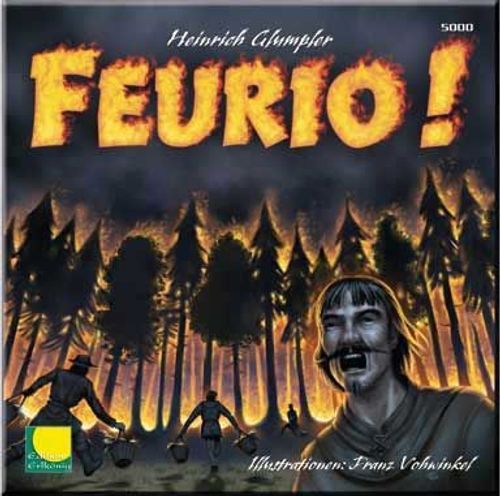
Feurio!
Feurio! Rulebook
Table of Contents
Table of Contents
Material
- 48 firefighters in four colors
- 36 forest tiles
- 1 set of rules
The forest tiles display a number between 1 and 6 (each number is represented six times).
High numbers indicate a fiercer fire – low numbers indicate the presence of more water. Each forest tile also has one to three spaces on which a firefighter can be placed.
All forest tiles also display a "0" on the back.
Set-up
Each player takes all the firefighters of one color. The forest tiles are thoroughly mixed with the back (0) side face-up.
The oldest player turns over as many forest tiles as there are players (four in the four player game) and places them together in a 2x2 rhombus, orienting the numbers and edges as he chooses (in the example 3, 6, 5, 4).
The player on the oldest player's left then executes the first game turn. Play then continues clockwise.
A Game Turn
On his turn, a player turns over a forest tile and places it next to the existing forest tiles - the fire spreads. Afterwards, he may play from 0 to 3 of his firefighters on any one forest tile.
The Fire Spreads
As long as there are face-down forest tiles remaining, the player must turn one over and place it next to the existing forest tiles at the spot where the fire is burning the hottest. The hottest spot is always the place where the sum of the numbers on the immediately adjacent tiles is the highest (in the example 6+4). If more than one spot has the same highest sum, the player can place the new tile in any one of those spots of his choice. The number on the new tile does not count when calculating the spot where it is to be placed.
Place Firefighters
After placing the new forest tile, the player may place up to three of his firefighters on any one tile if he wishes. The firefighters are placed on the circular grey spaces. It doesn't matter which of the spaces on the tile they are placed on. Firefighters of different colors may be placed on the same forest tile.
Firefighters may only be placed on a forest tile as long as the total number of firefighters on the tile does not exceed the number of free edges, i.e. no other tile adjacent to the edge, on the forest tile.
Firefighters already in place on a forest tile remain in place even if the tile later becomes completely locked up by the fire.
Example: Red can only place two firefighters on the 6-tile since it only has 2 free edges.
End of the Game
Once all forest tiles have been placed, a player may only place firefighters or pass. A player who passes may place firefighters on his next turn, if he gets one. After all tiles have been placed and all players pass in turn, the game is scored.
Scoring
All interconnected forest tiles containing a firefighter of the same color form a wooded region that scores points for the corresponding player.
In order to determine points for a wooded region, add the numbers on all tiles in that region. This sum is divided by the smallest number on any tile in that region that still has a free edge. Always round up.
If a wooded region does not have any tile with a free edge, it scores 0 points!
Players add the points for all of their wooded regions and the player with the highest total score wins.
In the event of a tie, the player with the single most valuable wooded region wins.
Feurio with 3 Players
Each player gets 12 firefighters in one color and four neutral auxiliary firefighters in the fourth color.
The oldest player places three forest tiles face-up in a triangle and the player to his left starts. On his turn, a player may either place only his own firefighters or only auxiliary firefighters. Auxiliary firefighters can be used to block forest tiles during play. They are removed before scoring, however. Auxiliary firefighters may not be used to pay for firebreaks (variant rule).
Feurio with 2 Players
Each player gets all the firefighters of two colors.
The oldest player turns over two forest tiles and places them face-up side by side, after which his opponent executes the first game turn.
Players may only place firefighters of one color during their turn.
Points are determined separately for each color and then added together for the corresponding player.
Feurio as a Solitaire Game
The player gets all 48 firefighters and turns over a forest tile before his first game turn.
On each turn, he may only place firefighters of one color. He may not place firebreaks.
The player must place all 48 firefighters before the end of the game. All firefighters of one color must be part of the same single wooded region. Each wooded region must connect to a "1" tile that has at least one free edge. If these requirements are met, the player has successfully completed the solitaire game.
Important: The solitaire game ends immediately after the turn in which the last forest tile was placed. The player may still place firefighters on that turn, however.
Tip: The more turns a player waits before placing his first firefighter, the more difficult it becomes to solve the task.
Feurio as a Cooperative Game
For the cooperative game, the rules are the same as for two to four players, but the goal of the game is switched to that of the solitaire game.
The game ends after the turn in which the last forest tile was placed.
In a three player cooperative game, auxiliary firefighters are not removed at the end of the game but must also be part of the same single wooded region! No firebreaks are allowed.
The cooperative game is more difficult than the solitaire game since firefighters must be placed in the seating order of the players. Further, since there is a face-up forest tile in play at the beginning of the game equal to the number of players, there is more delay before the first firefighter can be placed.
Variant Rule "Firebreak"
Through the use of firebreaks, players can direct the spread of the fire. To do this, on his turn a player places the new forest tile face-down - only he knows the number shown on the front side.
On his turn, a player may draw a forest tile, secretly look at the number, and then place the tile face-down at the hottest position. To pay for this action, he must put one of his firefighters back into the box (it is removed from the game) and he may not place any firefighters that turn. If a player doesn't have any more firefighters, he may not use this action.
A firebreak shows the number "0", i.e. the fire is less likely to spread in the proximity of this tile. A firebreak tile locks the edges of other tiles exactly the same as a tile placed in the normal manner. No firefighters may be placed on a firebreak tile.
Variant Rule "Hotter Game"
When using this rule, you round down instead of up when scoring. Accordingly, it is occasionally worthwhile to place several firefighters on a forest tile in order to prevent other players from placing on it. This way, you can split up your opponent's fire-fighting crews, reducing the value of their wooded regions and, thus, scoring them fewer points.
Example for 4 Players
How does it start?
The oldest player is red. He turns over a 3-tile, a 4-tile, and two 6-tiles.
He places the forest tiles on the table as shown, and already the forest is in flames! Green sits to the left of red and takes the first turn.
First game turn: What does green do?
The fire spreads - green turns over a forest tile and places it at the spot where the sum of all adjacent numbers is highest.
Green reveals a 2-tile. The highest sum is 10 (6+4) and is in effect at two positions. Green can either place the 2-tile at the bottom or the upper right (shown by the red arrows). Green decides to have the fire spread to the upper right.
Afterwards, green may place up to three firefighters on any one (!) forest tile. He need not place the firefighters on the new tile he just placed and he is not required to place any firefighters at all, if he doesn't wish to do so.
The firefighters are placed on the grey spaces, one firefighter per space. But the raging fire limits the placement area even further, i.e. directly after placing firefighters there may never be more firefighters on the relevant forest tile than it has free edges. Accordingly, no firefighters can ever be placed on forest tiles that have no more free edges.
Green places one firefighter on the 6-tile at the lower left. The 6-tile at the lower left has 3 spaces and 3 free edges, i.e., green could have placed up to three firefighters on this tile.
It doesn't matter exactly on which spaces a firefighter stands on the forest tile. The spaces on the forest tile simply indicate the maximum number of firefighters that could ever be placed on that tile - the larger the amount of water in the tile, the less available space for firefighters.
Second game turn: What does blue do?
Blue turns over a 1-tile. The highest sum is 10 (6+4) - blue must place the 1-tile at the bottom. He places one of his firefighters on the 6-tile where the green firefighter stands.
Note, he could only place one of his firefighters on the 6-tile since it had only 2 free edges.
Third game turn: What does yellow do?
The highest sum is 9 (3+6) - up top or left. Yellow turns over a 2-tile, places it on the left, and places two of his firefighters on the upper 6-tile. Yellow has now blocked other players from placing on this 6-tile (it has 2 firefighters on it and only 2 free edges).
Example for 4 Players (continued) - Scoring Example
Fourth game turn: What does red do?
The highest sum is 9. Red can place the newly revealed 5-tile up top (3+6) or down below (2+6+1). He places it up top and then places one of his firefighters right on it. Note how the highest sum can also be achieved by three or more forest tiles.
Where should you place your firefighters?
You should place your firefighters onto many forest tiles that burn strongly (high numbers) while simultaneously ensuring that these tiles are part of an interconnected wooded region that links to a forest tile with lots of water (low number) that has a free edge.
What does a wooded region look like?
All interconnected forest tiles that contain at least one firefighter of the same color form a wooded region for the corresponding player.
It doesn't matter on which spaces on those tiles the firefighters stand, so long as the tiles are interconnected.
What is a wooded region worth?
The point value of each wooded region is determined separately. To do this, add the numbers of all forest tiles in the region and divide by the lowest number of any tile in that region that still has at least one free edge - ideally dividing by 1. Always round up.
If a wooded region is completely locked up (surrounded with no connection to any tile in the region that has a free edge, for example, the yellow wooded region on the 6-tile in the illustration), it scores 0 points.
And when does it end?
Once all forest tiles have been placed, players can only place firefighters or pass. Players who pass may play again on their next turn.
The game ends as soon as all tiles have been placed and all players pass (placing no firefighters on their turn). Scoring then takes place. Whoever has the highest score wins. In case of a tie, the player with the single most valuable wooded region wins.
Example of Wooded Regions and Points
The sample game has run an additional two complete turns.
Yellow has two wooded regions. One of them - the 6-tile in the middle - is completely locked up and thus worth 0 points.
The second yellow wooded region is worth 4 points (2+5 yields 7, divided by 2 and rounded up yields 4).
Red has two wooded regions. The 1-tile on the left side forms a wooded region worth 1 point (1 divided by 1). The 5-tile and the 2-tile on the right side form the second wooded region worth 4 points (2+5 yields 7, divided by 2 and rounded up yields 4). Red thus has 5 points at this time. Red would do well, however, to occupy the 4-tile between the 1-tile and the 5-tile since this would immediately increase his score to 12 points.
Blue has only one wooded region, worth 6 points (6+4+2 yields 12, divided by 2 yields 6). By blockading the 4-tile, Blue has prevented Green from spreading upward.
Green has occupied one wooded region worth 12 points, (5+6+1 yields 12, divided by 1 yields 12) but the other players have done a good job of skillfully blocking further growth of this region.