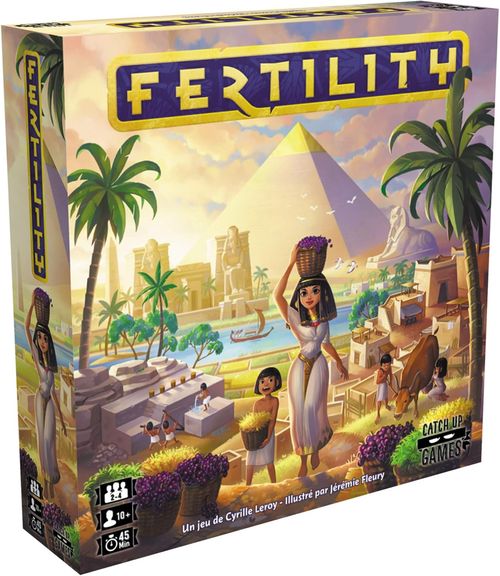
Fertility
Fertility Rulebook
Fertility is a game by Cyrille Leroy, illustrated by Jérémie Fleury, published by Catch Up Games and distributed by Blackrock Games. Graphism: Manoël Verdiel. Layout: Clément Milker. September 2018 - Catch Up Games.
Thanks Cyrille: Thanks to my wife Manue and my son Vianney for their support. A big thank to Steeve and Laurence from «L’Antre du Dragon» for their open availability. Thanks to Franck and Sophia, Romu, Lyse and Vincent, Pascal, Alexis, Guillaume, Eric and Bryan. Lastly, a big kiss to my little Lisa. Catch Up Games thanks Bertrand, Colin, Maël, Max & Jen, Igor, and all playtesters for their feedback and advice.
A game designed by Cyrille Leroy Illustrated by Jérémie Fleury
Valley tiles Metropolis boards
Each Valley tile is composed of 2 scenes, depicting Metropolis boards represent each player’s city. This is the 4 resources of the game: Alabaster , Bovines where they will build District tiles. , Papyrus flowers and Grapes . By laying Valley tiles on the central board, players can collect the corresponding resources. Each Metropolis board already includes 4 starting Shops...
You are a Nomarch in Ancient Egypt. The Pharaoh put you in charge of a Metropolis and its region. The flooding of the Nile is coming to an end and the lands of the Valley are ready to offer their riches. Organize the collection of resources, Icons indicate build districts with the most lucrative shops, each type of scene. supply them with goods and earn the most Debens for the glory of the Pharaoh.
The player who makes the best use Starting tile
of the resources of the Nile Valley The starting tile features the 4 types of existing scenes.
It indicates the game’s starting point on the central
wins the game. board.
... and 7 spots available for building new Districts with new Shops.
OBJECT OF THE GAME
Be the Nomarch with the most Debens earned. To achieve this, you will collect the resources of the Nile
Valley. You will use these to build and supply the shops Resources
of your Metropolis in order to accumulate more riches There are 4 of them: Alabaster, Bovines, Papyrus flowers than your opponents. and Grapes. The resources are used to build Shops, but also to supply them in order to earn Debens .
The Wheat Storehouse is used to indicate how much Wheat you possess.
GAME COMPONENTS
At the end of the game, use these iconographic reminders to count up your Debens.
Before your first play, take some time to discover the the main elements of the game.
Monuments District tiles There are 4 different ones (Obelisk, Pyramid, Sphinx Central board Each District contains at least 1 and up to 3 Shops. and Temple) that will be put into play by the players
The central board is made of several Valley boards. Players earn Debens by supplying their Shops with throughout the game. During the final scoring, they This is where the players collect the resources that they resources. are worth extra Debens for the players who have need to develop their Metropolis. played the most. Building cost This District Note: Before your first play, assemble each player’s of the District. features Monument pawns. 2 Shops.
This Shop requires 2 Alabasters to be fully supplied.
SETUP
LIST OF COMPONENTS
Take 3 Valley boards for a 2 or 3 player game, and 4 face up in front of them: it is their Personal Pool . 4 Valley boards boards for a 4 player game. In any orientation, place Reveal 3 Valley tiles out of the draw pile next to the 6 connectors for assembling the central board them vertically side by side in order to construct the central board, which will be the Common Pool . 1 starting tile central board . Tie the Valley boards to each other Each player takes a Metropolis board and places it in 50 Valley tiles by using the included connectors . front of them . They each put a Wheat token on the 4 Metropolis boards Place the starting tile in any orientation ontop of 0 square of the Wheat Storehouse . 4 Wheat tokens the start symbol that is the closest to the center The District tiles are shuffled into a face down draw 40 District tiles of the Valley. If two start symbols are equally pile, close to the central board. Reveal 4 Districts to 80 resources (20 of each type) distanced from the center, freely choose which one to arrange face up in a line . 16 Monument pawns (4 of each type)
use. All other start symbols are ignored during Gather the resources close to the board, within reach 1 scorepad the game. Randomly take a certain amount of Valley of all players: this is the Stock . tiles, depending on the number of players: 46 with 4 Each player selects a type of Monument and takes its 4 players, 35 with 3 players, 24 with 2 players . Form corresponding pawns .
a face down pile with these , and put the other Keep the scorepad within reach , as it will be used at remaining ones aside into the box: they will not be the end of the game. used during this game. Each player places 3 Valley tiles
OBJECT OF THE GAME Placing a tile allows the player D. Creation of a Quarry
to collect resources. 4 situations can If a player forms an entirely closed space of an empy The youngest player starts the game. Players occur, all of which are cumulative. square with their tile, they form a Quarry. They can earn
successively take turns, going clockwise. On their turn, one of the four resources from the Stock (Alabaster, a player resolves the 3 following steps, in following Bovine, Papyrus flower or Grapes) and place it next order: to their Metropolis board . They can also choose not to take the resource, and instead they can put one
A. Connection with another tile Monument in their color in the Quarry that they just
1 Place a Valley tile and Each Scene of the tile that has just been played created. The Monuments placed on the central board
collect resources (mandatory) earns the player one resource for each identical can be worth Debens at the end of the game (see final
Scene to which it is connected. The player takes the scoring section for more details).
2 corresponding resources from the Stock and places
Build a District tile (optional) them next to their Metropolis board. Gain Gain
3 Supply Shops in their
Metropolis (optional) +1
1 Place a Valley tile and
collect resources (mandatory) one resource
OR The player takes one of the 3 Valley tiles from their a Monument Personal Pool and places it on the central board, in
any orientation. They must connect it to at least one B. Connection with a Wheat square
other tile that is already in play (including the starting The played tile earns the player one Wheat for each tile), by making at least one of the two Scenes of their Wheat square on the board to which it is connected.
tile match horizontally or vertically with a Scene that For each such earned Wheat, the player’s Wheat token 2
is already in play. Tiles always have to lay on desert moves up one square on their Metropolis board . Build a District tile (optional)
squares: it is forbidden to place them either on a Wheat square or on a Water square. Once they have gathered their resources, the player
If the player cannot play any tile, they then discard one Gain can build one of the District tiles that are available
from their Personal Pool and proceed normally to the face up next to the board. They pay the tile’s cost, next step of their turn. then place it on one of the available spots of their Metropolis board. The cost for building is indicated on the top right of the tile. It can be paid with any
This a valid play. The +1 combination of resources : Alabasters, Bovines,
| Papyrus field Scene | Papyrus flowers, Grapes and Wheats. If the player |
|---|---|
| is connected to an | uses Wheat, they move their Wheat token down on |
identical Scene that is +1
their Wheat Storehouse track from the corresponding already in play. amount of Squares. In all other cases, the resources used must be taken from the ones currently next
to the player’s Metropolis board. The player can This move is not never use any of the resources that have already valid. Neither of been placed on their Metropolis board to pay for
C. Covering a resource on the board the cost of a District tile.
| the two Scenes | |
|---|---|
| of the tile that is | If a player places a tile ontop of a resource icon, the |
| brought into play | player earns the corresponding resource. They take |
| is connected to an | this resource from the Stock and place it next to their |
| identical scene. | Metropolis board . The Scene covering the icon can |
| be of whichever type. |
These two plays are not valid. It is forbidden to lay a tile on a Wheat or Water square.
Gain
Lisa buys the tile on the right. She has to pay 2 resources of her choice, as indicated at the top-right corner of the tile.
Examples of Shops
She decides to pay with one Grape and one Wheat. She takes one Grape that was placed next to her board and puts it back into the Stock. Then she moves her Wheat token one square backwards on her Metropolis board.
Lisa then places the District tile that she just bought on a free spot on her Metropolis board.
A player can only build one single District tile on their turn, but this is not required. If they have no remaining free spot on their Metropolis board, they cannot build any new District tiles.
If it is supplied with 1 Papyrus flower, this Shop earns 5 Debens at the end of the game (see final scoring section for more details). She then uses the Papyrus flower to supply a Shop that will earn her 5 Debens at the end of the game. She places the Bovine in a shop that also requires an This Shop earns 1 Wheat as soon as Alabaster to be fully supplied. If Lisa does not place it gets supplied with a Grape. The the required Alabaster here until the end of the game, player moves their Wheat token up this Shop will earn her no benefit. one square on their Storehouse track. Important: the resources can never be moved or taken off a Shop that they have been placed on. If it is supplied with 1 Alabaster, They stay there until the end of the game. this Shop earns the Statue of the represented God at the end of the game (see final scoring). END OF If supplied with one Bovine, A PLAYER’S TURN this Shop earns the player 1 Deben at the end of the game for each Bovine placed on their Metropolis If the player has any remaining resources next to their (see final scoring). board because they have neither used them to build a district, nor placed them on a Shop, they have to be put back into the Stock. The player now completes This Shop can be supplied with their Personal Pool by picking a tile of their choice any one resource coming from from the Common Pool. A new Valley tile is revealed the Stock . It is worth 2 Debens from the draw pile to be added to the Common Pool, during final scoring (see final scoring). so that there are always 3 available tiles. If the player builds a District tile during this turn, a new District is revealed from the draw pile to replace the one that If it is supplied with 1 Bovine and 1 has been taken. Play then proceeds to the next player, Grape, this Shop earns the player following the turn order. the Statue of the God of their choice at the end of the game (see final scoring). END OF THE GAME
As soon as it is sup- The end of the game triggers as soon as the Common 3 Supply Shops in their plied with 1 Papyrus pool cannot be replenished to 3 tiles. Each player flower, this Shop earns takes a last turn, then all players proceed to the final Metropolis (optional) 1 of the 3 resources indicated to the right. The scoring. Each player will have played 9 turns. Take the Whether they chose to build a District or not, the player player takes whichever resource they choose and scorepad and count up the Debens earned by each can place the resources that are still available next to immediately places it on another Shop in their player, as indicated on the next page . The player their board ontop of the Shops of their Metropolis. Metropolis . with the highest total wins the game. In case of a tie, Each District tile can come with 1 to 3 Shops to supply. the player with the least resources on their Metropolis A Shop can receive as many of the corresponding board is the winner. If there is still a tie, the tied players resources that it shows icons . The player is allowed share victory. to supply several Shops during a same turn. If a Shop requires more than one resource in order to be supplied, the player does not have to place them on 2 PLAYER vARIANT the same turn. When a Shop has been fully supplied, the player earns the benefits indicated to the right of the arrow. There Once acquainted with the game, you may want to use are several types of benefits a player can claim from Lisa collected 1 Bovine, 1 Papyrus flower and 1 the following variant for your 2 Player games: during the Shop, which ultimately depend on its type. Grape. She starts by placing her Grape and instantly setup, take 39 Valley tiles instead of the 24 mentioned moves her Wheat token up one square. in the classic rules. On each turn after completing their Personal Pool, the players removes 1 tile from the game’s Common Pool before replenishing it to 3 tiles.
FINAL SCORING
To count how many Debens each player earned, proceed in the following order:
1. Generic Shops
2. Specialized Shops
3. Statues of Gods 4. Monuments 5. Wheat Storehouse
1. Generic Shops
Each fully supplied generic Shop is worth the indicated value in Debens. If a generic Shop is only partly supplied, it is worth nothing.
Lisa has 5 generic Shops in her Metropolis. She fully supplied 4 of these for a total earning of 18 Debens (2 + 4 + 5 + 7). The 5th Shop, which would have a value of 9, is worth nothing because it is not fully supplied.
2. Specialized Shops
At the end of the game, a fully supplied specialized Shop earns 1 or 3 Debens for each copy of the corresponding resource that you have in your Metropolis. Take into account all the tokens of this resource in your Metropolis, regardless of the Shop they are on - fully supplied, partially supplied Shops and this Shop itself.
Lisa supplied her specialized Shop with Grapes, so she earns 3 Debens for each Grapes token in her Metropolis. She takes all of her Grapes into consideration, even the one that she has on a partially supplied Shop. With 7 Grapes, she earns 21 Debens.
3. Statues of Gods
Each player is awarded Debens for the biggest collection of different Statues that they have gathered in their supplied Shops. The bigger the collection, the more Debens the player earns. The scale of earnings is indicated on each Metropolis board.
Lisa supplied 2 Shops, providing a total of 3 different Statues. As indicated on the scale on her Metropolis board, she earns 10 Debens.
- Wheat Storehouse At the end of the game, Wheat token’s final placement on the Wheat track indicates the amount of Debens the player earns.
4. Monuments
The player who built the most Monuments to their color on the central board is awarded 15 Debens, and the player in second place receives 7 Debens. In case of a tie for first or second place, tied players all earn the corresponding value. If several players place first, the next player in the ranking is granted second place (or all next ranked players if there is also a tie regarding second place). A player is awarded no Deben if they did not build at least one Monument.
With 3 Monuments built during the game, Lisa is the player with the most of them. She earns 15 Debens.
Lisa has gathered 7 Wheats in her Storehouse. She earns 23 Debens.
Lisa earned a total of 87 Debens for this game.
18 + 21 + 10 + 15 + 23 = 87