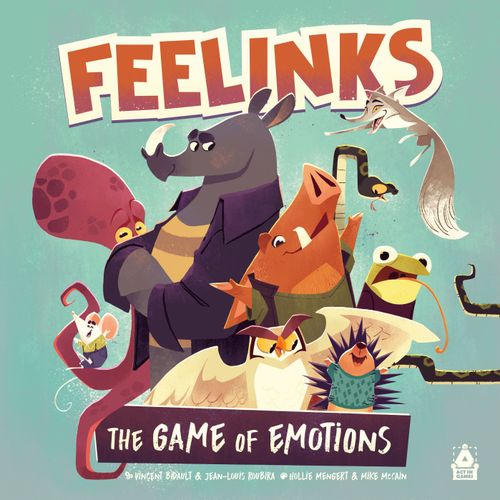
Feelinks (Second Edition)
Feelinks (Second Edition) Rulebook
Table of Contents
Table of Contents
Goal of the Game
"Your father pees next to the neighbours' hedge." "Someone asks you to join their band." "Your parents forbid you from criticizing adults."
These are the kind of situations to which Feelinks asks you to react.
In this cooperative game, express your emotions when faced with certain situations, then try to guess how other players felt. After the 8 situations of a game, you will evaluate the degree of empathy that binds you to the other players.
Contents
- 1 rulebook
- 1 gameboard
- 4 double-sided Score cards, according to the player count
- 18 Emotion cards
- 1 pawn
- 48 Vote cards in 8 colours
- 156 Situations cards, divided into 4 themes:
- As a Family: about family life (ages 8 and up, numbered from 1 to 40)
- At School: about group life and school (ages 8 and up, numbered from 41 to 80)
- Among Friends: about various themes (ages 12 and up, numbered from 81 to 120)
- In Society: about social issues (ages 8 and up, numbered from 121 to 156). These cards are subdivided into 6 categories, each shown by an icon on the top of the card: Health, Parenthood, Digital World, Education, Ecology and Living together. We advise that an adult be present while using this theme, in order to make sure that the sensitive situations are dealt with all the necessary care and attentiveness.
Setup
Example of a setup for 4 players with the theme "As a Family".
A. Place the gameboard in the middle of the table. Place the pawn on the starting space of the empathy track (the most central on the board).
B. Set the Score card corresponding to the player count near the board, to evaluate the degree of your success during the game.
C. Give each player a colour of the 6 Vote cards.
D. Choose a deck of Situations cards and place it near the gameboard. You can also use several decks of Situations cards and let the active player choose one theme while playing.
E. Divide the Emotion cards according to the symbol on their back, the cross or the circle.
- Shuffle the two decks and place them face down near the gameboard.
- Draw 3 Emotion cards from each deck and place them around the board, such that each card is next to one symbol.
F. Choose the first active player.
Playing the Game
-
Starting at round one, the active player discards one Emotion card of their choice from those placed around the board, and replaces it with the first card from the deck with the same symbol (cross or circle). Make sure everybody understands the available emotions.
-
The active player draws a Situations card. They choose one of the 3 situations and read it aloud. Then they place this Situations card near the board: it will help to count the number of rounds completed. None of the situations on the card suits you? Draw a new one! After all, we are here to have fun.
Example: Maeyva is the first active player. She draws a Situations card and chooses: "Your father invites you to go cycling together."
-
Each player selects the Vote card that best indicates how they would feel in this situation. They place this card face down in front of them.
In this example, the Vote card showing the Joy symbol is selected.
-
The active player tests their empathy first. They choose another player and tell which emotion they think they have chosen. If this is correct, the group scores a point and the pawn moves forward one space on the empathy track. Feel free to comment on your emotion or to qualify your choice.
Example: Maeyva chooses to guess which card Enola played. She announces: "Enola, I think you chose Joy." Enola flips her card over, showing the symbol corresponding to Joy. Great! The group scores a point; the pawn immediately moves forward one space on the track.
-
Now the player who has just been targeted must guess the Vote card played by another player of their choice. Continue this way until each player has been chosen once.
A round must end with the active player (the one who read the situation). They will therefore always be the last one targeted during the round.
Example: Now Enola must guess someone's emotion. Because Maeyva is the active player, she can not be targeted. Enola chooses Felix instead; she thinks he has also chosen Joy. Unfortunately, this is wrong, because Felix chose Surprise. No point scored this time.
End of the Game
The game ends after you have played 8 Situations cards. The time has come to determine how much empathy your group has.
Note how far you went on the empathy track and determine your result, according to the Score card or the chart below. Then read the corresponding comment opposite.
The empathy score ranges are printed as follows. The four columns are the four result levels, shown by one to four star icons on the Score card.
| Player count | Empathy score (1 star) | Empathy score (2 stars) | Empathy score (3 stars) | Empathy score (4 stars) |
|---|---|---|---|---|
| 2 | 0 → 4 | 5 → 8 | 9 → 12 | 13 → 16 |
| 3 | 0 → 6 | 7 → 12 | 13 → 18 | 19 → 24 |
| 4 | 0 → 8 | 9 → 16 | 17 → 24 | 25 → 32 |
| 5 | 0 → 10 | 11 → 20 | 21 → 30 | 31 → 40 |
| 6 | 0 → 12 | 13 → 24 | 25 → 36 | 37 → 48 |
Note: the printed 8-player row reads "33 → 38" for the three-star column and "49 → 64" for the four-star column, which leaves 39 to 48 unassigned. This is transcribed exactly as printed in the source. It appears to be a typographical error in the rulebook, and the Score card is the reference to check against.
One star. Good news! You still have plenty to discover about one another. Your results will for sure be better next time you play. Have you learnt things about yourself and about the others?
Two stars. Nice! You have proven to have great bonds, and have shown a lot of empathy to achieve this result. Did you discover anything new that you did not know?
Three stars. Bravo! What a superb result! You are really good at putting yourselves in each other's shoes; you seem to keep no secrets from one another. It looks like you're on track to achieve the ultimate 4-star score!
Four stars. Magnificent! You have joined the gaming legends: you have attained the maximum score. You are empathy aces, gold medalists at reading emotions. But could you repeat this amazing feat?