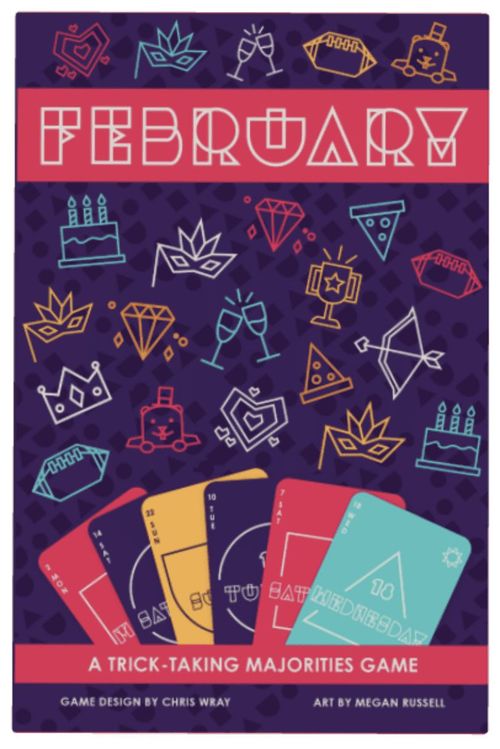
February
February Rulebook
Table of Contents
Table of Contents
February: A Trick-Taking Majorities Game (The Original 2022 Ruleset)
Approximately 20 Minutes. For 3-5 Players.
Materials Needed
- 56 Date Cards: 2 for Each Date of February (One Daytime, One Nighttime) in Four Suits
- 2 Special Cards: 1 "Leap Year" Card, 1 "Reschedule" Card
- A Calendar of the Month of February
- This Rules Sheet
- You'll need approximately 12 markers (possibly more) for each player color, which are not provided.
Setup
Deal the deck of cards equally among the players, excluding the special cards. In the 3-player game, two cards are set aside without looking at them, and in the 5-player game, 1 card is. You'll need these set-aside cards for the second round.
The Trick-Taking Game
The start player (traditionally to the left of the dealer) plays a card from their hand. Players then play into this trick in clockwise order. Each player must follow, playing a card of the same week or day of the week as the lead player, if possible. Thus, the "1" card could be followed by either a card of that week/suit (a 1-7) or another Sunday (the 8th, 15th, or 22nd). If a player can't follow, they may play any card from their hand (but they won't win the trick). The "Leap Year" and "Reschedule" cards (which come into play in the second round) are considered part of all suits and can be played at any time on a player's turn.
The latest date following the card led (by week and/or day) wins the trick and leads the next one: you need more time to plan your events, so later is better! If both cards from the same date are the latest date, the nighttime card wins, since events are much better attended at night. The winning player puts a marker on the winning date, removing any marker already present. (Some groups prefer to "double mark" for replaced markers, showing which cards are out of the game. If you have enough markers, that is recommended. This never affects gameplay.) The winning card is removed from the game; you won't need it again. Set the other cards aside for use in Round II.
After you have played your hand of cards, you'll play a second round, beginning with the player that won the last trick in Round I. Take the non-winning cards from all of the played tricks, any cards set aside at the start of the game, and the special cards. In a 3-player game, take out one of the "1" cards, and in the 5-player game, take out both "1" cards. Shuffle the remaining cards and deal them back out; you should have an equal number of cards for each player.
Scoring
Having the most markers in a particular week earns two points; ties are broken by the marker closest to Sunday (with Sunday winning ties). Having the most markers on a particular day of the week (e.g. Monday) earns one point; ties are broken by the earlier date. Add these points, and the most points wins; ties are broken by the earliest marked date. Thematically, though you need more time to plan the events, the press wants to cover what is happening the soonest, so that is why earlier always wins.
The Special Cards
The special cards are only in the deck in the second half of the game. They are part of all suits, and thus can always be played; they never have to be played if a player has other cards. If they are led, the next card in the trick is the one that must be followed. The "Leap Year" card wins the trick, but it does not get to mark any date. The "Reschedule" card can't win the trick, but the person playing it gets to pick where the marker goes from among the other cards in the trick (still replacing any marker already there).
Strategy Tip
It is more difficult to win tricks with cards from the earlier weeks, but when you do win those tricks, they are far more powerful for scoring purposes because of the strength of the tiebreaker in this game. The winner often is not who won the most tricks, but rather who won the best tricks.
Low-Luck February (The 2024 Ruleset)
Approximately 25 Minutes. For 3-5 Players.
Materials Needed: The same as in February.
The Premise
A friend observed on BGG that, in the original ruleset, "you get the cards you are dealt." That statement reflects not just a truism of most trick-taking games, but also one of the most common (and fair) criticisms of the original February design: players simply cannot capture a space if they do not have one of its cards. And given that the shuffle is random, that bothers some players.
I've never minded a little luck in trick-taking games, but removing the randomness is straightforward. Shuffling the cards takes less time and (at least to me) is better for new players. But for a few more minutes of gameplay, February can become a low-luck game. I'd recommend this as an advanced variant.
I experimented with a few different ways to make a low-luck version of February, and drafting proved to be the playtesters' favorite. Plus, drafting works here in ways it would not work in other trick-taking games. In many trick games, you'd seek to draft all high cards (like in most plain trick games) or all low cards (like in trick avoidance games). But here, given the strength of the tiebreaker and the tiered suits, the drafting has a bit more depth.
The Gameplay
The trick-taking game and scoring is identical to February. The only difference is that, rather than random deals being given to each player, the hands are drafted. All that changes is the setup.
Round I Setup and Draft: Deal the deck of cards (without the "Reschedule" or "Leap Year") equally among the players, excluding the special cards. In the 3-player game, two cards are set aside without looking them, and in the 5-player game, 1 card is. You'll need these set-aside cards for the second round.
Players look at their hand, choose two cards, and pass the remaining cards clockwise to the player to their left. This continues until all cards are drafted. In the 5-player game, the final pass will only be of one card.
Round II Setup and Draft: Take the non-winning cards from all of the played tricks, any cards set aside at the start of the game, and the special cards. In a 3-player game, take out one of the "1" cards, and in the 5-player game, take out both "1" cards.
Players look at their hand, choose two cards, and pass the remaining cards counterclockwise to the player on their right. The final pass will only be of one card.
February Teams (The 2023 Ruleset)
Approximately 25 Minutes. For 4 Players.
Materials Needed: The same as in February.
The Premise
I wish there was some clever premise here, but I simply love a team trick-taking game!
Setup
Teammates sit opposite each other. Deal the deck of cards equally among the players, excluding the special cards. Pass one card to each other player (i.e. a total of 3 cards).
The Trick-Taking Game
The start player (traditionally to the left of the dealer) plays a card from their hand. Players then play into this trick in clockwise order. Each player must follow, playing a card of the same week or day of the week as the lead player, if possible. Thus, the "1" card could be followed by either a card of that week/suit (a 1-7) or another Sunday (the 8th, 15th, or 22nd). If a player can't follow, they may play any card from their hand (but they won't win the trick). The "Leap Year" and "Reschedule" cards (which come into play in the second round) are considered part of all suits and can be played at any time on a player's turn.
The latest date following the card led (by week and/or day) wins the trick and leads the next one: you need more time to plan your events, so later is better! If both cards from the same date are the latest date, the nighttime card wins, since events are much better attended at night. The winning player puts a marker of their team on the date of their choosing (this is different than in the other rule sets), removing any marker already present. (Some groups prefer to "double mark" for replaced markers, or if they win a space again, showing which cards are out of the game. If you have enough markers, that is recommended. This never affects gameplay.) The winning card is removed from the game; you won't need it again. Set the other cards aside for use in Round II.
After you have played your hand of cards, you'll play a second round. Take the non-winning cards from all of the played tricks and the special cards. Shuffle them and deal them back out; you should have an equal number of cards for each player. Each player again passes a card to each other player. Make sure you remember who won the last trick: they start the next round!
Scoring
Having the most markers on a particular day of the week earns two points for the team. (There are no points for having the most markers in a particular week.) In the event of a tie, neither team gets the points. Each team also gets points for their largest set of adjacent adjoining markers (i.e. diagonal does not count). Add these points, and the most points wins. In the event of a tie, it is broken by the earliest marked date.
The Special Cards
The special cards are only in the deck in the second half of the game. They are part of all suits, and thus can always be played; they never have to be played if a player has other cards. If they are led, the next card in the trick is the one that must be followed. The "Leap Year" card wins the trick, but it does not get to mark any date. The "Reschedule" card can't win the trick, but the person playing it gets to pick where the marker goes from among the other cards in the trick (still replacing any marker already there), even if the other team won.
Communications Rules
You may not communicate with your partner about precisely what is in your hand. You may, however, freely recommend and discuss spaces where to place a marker.
Can't Follow February (The 2024 Leap Year Ruleset)
Approximately 25 Minutes. For 4 Players.
Materials Needed: The same as in February.
The Premise
In 2023, when I announced that there would be a new set of rules each year, I also posted a poll on BoardGameGeek asking what type of game everybody wanted in 2024. A "can't follow" game won with 62% of the vote.
I'm amazed at how well this works. This might be my personal favorite way to play!
Round I Setup and Draft
Deal the deck of cards (without the "Reschedule" or "Leap Year") equally among the players.
Players look at their hand, choose two cards, and pass the remaining cards clockwise to the player to their left. This continues until all cards are drafted.
Round II Setup and Draft
Take the non-winning cards from all of the played tricks and the special cards.
Players look at their hand, choose two cards, and pass the remaining cards counterclockwise to the player on their right. The final pass will only be of only one card.
The Trick-Taking Game
The start player (the player who drafted the daytime "1", or otherwise the lowest card still in the game) plays any card from their hand. Players then play into this trick in clockwise order. Each player cannot follow the suit (i.e. week) of any previously played card, if possible. Thus, ideally, each trick will have a card from each week.
If a player must follow a previously-played suit, they may play any card from their hand, but they won't win the trick, and they must remove their marker (if any) from a board space of their choosing. A player cannot do this.
Note: the source sheet ends the preceding paragraph with the sentence "A player cannot do this." as printed; the source does not elaborate on the sentence, and it is transcribed here unchanged.
The "Leap Year" and "Reschedule" cards (which come into play in the second round) are considered part of all suits and can be played at any time on a player's turn, but they never need to be played if a player has other cards.
The player playing the latest lone day of the week wins the trick. If there are multiple cards of that day of the week (e.g. two or three or four Saturdays), they are all eliminated from contention to win the trick. Thus, the highest lone day of the week wins.
The winning player (if any) puts a marker on the winning date, replacing any marker already present, and leads the next trick. (Some groups prefer to "double mark" for replaced markers, showing which cards are out of the game. If you have enough markers, that is recommended. This never affects gameplay.) The winning card is removed from the game; you won't need it again. Set the other cards aside for use in Round II.
It is possible that a trick will not have a winner. If there is not a winner, remove the highest numbered card (if there is a tie, it does not matter which one) from the game, set the other cards aside for Round II, and the next trick will be led by the same person as before. No space gets marked.
After the first hand of cards, play a second round, with the draft specified above. The second round will begin with the player that drafted the "Reschedule" card, but they can start with any card. Play then proceeds as normal.
Scoring
Having the most markers in a particular week earns two points; ties are broken by the marker closest to Sunday (with Sunday winning ties). Having the most markers on a particular day of the week (e.g. Monday) earns one point; ties are broken by the earlier date. Add these points, and the most points wins; ties are broken by the earliest marked date.
The Special Cards
The special cards are only in the deck in the second half of the game. They are part of all suits, and thus can always be played. If a player would otherwise violate the "can't follow" rule, they must play the special card before they do the move where they remove a marker. The "Leap Year" card wins the trick, but it does not get to mark any date. The "Reschedule" card can't win the trick, but the person playing it gets to pick where the marker goes from among the other cards played into the trick (including on any cards played in violation of the "can't follow" rule).
Frequently Asked Questions
Why aren't markers included in the box?
It added too much to the production cost on The Game Crafter, plus everybody had a different preference about what kind of markers to use. When we play, we use either (1) meeples from another game, or (2) a set of cubes I bought online from a popular meeple source. The calendar comes folded, which makes it an uneven surface for placing markers. Any suggestions?
I've posted a PDF file on BoardGameGeek. Feel free to print yourself a flat one. One group had them printed on mouse pads, which I think is a cool idea.
What are the other special cards in the box for?
The Leap Year Edition includes "Birthday," "Holiday," and "Change of Heart" cards. They are currently just "alternative art" versions of the "Reschedule" card. They may gain functionality in the future, since I've been working on a game where I might need them.
Why February? Why not another month?
Four equal-sized suits (assuming the weeks are suits) makes it an ideal candidate for a card game!
This game is a little mean/cutthroat/nasty?
Yes, that's true. Most majorities games are like that. I've never minded that in games, and I think it leads to big, exciting moments. Nonetheless, if you want to make these games a little friendlier, you can make it so spaces can be double marked by different players, rather than the second marker replacing the first. If you do that, I would still make it so the earlier marked spaces break ties for majorities purposes. If there are still multiple players among those tied on that particular space, they then share the points (or, if it is a game tiebreaker, they share the victory).
In what years does February 1 fall on a Sunday, like in the calendar here?
I believe the next five times that occur are 2026, 2032, 2037, 2043, and 2054.
Where and when do you post the new rule sets?
On BoardGameGeek, on or around February 1 of each year.