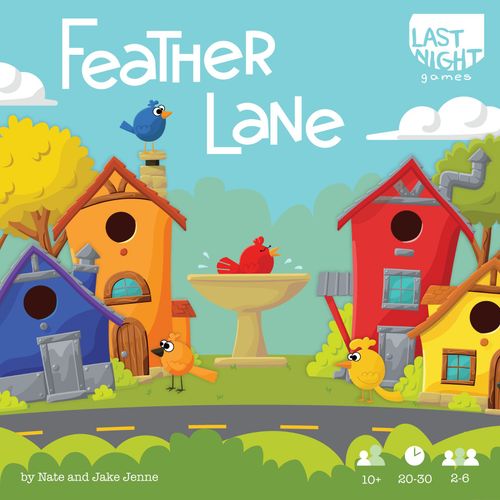
Feather Lane
Feather Lane Rulebook
Table of Contents
Table of Contents
Game Contents
- 270 street cards
- 40 community preference cards
- 14 yellow bird tokens
- 14 red bird tokens
- 14 orange bird tokens
- 14 blue bird tokens
- 24 mouse tokens
- 1 bag
- 1 score pad
Game Setup
- Place all bird tokens into the provided bag and set the bag in the center of the table.
- Place the mouse tokens on the table.
- Shuffle the deck of street cards and place the deck face down within reach on the table. Only a portion of this deck will be used each round.
- Shuffle each of the four community preference decks and randomly select one card from each. Place the selected cards face up in the center of the table. Place the remaining community preference cards back in the box.
- Give the first player token to whomever most recently saw a bird.
Round Setup
This game is played in 3 rounds. At the beginning of the game, and at the beginning of each subsequent round, you should perform the following steps:
- Draw cards from the street deck based on the number of players according to the chart below. Place those cards in a small face down deck in the center of the table. This will be the deck of cards in play for the round.
| Player count | Cards per round |
|---|---|
| 2 players | 20 cards |
| 3 players | 28 cards |
| 4 players | 36 cards |
| 5 players | 34 cards |
| 6 players | 40 cards |
- From this small deck, reveal 6 of the cards and place them in 3 rows with two cards in each row.
- Draw 3 random bird tokens from the bag and place one next to each of the 3 rows of cards. The cards and birds together form the display from which all players will choose.
Community Preferences
Four community preference cards are in play for the whole game. These four community preferences will be the main way to earn points, so read them carefully.
The four community preference cards in the example are:
- Trees (4 points): 4pt for each pair of adjacent same-colored trees.
- Little houses (4 points): 4pt for each pair of adjacent little houses, containing one blue and one yellow.
- Tall houses (5 points): 5pt for each pair of same-colored tall houses, separated by two spaces that aren't tall houses.
- Birds (9 points): 9pt for each set of 3 same-colored birds, anywhere.
On Your Turn
The game is played over 3 rounds. Beginning with the player who has the start token, all players take turns choosing two cards and a bird from the display and adding them to their collection. The steps of a turn are highlighted below.
- Choose a row of the display to take.
- Add both cards to your city and set aside the bird for later.
- Shift the cards in the display and refill it with 2 new cards and a bird.
1. Choose a Row
Choose one row of the display to take. Collect both the cards and the bird token from the row you choose. Set the bird token aside until the end of the round.
Cards can include various combinations of four different colors of birdhouses, two different colors of trees, and bird baths. Each element can help you score in different ways.
2. Add Both Cards to Your City
Over the course of the game you may create up to three separate streets (horizontal lines of cards) which, together, make up your city. Both cards chosen on your turn must be added to your city, but they do not need to be added to the same street. The first card played on any of your 3 streets is simply laid on the table. Additional cards are added to a street by overlapping with existing cards. You may add to either side of a street, on top or underneath the existing cards. You must overlap cards along the dotted lines printed on them, covering up at least one element of a card. You may overlap more or all of a card (along the dotted lines) as you add it to your street. Once a card is added it cannot be moved. You may cleverly place a future card on top, but you cannot move cards once they are placed.
When you choose to begin a second or third street, you may choose to start that street above or below your existing street(s). In the end, players will score points for having the longest top, middle, or bottom street. Pay attention to your opponents and choose carefully whether to begin a new street above or below your existing ones. Once a street is started it cannot be moved.
More details about how cards may be placed are illustrated below.
- You may lay your new cards on top of existing cards like the five examples in the rulebook illustrations.
- You may also tuck your new cards under your existing ones like the four examples in the rulebook illustrations.
- You may completely cover another card when placing a new one. That's okay, but not a very efficient way to play. Try to find ways to score in multiple ways at once!
- Note that later in the game you may have birds and mice on some of the spaces on your streets. If you place a card on top of a bird/mouse token, it must be removed from the game.
3. Refill the Display
Shift the cards in the display and refill it with 2 new cards and a bird. Shift cards in the first column down to fill any gaps. Shift cards in the second column up to fill gaps. Then, draw two new cards from the round deck to refill the display. Add a random bird token from the bag to replace the one that was taken.
Play continues clockwise until the round deck runs out of cards (leaving four unused cards in the display).
End of the Round
Once all the cards in the round deck are gone and there are not enough cards to refill the display, the round ends. All players should have had equal turns. In a 2-4 player game, each player will have had 4 turns. In a 5-6 player game, each player will have had 3. You can count how many birds each player has set aside as a quick reminder of how many turns everyone played.
When the round ends, discard the remaining cards in the display and place the remaining birds back into the bag. Pass the start token clockwise to the next player.
Place Your Birds
At the end of each round, all players should place their collected birds onto houses in their city. Each bird may only be placed on an unoccupied house of the matching color. Be sure to pay attention to the community preference regarding birds to maximize your score. If you cannot place a bird or do not want to, you may exchange any number of birds collected this round for the same number of mice tokens instead. Add mice tokens to any empty house on any street. If you don't have room for your birds or mice, you forfeit the animals altogether and discard them for the rest of the game.
At the end of the game, mice tokens placed on a house will add an extra point to your score, but they won't help you with the community preferences. Once a bird/mouse is placed on a house, it cannot be moved.
Note: Mice can help you gain points when you can't quite meet the community preference for birds, but be careful. Mice can disrupt some of the community preferences by occupying houses that you want to be empty, or that you might need for future birds.
Note: If a future card is played on top of a bird or mouse, that animal token is removed from the game.
End of the Game
At the end of the 3rd round, after all players have placed their birds and mice, the game ends and players tally their scores.
Scoring
Using the included score sheet, tally up the scores for every player.
Community Preferences
Count the points earned from each of the four community preference cards. Write each player's score on the correlated line of the score sheet. Note that houses, trees and birds may only be counted once per community preference card. For example, a house cannot be part of two different pairs of houses in order to count it twice.
Bird Baths
Each bird bath has a point value printed on it. Count the points of all the visible bird baths in your city.
Mice
Each mouse placed on a house in your city scores one point.
Longest Street
The player with the longest top street scores 5 points. The player with the longest middle street scores 5 points. The player with the longest bottom street scores 5 points. In the case of a tie for a longest street, all tied players score the points. To determine the length of each street, count each visible section of the cards on that street (marked by dotted lines).
Note: it is strongly recommended to create 3 streets to score the most points. However, if any player has only 1 street at the end of the game, their street is considered a top street for the sake of comparison. If a player has only 2 streets, they are counted as a top and middle street.
Winning
Add all the scores for each player. Whoever has the highest score wins. In the case of a tie, the victory is shared.
End of Game Example
The example in the rulebook portrays Ethan's completed game given four randomly-selected community preference cards.
- Trees: Ethan has 4 pairs of trees and scores 16 points.
- Little houses: Ethan has 5 pairs of houses and scores 20 points.
- Tall houses: Ethan has 5 pairs of tall houses and scores 25 points.
- Birds: Ethan has 3 sets of birds and scores 27 points.
- Mice: Ethan has two mice and scores 2 points for them.
- Bird baths: Ethan has five bird baths and earns 10 points.
- Longest street: Ethan's middle street was the longest among all other players (with a length of 17), so he earns 5 points for that.
His total score is 105.