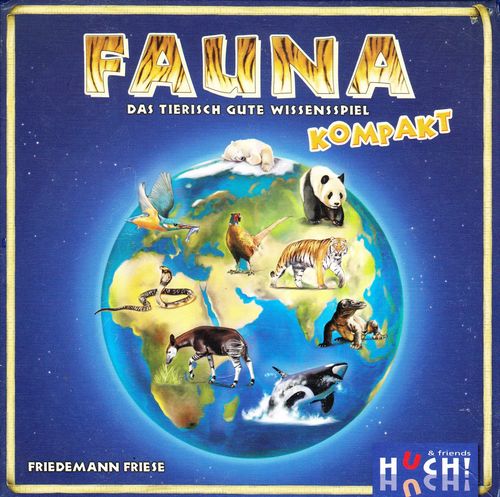
Fauna Kompakt
Fauna Kompakt Rulebook
Table of Contents
Table of Contents
Contents
- 87 animal cards with 174 animals
- 6 game board cards "World"
- 3 scale cards
- 1 card box
- 14 guess stones in 2 player colors (2 x 7 guess stones in turquoise and orange)
6 game board cards and 3 scale cards form a game board with 7 land regions and 6 sea regions. The scale cards show scales for weight, length and tail length.
With the included material you can play the game both on its own and as an expansion to the game Fauna. In the following, the stand-alone game is explained. On page 7 you will find the rule adjustments for use as an expansion.
The Animal Cards
On the cards there is a lot of interesting information about the individual animals. The detailed list of habitats is only needed when the game is used as an expansion. The stand-alone game Fauna Kompakt assigns the animals to larger regions.
The upper half of the card contains information that the players receive at the beginning of a round. With it they can estimate how many correct answers they can give.
- Animal class
- Name
- Scientific name
- Illustration of the animal
- Number of areas in which the animal occurs in the wild
This information is visible when the card is in the card box.
The lower half of the card contains the zoological classification and the facts being asked for about the animal:
- Areas in which the animal is found in the wild
- Average values of the measurements asked for:
- Weight
- Length (head-and-body length, without tail)
- Total length (with tail)
- Tail length
- World map for quickly finding the areas asked for
The lower half of the card remains hidden from all players during a round and is only taken out of the card box for scoring at the end of the round.
Setup for Fauna Kompakt
(The game FAUNA and knowledge of its rules are not required.)
Sort the 6 game board cards and the 3 scale cards out of the card deck. These 9 cards are put together to form a world map, as shown in the illustration.
The card box is filled with the animal cards so that the picture of the animal is visible on top. The 14 guess stones are placed within easy reach of everyone next to the world map. Now put paper and a pencil ready for noting the victory points.
One player is determined to note the bids and the victory points scored by all players; he is also the first starting player.
Course of Play
Each round, the players estimate the habitats and measurements of the animal that is in the front of the card box.
First the starting player reads out the name of the animal, as well as the number of areas asked for and the measurements asked for. Then each player, beginning with the starting player, makes a bid. In doing so the players estimate how many correct statements they can make about the areas and measurements asked for. After the bidding, the highest bid is checked by placing the guess stones. Finally the points scored are noted.
I. Making the Bids
The starting player makes his bid first; the other players follow clockwise. With his bid a player states how many of the areas and measurements asked for he believes he can name correctly. The starting player notes the bids made.
Each bid can be freely determined and may even be lower than the previous one.
Only the player with the highest bid must afterwards place guess stones. If several players share the highest bid after the bidding, the one among them who made his bid last must place the guess stones.
There are 6 sea regions: Atlantic, Indian Ocean, Arctic Ocean, East Pacific, Southern Ocean and West Pacific ... and 7 land regions: Africa, Antarctica, Asia, Australia, Europe, North America and South America.
II. Placing the Guess Stones
Now the player with the highest bid marks his answers with the guess stones on the game board cards and the scale cards. The number of stones to be placed must be exactly as high as the player's bid.
Attention: For some questions it is possible, depending on the animal, to give several correct answers, i.e. to place several guess stones (see illustration below).
Placing on a Region of the World Map
A guess stone can be placed on a land region as well as on a sea region of the world map. Sea regions are marked with a white name, land regions with a black name.
Attention: Besides the stretch of sea, sea regions also include the islands lying in that region, unless these are specially marked as a land region!
Placing on a Scale
A stone can also be placed on a field of a scale. Each scale field is assigned a measuring range. For lengths there are centimeters on the left and meters on the right. For weight the scale ranges from grams through kilos up to tonnes.
Attention: In the upper half of the card you can see which measurements are asked for.
Example: The Eastern Grey Kangaroo weighs between 15 and 54 kg. In this case even 3 fields on the weight scale are correct: the field between 10 and 20 kg, the field between 20 and 50 kg and the field between 50 and 100 kg.
III. Scoring
Now the player to the left of the player with the highest bid checks the marked answers with the help of the animal card. For this the animal card is taken out of the card box.
Checking the Guess Stones on the Regions of the World Map
On every animal card the areas of distribution of the animal are listed in the text and highlighted in color in the world map overview in the lower part of the card. If at least one of the areas named on the animal card lies within a region that the player has marked with his guess stone, the answer is correct!
Example: To answer the question about this area correctly, ASIA must be marked.
Checking the Guess Stones on the Scale Fields
Here, too, the marked scale fields are compared with the data of the animal card. If the value given on the animal card is covered wholly or partly by the scale field marked by the player, the answer is correct!
Example: Correct answers to the question about weight are the fields between "1 and 2 kg" and "2 and 5 kg". Each of these two fields would earn one victory point.
Attention: All answers must correspond exactly to the correct value or the correct region. If a guess stone lies merely in a neighboring region or a neighboring field of a scale, the answer is wrong!
- If the player has placed all guess stones correctly, he is credited as victory points with the number of guess stones placed plus 3 further points.
- If even only one guess stone is placed wrongly, the player receives no victory points.
- Regardless of whether the player with the highest bid answered correctly or wrongly, all other players receive their previously noted bids as victory points.
IV. End of a Round
Once all victory points have been noted, the player to the left of the previous starting player becomes the new starting player. The old animal card is put aside and a new round begins.
End of the Game
The game ends when every player has been starting player twice. The player with the most victory points wins. In case of a tie there are several winners.
Fauna Kompakt as an Expansion to Fauna
The animal cards are used exactly as in the base game. The animal cards of Fauna Kompakt, however, are no longer divided into "simple animals" and "exotic animals". Both sides of a card show a uniform color on the border.
When playing with 7 or 8 people, the following changes apply.
- When placing, the guess stones may also be placed on other stones. However, at most 2 guess stones may be in the same field.
- For guess stones that stand on other stones, i.e. were placed later, the corresponding player receives 2 points fewer at scoring. Attention: A player can never receive fewer than 0 points this way!
- The game ends as soon as the first player has reached 80 or more points.