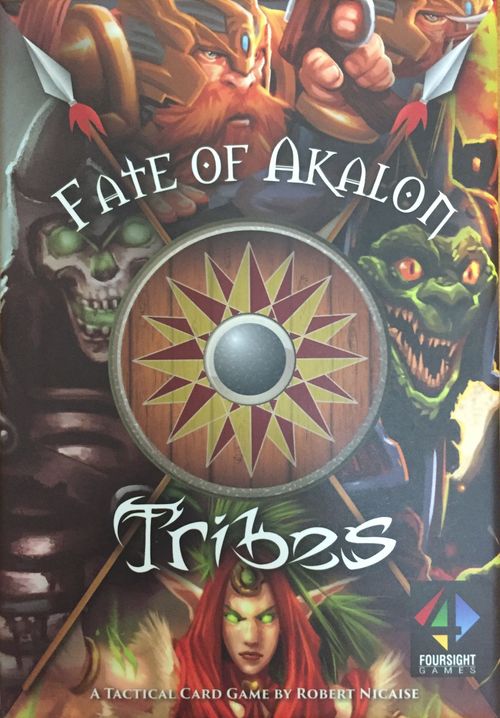
Fate Of Akalon: Tribes
Fate Of Akalon: Tribes Rulebook
Table of Contents
Table of Contents
Contents
- Rulebook
- 4 Faction Decks, 28 cards each
- Elf
- Dwarf
- Orc
- Undead
Introduction
In Fate of Akalon: Tribes, players fight in a series of battles using cards to overpower and outlast their opponents. Synergistic card effects provide subtle, complex strategies and almost endless replayability. The surprising depth of play is belied by its simple mechanics. Each faction sports a different theme. Orcs focus on offense while Dwarves focus on defense. Elves are the masters of card manipulation while the Undead manipulate the cemetery. Which faction will survive? You decide!
The basic rules are for the 2-player game followed by rule changes for 3-player and 4-player games at the end.
Card Anatomy
- Name
- Combat Value
- Card Text
- Faction
- Attribute (in the lower left of the text box)
- Frequency (at the bottom of the card)
Player Setup
Each player chooses a faction deck, shuffles it and forms a face-down deck. Do not draw any cards yet.
Each player has their own set of card areas: Deck, Discard, Cemetery, Hand, and an Out-of-play area. The battlefield is shared. Each player's cards cannot go to card areas belonging to other players.
The first step, the skirmish, is a special battle done once at the start of the game to determine the first attacker and first defender.
Skirmish
- Place the top card from each deck onto the battlefield, ignoring all card text.
- Highest combat value wins the skirmish. If tied, discard battlefield cards and skirmish again. The winning card is placed in that player's discard.
- Example: Elf Hunter (3) wins over Orc Goblin (1). Elf Hunter is placed in the Elf discard.
- Loser of the skirmish decides which player is the first attacker. The losing card is placed in that player's cemetery.
- Example: Orc Goblin is placed in the Orc cemetery. The Orc player chooses themself to be the first attacker, which makes the Elf player the first defender.
- Both players draw 5 cards from their deck to form their initial hand.
Battles
Most of the game is spent in a series of battles where cards are played to the battlefield and their combat values are totaled to determine the battle outcome. To play a card means to place it on the battlefield and follow the card text. Almost every card has card text that affects the game. Unless otherwise stated on the card, the effect only occurs when the card is played to the battlefield and any choices must be made immediately. The seven battle steps are described below.
1) Attack
The attacker plays a card from their hand to the battlefield and immediately follows the card text.
- Example: An Orc Battering Ram (6) does not get the -2 penalty since Orcs are not on defense this battle.
- The attacker is left with 4 cards from their initial 5 card hand. No new cards are drawn yet!
2) Defend
The defender plays a card from their hand and immediately follows the card text.
- Example: Elf Archer (2) allows another card to be played. Elf Wizard (7) is then played.
- The defender is left with 3 cards from their initial 5 card hand. No new cards are drawn yet!
3) Fight!
After all cards are played, add combat values for all cards for each player on the battlefield, including card text effects, to find the battlefield value.
- Example: Attacker (Orc) Battlefield Value: 6. Defender (Elf) Battlefield Value: 9.
Compare the battlefield values to determine the winning player. Highest battlefield value wins the battle. If there is a tie, both players lose the battle.
- Example: Elf (9) > Orc (6). The Elf player wins the battle!
4) Aftermath
- Victorious card(s) are placed on top of the discard in any order. The order cannot change later.
- Defeated card(s) are placed in the cemetery. Order does not matter.
5) Initiative
If the attacker wins, or if there is a tie, then the attacking player does not change. If the defender wins, that player becomes the attacker.
- Example: The Elf player won the battle and becomes the next attacker.
6) Victory?
The total combat value of all cards in a player's cemetery is the cemetery value. Check the cemetery value for both players. If either has 30 or more, the game ends. The winner is the player with the least cemetery value. If the values are equal, the game is a tie.
- Example: The Orc cemetery has a value of 7. The Elf cemetery has no cards yet, so the cemetery value is 0.
- Neither player has 30 or more cemetery value, so keep playing!
- Tip: Arrange cards in groups of 10 to help track cemetery value.
7) Reinforce
At this step, if a player has no cards in hand, then that player reinforces by drawing five new cards from their deck.
Repeat the battle steps until there is a victor. The players go to the first battle step and the Elf player attacks.
Reshuffling
If a player's deck is ever empty, immediately shuffle the discard to form a new deck. Continue drawing from the deck if required.
Card Text
Normally, card text is followed immediately when the card is played on the battlefield and remains in effect until that card leaves the battlefield. Some effects may happen later in the battle.
Many cards have conditional text signified with a bold keyword. Any text after the bold keyword is followed only if the condition is met.
- Example: Elf Sylvan has a Cemetery condition. If it is in the player's cemetery during reinforcement and that player has no cards in hand, they draw one extra card. There is no hand size limit.
Some cards have attributes in the lower left of the text box which help determine how other cards may affect them.
There are many circumstances where the card text will conflict with game rules or other cards. This is part of the game design and promotes deeper tactical play.
- If the text on a card conflicts with the basic game rules, follow the card text instead.
- If the text on a card directly conflicts with other played cards, then the text on the card and only on the card whose effect happens last is followed.
- A card text effect cannot reduce any card's combat value to less than zero.
- Some card text effects cause cards to be removed from the game. Place these in the out-of-play card area.
Simultaneous Effects
It is possible to have simultaneously triggered card effects, such as multiple cards with "After all cards are played...". If more than one card is triggered at the same time, use the following process.
- Resolve simultaneous card text effects starting with the attacking player. Repeat for each other player going clockwise from the attacker.
- If any player has multiple simultaneous card text effects, that player chooses the order in which they occur.
- It is possible for more cards to be played in this step if the battle has not resolved yet. If this happens and more simultaneous effects are played, finish resolving all current effects and repeat the same process until no more effects remain.
- A card's effect cannot be triggered more than once per battle.
Play Examples
- Orc Goblin/Hobgoblin then Dwarf Tactician: The Goblin allows a player to play a Hobgoblin, giving them two cards on the battlefield. If this is followed by a Tactician, then the Hobgoblin remains on the battlefield because it was already played. However, the Goblin and Hobgoblin no longer get their attack bonuses because their card text is ignored. Any opposing card played after the Tactician is treated as if it had no card text.
- Undead Ghoul then Elf Master Summoner: The Ghoul limits each opponent to play only one card in this battle. This is stricter than the game rule of playing one card. The Master Summoner says to reveal two cards from the deck, play one and discard the ones not played. Since only one card can be played this battle, both cards are revealed and then discarded.
- Undead Vampire: The Vampire says to choose an opponent and that player then discards a card at random from their hand. If that player has no cards, then nothing happens. If that player has one card and has not played yet, they will discard the one card and have nothing to play this battle.
- Dwarf Hammer then Orc Kobold: The Hammer says to choose an opponent and that player is the attacker next battle. The choice is made when the Hammer is played. The Kobold says if defeated you may choose yourself to be the attacker next battle. So it is possible two different players may be chosen. The last effect has priority, so the choice from the Orc Kobold is followed.
3-Player Rules
3-player is a free-for-all game and is played as 2-player, except there is one attacker and two separate defenders. Play proceeds clockwise from the attacker.
- When skirmishing, if there is a tie for the highest combat value, only the tying players discard their cards and skirmish again. The player to the left of the winner of the skirmish chooses a player to be the attacker for the first battle, and the other two players are defenders.
- The highest individual battlefield value wins and becomes the next attacker, and the other two players lose. If there is a tie between the attacker and one or both defenders, everyone loses and the attacker does not change. If there is a tie for the highest battlefield value between the defenders, then everyone loses and the player to the left of the attacker becomes the next attacker.
- When checking for victory, if only one player's cemetery value exceeds 30, then the game continues for the remaining two players using the 2-player rules.
- Example: Dwarf (8) > Orc (5+1=6) or Elf (3). The Dwarf player wins the battle and becomes the next attacker.
4-Player Team Rules
The 4-player team game is played using two teams of two players where teammates sit across from each other. Teams do not share card areas.
- When skirmishing, total each team's combat value. The team losing the skirmish then decides which individual player is the lead attacker. Play (and processing simultaneous card text effects) proceeds clockwise from the lead attacker.
- If a player or their teammate leads the attack, then they are both considered to be attacking. Otherwise, they are both considered to be defending.
- The lead attacker will start the attack each battle until the attacking team changes. When a team loses the attack, the player to the left of the current lead attacker becomes the next lead attacker.
- Although each player has a separate cemetery, when a team has 60 or more combined cemetery value, the game ends. The team with the least combined cemetery value wins the game. If the values are equal, the game is a tie.
- Example: Orc (5+1) + Undead (4) = 10. Elf (3) + Dwarf (8) = 11. Defenders 11 > Attackers 10. The defending team wins the battle and the lead attacker rotates clockwise to the Elf player.
Game Summary
- Skirmish: Determine first attacker.
- 1) Attack: Attacker plays a card and follows text.
- 2) Defend: Defender plays a card and follows text.
- 3) Fight!: Highest battlefield value is winner.
- 4) Aftermath: Move cards from battlefield.
- 5) Initiative: Determine who is the next attacker.
- 6) Victory?: If a cemetery value is 30 or more, the game ends.
- 7) Reinforce: If hand is empty, draw 5 cards.
More Information
The publisher's website, www.FoursightGames.com, carries announcements, rules clarifications, card errata, and upcoming expansions.