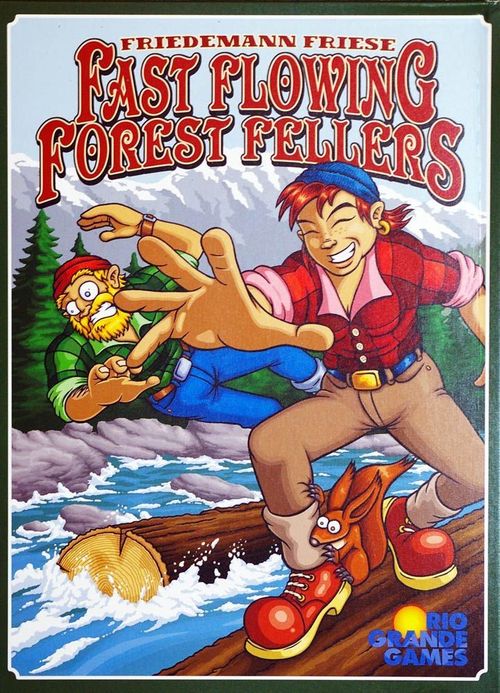
Fast Flowing Forest Fellers
Fast Flowing Forest Fellers Rulebook
Table of Contents
Table of Contents
Goal
Each player controls small group of lumberjacks and competes with the other players to bring his group across the finish first.
Contents
10 Lumberjacks on Logs
Two figures each (male and female) in the colors green, yellow, red, and blue, plus 1 black female and 1 white male lumberjack.
45 Logs
80 Movement Cards
Each lumberjack (male and female) has 1 set of eight cards. Each card shows the lumberjack it belongs to and the maximum move length for that card.
5 Jokers (Beavers)
Each joker card shows a maximum move length of 3.
5 Player Cards
Player cards indicate which lumberjacks the player plays, showing the lumberjack figures and the number of players for which that card is used.
6 Game Boards with a Total of 12 River Segments (Front & Back)
As each game board has two sides, the look of the racecourse can be changed with each game, giving each game a new feel. Each new racecourse offers its own new strategy.
Board Space Types
- Bank or rock — cannot move through these spaces.
- Current — take effect at the end of a turn; otherwise river movement spaces.
- Rapids — may only move in the direction of the goal through these spaces.
- Start spaces — the first three spaces of the river.
- Water spaces — river movement spaces.
- Logs — put logs here at the beginning of the game; otherwise river movement spaces.
- Goal spaces — players move lumberjacks over these spaces to finish the race.
- Finish — leave the game board!
Setup for the First Game
Preparation
Put two game boards together so that there are rapids between them. For the first game, we recommend that players use the game boards shown.
Place 1 log on each of the marked spaces on the game boards.
Depending on the number of players, each player takes a player card and the figures shown on that card. Each player also takes a Joker.
- With 2 or 3 players, each player has 3 figures, each with 8 cards and a Joker, for a total of 25 cards.
- With 4 or 5 players, each player has 2 figures, each with 8 cards and a Joker, for a total of 17 cards.
All players place their lumberjacks in front of the 3 starting spaces of the river and place their player cards before themselves (their play areas). Subsequently, each player shuffles all his cards thoroughly together.
Then, each places his deck face down in his play area and draws 3 cards, placing them in his hand.
Thus, each player has his own card deck, from which he draws cards during the game. Each player will always have 3 cards in his hand.
The players choose a starting player using any method they prefer.
Playing the Game
Moving
Beginning with the start player, each player plays one of his 3 hand cards and moves the corresponding lumberjack up to the number of spaces shown on the card. Players place played cards in a face-up discard pile next to their deck.
When first moving a figure on the board, the player must use one of the three starting spaces.
A player may choose to move a lumberjack fewer spaces than allowed by the card played. The player may even choose not to move the corresponding lumberjack, leaving it where it was. The player may move the lumberjack through allowed spaces (not the banks or rocks) in any direction (except in the rapids), including up river.
With the joker, the player may move any of his lumberjacks that he chooses.
When a player has already moved one of his lumberjacks to the finish of the race, he may use cards of that lumberjack as jokers to move any of his other lumberjacks.
Shoving
A player may not move other figures directly (that is other players' lumberjacks or logs). However, when moving his lumberjack, a player may shove up to two other figures in a straight line.
Note: the player may not shove a figure onto the bank nor the rocks. Basically, only one figure may be on each space.
If 3 or more figures are standing in a row, the player cannot shove them in that direction (see the Example for a detailed illustration).
Rapids lie between the two game boards. Once a figure has crossed the rapids, it cannot go back through the rapids. No figure may be moved or shoved backwards through the rapids. This rule also applies to the start spaces.
The Current
At the end of movement, the player checks to see if any figures have ended movement on a current space (with arrows). Any figure on such a space floats (moves) one space in the direction of the arrows. When such a figure is moved it can shove up to two other figures in the same direction. The player whose turn it is decides which order the figures float.
If the space it floats to is also a current space, it continues to float until it reaches a normal river space or is blocked.
If there are more than 2 figures standing in the direction a figure is to float, there is no empty space in that direction, or there is no empty space behind the figures to be shoved, the figure does not float, but remains where it is on a current space. If after subsequent turns, such a figure can float (the spaces or figures blocking it no longer block it), it will float as described above.
If several figures are on current spaces at the end of a turn, each figure must complete its float before the next begins to float (see the Example for a detailed float example).
Draw Cards
To end his turn, the player draws cards from his deck to return his hand size to 3 cards. Then, the next player in clockwise order takes his turn.
When a player's deck is exhausted, he shuffles his discards to create a new deck.
Game End
The first player to move all his lumberjacks past the finish spaces of the river is the winner!
A player can only win on his turn, so if a player shoves another player's last lumberjack over the finish, that player cannot win until his turn. Of course, another player could win before his next turn.
Note: the "half" middle space beyond the middle finish space is already off the board and not part of the game.
Example
The green player played this card (4). He moves his lumberjack on the right, since the card shows that figure. He may not move it to the right as that direction is blocked by two figures next to the bank.
He moves it in a zigzag movement to the left along the lower bank. The current it moves through has no effect during its movement. It shoves the log and yellow lumberjack in straight lines as it moves. These two figures may not be shoved further, since the bank blocks them.
After his movement, the board looks like this: two figures are now on current spaces.
Both must be moved with the current. Green can decide in which order this occurs. He decides that yellow floats first. Yellow floats along the current completely to the right and stops before the blue figure. Now the green lumberjack floats up one space, shoving the log into the current above it. This log now floats on the current up to the last space of the current. It cannot float further because the yellow and blue figures block it. If the space behind blue were empty (no bank), the log would continue and shove both the yellow and blue figures one space further.
Now it looks like this: the log floated on the current to the right, after yellow floated and stopped next to the blue figure.
Game Testers (Thanks)
Eric Anders, Hanno Balz, Lüder Basdow, Sören Bendig, Andreas Ebert, Christian Frank, Steffi Giese, Thomas Glander, Ingrid Hahn, Lutz E. Hahn, Christian Hildenbrand, Henning Kröpke, Fraser Lamont, Gordon Lamont, Angelika Ludwig, Jago Matticzk, Maura, Andrea Meyer, Stefan Mibs, Jürgen Münzer, Hedwig Thelen, Martin Wehnert and the players from BSW Burgtreffen, Gathering of Friends, Bödefeld and Helmarshausen.
Author: Friedemann Friese. Graphics & Design: Maura Kalusky. ©2008, 2F-Spiele, Bremen. ©2008, Rio Grande Games for the English version.