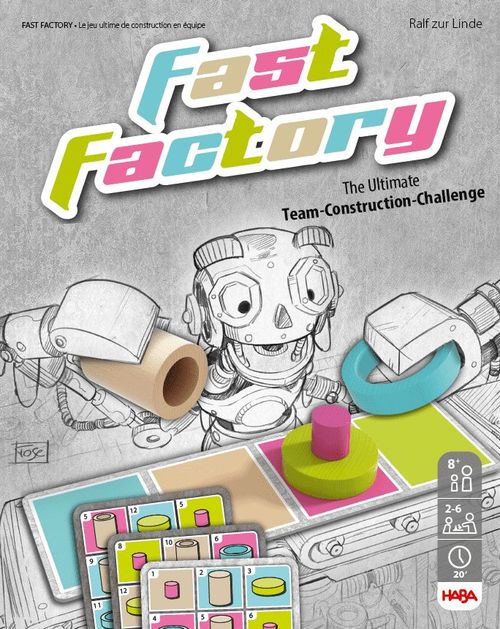
Fast Factory
Fast Factory Rulebook
Table of Contents
Table of Contents
What's in the Box
- 1 punch press (consisting of 1 frame, 1 pressing plate, 1 wooden rod)
- 2 assembly lines
- 8 components (2 green disks, 2 pink cylinders, 2 brown barrels, 2 blue rings)
- 20 challenge cards with 40 challenges (light gray side "easy", dark gray side "difficult")
- 3 golden tickets
Before Starting
- Divide into 2 teams of roughly the same size (one person more or fewer per team is okay).
- Both teams sit opposite one another at the table.
- Each team places an assembly line and a set of components in front of them. Place the components on the spaces on your assembly line of the same color – this is the starting setup.
- Important: In the starting setup, the barrel must always be positioned "closed" (with the opening facing downwards)!
- Place the frame of the punch press between you in the center of the table, with the pressing plate and the wooden rod next to it.
- Place the golden tickets and the pile of challenge cards a little bit away from the action.
- Make sure that the challenge cards have the dark gray side facing upwards. Why? So you don't get a sneak preview of the light gray side showing the challenges that await you.
Light Gray – Dark Gray: What's the Difference?
The challenges on the light gray side are easier because they show the steps in numeric order. This provides a clear overview of the actions you need to take in sequence. The challenges on the dark gray side are more difficult because the numbered steps are all muddled up. You first have to find the number of the next step before you can carry out an action. If you have been practicing and want to complete the more difficult challenges, simply place the challenge cards the other way around (with the light gray side facing up).
Let's Get Started
Activate the punch press: The oldest player takes the top challenge card from the pile and places it carefully and precisely on the frame (without anyone seeing the back!). The punch press is activated with the help of the pressing plate and wooden rod as shown in the diagram on page 4 of the manual.
Tip: If the two ends of the challenge card don't fold up right away, just experiment a little with different techniques and pressures until you get the hang of it. If the ends are still not vertical enough once folded up (not easily visible), you can bend them slightly by hand.
Are the two ends of the challenge card folded up? Then everything happens very quickly. Each team can see an identical challenge with 12 steps. On an agreed signal, both teams start at the same time to carry out the steps from 1 to 12 in ascending order. The youngest person in each team carries out step 1. After this player, you each take turns within the team, always in the same order. If you're playing as a "1-player team," you simply carry out all 12 steps yourself.
Important: Like one-armed assembly robots, you can only ever use one hand. The other hand stays still.
What exactly do you have to do? Each step shows 2 pieces of information:
- the type of component you must lift up vertically (including any components that may be on top of it or inside it!), and
- the color of the space on your assembly line in the middle of which you must then place this component.
But don't be too hasty, because mistakes can creep in surprisingly quickly, and often go unnoticed! Especially as each component has unique features:
- The green disk always takes everything sitting on top of it with it.
- The blue ring can encircle the brown barrel and the pink cylinder.
- The pink cylinder can "disappear" inside the open barrel.
- The brown barrel requires special attention: if there is no other component on top of it when you lift it, it must be turned over before you place it down. An open barrel therefore becomes a closed barrel – and vice versa.
Tip: If you have to turn over the open barrel, including the pink cylinder inside it, close the barrel opening slightly with your index finger until you place it down to stop the cylinder from slipping out of the barrel.
The manual shows four pairs of example consecutive steps (steps 1–4 and 5–9 with illustrations of each step); the illustrations are not reproduced here.
Finished? As soon as a team has carried out all 12 steps, they call out "stop!" This ends the round straight away. Take the challenge card out of the punch press and turn it over: you can see the solution on the back.
- Yes! Excellent. The finished team takes the challenge card and places it in front of them.
- No! Oh well. The other team takes the challenge card and places it in front of them. If you like, you can go through the challenge again together to understand what went wrong.
Then put the components back on your assembly lines in the starting setup (barrel opening facing downwards!). Take the next challenge card from the pile and start the next challenge. You can take turns activating the punch press with each round.
When Does the Game End?
As soon as a team wins its third challenge card, it gets a golden ticket. All the challenge cards collected by both teams up to that point are put on a discard pile. The game continues as described.
As soon as a team wins its second golden ticket, the game ends. Congratulations – you've won! The tickets give you access to the illustrious world of VIP robot parties …
Solo Version for Puzzle Fans
Do you love brain-scrambling challenges? Then grab an assembly line and a set of components. Place the components on the assembly line in the starting setup. Activate any challenge card you like using the punch press. Now you work through the 12 steps as usual – but only in your mind, without moving the components! Once you've finished, move the components directly onto the final space in the final arrangement. Take the challenge card out of the punch press and turn it over:
- No! Oh well. Try again with the next challenge card.
- Yes! Wow, the power of your mind can move mountains – or at least building components!