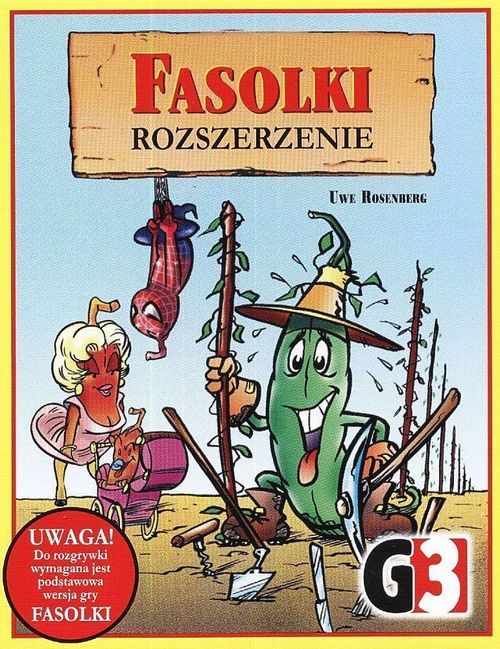
Fasolki: Rozszerzenie
Fasolki: Rozszerzenie Rulebook
Table of Contents
Table of Contents
Module 1: New Bean Varieties
Expansion for 3–7 players. Age 12+. Playing time about 60 minutes.
Description
With this expansion, new bean varieties are added to the Fasolki bean deck, which makes it possible to play in a larger group. Among the new cards are the Farmers, who give players an alternative way to obtain the Third Field card during the game.
Note: Cards of the new bean varieties may only be used in combination with the base game. Therefore the rules of the base game apply when playing with this expansion, unless these instructions say otherwise.
Components
The base set and this expansion contain 12 bean varieties in total. The new bean varieties are:
- Businessman: 24 cards
- Partygoer: 22 cards
- Glutton: 4 cards
- Farmer: 3 cards
This expansion also contains one Third Field card and three helper cards.
Farmers
Farmers give players a special opportunity. If a player grows two beans of the Farmer variety on one of their fields and harvests them, they receive a Third Field card for free. After doing so, both cards are placed on the discard pile. If the player already has a Third Field card, they receive nothing.
Preparation
Card count and number of players
The number of cards in play depends on how many players take part in the round:
- 6 or 7 players: the Gardener, Glutton and Farmer cards are removed from the deck. The player seated to the left of the dealer receives three cards at the start of the game. The next player receives four cards, and the following player receives five cards. All remaining players receive six cards each.
- 4 or 5 players: the Businessman cards are removed from the deck. In addition, the players must choose whether to remove the Glutton cards or the Farmer cards. All players receive five cards at the start of the game.
- 3 players: the Glutton and Farmer cards are removed from the deck. All players receive five cards at the start of the game. Each player begins the game with a Third Field.
The way of preparing the game for each number of players is shown on one side of the helper card.
Third Field card
This expansion contains one Third Field card, intended for a seventh player. The other six Third Field cards are available in the base set.
End of the game
As in the base game, the game ends when the bean deck runs out for the third time.
Only in a three-player game does the game end when the bean deck runs out for the second time.
Module 2: Fasolkopajaki
Mini-expansion for 3–5 players. Age 12+. Playing time about 45 minutes.
Description
This mini-expansion consists of six Fasolkopajak cards. They introduce the possibility of bluffing into the game, and they also introduce a different type of beanometer, based on groups of beans of the same colour.
Note: Fasolkopajak cards may only be used in combination with the base game. Therefore the rules of the base game apply when using them, unless these instructions say otherwise.
Components
The base set and this mini-expansion contain nine bean varieties in total. The new bean variety is the Fasolkopajak (6 cards).
Three of the Fasolkopajaks are black and three are red, which matters when trading. Fasolkopajak cards are always treated as one bean variety and follow the normal planting rules.
The Fasolkopajak cards carry a completely different beanometer. It shows a running bean, called the "bean race" (fasolowy wyścig).
Card note: The special beanometer on the Fasolkopajak cards is printed as four stacks of gold coins (one to four coins), labelled 2, 2 with the bean-race symbol, 3 with the bean-race symbol and 4 with the bean-race symbol.
Bean race
A bean race is a group of Fasolkopajak cards of one colour that lie on one field. In this case it does not matter how many Fasolkopajaks lie on one field. Only the number of bean-race groups of one colour matters.
The beanometer is read as follows:
- If there are at least two cards of the same colour on the field, the player receives one gold coin.
- However, if there is one red and one black Fasolkopajak card on the field (2 groups), the player receives two gold coins.
Other cases:
- 2 groups of Fasolkopajaks provide 2 gold coins. Example: red, red, black, black = 2 groups.
- 3 groups provide 3 gold coins. Example: black, red, red, red, black = 3 groups.
- 4 groups provide 4 gold coins. Example: black, black, red, black, red = 4 groups.
Transcriber's note: the printed examples count a group as an unbroken run of one colour, in the order the cards lie on the field. For example, black, red, red, red, black has three runs and is shown as 3 groups.
Preparation
Remove the Gardener cards from the deck and replace them with the Fasolkopajak cards. The Fasolkopajak cards are shuffled into the deck normally.
Play
Stage 2: Trading and handing over beans
A player who, as part of a trade, offers a red Fasolkopajak card from their hand must state that it is a red card.
However, a player who wants to trade or give away a black Fasolkopajak card from their hand does not have to tell the truth about its colour. They may lie and say that it is a red card.
Only after the transaction is completed is the colour of the card revealed.
Module 3: Fasolufka
Beans are hot! Expansion for 3–5 players. Age 12+. Playing time about 60 minutes.
Description
In this expansion, unlike the base game, players must pay closer attention to the beanometers on the beans they plant. Ladies and men of the same bean variety have completely different beanometers, and child beans have no beanometers at all.
Note: Cards from this expansion may only be used in combination with the base game. Therefore the rules of the base game apply when using them, unless these instructions say otherwise.
Components
This expansion contains cards of the same bean varieties as the base set. However, the cards from this expansion show ladies and children of bean varieties known from Fasolki:
- 10 Cowboy (5 ladies, 5 children)
- 9 Pyromaniac (4 ladies, 5 children)
- 8 Fatty (4 ladies, 4 children)
- 6 Drunkard (3 ladies, 3 children)
- 5 Hippie (2 ladies, 3 children)
- 4 Boxer (2 ladies, 2 children)
- 3 Golas (1 lady, 2 children)
- 2 Gardener (1 lady, 1 child)
This expansion also contains three helper cards.
The number of Gardener and Golas cards available in the game does not change. The number shown on the ladies' and children's cards reflects the actual number of cards of that variety in play.
Preparation
Before the game, prepare the bean deck as follows.
From the deck in the base set, set aside 11 Cowboys, 10 Pyromaniacs, 9 Fatties, 9 Drunkards, 8 Hippies, 7 Boxers, 5 Golas and 4 Gardeners. The remaining cards from the base version of Fasolki are not needed and go back into the box.
Shuffle the set-aside cards from the base version together with the cards included in this expansion. Deal cards to the players from the deck prepared in this way, as in the base game.
Note: Not all bean cards from the base game are used in this expansion. Because ladies and children are added to the deck, the number of beans of each single variety in play changes. In the deck prepared as above, there is one more Cowboy, Pyromaniac, Fatty, Drunkard, Hippie and Boxer than the value shown on the card in the base set. The helper card in the box is a reminder of this.
Example: The Cowboy card in the base game shows the number 20. However, during play of Fasolufka the deck contains 21 Cowboy cards: 11 men, 5 ladies and 5 children.
The number of cards of each variety other than Golas and Gardeners is one more than the value shown on the card from the base set. The number shown on the ladies' and children's cards reflects the actual number of cards of that variety in play.
Play
The course of play changes slightly compared with the base game. Men, ladies and children of the same variety are planted on the same field. Planting takes place, as in the base version, in the phases Playing bean cards and Planting beans. Children are planted in stage 2. A new bean card is always placed on top of the field and cannot be slipped in between the cards already on the field.
Note: When beans are harvested, the beanometer on the card on top of the field is taken into account.
Stage 2: Trading and handing over beans
During trading and handing over of cards from hand, players may share information about the bean variety. However, they must never say whether the bean offered is a lady, a man or a child.
Adding children: If a player receives a child card through a trade or handover, they must immediately place it on top of a field with beans of the same variety. If the player has no field with beans of the matching variety, they plant the child in stage 3.
For each child added to a field, a lady already on that field may be moved two positions toward the top of the field. In this way the beanometer on the lady's card may "appear" on top of the field.
Example: On a field with a Golas, the cards are in this order: man, man, lady, man, man (A). A child is planted on the field, so the lady moves two positions up. The new order of the cards is: man, man, man, man, lady, child (B). Another child is then placed on the field, and the lady's intended goal is reached: the lady is on top of the row. The final order of the cards is: man, man, man, man, child, child, lady (C).
Tip: If opponents want to annoy a player, they should give that player a child and a man. The player will have to plant the child on their field first, and then the man.
Stage 3: Planting beans
As in stage 2, for each child added to a row, a lady in the same row may be moved two positions up.
Harvesting and selling beans
When beans are harvested and sold, only the beanometer on the card on top of the row is taken into account. Because the beanometers on ladies' cards are much more favourable, it is best to sell beans when a lady's card is on top of the row.
Always use the cards added last to the row as the gold coins. The remaining cards are normally placed on the discard pile.
Exception: Gardener ladies have an exceptional beanometer. If beans are harvested from a field whose top card is the Gardener lady, the gold coins must be taken from the discard pile. If there are not enough cards on the discard pile, the coins must be drawn from the deck. For example, four Gardener cards from one field are worth five gold coins taken from the discard pile.
All harvested Gardener cards are placed on the discard pile, so that they are always available in the game.
Note: Child cards have no beanometers. If a child card is on top of the field, the player receives no gold coins for the harvest.
Third Field cards
During play, only two Third Field cards are available. If two players buy a third field, the remaining players must do without an additional field until the end of the game.
A player may buy one Third Field card only during their own turn. The field costs three gold coins. The player who buys it has three fields for growing beans, not two.
The player pays for the field with three gold coins chosen from their own stock. They place those coins on the discard pile with the gold-coin side facing down. The player then places the Third Field card in front of them so that opponents can see it.
Module 4: Duel (Pojedynek)
Variant for 2 players.
The same rules as in the base version of Fasolki apply to a two-player game. In addition, the following changes are introduced:
- Add the Partygoer and Businessman cards (from the New Bean Varieties module) to the deck, and remove the Gardener cards.
- Players receive five cards at the start of the game.
- A player may sell beans from their fields only during their own turn.
- In this variant, players do not trade beans.
- When buying a third field, the player pays three gold coins, which they return to the box.
- The game ends when the bean deck runs out for the first time. The round is completed in the normal way, and players may sell the beans that are on their fields.
During their turn, the active player performs the following actions, in the order given.
1. Playing or discarding the offered bean cards
The player may either plant or discard the bean cards that the opponent left as an offer during stage 3 of the opponent's turn. The active player chooses the order in which they discard the cards. This stage is skipped at the beginning of the game.
2. Planting bean cards and discarding a card from hand
After planting one or two cards from hand (as normal), the player may remove one card of their choice from their hand and place it face up on the discard pile.
3. Revealing, planting and offering beans
The active player reveals three cards from the top of the bean deck and places them face up in the middle of the table, so that they are visible to both players.
If the card on top of the discard pile is of the same variety as one of the revealed cards, the player moves it to the revealed cards. The player does the same with the next card on the discard pile, until the card on top of the discard pile does not match any of the three revealed cards.
The player may then plant any of the revealed beans that lie in the middle of the table. During this time they may also sell, as they wish, the bean cards they have on their fields.
All revealed cards that the player does not want to keep are left as an offer for the opponent. The player does not have to plant any of the revealed cards.
4. Drawing new cards
The active player draws two new cards from the bean deck. They do this one at a time, adding each drawn card to the end of the cards they have in hand.