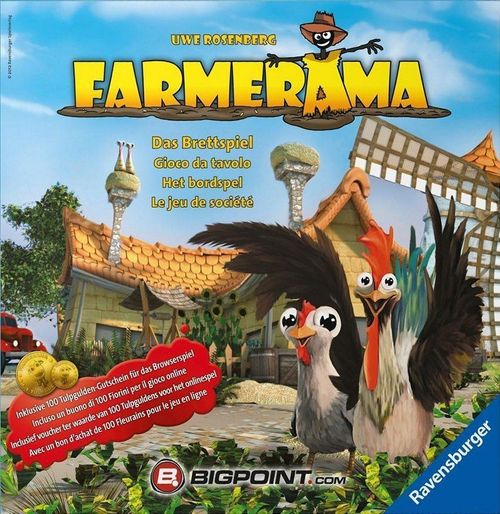
Farmerama
Farmerama Rulebook
Table of Contents
Table of Contents
Game Contents and Setup
-
Place the action wheel where everyone can see it. Turn the wheel so that the number combination "3/2" is visible at the symbols "Sow" and "Harvest".
-
Place the 160 tiles showing the feed plants and water next to the action wheel as the general supply. There are 32 each of: carrots, hay, oats, corn, water.
-
From the 25 ornamental buildings, sort out the 5 with the dark wooden beam and set them aside (only for the Profi game). Then, depending on the number of players, draw some ornamental buildings face down and remove them from the game:
- with 2 players: 10 ornamental buildings,
- with 3 players: 7 ornamental buildings,
- with 4 players: 4 ornamental buildings.
Shuffle the remaining ornamental buildings and place them ready, back side up. Turn the top two face up and lay them next to each other.
-
Each player receives one of the 4 farmland boards (4a), one of the 4 score boards (4b) and one of the 4 ornamental gardens (4c) and places them in front of themselves. The player wheel on the farmland is turned as shown in the illustration (4d). It shows in which area of the farmland which feed plant may be grown. The areas are separated by the rivers.
-
Each player also receives:
- from the 16 animals, 1 sheep, 1 pig, 1 cow and 1 horse, which they place in their stable (5a);
- 3 water, 2 carrots, 2 hay, 2 oats and 1 corn for their barn (= personal supply) (5b);
- from the 16 score markers, 1 each in white, pink, black and brown, which they place on their score board (5c);
- from the 33 cards, one card set (same-coloured backs) with 5 different action cards (5d).
Also lay out the overview cards and the ornamental building cards where everyone can see them.
In the 3-player game, the player who most recently petted a sheep becomes the "Boss Sheep".
For the solo game you need these 3 tiles for special actions.
Also included in the game: 1 spare ornamental garden.
Idea and Goal of the Game
The players slip into the role of farmers and try to collect the coveted little stars. As in the browser game, each player has their own farmland on which they can grow feed plants. These, however, only thrive with water. Whoever succeeds in growing their plants can use them to feed their animals and eventually enjoy their products, such as wool and milk. For only the products earn stars at the end of the game! Whoever has collected the most stars at the end of the game wins.
Course of Play
The game is played in rounds. Each round consists of 4 PHASES, played one after another. All players go through the phases of a round together at the same time. In principle, all players can carry out their actions simultaneously. For the first few rounds, however, we recommend playing in turn until everyone has internalised all the actions.
- PHASE 1: Choose action cards
- PHASE 2: Award ornamental buildings
- PHASE 3: Carry out actions
- PHASE 4: "Mucking out"
Phase 1: Choose Action Cards
With the action cards you choose what you want to do this round. Each time you have 5 different actions to choose from.
Now all choose one of your 5 action cards simultaneously and in secret, and place it face down in front of you. Then reveal the cards simultaneously and look at who has played which action.
Phase 2: Award Ornamental Buildings
If several players have played the same action card, ornamental buildings are awarded; otherwise play continues with PHASE 3.
If several identical action cards were played, one player who played one of these cards receives one of the face-up ornamental building tiles. They place it with the back side up on one of their empty spaces in the ornamental garden. (If the ornamental garden is full, take another ornamental garden from the box.) For the ornamental building tile they choose, they immediately collect the printed reward, once only.
Who gets the tile?
Who receives the ornamental building tile is determined by the players' situation. See the overview card.
I. First, compare which of the affected players has the fewest ornamental buildings in their ornamental garden. That player receives the ornamental building.
II. If there is a tie, the player with more scarecrows visible on their farmland receives the ornamental building.
III. If there is again a tie, the player with fewer feed plants in their barn receives the ornamental building.
If there is again a tie, the tile is not awarded (as, for example, in the first round of the game).
The player who receives the tile chooses one of the two tiles and places it in their ornamental garden.
In case two pairs of players have each played the same card, lots are drawn to decide who receives which ornamental building.
Phase 3: Carry Out Actions
All players simultaneously carry out the action they committed to with their action card. (In the first game we recommend proceeding in turn and only later playing simultaneously.)
For the action cards "Sow", "Harvest" and "Water", the action wheel shows how many times the players can perform their played action in a row. (The action may of course also be performed fewer times.)
Every round, the action wheel assigns each of these actions 2 numbers: the number with the higher value shows how often a player can perform the action if they played the action card alone.
If several players have chosen the same action card, the smaller number counts for all players who chose this action.
Example: "Sow" played alone: the player may perform the action "Sow" up to 3 times. Several players have played the card "Sow": they may perform the action "Sow" up to 2 times.
The actions in detail:
Sow: Place 1 feed plant from your barn onto an empty cultivation field of your farmland. Then take a second tile of the same feed plant (colour) from the general supply and place it on top of the first tile. Together this is 1 "Sow" action. Depending on the position of the player wheel, a different section is intended for sowing each feed plant. The symbols on the wheel show where which feed plant may be sown. (Illustrations: "Carrots can be sown here"; "Hay can be sown here".)
Harvest: Take 2 stacked feed tiles from your farmland and place them in your barn. Together this is 1 "Harvest" action. The feed plants must be located in the green harvest area of the player wheel. (Illustrations: 1x harvest in each of three wheel positions.)
Water: For each "Water" action on the action wheel you may take one water tile from the supply: e.g. 3 water tiles for 3x Water.
Feed: Feed animals that are in your stable as often as you like. Depending on the species, return the corresponding feed from your barn to the supply. Once you have fed an animal, move it from the stable to the pasture marked by the corresponding animal head. Each pasture has room for two animals. (Illustrations: 3x carrot; 3x oats.)
How feeding works:
| Animal | Feed |
|---|---|
| Sheep | 2x hay + 2x oats |
| Pig | 3x carrots + 2x corn |
| Cow | 3x hay + 2x corn |
| Horse | 3x carrots + 3x oats |
(The costs are also printed on the stable.)
Seed Store: For each feed plant that you do not have in your barn, take 1 tile from the general supply and place it in your barn. This also applies to water. (Feed on your farmland does not matter here.) Afterwards you may perform the action "Sow" once.
Phase 4: "Mucking Out"
All players take their played action cards back into their hands.
Then the action wheel is turned one section further in the direction of the arrow. Thus every round the frequencies of the actions "Sow", "Harvest" and "Water" change.
Afterwards the ornamental buildings are refilled to two face-up tiles. If this is not possible, the game ends immediately and final scoring takes place.
If enough ornamental buildings remain, a new round begins with PHASE 1.
At Any Time During the Game
Player Wheel
The player wheel can only be turned counterclockwise by paying water, but at any time: before, during or after carrying out the actions. For each farmland area by which the player wheel is turned, 1 water must be paid. Caution: it can only be turned if the bar of the wheel passes over a completely empty farmland area.
Tip: For example, it is possible, before the "Sow" action, to turn the player wheel one section with 1 water, sow once, then spend another water to turn the wheel and perform two further "Sow" actions. The same of course applies to harvesting.
Products
Whenever the player wheel is turned so far that an animal standing on the pasture is on the "pacifier" (dummy) symbol, it immediately and automatically returns to the stable. On the player's score board, the marker of the corresponding animal/product is moved up 1 position. The player has thus collected the coveted stars.
End of the Game and Final Scoring
If an ornamental building tile would have to be refilled but the stack of ornamental buildings is empty, the game ends immediately.
First, each player counts how many stars they received for the products produced (wool, truffles, milk and riding lessons). (Example in the rulebook: 27 + 30 + 42 + 36 = 135.)
Add 1 star for each feed tile you have in your barn and on your farmland. (Example: 3 + 2 + 2 = 7.)
3 stars for each ornamental building with a star symbol. (Example: 3.)
In addition, the animals still on pastures count the stars visible in the stable. (Example: 8.)
The player with the most stars in total wins. (Example total: 153.) In case of a tie, the tied player with more water in their barn wins.
Special Rules for 2 Players
PHASE 1 - Playing action cards: Each player plays 2 action cards. In which order they carry out the actions in PHASE 3 is up to the player.
PHASE 2 - Awarding ornamental buildings: If both players have played the same action card twice, 2 ornamental building tiles are awarded. They are distributed one after the other, and after the first is awarded it is newly determined who gets the second: the first player can choose the ornamental building tile; the second must make do with the remaining one. (Not infrequently both ornamental building tiles go to the same player.)
Special Rules for 3 Players
PHASE 1 - Playing action cards: One player receives the "Boss Sheep". This round they may play 2 action cards. In which order they carry out the chosen actions is up to them. At the end of the round, in PHASE 4, the "Boss Sheep" passes clockwise to the next player.
End of the game: If in PHASE 4 there are no longer enough ornamental building tiles to refill, rounds continue to be played until every player has had the "Boss Sheep" the same number of times, and thereby had the advantage of being allowed to play 2 action cards. For these last rounds the face-down stack of ornamental building tiles is supplemented with the sorted-out tiles. (Thus up to the end of the game it is always possible to refill to 2 ornamental building tiles.)
Profi Farmer (For Advanced Players)
The Profi Farmer follows the same rules as the basic game. In addition there are three small changes:
- The 5 ornamental buildings with the dark boards are mixed in during setup.
- The ornamental building is awarded as described on the overview card on the "Profi game" side. (This card is a physical component and is not reproduced in the rulebook text.)
- Water has a further function. The number of "Sow" or "Harvest" actions can each be increased by 1 for 1 water. Any number of water tiles may be used for this.
Example: Sow is at 4/2. Philipp and Tina both play the card Sow. Philipp and Tina may now sow 2 times. Philipp, however, returns 3 water to the supply and thus sows 5 times.
The Solo Game
As a solo player you take one turn after another. Your goal is to reach at least 150 points.
Preparation
Sort out 1 action card each of "Water", "Sow" and "Harvest". Shuffle these 3 cards and place them face down in front of you as an action stack. From the remaining cards you need 2 cards each of "Water", "Sow" and "Harvest". Shuffle these 6 cards and place them face down next to the action stack as the supply stack. The remaining action cards and the ornamental buildings are removed from the game entirely.
The action wheel goes together with the supply in the middle of the table. Of the water, only 4 tiles are placed in the general supply; the remaining water tiles are not needed. The three "Special Action" tokens are placed ready. Otherwise you receive everything that is described on the setup sheet for the multiplayer game.
Course of Play - A turn consists of three parts
-
You reveal the top card of the action stack and place it next to it. If it is a water card, you must turn the action wheel one river further in the direction of the arrow. The card shows which action is particularly good this round. If the action stack is empty, you shuffle the top card of the supply stack, without looking at it, into the discarded cards and form a new action stack. Afterwards you place the action stack face down again. With each supply card that is shuffled in, you additionally receive one "Special Action" token in your supply. You may not have more than three Special Action tokens at the same time.
(The first action stack thus comprises 3 cards. You therefore receive the first "Special Action" token after the third turn. Afterwards you shuffle in one card from the supply stack; the second action stack then comprises 4 cards, etc. The last action stack consists of 9 cards.)
-
If you do not like the action card revealed in 1, you may place this card face down under the action stack and then reveal a new action card. For this you must give back one "Special Action" token to the supply. (Even with water cards that you push under the action stack, you must turn the action wheel. The newly revealed action card is treated as in 1.)
-
Then you carry out one of the 5 actions "Water", "Sow", "Harvest", "Feed" or "Seed Store" - regardless of which card was revealed in 1. Carrying out these actions corresponds to the multiplayer game. The action wheel thus shows how often the actions "Water", "Sow" or "Harvest" may be used. In the solo game, the second (i.e. lower) numbers always apply. Important exception: for the action that was revealed in 1, the first, i.e. higher, number applies. If you choose the action "Water" and there is not enough water in the general supply, you receive correspondingly less. (For the actions "Feed" and "Seed Store", the action card and the action wheel play no role.)
Any-Time Action
At any time you may give back a "Special Action" token to freely choose one of the five goods (a feed plant or a water) for yourself.
End of the Solo Game
The solo game ends after exactly 42 turns, when in part 1 of a turn an action card is to be drawn from the supply stack but no card is left. Afterwards scoring is done as in the game with 2-4 players.