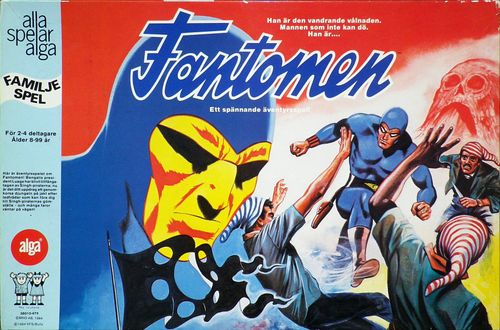
Fantomen
Fantomen Rulebook
Table of Contents
Table of Contents
Contents
The game consists of: 1 game board, 2 dice, 4 playing pieces, 58 "Jungle Drums" cards, 36 "Event" cards, 17 "Singh pirates" cards, 12 "Morristown" cards, 4 "Injured" cards and 1 "President Luaga" card.
Setup
-
Carefully separate all the cards from one another. Sort the cards into different piles by their backs and according to the contents list above.
-
Place the game board in the middle of the table and study it for a minute or two so that you can see where the different named locations are. Note that the board is divided into areas bounded by black solid or dashed lines. For simplicity, these areas are called squares.
-
Punch out the round playing pieces. Note that each piece has the Phantom on one side and a bandit on the other.
-
All players roll both dice. The player with the highest roll chooses a playing piece and places it on the correct starting square; play then continues clockwise. Blue always starts from the ruins of Zheta-Betau, red from the Jade House, green from Obangi, and yellow from the ruin town of Thomas. The pieces are placed with the Phantom side face up.
-
Shuffle the 12 "Morristown" cards and place them as a pile with the back side up next to the game board.
-
Shuffle the 36 Event cards and place them as a pile with the back side up next to the game board.
-
Set the 4 "Injured" cards aside for now.
-
Shuffle the 17 "Singh pirates" cards and place them as a pile with the back side up next to the game board. Then take the top 5 cards of this pile, set them aside without looking at them – they will not take part in the game. Next, take the "President Luaga" card and place it at the bottom of the pile of "Singh pirates" cards, with the colour-picture side facing down.
-
From the pile of "Jungle Drums" cards, each player takes one card with Devil and one card with Hero and places them face up in front of them on the table. If there are 2 or 3 players, the remaining Hero and Devil cards are set aside; they are not used in the game. Then the 3 cards with Bandits are set aside and placed next to the game board. Finally, the remaining 47 "Jungle Drums" cards are shuffled thoroughly and placed as a pile with the back side up next to the game board. Each player now takes four "Jungle Drums" cards in turn and holds them in hand. No other player may look at these cards – only the player holding them.
In the following rules, the "Jungle Drums" cards will for simplicity be called DT cards.
Playing the Game
The highest roller starts, and then the turn order continues clockwise throughout the game. Each time it is your turn, you must do the following (except as described below):
- Move your piece.
- Play out a DT card from your hand (if you want to and can).
- Draw an Event card and follow it.
- Draw a DT card, or get rid of a DT card, or possibly do something else (depending on the result of the Event card).
Moving Your Piece
As long as you have your Hero card, you may move 1 or 2 squares in each move, wherever you wish. If you lose your Hero card, you may only move 1 square in each move.
Two or more pieces may not occupy the same square, and a piece may not pass through a square where another piece already stands.
Important rule: a piece may only move to an adjacent square if the squares share a continuous solid line. See the examples below:
From the square with the dot, one step can move a piece to any of squares A, B, C, D and F. To reach square E, two steps are required (via D or F). Nor can you move one step from the dot square to G (the dot square and G have no common solid line; they meet only at a corner). If you want to move from the dot square to G, two steps are required via F.
Areas that are completely surrounded by dashed lines are larger waterways and are not counted as squares. On four places on the board, however, you may cross dashed lines, namely where they connect with a thick black line. An example of this is shown in the figure: one may move from X to Y in one step (or vice versa).
You must move in every move, unless you are forced to stand still (for example, because of a card or because of injuries).
Playing Out a DT Card
The only DT cards you may play out after moving, but before drawing an Event card, are Information, Ambush, False Trail and Guide. After following the text on the card, it is discarded, and you continue by drawing an Event card (with the exception of Guide, which ends your move when you play it out).
If, after an Ambush card, you draw a DT card from an opponent, this is done as usual (see under Combat): he holds up his DT cards (but not Hero, Devil or Bandits) with the backs facing you, you draw a card at random, and add it to your hand.
If you yourself are ambushed by an Ambush card (either a DT card or an Event card), you must immediately play the jungle proverb card "You will never find the Phantom, etc." (even if it is not your turn). The ambush then fails.
Event Cards
When you draw an Event card, it must be shown to all players. At the top of each Event card, two or four colours are always listed. If your piece's colour is listed there, the card applies to you and you must follow the instructions on it. If your piece's colour is not listed there, the card does not apply to you, and you must discard it. All Event cards that are discarded must be placed in a separate discard pile, face up. If the draw pile of Event cards runs out, turn over the discard pile, shuffle it, and it becomes a new draw pile.
Some Event cards (Guide, Bad Weather, Take a DT card, and Ambush) need only be read and followed, after which you discard the card.
If you draw one of the other Event cards (Tiger, Crocodile, Snake, Bandits, Tribal Warriors, Jungle Patrol), you have run into an encounter in the jungle. Before an encounter there are three possible options: 1) you may try to avoid it; 2) you may try to win the friendship of the person or persons; 3) you fight the one or those you have met. On the Event cards, however, there are only one or at most two of these options.
You must declare in advance which option you choose, before you begin laying out cards or rolling the dice.
At an encounter you may (if you wish) use the cards you have in hand or lying in front of you, to increase your chances of getting through the situation. Note, however, that the cards you use in this case are used up and must then be discarded (with one exception: the Devil card).
Avoiding an Encounter. If you want to try to avoid an encounter (through intimidation or sneaking away), first lay out the card or cards you wish to use (these cards must have a plus-marked value under the heading Avoid Encounter). Then roll the dice and add the values of the cards. If the sum equals or is higher than the value on the Event card, you have succeeded in avoiding the encounter. However, if the sum is lower than the value on the Event card, you have failed to avoid the encounter, and you must then immediately continue the move by fighting. The combat value of the Event card is then raised by +1.
Example: Player A draws the Tiger card (avoid 6, combat 7); he wants to avoid the encounter. He has the DT card "Rifle" in hand (with a value of +2 for Avoid Encounter) and lays it on the table. In addition, the value for Devil is counted in (+1). He rolls the dice and gets a 3 and a 4, adds the value for the rifle and Devil, and has 3+4+2+1 = 10. Since this is higher than 6, he has avoided the encounter. The Tiger card is discarded, and the rifle card is discarded – it is now used up. A may, however, keep the Devil card.
If A had been unlucky and rolled two 1s on the dice, it would not have been enough: 1+1+2+1 = 5 is lower than 6. The rifle card is discarded, but the Tiger card stays in play, and he must now fight the tiger, and the tiger's combat value is raised by +1 at the same time (so it becomes 8).
Friendship. This option exists only on the Event cards Tribal Warriors and Jungle Patrol (and on some of the Morristown cards). Here you only roll the dice; no cards may be added. If you roll equal to or more than what is required, you may take the card and lay it in front of you on the table, to use in a future combat. However, you may only hold one Jungle Patrol card. If you fail with the Jungle Patrol, the card is simply discarded; if you fail with the Tribal Warriors, you must fight the card (whose combat value is then raised by +1, exactly as under Avoid Encounter).
Combat. If you choose combat, or are forced into combat, you must first decide whether you want to use any card or cards (all cards that have a combat value may be used). The cards are then laid on the table. Then roll the dice. If the sum of the dice plus the combat value of any cards used equals or is higher than the value on the Event card, you have won the combat. The Event card and the cards you used (with the exception of Devil) are then discarded.
Example: B draws the Hostile Tribal Warriors card (combat 9) and chooses to fight it. He has previously been given a Jungle Patrol card, and chooses to use it, as well as a card with the jungle proverb "The Phantom sneaks more quietly than the jungle cat" (combat value +2), which he has in hand. He now rolls the dice and gets two 3s. The sum is then 6, plus 2 for the Jungle Patrol, plus 2 for the jungle proverb, plus 1 for Devil, which makes 11. Since this is higher than 9, he has won the combat; all cards (except Devil) are discarded.
If the sum is lower than the combat value of the Event card, you have lost the combat. As above, the Event card and the cards you used are all discarded (including the Event card, but not Devil), and then you lose one of the DT cards you have left. This is done as follows: first you pick up the DT cards you may have lying in front of you on the table (Hero, Devil, Bandits) and take them into your hand. Then you hold up all your DT cards and let the player to your right draw a card. Note: the player to your right may only see the backs of your DT cards, so he must draw the card at random. The DT card that is drawn is discarded face up.
Devil card. The Devil card has a special role. Its value for Avoid Encounter, respectively its combat value (+1 on both), counts for you in each encounter, as long as you have the card lying in front of you. If you lose it (by losing a combat and the card being drawn from your hand), it is discarded. The only chance for you to get it back is to draw it from the pile of DT cards. Note: if you already have a Devil card and draw a new Devil card (which has therefore been discarded earlier), you must immediately discard it again and draw a new DT card. In the same way you can lose, or get back, the Hero card.
Then (but only if you have lost a combat) you must roll the dice to see whether you were injured in the combat. If you roll 6 up to and including 12, you came through unharmed. But if you roll 2–5, you were injured. You must then take an Injured card and lay it in front of you with the "Injured" side face up. You now have two options: either you stand still for the next two moves and do nothing while the injury heals, after which you return the Injured card and continue as normal; or you continue, but then you must subtract 2 from your total if you happen to get into a new combat during the next four moves; the Injured card then has a "combat value" of –2. If you lose a new combat during these four moves, you are automatically seriously injured: place the Injured card with the "Seriously injured" side face up, and move your piece immediately to Dr. Axel's Jungle Hospital. There you must stand still for four moves, but may then hand in the Injured card and continue as normal.
Note that some of the Event cards carry "special results" if you lose a combat against them: you may lose two DT cards instead of only one, or stand still for the next move (and then hand over one DT card as usual), or go directly to being seriously injured and be taken to Dr. Axel's Jungle Hospital (but in that case you do not have to hand over a DT card).
Jungle Drums (DT) Cards
After you have "finished" the Event card, you roll both dice: if you roll 5 or higher, you take the top card of the DT pile and hold it in your hand. If you roll 2, 3 or 4, you may not take any DT card.
Exception: if you have lost a combat in the same move, you may not take any DT card; nor may you take a DT card if you have just had an Event card that said your move was over. Nor may you take a DT card if you earlier in the same move played a DT card with a Guide.
If, on the other hand, you received an Event card that did not apply to you, you roll the dice as above and try to take a DT card.
Important rule: you may have at most eight DT cards in hand when you end your move (Devil and Hero are not counted among the eight, and neither are Bandits). If during your move you have taken up so many cards that you have more than eight DT cards in hand, you must end the move by discarding so that you only have eight DT cards left. This rule always applies.
Another important rule: all DT cards that are discarded, played out, or used up against Event cards are placed in a separate discard pile, face up. When the DT draw pile runs out, turn over the discard pile, shuffle it thoroughly, and let it become a new draw pile.
Note that some cards may only be used once during the game; after that they leave the game, instead of being discarded.
Special Squares
Skull Cave. If you come to this square, you must immediately take a card with "Bandits" (if any is left). During the same move you may not draw any Event card or other DT card, or play out any card. The Bandit card has a combat value and may be used in combat according to the rules above. Used-up Bandit cards are placed on the discard pile. You may only have one Bandit card lying in front of you on the table.
Wambesi and Llongo. If you come to any of these squares, you must immediately take up two DT cards. During the same move you may not take up any Event card, nor play out any card. This applies only once per player, per square, per game. You can therefore only do this once on the Wambesi square and once on the Llongo square; thereafter these squares count as normal squares for you.
Morristown. Visiting Morristown is a gamble that can send you home, or cost more than it is worth... it is a tough place.
If you come to one of the two Morristown squares, you take no Event card; instead you draw the top card of the Morristown pile. If it is a blank card, you get through unharmed. If it is some other card, you must, as usual, decide whether to try to avoid the encounter, fight, or try to win friendship. The normal rules above apply. And note that some cards may not be used in Morristown!
If you lose a combat, you lose one DT card from your hand as usual, and must roll the dice to see whether you were injured. But if you get a blank card, or avoid the encounter, or win friendship (keep that card), or win a combat, you must immediately roll the dice: if you roll 2–5, you draw one DT card; if you roll 6–10, you draw two DT cards; if you roll 11–12, you draw three DT cards. Important: you may not look at these cards until you leave Morristown, nor may you use them in Morristown! You may stay as many moves as you wish in Morristown (without having to move) and collect DT cards in a pile with the face side down, for as long as you can manage. In each move you then draw one new Morristown card. In Morristown you may not play out any DT card against another player; the only cards you may use to help you are those that are on the table or in your hand and that apply in Morristown. Nobody else may play a DT card against you while you are in Morristown.
When you leave Morristown, you move as usual, and then you may take the cards you have collected, after which you draw an Event card and continue the move as usual. Do not forget to end by discarding cards, so that you only have eight left in hand.
Finding President Luaga
Among the DT cards you draw, there are cards saying "The jungle drums say President Luaga is held captive in Bengalitown" (or Corba, Trondelay, Albatross Tower or Kaz-Mir-Ora – there are five different possible hiding places).
If any player lays down two such identical cards (for example two with Corba) on the table, it is established that the Singh pirates are holding Luaga captive at that place. All other cards with other names are then immediately worthless. The two cards may be laid down at any time during the player's move; as compensation the player immediately draws two new DT cards. Note that the worthless name cards remain in play just as usual.
If nobody has laid out two identical cards by the time the DT draw pile runs out for the first time, the rule is that it is enough to play out one such card, of any kind. Just as above, it is then established where Luaga is held captive, and the player gets immediately to draw one new DT card (from the discard pile, which has been shuffled and turned over) as compensation.
Freeing President Luaga
As soon as any player has laid down two identical name cards (or one, according to the rule above), a race begins toward the square where Luaga is held captive. During the journey, all moves are made as usual, with DT cards being drawn, Event cards and so on. The first player to reach the square where Luaga is held may begin the attempt to free him immediately, in the same move.
The attempt to free him is carried out as follows: you turn over the Singh pirate cards in the pile one at a time (you therefore have 12 cards to "get through"). You do this in sequence for as long as you can manage, until you free Luaga or become seriously injured; the other players must wait meanwhile.
Each card must be "defeated": armed pirates and guard dogs must be defeated in combat as usual, with the help of dice and any cards you wish to use. Remember that the cards you use are used up (with the exception of the Devil card)! You may not take any new DT cards while you are attempting to free him.
You must defeat electrified walls and nets using only the dice, by rolling equal to or higher than the value on the card. You pass locked doors in the same way, or by playing a card with "The Phantom has the strength of ten tigers".
If you fail with a card, the Singh pirate card is nevertheless discarded, but you then lose one DT card as usual (this also applies to electrified walls, nets and locked doors). If you lose a combat, you must (in addition to losing a DT card as usual) also roll the dice to see whether you were injured: 2–5 and you were injured, 6–12 and you came through.
If you were injured, you take an Injured card as usual and lay it in front of you, and in the following attempts you must subtract 2 from each dice roll, for as long as the attempt to free him continues. If you lose one more combat, you are seriously injured and must abandon the attempt to free him: move your piece immediately to Dr. Axel's Jungle Hospital and stand still for four rolls as usual. The next player who reaches the square may continue the attempt to free him, against the Singh pirate cards still left (the cards that have been got through are removed from the game).
When all the Singh pirate cards have been defeated (whether you did it alone or took over after a player who became seriously injured halfway), Luaga is freed. Turn the card over so that the colour side faces up, and place it in front of you on the table. Now the task is to bring him to either Morristown or the Skull Cave if you want to win the game.
Journey Home
As soon as Luaga is freed, the other players must immediately turn their playing pieces over so that the bandit side faces up (your own piece keeps the Phantom side up). After that, you, who freed Luaga, immediately move two extra squares, but then the turn continues clockwise. No Event cards are drawn now, and all DT cards (except Hero and Devil) are worthless and leave the game.
Move as usual (one or two squares if you still have the Hero card, one square if you have lost the Hero card; this also applies to the players whose pieces are showing the bandit side).
If the Phantom piece and a bandit piece end up on the same square (which is now allowed after Luaga has been freed), a combat takes place. This combat is resolved by both players rolling the dice: the bandit player may not add anything to his dice, while the Phantom player may add +1 if he still has the Devil card, and +4 because he is the Phantom.
If the Phantom wins, he simply moves the bandit player's piece three squares in any direction he wishes; after that it is the next player's turn (the turn order around the table is kept).
If the bandit player wins the combat, he turns his piece over and becomes the Phantom again. The player who was the Phantom must turn his piece over so that the bandit side faces up, and the new Phantom moves the bandit piece three squares in any direction he wishes. The new Phantom takes over the Luaga card, and then it is the next player's turn.
The game continues until Luaga is brought "home".
Who Wins?
The player who manages to bring President Luaga to either the Skull Cave or Morristown has won the game.