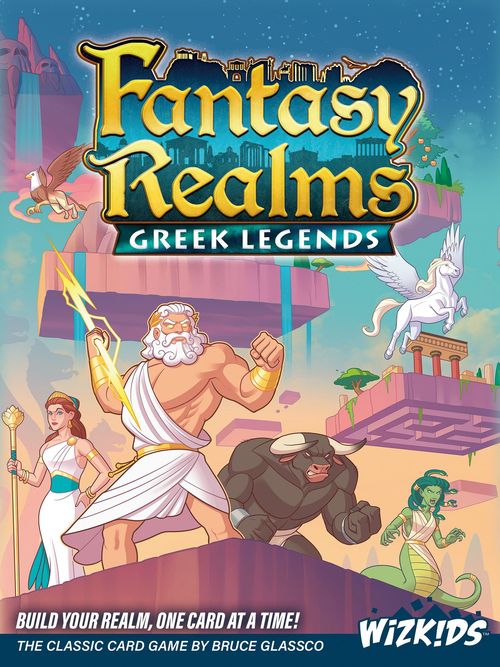
Fantasy Realms: Greek Legends
Fantasy Realms: Greek Legends Rulebook
Table of Contents
Table of Contents
Components
79 Cards · 6 References · 1 Score Pad · 1 Rulebook
Overview
Every card contains the following information:
- Name – Every card has a unique name.
- Suit – 15 Gods, 19 Heroes, 11 Items, 12 Locations, 11 Monsters, 11 Quests
- Base value
- Bonus or Penalty – Cards may have a bonus, a penalty, or both. There is a diagram above the text to help remind you of the effect, and the information is the same. (See Scoring on page 2 for more information.)
- Tags – Many cards have tags (icons along the left edge).
Example: Athena — Base value 4. BONUS: +4 for each Living Hero with one or more of Athena's icons. Athena may ADD one of her icons to a Living Hero.
Tags
Heroes only:
- MONARCH
- NIMBLE
- STRONG
Heroes and Gods:
- ARTISTIC
- CLEVER
- WARRIOR
- WISE
Monsters only:
- FRIENDLY
- HOSTILE
Locations, Items, & Gods:
- AQUATIC
- DIVINE
- PLANT
- MAGIC
Other icons: Endgame, Afterlife
Setup
Shuffle the deck of cards. Deal every player seven cards, and give them a reference card. Leave space for a discard area next to the deck, and an Afterlife area in front of each player. Choose a starting player randomly, and play goes clockwise.
Example of game setup for 3 players: each player has an Afterlife area, there is a Draw Pile in the center, and a Discard Area where cards are spread out face up so they are visible to all.
Gameplay
TURNS: During each player's turn, they have a choice of drawing the top card from the deck or taking any one faceup card from the discard area. The player who goes first must draw a card from the deck.
At the end of each turn, a player must discard a card to the discard area or their own Afterlife.
All cards in the discard area should be spread out so that they are visible to all.
END OF GAME: The game ends when there are ten cards in the central discard area. The player holding the highest scoring hand and afterlife wins. In case of a tie, the hand with the lowest total base value (including afterlife) wins. If still a tie, the players share the victory.
SCORING HANDS: At the end of the game, add the base values, applying any Bonuses and Penalties, of all cards in your hand and afterlife. Cards only care about what is in your hand and afterlife, and ignore your opponents' cards.
Note: Cards held by your opponents' hands or afterlives have no effect on the scoring of your hand.
Terminology
These are terms that are used in the Bonus and Penalty sections of cards:
With — If a card receives a Bonus WITH a certain other card or type of card, then it may only receive that Bonus once. (In the diagram, / means OR.)
Example: You have Hector, and also have Ares and Apollo. You only get the +6 bonus once.
For Each — A card that receives a Bonus or Penalty FOR EACH of a particular kind of card may receive that Bonus or Penalty once for each card you hold of the variety named. (In the diagram, | means AND.)
Add — Certain cards say to ADD tags to other cards (usually Heroes). This is done during the Endgame (see below). No card may have a tag Added to it that it already has – in other words, no card may ever have two duplicate tags on it.
Requires — Some bonuses include the keyword REQUIRES. A bonus with this keyword is only granted if the required suit or tag is present in the hand or Afterlife.
Clear — A special kind of Bonus or Penalty is the ability to CLEAR Bonuses, Tags, Penalties, or parts of Penalties from other cards. A card that has had its Penalty cleared still keeps its suit, base value, and Bonus. Bonus clears are optional, and occur before Penalties which can help you avoid them. Penalty clears are mandatory.
Some more complex bonuses and penalties are clarified in the FAQ.
The Afterlife
Each player has their own Afterlife area, consisting of any number of cards face-up in front of them. Anything that refers to "the afterlife" just means your afterlife, not that of other players. All cards in the Afterlife still contribute their base value plus any bonuses to the player they belong to, and their tags and bonuses interact freely with other cards in the player's hand as if they were included in the player's hand. Hermes, for example, who gets a bonus for each Location card, won't care if some of your Locations are places like the River Styx or Persephone's Garden that you've placed in the Afterlife.
At game end during scoring, every card in the Afterlife subtracts 10 points from that player's score. Many Quests and other cards require "living" Heroes, which means Heroes that are not in the Afterlife.
There are two ways that cards may end up in a player's Afterlife area:
-
Discard. Some Locations, Gods, Items and Monsters have the text "May be discarded to Afterlife." At the end of your turn, instead of discarding a card to the Discard Area, you may discard a card with this text to your own Afterlife. Some of these cards have bonus effects that trigger instantly when they are played to the afterlife.
Example: Oracle at Delphi: May be discarded to Afterlife. If you do so, look at the top five cards of the deck and put any number of them on the bottom of the deck. Then put the rest back on top in their original order.
-
Death. Monsters with the HOSTILE tag have a condition that sends Heroes to the Afterlife at the end of the game unless you meet their requirement.
For example:
- Sirens. Endgame: Place all Heroes in the Afterlife unless you have a Hero with CLEVER.
- Calydonian Boar. Endgame: Place all Heroes in the Afterlife unless you have three or more living Heroes.
Additionally:
- You do not need to use a "may be discarded to the afterlife" card on the turn you acquire it.
- At the end of every turn, at least one card needs to be added to the Discard Area. After discarding a card to your afterlife, add the top card of the deck directly to the Discard Area, face up. If a card effect adds cards to the Discard Area, (such as the Cornucopia and the Fates), you do not have to add an additional card.
- If a player forgets to do this, wait until the end of their next turn, so the following player has the first opportunity to draw it.
Endgame
The game ends when there are ten cards in the discard area. Then players take endgame actions and tally up their total points. Often, the timing of clearing and certain actions may make a difference — in those cases, players take the following steps in order. Within each step, players may take actions in whatever order they wish.
-
Activate any bonuses that CLEAR anything. Using these bonuses is optional.
-
Activate any penalties that CLEAR anything (if these penalties have not already been cleared in step 1).
-
Activate any bonuses that ADD tags. A card may not have more than one of the same tag. Tags that were Cleared in step 2 may be restored in step 3.
Example: If Theseus has his tags stripped away by Circe during phase 2, Athena could still ADD a tag to him in phase 3.
-
During this phase, check to see if there are any penalties with the Endgame symbol that move cards from your hand to your Afterlife. If there are any, activate them one at a time, in whatever order you wish.
Example: You have three heroes, one of whom has NIMBLE, plus the Medusa. Medusa has the penalty "Endgame: All Heroes go to Afterlife unless a living Hero is CLEVER or NIMBLE." You may find that Heroes in the Afterlife score more for you than they would alive; if so, you could have two Heroes face the Medusa and be killed, before the third Hero with NIMBLE defeats her.
-
Add up your score, remembering to subtract 10 from the total for each card in your Afterlife.
Scoring Example
A hand of Hera, Arachne, Hippolyta, and Orpheus, plus Antaeus, Apotheosis, and Moly, with Pomegranate and River Styx in the Afterlife, scores as follows:
- Hera (+12 for one pair of Heroes): 6+12=18
- Arachne (+10 since Heroes > Gods): 3+10=13
- Hippolyta (Strong): 10
- Orpheus (adds value of one card in afterlife): 6+6 (Pomegranate) = 12
- Antaeus (no penalty since Hippolyta has Strong): 18
- Apotheosis (meets all requirements in hand and Afterlife): +28
- Moly (clears penalty on Pomegranate): 4
Running score by card: Hera 18, Arachne 13, Hippolyta 10, Orpheus 12, Antaeus 18, Apotheosis 28, Moly 4.
Afterlife:
- Pomegranate (penalty cleared by Moly): 6
- River Styx (+5 since 1 pair of god & hero): 0+5 = 5
- Afterlife penalty (2 cards in Afterlife): -20
Total: 92
FAQ
Does Argo count its own Aquatic tag when multiplying? Yes. In a hand with Argo, Poseidon, and three Heroes, Argo would be worth 2×3×5 or 30 points.
Is using a bonus mandatory? No, using a bonus is always optional. For instance, you can choose not to use the Helm of Hades to save a Hero if you would prefer to see the Hero in the Afterlife. Likewise, if you have the Charmed Bridle and a monster that would kill all your Heroes, you can choose not to use the Bridle to remove the monster's penalties. However, you must choose whether a Bonus is active or not just once during the proper phase – you can't use it to save some Heroes from the Monster's penalty and doom others.
What about Heroes defeating monsters? Is that mandatory? Heroes want to save their own lives, even if they're too late to save the other Heroes. If they have the ability to defeat a Monster, they must. But, the order in which the Omega phase resolves may change which heroes can defeat which monsters.
So how exactly does the Omega phase work? During Phase 4 at the end of the game, you must choose each card in your hand with an Omega symbol in the icon line, one at a time, in whatever order you wish.
You may also choose what order a Monster faces Heroes; as soon as a Monster faces a Hero with the icon needed to defeat it, it will stop attacking.
When you choose to activate the Calydonian Boar or the Lernaean Hydra, it will immediately check to see if there are sufficient living Heroes or icons on living Heroes to stop it.
Does Circe's penalty trigger even if she is in the Afterlife? Yes.
Can Moly cancel the -10 penalty for being in the Afterlife? No.
Can cards with multiple tags count more than once for the bonuses of other cards? Yes. For example, Poseidon reads "+5 for each other AQUATIC tag and for each Monster." Since the Sirens are an Aquatic Monster, they will give Poseidon +10.
Some cards, such as Persephone, give bonuses for Pairs of cards. Persephone's bonus reads "+6 for each pair of one other card in [Gods] and one other [Afterlife]. May be discarded to [Afterlife]." These bonuses are still granted even if both of the things they are seeking are on the same card – for instance, Persephone would still get her bonus if there was only one card in the Afterlife, and it was the only card with the Afterlife tag (such as the Cornucopia). Also, even though Persephone says "one other card," she still gets her bonus even if she herself is not in the Afterlife area. The word "other" simply means not to count Persephone herself when checking for pairs. Likewise, although Jason and Sappho refer to "other living Heroes," they can still get their bonus even if they themselves are in the Afterlife.
Quick Reference
Remember: When at least one card is placed into the Afterlife, at least one card must be added to the Discard Area.
Endgame Steps: Game ends when there are 10 cards in the Discard Area. Take these steps to score your hand. You may take actions within each step in whatever order you wish.
- OPTIONAL: Activate BONUSES that CLEAR
- MANDATORY: Activate PENALTIES that CLEAR
- Activate BONUSES that add tags (A card may not have more than one of the same tag)
- Activate any penalties with the Endgame symbol
- Subtract 10 for each card in your afterlife
Suits: Items, Locations, Gods, Heroes, Quests, Monsters
Tags: Divine, Aquatic, Plant, Artistic, Clever, Magic, Warrior, Wise, Monarch, Nimble, Strong, Friendly, Hostile
Other Icons: Afterlife, Living, Endgame, Clear, Discard to Afterlife ("with"), Discard to discard area ("for each"), Draw from deck ("unless")